Traceability records are the written and digital trail that shows where every product on your farm came from, how it was produced, and where it went after harvest. For a Kenyan farmer selling to exporters, supermarkets or county markets, this trail has become as important as the produce itself. Buyers no longer ask only about price; they ask whether you can prove your story.
At its simplest, a traceability records system answers four questions about any bag, crate or litre leaving your gate: which field did it come from, which inputs touched it, who handled it, and who received it. If you can answer all four within minutes, you already have the foundation of farm traceability. If you cannot, this guide will show you how to get there.
Many Kenyan farmers already keep some notes in exercise books, but scattered notes are not traceability. A working system connects those notes into one chain that follows the product from seed to sale. That chain is what exporters, certification bodies and insurers want to see.
This guide walks through what traceability means, why it now determines market access, how to build a system step by step, and what it costs. It is written for small and medium farms across Kenya, from a quarter-acre in Kiambu to a hundred acres in Uasin Gishu.
The good news is that traceability records do not require expensive software or a computer science degree. A well-organised notebook, standard forms and a smartphone can carry a small farm a long way. What matters is consistency, not complexity.
By the end of this guide you will know exactly what to record, when to record it, and how to link each harvest back to the field and the inputs that produced it. You will also know how traceability records unlock certifications, contracts and better prices.
What Farm Traceability Means for Kenyan Farms
Traceability is the ability to follow a product through every stage of its life on your farm. Traceability records are the evidence of that journey, captured at each step instead of reconstructed from memory afterwards. The difference matters when a buyer asks a question three months after delivery.
International buyers describe the standard as one step back, one step forward. One step back means you can identify where your inputs came from: the seed lot, the fertiliser bag, the chemical container. One step forward means you know where your produce went: which packer, which truck, which market.
Traceability records sit at the centre of that standard, connecting inputs to outputs through dated, signed entries. Without them, one step back becomes guesswork, and guesswork is expensive in modern markets.
Consider a simple example. You export French beans to a packer in Naivasha, and a week later the packer calls about a customer complaint mentioning pesticide residue. If your traceability records show exactly which block was sprayed, with which chemical, on which date, and when that block was harvested, the packer can isolate the affected lot within hours.
Without such documentation, the packer may have to reject every bean you delivered that month. One unlinked lot can turn a small, manageable problem into a season-long loss.
Traceability also protects you from the other direction. If a complaint arrives about produce that never left your farm, your traceability records prove the shipment came from somewhere else. Documentation is not only about catching problems; it is about deflecting false ones.
On a mixed farm, traceability extends beyond crops. Milk from specific cows, eggs from specific houses and honey from specific apiaries all benefit from the same discipline. The principle never changes: record the source, the journey and the destination.
There is a difference between general farm records and traceability records. General records track money, labour and yields for your own planning. The traceability side is built for an outside reader: an auditor, an inspector or a buyer who must be convinced by evidence, not memory.
Both types matter, and they share information. But when you design your system, design the traceability side for scrutiny. Assume a stranger will read every page and ask one question: how do you know?
Traceability records also create institutional memory. When a manager leaves or a family member takes over, the written trail keeps the farm’s knowledge alive instead of walking out with the departing worker.
In short, traceability is a promise you can prove. The records are the proof. Everything else in this guide is about making that promise easy to keep every single day.
Why Kenyan Farms Cannot Ignore Traceability Anymore
Export markets led the way. European supermarkets require full chain traceability under their food safety laws, and every Kenyan exporter passes that requirement down to the farmer. If you sell to an exporter, your traceability records are part of their licence to trade.
The pressure is spreading beyond exports. Kenyan supermarket chains now ask suppliers for batch information on vegetables, dairy and eggs. County governments are beginning to demand source documentation for produce entering urban markets. The direction is one-way: towards more proof, not less.
Food safety incidents explain why. When aflatoxin, pesticide residues or contamination appear in the news, buyers move immediately to protect themselves, and they protect themselves by demanding documentation from suppliers. Traceability records are the first thing they ask to see.
Certification schemes make the same demand. GlobalG.A.P., KenyaGAP, KS 1758 and organic standards all require documented traceability as a core condition. You cannot pass an audit with good intentions alone.
An auditor will pick a random crate from your packing shed and ask you to trace it backwards to the field and forwards to the buyer. Traceability records that pass that test open the door to certificates; certificates open the door to contracts.
Money follows proof. Exporters pay premiums for traceable produce because it lowers their risk, and some now refuse farmers without any documentation at all. Banks and insurers read the same evidence the same way: a farm that knows its own chain is a farm that manages risk.
Traceability records also strengthen loan applications, because they demonstrate management capacity to a credit officer who has never visited your farm. A complete paper trail tells a lender more than a polished interview.
Insurance works the same way. When a crop fails and you claim, the insurer wants evidence of what was planted, when, and what inputs were applied. Traceability records provide that evidence without argument.
There is also the quiet benefit of honesty with yourself. Farms that trace their products discover waste they did not know existed: inputs applied twice, fields harvested late, lots lost in stores. The records pay for themselves in recovered losses.
Consumer trust is the final layer. More Kenyan consumers now ask where their food comes from, and a farm that can answer with documentation stands out in a crowded market. Traceability records turn trust me into check for yourself.
None of these forces will reverse. Regulations tighten every few years, buyers add requirements, and verification becomes cheaper and more common. Farms that build documentation habits now will sign the contracts of the next decade; farms that wait will spend those years explaining gaps.
Traceability records are, in that sense, a form of market insurance purchased with discipline instead of cash. The premium is a few minutes of writing each day.
The cost of starting is small. The cost of being unable to answer a buyer’s question is a lost contract. That asymmetry is why this guide treats traceability as core infrastructure for every Kenyan farm, whatever its size.
The Building Blocks of a Traceability System
Every traceability system, from a shamba notebook to export-grade software, rests on the same three blocks: identification, stage-by-stage recording, and linkage between inputs and outputs. Get these right on paper first, and any tool you later adopt will simply speed them up. Traceability records grow out of these blocks; software never substitutes for them.
Identification: Names, Codes and Lots
Identification starts with giving every meaningful unit a unique name. Fields, blocks, greenhouses, herds, houses and stores all need codes that never change. A code like F3-North is better than the plot near the road because it survives staff turnover.
Inputs get identifiers too. Every seed lot, fertiliser bag, chemical container and feed delivery should carry or reference a batch number. Traceability records then connect your field code to the input batch that entered it, creating the backward chain buyers ask about.
Harvests get lot numbers. A lot is simply a quantity harvested under conditions you consider uniform: one block, one day, one variety. Keep the rule simple and apply it the same way every time, because traceability records are only as strong as the consistency of your lots.
Recording Every Stage
Once units are identified, every stage gets an entry: planting, spraying, fertilising, irrigating, harvesting, sorting, storing and dispatching. Traceability records do not need essays at each stage; a dated line on a standard form is enough. What matters is that every stage leaves a mark.
Timing matters more than beauty. An entry made in the field at the moment of work is worth ten entries reconstructed at the office on Friday. Train the habit of writing while the sprayer dries or the crates are counted.
Who did the work belongs in the record too, and initials are enough. When a question arises later, knowing which person handled a stage turns a broad investigation into a short conversation. Traceability records with names attached are dramatically more useful during audits.
Linking Inputs to Harvests
The linkage block is where most farms fail. Knowing what you sprayed and knowing what you harvested are separate facts; traceability records must connect them, so that any lot can be traced back to every input that touched it.
The connection is made with codes, not memory. When you harvest block F3-North on 12 March, the harvest form references F3-North, and the field history for F3-North references the spray of 28 February. Follow the codes and the chain assembles itself.
Test the linkage monthly. Pick one lot at random and trace it backwards to inputs and forwards to dispatch, using only what is written. If the chain breaks anywhere, fix the form or the habit that broke it. Traceability records that are never tested will fail exactly when they are needed most.
Three Directions of Traceability: Backward, Forward and Internal
Backward traceability answers where did this come from. Given a crate at the packhouse, backward tracing uses traceability records to reach the field, the seed lot and every input applied. This is the direction auditors test first.
Forward traceability answers where did this go. When a problem is discovered in a harvested lot, forward tracing identifies every buyer, truck and market that received from it. Speed here decides whether a recall touches ten crates or ten tonnes.
Exporters run mock recalls for exactly this reason: they need to know how fast a supplier can produce a full distribution list. Farms whose traceability records are complete answer in minutes; farms without them answer with silence and lose the account.
Internal traceability is the connective tissue inside your farm: how a lot moves between field, store, grading table and loading bay without losing its identity. Each time a lot is split or merged, internal traceability records must document the new composition.
Splitting and merging is where small farms lose the thread most often. One block’s harvest graded into three boxes, two boxes blended with another block’s lot: every event like this needs a line noting what went in, what came out, and what changed.
A simple rule keeps it manageable: a lot may shrink, but its identity never dilutes. If two lots merge, the merged lot inherits the stricter status of both, meaning the latest spray date, the shortest shelf life and the pending residue test. Traceability records should make that inheritance visible at a glance.
Practice all three directions quarterly. Backward drill: trace one crate to its inputs. Forward drill: trace one field’s harvest to all its buyers. Internal drill: trace one store pallet through grading. Fifteen minutes per drill keeps the whole system honest.
Farms that drill report a curious side effect: the exercises expose operational waste. Broken chains usually point to real process problems such as an unlogged transfer, an unlabelled store shelf or a missing signature. Fixing the chain fixes the farm, which is why traceability records double as a management mirror.
Setting Up Traceability on Your Farm Step by Step
Step one: map the farm. Draw every field, block, greenhouse, store and water point on one page and give each a code. Post the map where workers gather. Traceability records begin with a shared map, because every entry later references it.
Step two: design the lot system. Decide what makes a lot for each enterprise, such as one block per day for vegetables, one milking session per tank for dairy, one house per week for broilers. Write the rule on the map itself so nobody has to guess.
Step three: build standard forms. You need at minimum a field diary, an input log, a harvest log, a store log and a dispatch log. Keep each form to one page, with code columns instead of prose. Traceability records live or die by how easy the form is to fill at six in the morning in the rain.
Step four: train every worker who touches produce. Two rules carry most of the weight: no harvest without a lot number, and no movement without an entry. Teach the rules at a staff meeting, then spend a week checking gently.
Step five: run a dry season. Choose one crop cycle and run the full system, forms and all, before any audit or buyer visit. Expect gaps in week one, fewer in week two, and a working rhythm by harvest. Traceability records improve with use, not with planning.
Step six: review weekly. Every Friday, spend twenty minutes checking that forms are complete, codes match the map, and any broken chain from the week is repaired while memory is still fresh.
A wall calendar in the store, marked with each week’s completed entries, keeps the habit visible to everyone. Traceability records survive on routine far more than on enthusiasm.
Step seven: archive deliberately. Completed forms go into dated folders, one per month per enterprise, stored dry and safe. Traceability records lose their value the day a page cannot be found; archiving is part of the system, not an afterthought.
Traceability for Different Farm Enterprises
Vegetables and Export Horticulture
Horticulture is where Kenyan traceability is most mature, because exporters enforce it. Each plot gets a code, each spray gets an entry with the pre-harvest interval written beside it, and each harvest lot carries its code to the packhouse. Traceability records here decide whether your beans enter the European market or get dumped.
The pre-harvest interval deserves special attention. Your records must show that every lot was harvested only after the interval for every chemical applied had elapsed. This single check prevents the residue rejections that hurt Kenyan exporters most.
Dairy
Dairy traceability centres on the animal and the tank. Each cow has a number, each milking session is logged, and each tank load references the cows milked into it. Traceability records let a processor trace any contaminated tank back to the exact animals within the hour.
Treatment withholding is the dairy equivalent of the pre-harvest interval. Milk from a cow under treatment must be discarded for the labelled period, and only written proof shows that it was. A single undocumented lapse can cost a farmer an entire buyer relationship.
Poultry
Poultry works by house and by batch. Day-old chick delivery, feed lots, vaccination dates and medication withdrawals all attach to the batch number, and that number follows the birds to slaughter. Traceability records let the processor certify that withdrawal periods were observed for every flock.
The same pattern extends to eggs, honey and fish. Wherever animals or produce leave the farm in batches, the batch is the traceability unit, and the discipline is identical.
Going Digital with Your Farm Records
Paper first, digital second is the sensible order for most Kenyan farms. A paper system that works every day beats a stalled app on a dead phone. Once the paper habit holds for a full season, digitising becomes a copy exercise rather than a redesign. Traceability records migrate cleanly when the underlying system is already sound.
When you do go digital, start with the forms you already use. Photographing completed paper forms into dated cloud folders is a legitimate first step that costs nothing and survives phone loss.
A spreadsheet or farm app comes next: one sheet mirroring each form, with the same code columns. Traceability records in a spreadsheet gain instant search, which turns a three-hour recall exercise into a three-minute query.
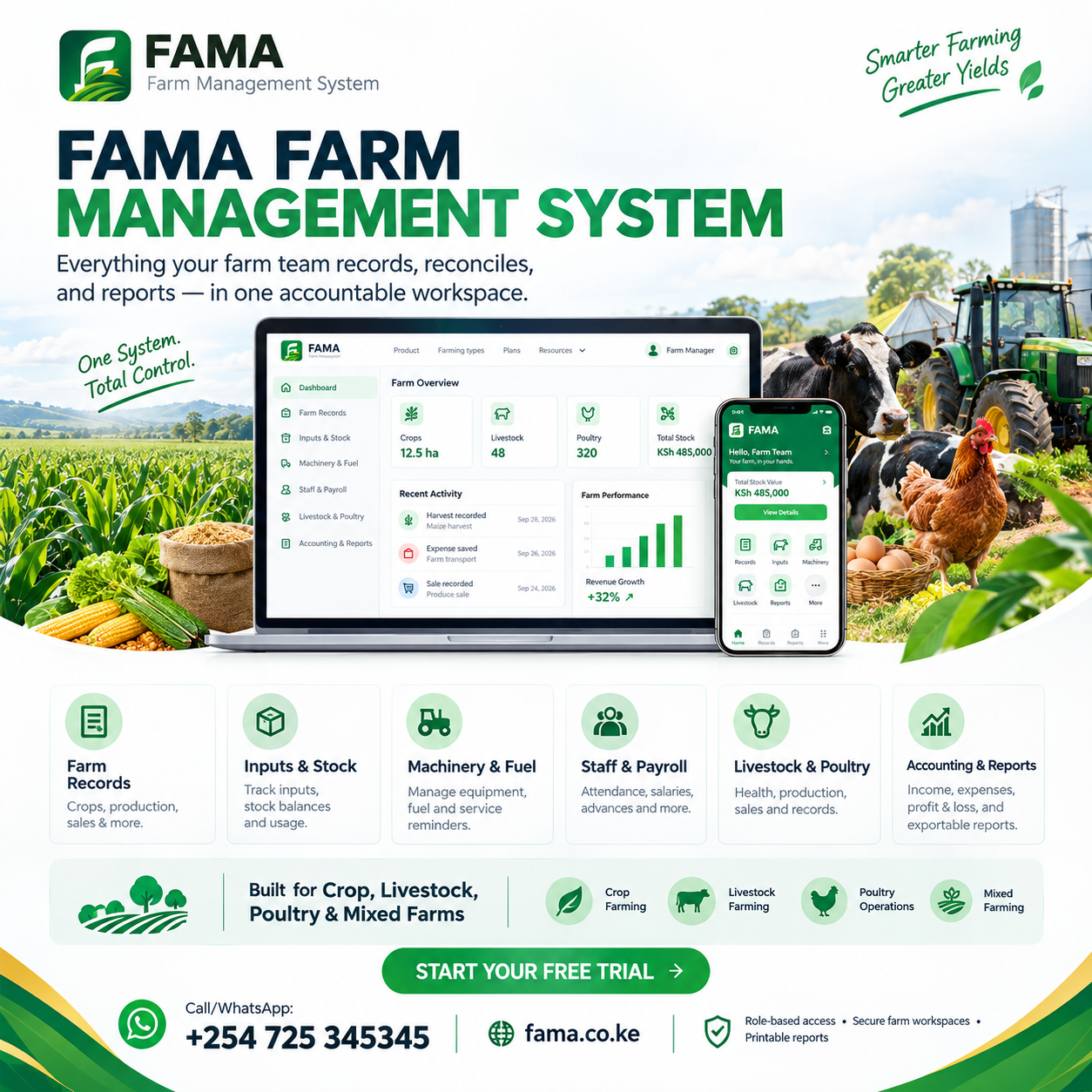
Purpose-built farm management platforms go further, linking inputs, field activities, harvests and sales in one database and generating audit reports automatically. Whatever tool you choose, keep the paper backup through at least two full seasons, because systems fail and traceability records must survive every failure.
Certification, Audits and Market Access
Certification is where traceability records pay their clearest dividend. GlobalG.A.P., KenyaGAP, KS 1758, organic and HACCP schemes all list traceability among the first control points audited, because every other requirement depends on it.
An audit follows a simple logic: the auditor picks a sample of produce and asks you to walk it through the chain using only documentation. Farms with complete traceability records pass the sample test calmly; farms without them fail on the first pick, regardless of how good their agronomy is.
KS 1758, Kenya’s own produce standard, was designed with smallholder realities in mind, but its traceability clauses are not optional. Preparing for it is far easier when the system in this guide has already run for a full season before the auditor arrives.
Keep an audit file separate from daily working forms. It should hold the farm map, the code register, input purchase records, blank form templates, completed monthly forms, training notes and the results of your mock drills. Traceability records win audits when they can be produced in minutes, not reconstructed over days.
Certification fees look steep until you price the alternative. A certified farm signs multi-season contracts; an uncertified farm sells spot, at the buyer’s price, whenever the buyer feels like buying. The certificate is simply a documented promise, and traceability records are the evidence behind it.
Common Traceability Mistakes and How to Avoid Them
Mistake one: recording harvests but not inputs. A beautiful harvest log with no matching input log cannot answer a residue question, and auditors know it. The chain has two ends, and traceability records must cover both.
Mistake two: codes that drift. If workers call block F3-North the new plot by Tuesday and Mzee’s shamba by Friday, the chain shatters. Retrain until one name sticks, and print the codes onto the forms so there is nothing else to write.
Mistake three: pencil entries copied later in ink, or worse, rewritten from memory by one diligent person. Rewriting destroys the evidential value of traceability records, because the auditor can no longer tell observation from reconstruction. Record once, at the point of work, in permanent ink.
Mistake four: lot numbers that mix fields or days. The temptation to save paperwork by combining two blocks into one lot is real, and it is how one contaminated row contaminates an entire shipment on paper. When in doubt, keep lots smaller. Traceability records cost less than a rejected container.
Mistake five: no training for new staff. Traceability habits live in people, and every untrained hire is a leak in the chain. Add a ten-minute records briefing to every onboarding, whatever the season.
Mistake six: records stored in one copy, in one place. Rain, rats, roof leaks and theft all read single copies well. A weekly phone photo of each completed page, filed in a cloud folder, makes traceability records effectively indestructible at zero cost.
Mistake seven: treating the system as a costume worn for audits and abandoned afterwards. Auditors increasingly visit unannounced, and buyers now trace randomly throughout the year. The farm that keeps traceability records every week is the farm that passes every week.
What Traceability Costs and What It Returns
Set-up costs are refreshingly small. A farm map, a code register and printed forms cost little more than printing. A month of focused training costs some hours. Traceability records, started this way, demand discipline rather than capital.
Digital costs arrive only when you choose them: a smartphone you likely own, modest cloud storage, or a farm management subscription. Compare any of these against a single rejected export consignment, and the arithmetic settles itself.
The returns arrive on four tracks. First, market access: contracts and certifications that undocumented farms cannot sign. Second, premiums: buyers pay more for provable safety. Third, waste recovery: drills and reviews expose losses you were absorbing silently. Fourth, finance: traceability records strengthen loan and insurance files in the eyes of institutions.
One Kenyan vegetable grower put it plainly after his first GlobalG.A.P. audit: the certificate did not change how he farmed, but it changed who would buy from him, and at what price. That gap is the real return on documentation.
There is also the return you never see because it is a non-event: the recall that never spread, the false complaint dismissed in an afternoon, the buyer who stayed because the answer came fast. Traceability records earn their keep most on the days nothing happens.
Start where you are this week. Map the farm, write the lot rule, print five forms, and record one crop cycle completely. By the second cycle the system runs itself, and by the first buyer visit you will have something most competitors still lack: proof.
Frequently Asked Questions
How much does it cost a small farm to start keeping traceability documentation?
Less than the price of one seed packet per season if you start on paper: a farm map, a code register and five one-page forms. Most of the cost is habit, not hardware. Once the paper system runs for a season, moving traceability records to a spreadsheet or app costs only time. Traceability records scale with your ambition, not your budget.
How long should a farm keep its documentation before disposing of old files?
Keep complete records for at least three years, and longer for export crops if your buyer’s contract specifies it. Some liability questions surface seasons later, and traceability records only protect you while they still exist. Archive monthly, back up digitally, and never destroy a season’s file without checking contract terms first.
Can I run a traceability system without a smartphone or computer?
Yes. Paper forms, a printed map and a code register were the global standard for decades and still satisfy most audits. Traceability records fail from inconsistency, not from lack of technology. Add digital tools later as a convenience, never as a prerequisite.
What is the fastest way to prepare for a surprise buyer inspection or audit?
Run your own mock drill the day before: pick one lot and trace it backwards to inputs and forwards to dispatch using only your files. Traceability records that survive your own drill will survive an auditor’s, because auditors use the same test. Keep the audit file by the door so nothing depends on memory.
Do traceability requirements also apply to farms selling only in local Kenyan markets?
Increasingly, yes. Supermarket suppliers, institutional buyers such as schools and hotels, and county market programmes all ask source questions today that they did not ask five years ago. Building traceability records now puts you ahead of requirements that are already moving towards local trade.