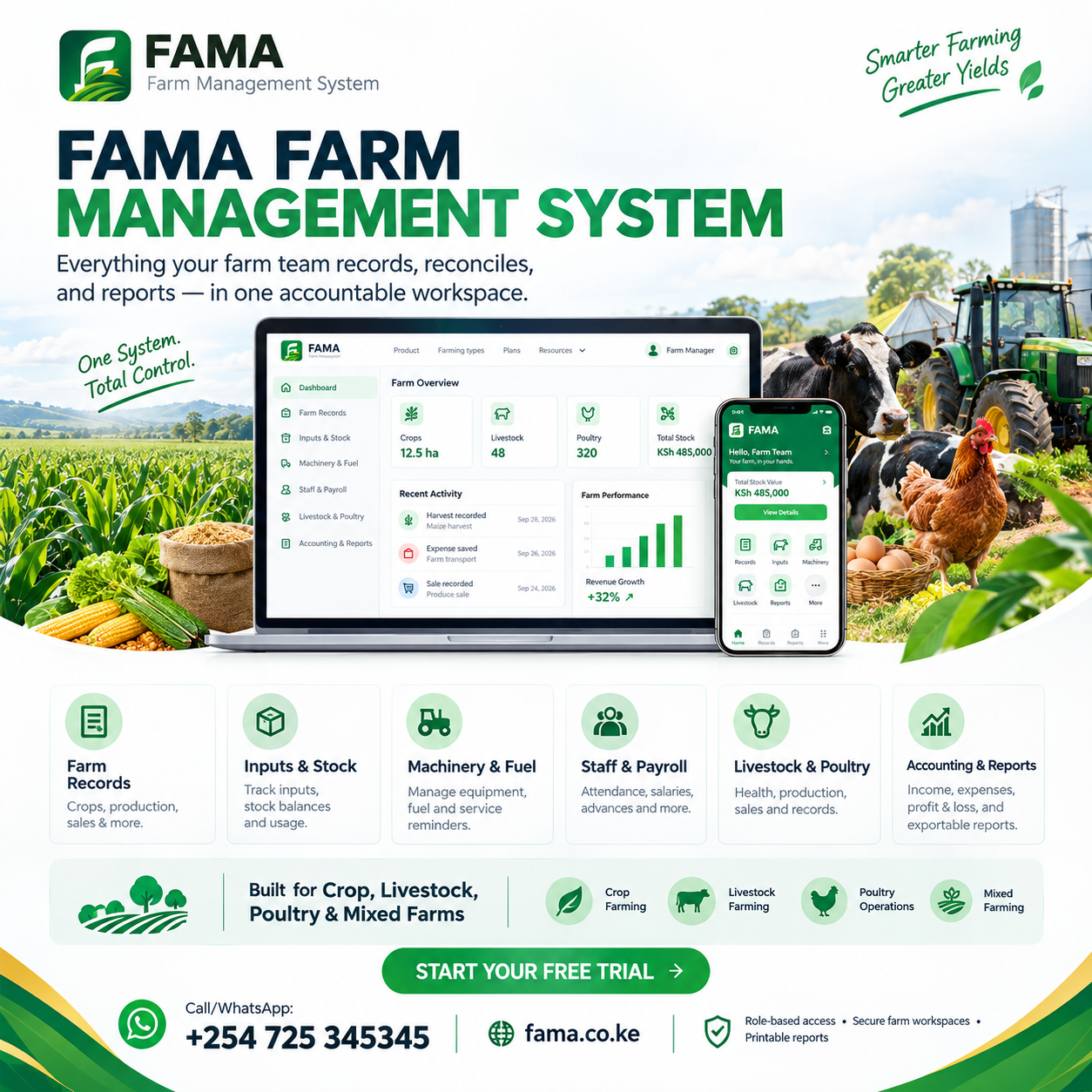
Farm input purchase invoice tracking has become the single most important record-keeping discipline for Kenyan farmers seeking to claim legitimate tax deductions, resolve supplier disputes, and build the financial records that lenders demand. Fama.co.ke provides an innovative platform that makes farm input purchase invoice tracking simple and practical, helping farmers move from crumpled receipts in glove compartments to organised, searchable digital archives. With KRA now requiring all farm-related expenses to be supported by eTIMS-compliant invoices, or the deduction being disallowed even when the cost is genuine, mastering farm input purchase invoice tracking has shifted from good practice to legal necessity.
The consequences of poor invoice tracking are severe and quietly expensive. One coffee grower in Nyeri paid a KSh 20,000 penalty after discovering two weeks later that a fertilizer invoice was never paid. Another farmer had penalties that ate KSh 250,000 by the time she filed her KRA return. These are not isolated cases—they are the predictable result of farming without systematic farm input purchase invoice tracking. When every invoice is captured at the point of purchase and stored in one place, penalties become avoidable rather than inevitable.
Fama.co.ke‘s platform helps farmers master farm input purchase invoice tracking by providing tools to capture invoices digitally, link them to specific fields and crops, track payment status, and generate KRA-ready reports. Research shows that farmers who keep proper records increase their incomes by 26 per cent, yet seven out of ten commercial farmers in Kenya report having kept no records for their farm. With farm input purchase invoice tracking, farmers can finally prove their expenses and claim every legitimate deduction.
The financial case for adopting farm input purchase invoice tracking is compelling. Inputs account for 40 to 60 per cent of total crop production costs, and without invoices, none of these expenses can be documented for tax purposes. A farmer spending Sh200,000 per season on seed, fertilizer, and chemicals who cannot claim these expenses may pay tens of thousands of shillings more in tax than necessary. A farm input purchase invoice tracking system that stores every invoice ensures that no legitimate deduction is lost.
Supplier disputes are another area where farm input purchase invoice tracking delivers immediate value. When a delivery arrives short, when a product turns out to be counterfeit, or when a supplier claims an invoice was never paid, the farmer with organised records has evidence. The farmer without records has only memory and argument. With farm input purchase invoice tracking, every transaction is documented with date, quantity, price, and supplier details.
eTIMS compliance is the feature that makes farm input purchase invoice tracking essential in 2026. The platform generates KRA-compliant invoices automatically and stores them in a format that matches e-Filing requirements. Where a supplier’s annual turnover is at or below KSh 5 million, buyer-initiated invoicing lets the buying business generate the eTIMS invoice on the grower’s behalf—a provision that keeps informal supply inside the system and keeps the purchase deductible. A farm input purchase invoice tracking system handles both supplier-issued and buyer-initiated invoices seamlessly.
Payment reconciliation is inseparable from invoice tracking. An invoice that is recorded but never matched to a payment becomes a dispute waiting to happen. A farm input purchase invoice tracking platform tracks every invoice against payments made, flags outstanding balances, and alerts farmers when payments are overdue. With farm input purchase invoice tracking, the entire purchase-to-payment cycle is visible and controlled.
For farmers managing multiple suppliers and seasons, farm input purchase invoice tracking provides the structure that manual systems cannot. The platform organises invoices by supplier, product category, field, and season, enabling cost analysis at any level of detail. It works offline and syncs automatically when connectivity returns, making it practical for farms in remote areas. With farm input purchase invoice tracking from Fama.co.ke, farmers gain the documentation discipline that separates commercially run operations from those that merely hope to profit.
Why Kenyan Farmers Struggle with Farm Input Purchase Invoice Tracking
The reasons farmers fail at farm input purchase invoice tracking are well understood. The lack of the right tools and a lack of knowledge in record keeping are the two biggest challenges reported by 68 per cent of farmers. Many farmers buy inputs informally, receive handwritten receipts or no receipt at all, and assume that formal invoicing is for large businesses only.
The complexity of input procurement makes tracking particularly challenging. A single season involves multiple purchases from multiple suppliers—seed from one agro-dealer, fertilizer from NCPB, chemicals from another shop, and equipment from a fourth vendor. Each transaction generates a document that must be captured, filed, and reconciled. Without a system, documents are lost within weeks.
The consequences of poor invoice tracking extend beyond tax penalties. Without invoices, farmers cannot prove product quality in disputes. They cannot calculate accurate cost per acre. They cannot demonstrate creditworthiness to lenders. They cannot identify which suppliers deliver the best value. Farm input purchase invoice tracking addresses all these gaps simultaneously.
Key Features of Farm Input Purchase Invoice Tracking
Digital Invoice Capture
Farm input purchase invoice tracking from Fama.co.ke captures invoices digitally at the point of purchase. The platform allows farmers to photograph paper invoices, import eTIMS invoices electronically, and record details manually where no document exists. With farm input purchase invoice tracking, no invoice is left in a pocket or drawer.
eTIMS-Compliant Invoice Generation
Farm input purchase invoice tracking includes buyer-initiated eTIMS invoicing for suppliers below the Sh5 million turnover threshold. The platform generates compliant invoices automatically and transmits them to KRA. With farm input purchase invoice tracking, every purchase is documented in the format the tax authority requires.
Supplier and Product Linkage
Farm input purchase invoice tracking links every invoice to a specific supplier and product. The platform maintains supplier profiles and product catalogues, enabling analysis by vendor and by input type. With farm input purchase invoice tracking, farmers can compare suppliers and identify the best-value vendors.
Field and Crop Attribution
Farm input purchase invoice tracking attributes every invoice to the field and crop where the input was used. The platform enables accurate calculation of cost per acre and cost per kilogram of produce. With farm input purchase invoice tracking, farmers know exactly what each enterprise costs.
Payment Status Tracking
Farm input purchase invoice tracking monitors payment status for every invoice. The platform records payments made, calculates outstanding balances, and alerts farmers when payments are due or overdue. With farm input purchase invoice tracking, cash flow is visible and controllable.
Document Archive and Search
Farm input purchase invoice tracking maintains a searchable archive of every invoice and receipt. The platform allows farmers to retrieve any document instantly by date, supplier, product, or amount. With farm input purchase invoice tracking, audits and disputes are handled with evidence rather than memory.
KRA-Ready Reporting
Farm input purchase invoice tracking generates expense summaries and tax reports that match KRA e-Filing formats. The platform exports data in the exact format required by the tax authority. With farm input purchase invoice tracking, tax filing becomes straightforward rather than stressful.
Mobile Accessibility and Offline Functionality
Farm input purchase invoice tracking from Fama.co.ke works on mobile devices and functions offline. The platform is designed for rural areas with connectivity challenges, allowing farmers to capture invoices at the point of purchase without internet access. Data syncs automatically when connectivity is restored.
Benefits of Farm Input Purchase Invoice Tracking
Elimination of KRA Penalties
Farm input purchase invoice tracking ensures that every legitimate expense is documented and claimable. Farmers avoid the penalties that result from missing invoices and disallowed deductions.
Accurate Cost Per Acre
Farm input purchase invoice tracking links every invoice to the field where the input was applied, enabling precise calculation of cost per acre for each crop and season.
Faster Supplier Dispute Resolution
Farm input purchase invoice tracking provides documented evidence for every transaction. Disputes over quantities, prices, or payments are resolved with records rather than argument.
Improved Access to Finance
Farm input purchase invoice tracking creates reliable expense records that support loan applications. Financial institutions require documented input histories before lending.
Better Supplier Negotiations
Farm input purchase invoice tracking reveals purchase patterns and prices paid over time. Farmers can negotiate volume discounts and better credit terms using historical data.
Time Savings
Farm input purchase invoice tracking saves farmers hours of manual filing and searching. Digital capture and search mean any invoice can be retrieved in seconds.
How to Get Started with Farm Input Purchase Invoice Tracking
Starting with farm input purchase invoice tracking from Fama.co.ke is straightforward.
Create Your Account
Visit fama.co.ke and sign up for the farm input purchase invoice tracking platform.
Register Your Suppliers
Enter details for every supplier, including name, contact information, and KRA PIN where applicable.
Capture Invoices at Purchase
Record or photograph every invoice at the point of purchase. Link it to the supplier, product, and field.
Record Payments
Track payments against each invoice. The platform reconciles and flags outstanding balances automatically.
Generate Reports
Use the reporting features to produce expense summaries, cost per acre analyses, and KRA-ready tax documentation.
Real-World Applications in the Kenyan Context
Crop Farmers
Crop farmers use farm input purchase invoice tracking to document seed, fertilizer, and chemical purchases across multiple fields and seasons, enabling accurate cost per acre calculations.
Livestock Farmers
Livestock farmers use farm input purchase invoice tracking to document feed, veterinary, and equipment purchases, the largest cost categories in livestock production.
Cooperatives
Cooperatives use farm input purchase invoice tracking to document bulk input purchases and distribution to members, providing transparent records that build trust.
Agro-Dealers
Agro-dealers use farm input purchase invoice tracking to manage their own purchase documentation and ensure eTIMS compliance with their suppliers.
Overcoming Common Challenges
Internet Connectivity
Farm input purchase invoice tracking from Fama.co.ke works offline, allowing invoice capture without internet access. The platform syncs automatically when connectivity is restored.
Mobile Compatibility
Farm input purchase invoice tracking is fully mobile-compatible, allowing farmers to photograph invoices at the point of purchase.
Data Security
Farm input purchase invoice tracking uses encryption and secure servers to protect financial documents, with backup options to ensure records are never lost.
Ease of Use
Farm input purchase invoice tracking is designed to be intuitive and user-friendly, minimising complexity and focusing on essential document management features.
Frequently Asked Questions About Farm Input Purchase Invoice Tracking
What is farm input purchase invoice tracking?
Farm input purchase invoice tracking is the practice of capturing, storing, and reconciling invoices for seeds, fertilizers, chemicals, and other farm inputs. Fama.co.ke‘s platform automates this process with digital capture and KRA eTIMS integration.
Why is invoice tracking important for KRA compliance?
From 2026, KRA requires all farm-related expenses to be supported by eTIMS-compliant invoices, or the deduction can be disallowed. Invoice tracking ensures that every legitimate expense is documented and claimable.
Can I track invoices without internet access?
Yes. Farm input purchase invoice tracking from Fama.co.ke works offline, storing data locally and syncing automatically when connectivity is restored.
How does invoice tracking help with supplier disputes?
Invoice tracking provides documented evidence for every transaction, including date, quantity, price, and supplier details. Disputes are resolved with records rather than memory.
Does invoice tracking help with bank loans?
Yes. Invoice tracking creates reliable expense records that demonstrate farm management competence. Financial institutions require documented input histories before lending.