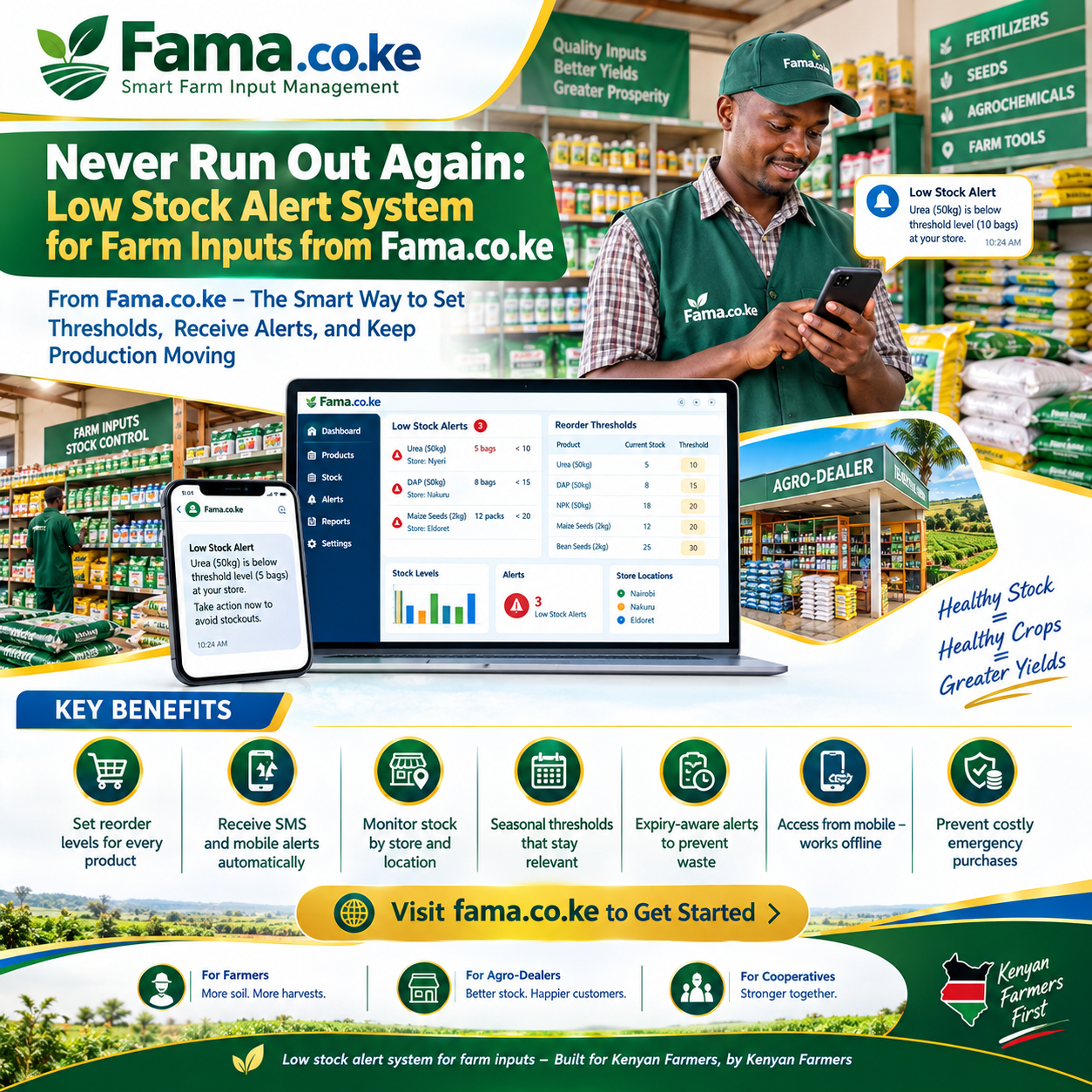
A low stock alert system for farm inputs is the single most important safeguard against the stockouts that silently destroy yields, because the most expensive bag of fertilizer is the one you cannot find when the rains finally arrive. Fama.co.ke provides an innovative platform that makes a low stock alert system for farm inputs simple and practical, helping farmers and agro-dealers move from guessing when to reorder to receiving automatic notifications before supplies run out. With inputs accounting for 40 to 60 per cent of total crop production costs and with 42 per cent of agricultural inputs in Kenya wasted through poor tracking and planning, the adoption of a low stock alert system for farm inputs has become essential for anyone serious about uninterrupted production.
The consequences of missing inputs at critical moments are severe and well documented. Farmers in Narok County have repeatedly found themselves without fertiliser during the planting window, forcing them to buy from private dealers at Sh3,200 per 50kg bag instead of the subsidised Sh1,800 rate. Others have missed top-dressing windows entirely because CAN was unavailable at the depot, accepting yield losses that could never be recovered. This is precisely the failure that a low stock alert system for farm inputs prevents. When the system notifies you that stock has fallen below a defined threshold, you have time to reorder, transfer from another store, or source from an alternative supplier before it is too late.
Fama.co.ke‘s platform helps farmers master a low stock alert system for farm inputs by providing tools to set reorder levels for every product, track real-time stock balances, and receive alerts automatically when quantities fall below defined thresholds. Research shows that stock management in many Kenyan agricultural operations remains largely manual, with depot clerks using ledger cards to track supplies—an archaic system prone to errors and manipulation. With a low stock alert system for farm inputs, users replace that fragile manual process with automatic, verifiable notifications.
The financial case for adopting a low stock alert system for farm inputs is compelling. Emergency purchases during peak demand typically cost 20 to 40 per cent more than planned purchases made in advance. A farmer who normally buys fertiliser at Sh1,800 per bag but is forced to pay Sh3,200 in an emergency loses Sh1,400 on every bag. For a modest 20-bag requirement, that is Sh28,000 lost purely because nobody knew stock had run low. A low stock alert system for farm inputs eliminates this premium by enabling planned, timely purchasing.
Reorder level configuration is where the intelligence of a low stock alert system for farm inputs lives. A reorder level is not simply zero—it is the quantity at which you must act so that replenishment arrives before the store empties. That calculation depends on daily consumption rate and supplier lead time. A farm using 5 kilograms of fertiliser per acre per day across 10 acres and buying from a supplier with a five-day lead time needs to reorder when 250 kilograms remain. A low stock alert system for farm inputs that understands these variables sets intelligent thresholds rather than leaving them to guesswork.
Seasonal variation makes simple reorder points inadequate on most farms. Consumption of certain inputs spikes dramatically during planting and top-dressing windows and falls to near zero between seasons. A low stock alert system for farm inputs that accommodates seasonal demand profiles prevents both false alarms during quiet periods and dangerous complacency during peak demand, when every hour of delay has consequences.
Multi-store visibility is another dimension that matters for larger operations. A farm with a main store and two satellite stores may hold adequate total stock while one location has run dry. A low stock alert system for farm inputs that monitors stock by location and supports internal transfers ensures that inputs are where the work is happening, not simply somewhere on the farm.
Expiry-aware alerting represents a more advanced capability within a low stock alert system for farm inputs. Products approaching expiry should trigger a different kind of alert—prompting timely use or redistribution rather than replenishment. This dual logic prevents the odd situation where a store is simultaneously overstocked with expired chemicals and understocked with usable ones.
Subsidy seasons bring their own alerting requirements. When subsidised fertiliser becomes available at NCPB depots, availability windows can be short. A low stock alert system for farm inputs integrated with e-voucher tracking ensures that farmers collect their allocation promptly rather than discovering after the window closes that their entitlement has lapsed.
Record discipline underpins every alert. An alert is only as accurate as the last recorded issue. Farms that record every issue at the moment it happens receive accurate alerts; farms that update records weekly receive alerts that are already a week stale. Fama.co.ke‘s platform makes recording fast and mobile, so the data behind the low stock alert system for farm inputs stays current. With the right thresholds, seasonal intelligence, multi-store visibility, and disciplined recording, a low stock alert system for farm inputs transforms input management from reactive scrambling into calm, planned control. With low stock alert system for farm inputs from Fama.co.ke, farms of any size can put that control in place.
Why Kenyan Farms Need a Low Stock Alert System for Farm Inputs
The reasons farmers and agro-dealers need a low stock alert system for farm inputs are grounded in the realities of Kenyan agriculture. Supply chains are unpredictable, subsidised stock arrives on uncertain schedules, and transport to depots can take a full day. A farmer relying on observation rather than alerts typically discovers a shortage when the tank, store, or bag is already empty—too late to avoid disruption.
The scale of input consumption makes planning essential. A 20-acre maize farm applying 50 kilograms of DAP per acre needs one tonne of basal fertiliser in a single planting window. That quantity cannot be sourced at short notice from a single local agro-dealer. Without a low stock alert system for farm inputs, such a farm discovers the shortage days before planting and pays whatever price is demanded.
Agro-dealers face an even sharper version of this problem. A shop that runs out of the region’s most popular fertilizer during the peak week loses sales to competitors and damages customer relationships that took years to build. A low stock alert system for farm inputs allows dealers to place orders during quieter periods, improve supplier terms, and never disappoint a walk-in customer.
Key Features of a Low Stock Alert System for Farm Inputs
Configurable Reorder Levels
A low stock alert system for farm inputs from Fama.co.ke lets users set reorder levels for every product individually. Thresholds can be based on quantity, days of cover, or consumption rate, whichever suits the item. With a low stock alert system for farm inputs, thresholds reflect the real dynamics of each input rather than a single blanket rule.
Automatic Notification Delivery
A low stock alert system for farm inputs sends notifications through SMS, mobile push, and dashboard warnings the moment a threshold is crossed. Alerts reach the storekeeper and the farm owner simultaneously. With a low stock alert system for farm inputs, nobody can claim they were not informed.
Real-Time Balance Updates
A low stock alert system for farm inputs updates stock balances with every issue and receipt. The platform reflects the true position within seconds of a transaction being recorded. With a low stock alert system for farm inputs, alerts are always based on current data, not week-old counts.
Seasonal Threshold Profiles
A low stock alert system for farm inputs supports different threshold profiles for different seasons. Planting season thresholds differ from off-season thresholds for the same product. With a low stock alert system for farm inputs, alerts remain relevant throughout the year.
Multi-Location Monitoring
A low stock alert system for farm inputs monitors stock by store, shed, or site. The platform highlights shortages at specific locations while showing total holdings across the operation. With a low stock alert system for farm inputs, transfers can be arranged before work is disrupted.
Supplier Lead-Time Integration
A low stock alert system for farm inputs records supplier lead times and factors them into alert timing. Products with longer lead times trigger earlier alerts. With a low stock alert system for farm inputs, reordering happens with enough time for delivery.
Consumption Rate Analytics
A low stock alert system for farm inputs calculates consumption rates from historical issue data. The platform predicts when stock will run out at current usage rates. With a low stock alert system for farm inputs, users see projected depletion dates, not just current quantities.
Expiry-Aware Alerts
A low stock alert system for farm inputs distinguishes between replenishment alerts and expiry alerts. Products approaching expiry trigger prompts for timely use or redistribution. With a low stock alert system for farm inputs, waste is prevented alongside shortage.
Mobile Accessibility and Offline Functionality
A low stock alert system for farm inputs from Fama.co.ke works offline, syncing when connectivity returns. Alerts are queued and delivered as soon as the device reconnects. With a low stock alert system for farm inputs, remote stores remain covered.
How to Configure Reorder Levels Correctly
Configuring a low stock alert system for farm inputs properly is what separates useful alerts from noise.
Step 1: Calculate Average Daily Consumption
Review historical records to establish how much of each input is used per day during peak and off-peak periods. A farm using 250 kilograms of fertiliser over 20 planting days consumes 12.5 kilograms per day during that window.
Step 2: Establish Supplier Lead Time
Record the number of days between placing an order and receiving delivery. Local agro-dealers may deliver in one to two days; NCPB and regional suppliers may take longer, especially during peak season when demand is high.
Step 3: Add a Safety Buffer
Add a buffer of 20 to 30 per cent to cover demand spikes, transport delays, and measurement error. This buffer is what protects against the unexpected.
Step 4: Set the Threshold
Multiply daily consumption by lead time, then add the safety buffer. A farm consuming 12.5 kilograms per day with a five-day lead time and a 25 per cent buffer should reorder at approximately 78 kilograms.
Step 5: Review Seasonally
Revisit thresholds at the start of each season. Consumption rates and lead times both change with demand, and stale thresholds produce either false alarms or missed shortages.
Benefits of a Low Stock Alert System for Farm Inputs
Prevention of Costly Stockouts
A low stock alert system for farm inputs prevents the emergency purchases that cost 20 to 40 per cent above planned prices. Timely reordering keeps input costs predictable and controlled.
Improved Planning Discipline
A low stock alert system for farm inputs imposes a rhythm of planned purchasing that improves cash flow and supplier relationships. Orders are placed calmly rather than desperately.
Reduced Waste from Overstocking
A low stock alert system for farm inputs discourages the defensive over-ordering that ties up capital and leads to expiry losses. Users buy to the threshold, not to a fear of running out.
Better Labour Utilisation
A low stock alert system for farm inputs prevents the wasted labour days that occur when workers arrive at a field only to discover there is no fertiliser to apply. Crews stay productive.
Protection of Planting Windows
A low stock alert system for farm inputs ensures that critical operations happen on time. Late planting and late top-dressing are among the largest causes of yield loss in Kenyan agriculture, and both are often caused by missing inputs.
Improved Record Quality
A low stock alert system for farm inputs requires disciplined transaction recording to function. That discipline produces the cost records, subsidy reconciliations, and KRA documentation that farms need anyway.
Stronger Subsidy Capture
A low stock alert system for farm inputs linked to e-voucher tracking ensures that subsidised allocations are collected within the available window rather than lapsing unused.
How to Get Started with a Low Stock Alert System for Farm Inputs
Starting with a low stock alert system for farm inputs from Fama.co.ke is straightforward.
Create Your Account
Visit fama.co.ke and sign up for the low stock alert system for farm inputs platform.
Build Your Product Catalogue
Enter every input you manage, including unit of measure, storage location, and supplier.
Record Opening Stock
Count physically and enter opening balances to establish an accurate baseline.
Set Reorder Levels
Configure thresholds for each product based on consumption rate and supplier lead time.
Record Every Transaction
Log every receipt and issue as it happens. Accurate alerts depend on current data.
Review Alerts and Act
Respond to alerts promptly, place orders, and record deliveries as they arrive.
Real-World Applications in the Kenyan Context
Crop Farms
Crop farms use a low stock alert system for farm inputs to ensure fertiliser, seed, and chemicals are available before planting and top-dressing windows, protecting yield potential.
Agro-Dealer Shops
Agro-dealers use a low stock alert system for farm inputs to avoid losing peak-season sales to stockouts and to order during quieter periods at better prices.
Cooperatives
Cooperatives use a low stock alert system for farm inputs to manage shared stores and coordinate bulk purchasing for members, ensuring adequate supply across the group.
Livestock Operations
Livestock operations use a low stock alert system for farm inputs to maintain feed and veterinary supplies, preventing production drops caused by missing rations or treatments.
Overcoming Common Challenges
Internet Connectivity
A low stock alert system for farm inputs from Fama.co.ke works offline, queuing alerts until connectivity returns.
Mobile Compatibility
A low stock alert system for farm inputs runs on smartphones and tablets, delivering alerts wherever the user is.
Data Security
A low stock alert system for farm inputs uses encryption and secure servers with backup options.
Ease of Use
A low stock alert system for farm inputs is designed for users with minimal technical experience.
Frequently Asked Questions About a Low Stock Alert System for Farm Inputs
What is a low stock alert system for farm inputs?
A low stock alert system for farm inputs notifies users automatically when stock falls below a defined threshold. Fama.co.ke‘s platform tracks balances in real time and sends SMS and mobile alerts.
How do I decide the reorder level?
Multiply average daily consumption by supplier lead time, then add a 20 to 30 per cent safety buffer. Review thresholds each season.
Can alerts work without internet?
Yes. A low stock alert system for farm inputs from Fama.co.ke works offline and delivers queued alerts when connectivity returns.
Does it track multiple stores?
Yes. A low stock alert system for farm inputs monitors stock by location and highlights shortages at specific sites.
Can it alert on expiring products?
Yes. A low stock alert system for farm inputs distinguishes replenishment alerts from expiry alerts, prompting timely use of products approaching their expiry date.