Greenhouse capsicum farming in Kenya has become one of the most profitable horticultural ventures for farmers seeking premium prices, year-round production, and protection from unpredictable weather. Fama.co.ke provides an innovative farm management platform that helps farmers track greenhouse capsicum farming in Kenya through disciplined record-keeping, input cost monitoring, and data-driven crop management. With greenhouse production yielding 50,000 to 60,000 kilograms per acre compared to 25,000 to 30,000 kilograms in open fields, the productivity advantage of greenhouse capsicum farming in Kenya is undeniable. Colored capsicums—red, yellow, and orange—command farm-gate prices of KSh 100 to KSh 150 per kilogram, and up to KSh 300 or more for premium grades, making greenhouse capsicum farming in Kenya a genuinely lucrative enterprise for farmers who master the technical requirements.
The financial case for entering greenhouse capsicum production is compelling and well-documented. A 240-square-metre greenhouse coloured-pepper operation producing 6 tonnes per year at an average KSh 220 per kilogram generates gross revenue of KSh 1.3 million, with operating costs of KSh 300,000 to KSh 500,000 leaving net profit of KSh 800,000 to KSh 1.0 million per year from a quarter-acre footprint. For farmers seeking a clear greenhouse capsicum farming in Kenya pathway, these numbers demonstrate why capsicum has become the crop of choice for greenhouse investors. Susan Wairimu, a farmer in Nakuru’s Molo sub-county, started using a greenhouse in 2024 after learning that her production would increase compared to growing peppers in the open air. Her peppers are popular with customers because they are large, attractive, disease-resistant, and inexpensive to maintain. This is what greenhouse capsicum farming in Kenya looks like when done properly—a steady, high-value income stream from a modest land footprint.
The market environment supports greenhouse capsicum farming in Kenya strongly. Capsicum, known locally as pilipili hoho, is a daily staple in Kenyan kitchens, used in everything from stews to salads to pilau. Demand comes from households, hotels, restaurants, schools, hospitals, and supermarkets, with urban centres driving consistent year-round consumption. A fruit of about 250 grammes costs between Sh20 and Sh30 for the yellow variety in high-end markets, while red varieties of the same weight range from Sh5 to Sh10. Understanding greenhouse capsicum farming in Kenya means recognising that coloured capsicums, particularly yellow, command double the price of red varieties because of their extended market window—farmers can sell them while green for those who want to consume before they turn yellow, extending the marketing period from green until yellow.
Variety selection is the single most influential decision in greenhouse capsicum farming in Kenya. The commonly grown varieties include Admiral F1, Buffalo F1, Maxibel, California Wonder, Green Bell F1, Yolo Wonder, Pasarella F1, Ilanga Wonder, Golden Sun F1, Kori F1, and Minerva F1. For greenhouse production specifically, indeterminate varieties like Commandant F1, Admiral F1, Nemalite F1, and Green Bell F1 are ideal because they grow continuously through a single apical stem with limited branching. Commandant F1 is a blocky hybrid pepper that eventually turns red at full physiological maturity, with yields of 25 to 30 tonnes per acre in open fields and 50 to 60 tonnes in the greenhouse. This greenhouse capsicum farming in Kenya guide recommends selecting varieties based on your target market, with coloured varieties fetching premium prices but requiring more careful management than green types.
Greenhouse construction and setup represent the largest upfront investment in greenhouse capsicum farming in Kenya. A greenhouse measuring 16 metres by 45 metres costs KES 950,000 to KES 1,200,000 for the structure. A small greenhouse of 8 metres by 15 metres costs KSh 250,000 to KSh 350,000, making entry-level production accessible to smallholders. The greenhouse should be located on well-drained land with access to reliable water sources, and the soil pH should be maintained between 5.5 and 7.0 for optimal nutrient availability. Drip irrigation is the standard for serious producers, delivering water and nutrients directly to plant roots while reducing disease pressure and water waste. This investment in greenhouse capsicum farming in Kenya infrastructure pays for itself through higher yields and premium prices.
Agronomic management bridges the gap between genetic potential and realised yield in greenhouse capsicum farming in Kenya. Seedlings are raised in a nursery for 30 to 45 days before transplanting into the main greenhouse bed, where they are spaced at 75 centimetres by 45 centimetres, allowing approximately 10,000 plants per acre. Organic manure is applied at 10 tonnes per hectare, or alternatively 250 kilograms of double super phosphate per acre. Top dressing with 100 kilograms of nitrogen per hectare is done when plants attain a height of 15 centimetres, repeated after one month with 200 kilograms of CAN. Consistent soil moisture is essential during flowering and fruit development to avoid blossom drop and fruit deformities. This greenhouse capsicum farming in Kenya guide emphasises that drip irrigation ensures even watering, which is particularly important because blossom end rot is caused by calcium deficiency linked to irregular moisture.
Pest and disease management in greenhouse capsicum farming in Kenya requires vigilance but benefits from the protective environment. Capsicum is affected by pests and diseases including blossom end rot, cutworms, root nematodes, and damping off. Blossom end rot is caused by lack of calcium and is characterised by black or dark-brown spots on immature fruits; controlling it requires even watering, preferably through drip irrigation, to ensure calcium is absorbed by the fruits during formation. Damping off, where seedlings fall and rot, is avoided by keeping the soil firm at the base of the seedling to prevent excess water around the plant. Nematodes and cutworms are controlled by crop rotation. The greenhouse itself reduces pest pressure compared to open fields, making integrated pest management more effective and reducing reliance on chemical controls. This is a significant advantage of greenhouse capsicum farming in Kenya over open-field production.
The profitability of greenhouse capsicum farming in Kenya is further enhanced by market timing and direct sales. In Nairobi, dozens of trucks deliver tonnes of capsicum to vegetable markets every day, with each capsicum going for an average of Sh15 for wholesale and Sh20 for retail. Bernard Watitu, a youth farmer in Juja, grows capsicum in a 20-metre by 50-metre greenhouse and harvests twice a month from his 700 plants, selling his produce from the boot of his car to traders and residents of Buru Buru. He used part of his Sh400,000 severance package to lease the farm, construct the greenhouse, buy a drip irrigation system, and plant the crop. The returns have been good enough to provide him with a livelihood since 2012. This demonstrates the potential of greenhouse capsicum farming in Kenya for youth and smallholders who approach it as a business.
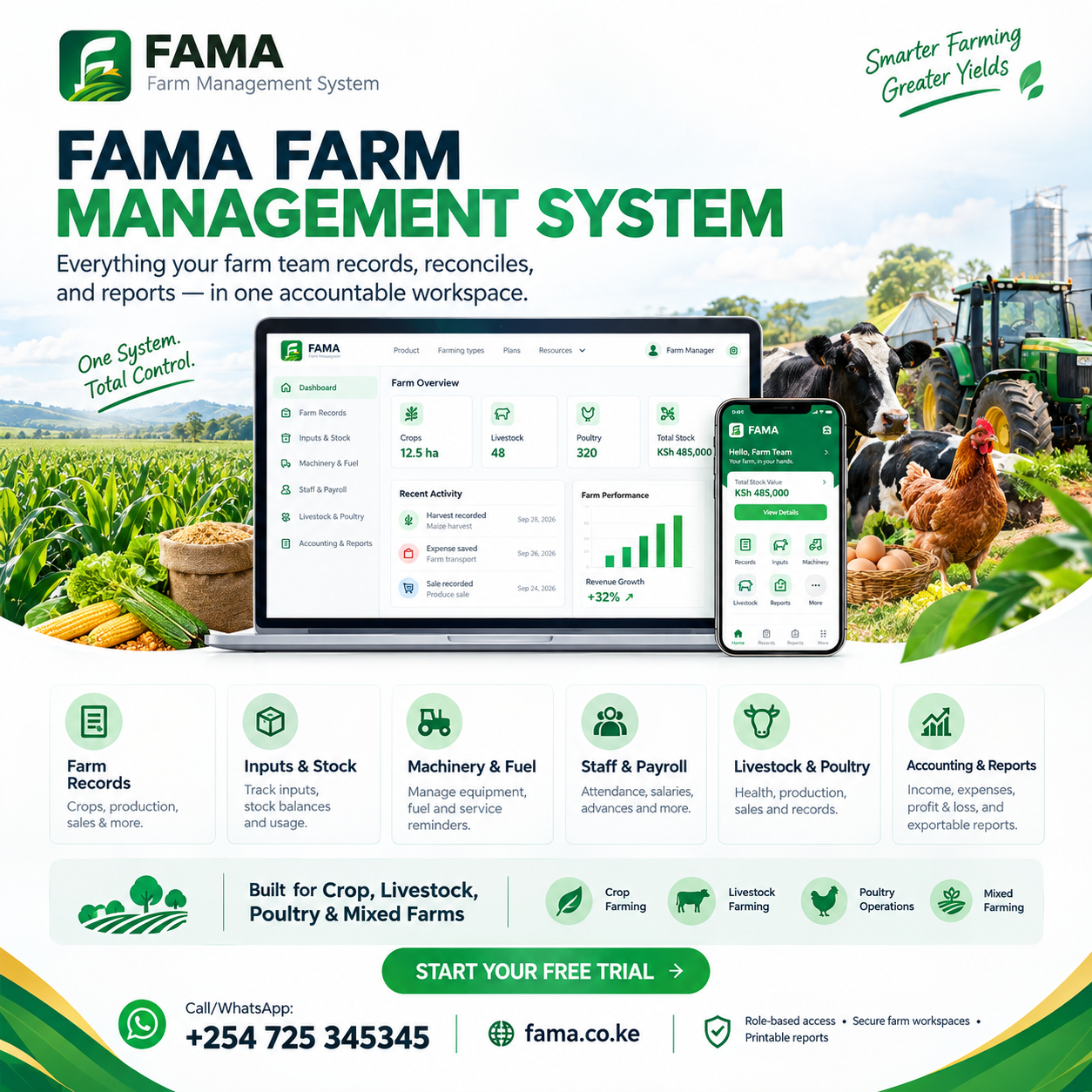
Record-keeping is the discipline that separates profitable greenhouse capsicum farmers from those who merely harvest occasionally. Without records, a farmer cannot calculate cost per kilogram, identify which variety cycles deliver the best returns, or detect disease outbreaks before they spread through the entire greenhouse. Digital tools make greenhouse capsicum farming in Kenya measurable rather than speculative, turning every planting date, input application, and harvest into data that guides the next cycle. Fama.co.ke offers daily farm records software designed for Kenyan farmers, capturing input costs, harvest quantities, labour records, and sales transactions in one system that works offline and on basic smartphones. Reports generated from this data show cost per kilogram, crop performance trends, and profitability that support informed management.
The outlook for greenhouse capsicum farming in Kenya is positive. The Kenya Capsicum Market is projected to grow steadily through 2031, driven by rising demand for fresh vegetables, expanding hospitality industries, and increasing interest in nutritious produce. Farmers who adopt greenhouse technology, select the right varieties, manage agronomy precisely, and keep rigorous records will be best positioned to capture premium prices and build sustainable, profitable enterprises. For those seeking comprehensive digital tools to support their journey, greenhouse capsicum farming in Kenya from Fama.co.ke provides the infrastructure to plan, track, and grow a successful capsicum enterprise. With the right knowledge and the right tools, greenhouse capsicum farming in Kenya transforms from a daunting question into a measurable business outcome. And for farmers ready to take the next step toward higher yields and better margins, greenhouse capsicum farming in Kenya offers the path to achieving them.
Why Greenhouse Capsicum Farming in Kenya Outperforms Open-Field Production
Greenhouse capsicum farming in Kenya offers distinct advantages over open-field cultivation that directly translate into higher yields and better returns. The controlled environment protects plants from extreme weather, reduces pest and disease pressure, and enables year-round production regardless of seasonal rainfall patterns.
Yield is the most measurable advantage. Open-field capsicum production yields 8 to 12 tonnes per acre under good management, while greenhouse production can reach 30 tonnes per acre or more under optimal conditions. Commandant F1 yields 25 to 30 tonnes per acre in open fields and 50 to 60 tonnes in the greenhouse. This dramatic productivity difference is the primary reason farmers invest in greenhouse infrastructure for capsicum production.
Quality is the second major advantage. Greenhouse-grown capsicums are larger, more uniform, and more attractive than open-field fruits, commanding premium prices from supermarkets, hotels, and export buyers. Susan Wairimu noted that her greenhouse peppers are popular with customers because they are large and attractive. This quality premium directly improves the profitability of greenhouse capsicum farming in Kenya.
Disease control is the third advantage. Capsicum is hardly affected by diseases compared to tomatoes, but greenhouse production further reduces disease pressure by excluding many pests and providing a controlled environment where humidity and temperature can be managed. This reduces the cost of chemical controls and the risk of crop loss, improving margins for greenhouse capsicum farming in Kenya.
Best Capsicum Varieties for Greenhouse Production in Kenya
Choosing the right variety is critical for success in greenhouse capsicum farming in Kenya. Indeterminate varieties that grow continuously through a single apical stem are ideal for greenhouse production because they maximise the vertical space and produce over an extended harvest period.
Commandant F1
Commandant F1 is a blocky hybrid pepper that eventually turns red at full physiological maturity. It is a medium-late variety producing blocky fruits with thick walls and excellent quality. Commandant is suitable for both greenhouse and open-field production, yielding 25 to 30 tonnes per acre in open fields and 50 to 60 tonnes in the greenhouse. It matures 90 days after transplanting and has a shelf life of 21 days. Seeds are available in packs of 500 or 1,000.
Admiral F1
Admiral F1 is a premium blocky variety known for its excellent quality and adaptability. Under optimal greenhouse conditions, yields can significantly increase to between 50 and 60 tonnes per acre. This variety is suitable for both greenhouse and open-field production, providing flexibility for growers. It is available from Syngenta and is particularly valued for its uniform fruit size and colour.
Victory F1
Victory F1, launched by Simlaw Seeds, is a new high-yielding capsicum variety that matures within 70 to 85 days with a long harvesting period of up to four months and potential yields of 250,000 fruits per hectare. It grows well in both outdoor and greenhouse conditions and can be harvested either while still green or when it turns red. One acre of land requires 100 grammes of seed, with 5 grammes costing Sh1,470, 10 grammes costing Sh2,390, and 50 grammes retailing at Sh14,560.
Buffalo F1
Buffalo F1 is another popular hybrid variety in Kenyan greenhouses, known for its vigour and reliable production. It produces large, blocky fruits with good colour development and is well-suited to the controlled environment of greenhouse production.
Green Bell F1
Green Bell F1 is a widely grown variety that produces classic bell-shaped fruits. While green capsicums command lower prices than coloured varieties, they mature faster and require less careful management, making them a good starting point for farmers new to greenhouse capsicum farming in Kenya.
Step-by-Step Guide to Greenhouse Capsicum Farming in Kenya
Step 1: Conduct a Soil Test
Soil testing is an important first step when preparing your greenhouse for capsicum planting. A soil test informs the farmer of the soil’s fertility and acidity levels and helps take steps to achieve favourable conditions, such as adjusting the pH of the soil to ensure proper nutrient uptake and plant health. Capsicum requires slightly acidic soil with high organic matter, good moisture-holding capacity, well-drained, and well-aerated. The optimal pH range is 5.5 to 6.8.
Step 2: Prepare the Greenhouse Structure
For a greenhouse measuring 16 metres by 45 metres, you will spend KES 950,000 to KES 1,200,000 for the structure. A small greenhouse of 8 metres by 15 metres costs KSh 250,000 to KSh 350,000. Choose a well-drained location with access to reliable water sources. The greenhouse should be oriented to capture good sunlight and equipped with insect nets to prevent pest entry.
Step 3: Raise Seedlings in a Managed Nursery
Capsicums are normally grown in the nursery before transplanting the healthy seedlings after 30 to 45 days. Place seedling trays on a raised flat surface in a greenhouse and fill them with cocopeat or other planting media. Irrigate gently until the cocopeat is moist, press gently to compact it, and place a single seed at the centre of each hole. Cover with a thin layer of media and irrigate until water drains from the bottom. Five to six days after sowing, spray the tray with a fungicide to prevent damping off.
Step 4: Transplant at the Right Spacing
In the main bed, seedlings are spaced at 75 centimetres by 45 centimetres, and one acre of land can hold up to 10,000 plants. Transplanting should be done in the evening or on a cloudy day to reduce transplant shock. Water immediately after transplanting to settle the soil around the roots.
Step 5: Apply Fertiliser Strategically
Organic manure is recommended at 10 tonnes per hectare, or alternatively apply 250 kilograms of double super phosphate per acre. Top dressing of the crop should be done when the plants attain a height of 15 centimetres with 100 kilograms of nitrogen per hectare. This should be repeated after one month where 200 kilograms of CAN is applied. Fertigation through drip irrigation allows precise nutrient delivery throughout the growing cycle.
Step 6: Manage Irrigation Consistently
Consistent soil moisture is essential during flowering and fruit development to avoid blossom drop and fruit deformities. Drip irrigation is the standard for greenhouse capsicum farming because it delivers water directly to plant roots, reduces disease pressure, and ensures even moisture levels. Avoid waterlogging, which can cause root rot and blossom end rot.
Step 7: Control Pests and Diseases
Blossom end rot is caused by lack of calcium and is characterised by black or dark-brown spots on immature fruits. Control it by watering evenly, preferably through drip irrigation, to ensure calcium is absorbed by the fruits during formation. Damping off is avoided by keeping the soil firm at the base of the seedling to prevent excess water around the plant. Nematodes and cutworms are controlled by crop rotation. Thrips and whiteflies must be controlled regularly to prevent flower drop.
Step 8: Harvest at the Right Time
Harvesting starts from 60 days to 90 days depending on variety. One plant can yield up to 35 standard fruits under good management. From one harvest, a farmer can realise up to 200 kilograms from a 15-metre by 8-metre greenhouse. When the price is at its lowest, one can earn Sh24,000 with one kilogram selling at Sh120. Coloured capsicums can be harvested green or left to mature to red, yellow, or orange for premium prices.
Cost of Production and Profitability of Greenhouse Capsicum Farming in Kenya
Understanding the economics of greenhouse capsicum farming in Kenya requires examining both costs and revenues at different performance levels.
Greenhouse Setup Costs
A greenhouse measuring 16 metres by 45 metres costs KES 950,000 to KES 1,200,000 for the structure. A small greenhouse of 8 metres by 15 metres costs KSh 250,000 to KSh 350,000. Drip irrigation adds KES 50,000 to KES 150,000 depending on the system. Seedling trays, media, and other equipment add KES 20,000 to KES 50,000. The total upfront investment for a small greenhouse operation ranges from KES 350,000 to KES 550,000.
Operational Costs Per Season
Production costs for capsicum farming range between KSh 150,000 and KSh 300,000 per acre depending on input intensity. Seeds for one acre require 100 grammes, with Victory F1 seeds costing Sh14,560 for 50 grammes. Fertiliser, crop protection products, labour, and irrigation costs add to the total. For a 240-square-metre greenhouse operation, operating costs are KSh 300,000 to KSh 500,000 per year.
Revenue and Profit Per Greenhouse
A 240-square-metre greenhouse coloured-pepper operation producing 6 tonnes per year at an average KSh 220 per kilogram generates gross revenue of KSh 1.3 million. Operating costs of KSh 300,000 to KSh 500,000 leave net profit of KSh 800,000 to KSh 1.0 million per year from a quarter-acre footprint. For one acre of greenhouse production yielding 30,000 kilograms at KSh 100 per kilogram, gross revenue reaches KSh 3 million, with net profit of KSh 1.2 to 1.5 million per acre after production costs.
Break-Even Analysis
For a farmer investing KSh 400,000 in a small greenhouse setup and KSh 200,000 in operational costs per season, total investment is KSh 600,000. At a farm-gate price of KSh 120 per kilogram, break-even requires 5,000 kilograms, or 5 tonnes. Given that greenhouse production yields 6 tonnes or more per year, the break-even threshold is comfortably exceeded in well-managed operations. The key to profitability in greenhouse capsicum farming in Kenya is achieving marketable yields above 5 tonnes per greenhouse and selling at prices above KSh 100 per kilogram.
Market Prices and Selling Strategies for Greenhouse Capsicum in Kenya
Understanding market prices is essential for maximising returns from greenhouse capsicum farming in Kenya. The current farm-gate price for capsicum stands at KES 100 to KES 150 per kilogram, with supermarkets paying even more for graded, uniform fruits. Colored capsicums command premium prices, with yellow capsicum earning twice as much as red types.
Coloured Versus Green Capsicum
A fruit of about 250 grammes costs between Sh20 and Sh30 for the yellow variety in high-end markets, while red varieties of the same weight range from Sh5 to Sh10. Yellow capsicum has two markets that make it more profitable: it matures earlier than red types, allowing farmers to sell it while green for those who want to consume it before it turns yellow, and the marketing period extends from green until yellow. High-end hotels and restaurants chop yellow capsicum for mixing with other vegetables consumed raw, and the Asian-originated population provides a ready market.
Selling Directly to Consumers
Selling directly to consumers through farm-gate sales, farmers’ markets, or social media platforms captures the highest margins. Bernard Watitu sells his produce from the boot of his car to traders and residents of Buru Buru, eliminating middlemen and capturing retail prices. Direct sales require more effort but deliver significantly better returns for greenhouse capsicum farming in Kenya.
Supplying Hotels and Supermarkets
Hotels, restaurants, and supermarkets pay premium prices for consistent, high-quality capsicum. These buyers require regular supply, uniform grading, and proper packaging, but they offer reliable off-take and better prices than open markets. Building relationships with chefs and procurement managers is essential for farmers targeting this segment of the greenhouse capsicum farming in Kenya market.
Export Markets
Export markets in Europe and the Middle East demand strict quality standards and traceability documentation. Farmers who meet these requirements can access premium prices, but the investment in certification, packaging, and logistics is significant. Export is best suited to commercial-scale greenhouse capsicum farming in Kenya operations with established quality management systems.
How Fama.co.ke Helps Farmers Track Greenhouse Capsicum Farming in Kenya
Fama.co.ke provides the digital infrastructure to track every aspect of your greenhouse capsicum enterprise, from seed purchase through harvest and sale.
Track Input Costs Per Greenhouse
The platform captures the cost of every input, including seed, fertiliser, and crop protection products, then tracks these costs against the number of greenhouses and kilograms harvested. This data shows the true cost per kilogram and helps you determine whether your greenhouse capsicum farming in Kenya is profitable at current market prices.
Monitor Crop Performance
Fama.co.ke helps farmers record planting dates, agronomic activities, and harvest quantities for each greenhouse and variety. By correlating practices with yields, farmers can identify which varieties and management approaches deliver the best greenhouse capsicum farming in Kenya results on their specific soils.
Calculate Profitability Per Cycle
The platform generates reports showing revenue, costs, and profit per greenhouse for each capsicum cycle. With proper record-keeping, farmers can compare profitability across seasons and make informed decisions about future planting.
Generate Reports for Lenders and Buyers
Fama.co.ke generates reports that demonstrate the economic viability of capsicum production, supporting loan applications and negotiations with buyers. Lenders increasingly require documented evidence of farm profitability, and the platform provides this in a structured, verifiable format.
Works Offline on Basic Smartphones
The platform works offline and on basic smartphones, making it accessible to farmers in all capsicum-growing regions. Data syncs automatically when connectivity is restored, ensuring that records are never lost even in areas with poor network coverage.
The Outlook for Greenhouse Capsicum Farming in Kenya
The outlook for greenhouse capsicum farming in Kenya remains positive, driven by consistent domestic demand and the crop’s adaptability to controlled-environment production. The Kenya Capsicum Market is projected to grow steadily through 2031, driven by rising demand for fresh vegetables, expanding hospitality industries, and increasing interest in nutritious produce.
The adoption of greenhouse technology is increasing the ceiling for greenhouse capsicum farming in Kenya. Coloured capsicums, particularly yellow, offer the highest margins because of their extended market window and premium prices. As more farmers adopt greenhouse production, supply will increase, but demand from urban consumers, hotels, and supermarkets is also growing, ensuring that quality producers can still command good prices.
The integration of climate-smart technologies, including AI-powered sensors for remote monitoring of fertigation and irrigation needs, is helping farmers manage greenhouse capsicum farming in Kenya more precisely. These tools reduce input waste, improve crop health, and increase yields, further improving the profitability of greenhouse capsicum farming in Kenya.
Farmers using Fama.co.ke to track greenhouse capsicum farming in Kenya and manage their production costs will be best positioned to capture these opportunities. By understanding their break-even point, monitoring market trends, and applying proven agronomic practices, they can transform greenhouse capsicum farming from a subsistence activity into a genuinely profitable business.
Greenhouse capsicum farming in Kenya offers yields of 50,000 to 60,000 kilograms per acre compared to 25,000 to 30,000 kilograms in open fields, with net profits of KSh 800,000 to KSh 1.5 million per year from a modest greenhouse footprint. For farmers seeking to maximise profitability, proper record-keeping and market intelligence are essential. Fama.co.ke provides the tools needed to track input costs, monitor crop performance, and make data-driven decisions that protect profitability.
Kenyan farmers who use Fama.co.ke to track greenhouse capsicum farming in Kenya position themselves for greater success in the evolving horticultural sector. The platform helps farmers make better decisions, reduce input waste, and achieve higher returns.
Fama.co.ke has developed farm management software that meets the unique needs of Kenyan farmers. The platform combines powerful features with intuitive design, making it accessible for farmers of all sizes.
Start your journey with Fama.co.ke today. Visit fama.co.ke to learn more about how farm management software can help you track greenhouse capsicum farming in Kenya and optimise your vegetable enterprise.
Frequently Asked Questions About Greenhouse Capsicum Farming in Kenya
What is the yield of capsicum in a greenhouse in Kenya?
Greenhouse capsicum production yields 50,000 to 60,000 kilograms per acre, compared to 25,000 to 30,000 kilograms per acre in open fields. Commandant F1 yields 25 to 30 tonnes per acre in open fields and 50 to 60 tonnes in the greenhouse. An 8-metre by 30-metre capsicum greenhouse can yield up to 8.4 tonnes per season.
How much does it cost to set up a capsicum greenhouse in Kenya?
A greenhouse measuring 16 metres by 45 metres costs KES 950,000 to KES 1,200,000 for the structure. A small greenhouse of 8 metres by 15 metres costs KSh 250,000 to KSh 350,000. Drip irrigation adds KES 50,000 to KES 150,000, and equipment adds KES 20,000 to KES 50,000.
Which capsicum variety is best for greenhouse farming in Kenya?
Commandant F1 is a blocky hybrid pepper suitable for greenhouse production, yielding 50 to 60 tonnes per acre. Admiral F1 is a premium blocky variety with excellent quality and adaptability. Victory F1 matures in 70 to 85 days with potential yields of 250,000 fruits per hectare. Green Bell F1 is a good starting point for beginners.
What is the market price for capsicum in Kenya?
The current farm-gate price for capsicum stands at KES 100 to KES 150 per kilogram, with supermarkets paying more for graded, uniform fruits. Coloured capsicums command premium prices, with yellow capsicum earning twice as much as red types. A 250-gramme yellow capsicum fruit costs Sh20 to Sh30 in high-end markets.
How long does capsicum take to mature in a greenhouse?
Harvesting starts from 60 days to 90 days depending on variety. Commandant F1 matures 90 days after transplanting. Victory F1 matures within 70 to 85 days with a long harvesting period of up to four months. Under controlled greenhouse conditions, capsicum can remain productive for longer periods than open-field production.