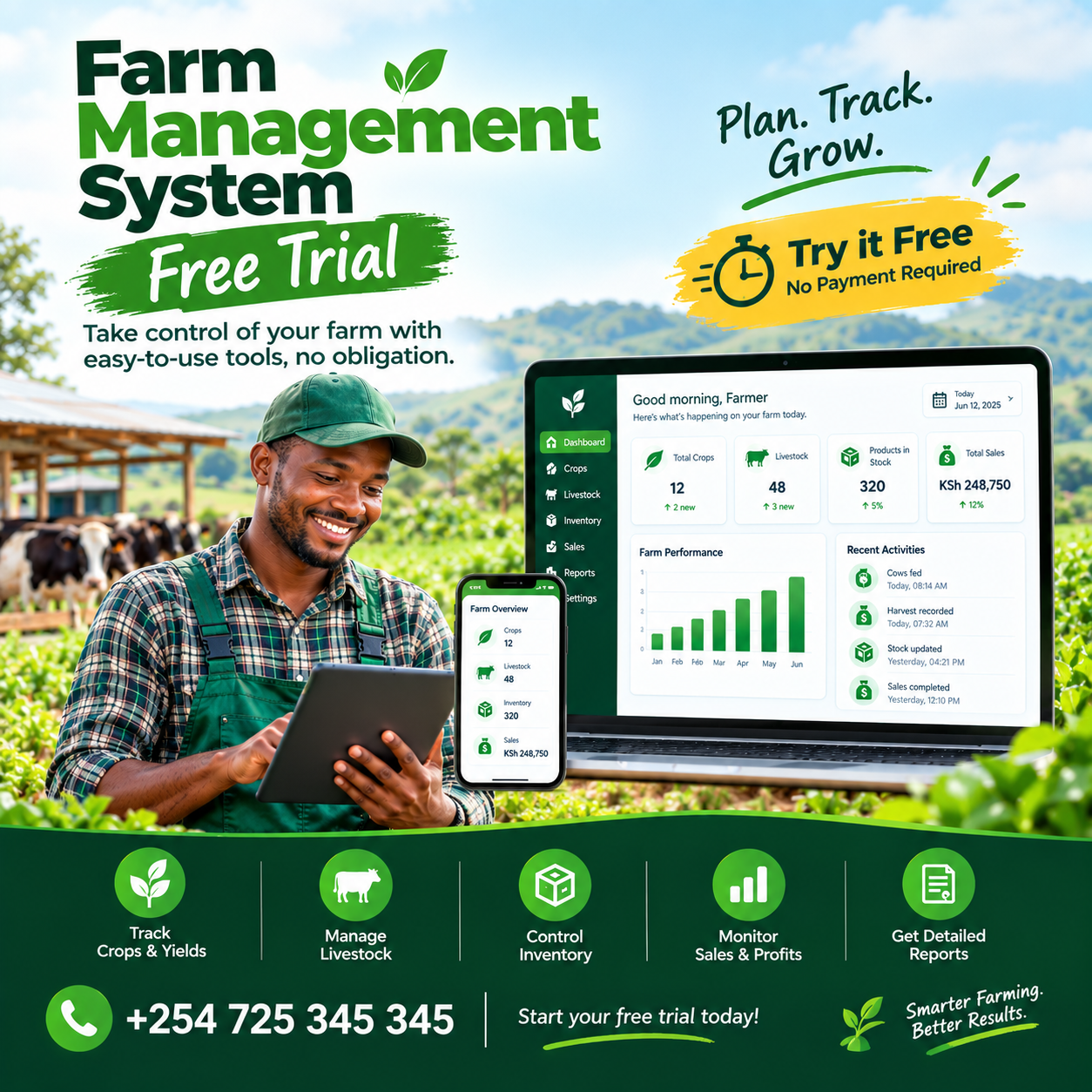
Farm management system free trial is the smartest first step in digitising a farm — the opportunity to run real farm software on real farm operations before paying anything, and the difference between a subscription that transforms a farm and one that quietly dies in a forgotten folder. Software decisions made from brochures and demonstrations are gambles; decisions made from trials are observations.
The trial matters because farm software is not like other purchases. A bag of fertiliser either works or doesn’t within weeks, but the wrong software wastes months — of set-up, of training, of records half-entered — before the farm realises the fit is wrong and starts over.
This is why every credible farm management system free trial offer exists: the provider knows that a farm which genuinely tests the system will discover its value, and a farm that doesn’t fit will discover that too — before any money moves.
Yet most trials fail on the farm’s side, not the software’s. Farms sign up, click around a demonstration screen, close the tab, and decide from a fifteen-minute impression — then either buy the wrong thing or dismiss the right thing.
This guide covers the complete trial discipline: what a trial should include, how to prepare for one, the exact tests that reveal fit or failure, how to involve the team whose adoption will decide everything, what to evaluate beyond the software itself, and how to convert a successful farm management system free trial into a confident, correct purchase decision.
Table of Contents
ToggleWhy a Free Trial Is the Smartest First Step
The first reason is financial: the trial costs the farm nothing but time, while the wrong purchase costs a year’s subscription plus the set-up effort plus the team’s lost confidence in “that software thing that failed.” The farm management system free trial is the cheapest insurance available on a decision that typically runs thousands of shillings annually.
The second reason is evidence. Demonstrations show the software working on demonstration data, staged by the provider’s own staff. A trial shows it working — or failing — on the farm’s actual fields, herds, and workers, which is the only test that predicts daily reality.
The third reason is adoption discovery. The single largest cause of farm software failure is not bad software; it is unadopted software. Only a trial with the real team reveals whether workers will actually record, whether supervisors will actually verify, and whether the owner will actually read the dashboards the platform promises.
The fourth reason is negotiation power. A farm that has run a complete farm management system free trial knows exactly what it needs, which plan fits, and what the software is worth to its operation — and that buyer negotiates from evidence rather than hope.
What a Good Free Trial Includes
Sufficient Duration
The standard trial runs seven to thirty days, and the honest evaluation needs at least two full weeks — enough to record a complete week of real operations, review the data, and run the second week against the first. A farm management system free trial shorter than fourteen days produces impressions; this duration produces evidence.
Real Functionality, Not a Demo Version
The trial should offer the actual platform — the real modules, the real dashboards, the real workflows — rather than a stripped demonstration. Some providers limit trials to sample data, and those limitations belong in the first conversation, because a farm management system free trial that cannot touch the farm’s real operations is a brochure with a login.
Multi-User Access
If the farm’s value lies in team recording, the trial must include multiple users — worker logins, supervisor verification, the owner’s dashboard — because single-user trials cannot reveal how the system behaves when the whole crew records simultaneously.
Support During the Trial
Good providers support their trials: onboarding guidance, answers during the test period, and — at the better end of the farm management system free trial market — a live walkthrough tailored to the farm’s actual setup. Trial support quality is a preview of customer support quality; providers treat trials badly rarely improve afterward.
Clear Trial Terms
The honest trial states its terms plainly: what happens when it ends, whether payment details are required upfront, how data can be exported if the farm declines, and what the post-trial pricing is. A farm management system free trial with unclear terms is a sales tactic wearing a generous costume — and the terms worth reading are always the ending ones.
Preparing for the Trial: The Setup That Determines Everything
Step One: Define What You’re Testing
Before signing up, the farm writes its evaluation questions: can the team record daily activities easily, does inventory track feed and fertiliser accurately, do reports answer the questions the farm actually asks each week, can the owner see the position remotely.
Trials without questions produce wandering impressions. The farm management system free trial conducted against a written question list produces answers — and answers are what the purchase decision requires.
Step Two: Involve the People Who Will Use It
The trial’s cast matters more than its duration. The owner evaluates strategy and dashboards; the manager evaluates operations; the supervisor evaluates verification; and one ordinary field worker — ideally the least technical one — evaluates the capture experience.
The least technical worker is the decisive test. If that person can record a real activity unassisted within a minute, the farm management system free trial will scale to the crew. If they struggle, no feature list will rescue adoption.
Step Three: Gather Real Data
The trial needs real material: current inventory counts, active worker lists, actual block and herd names, this season’s real transactions. A trial run on invented data tests nothing — the friction only appears where the farm’s real complexity lives.
Step Four: Plan the Test Schedule
Two weeks, structured: days one to two on setup — enterprises, blocks, users, inventory. Days three to nine on live recording — every real activity flowing through the system. Days ten to twelve on review — reports, dashboards, reconciliation against physical counts.
The final two days belong to evaluation: the team’s verdicts, the question list answered, and the comparison between what the farm management system free trial promised and what the farm experienced. This schedule converts a trial from an experiment into an assessment.
The Core Tests: What to Actually Evaluate
Test One: Daily Capture Speed
The foundational test is time: how long does a real worker need to record a real activity? A feed issue, a harvest count, a spray record — stopwatch them. Capture under thirty seconds sustains daily recording; capture at two minutes does not survive the second week.
This single metric predicts adoption more accurately than any other evaluation in the farm management system free trial — because recording that is easy gets done, and recording that is tedious gets abandoned by everyone but the owner.
Test Two: Offline Reality
Take the phone to your field’s actual dead zone and record there. Entries should save on the device and sync on reconnection, automatically and without loss. Every serious farm management system free trial claims offline capability; only the field test proves it.
Test Three: The Team Test
Hand the system to the crew for three full days and watch: who records, who resists, who asks for help repeatedly. The team’s unguided behaviour during the farm management system free trial is the adoption forecast — and it arrives before any money is spent.
Test Four: Reconciliation Accuracy
Count a store physically, then compare against the system’s balance. Record a harvest, then weigh the store’s receipt of it. The farm management system free trial whose records reconcile against reality earns trust; the one that drifts has revealed its future.
Test Five: Report Value
Open every report the trial offers and ask one question: would this change a decision I make this season? Reports that answer real questions earn their keep; reports that merely decorate earn nothing, no matter how colourful.
Test Six: Remote Visibility
Check the farm’s position from town — or from another county — on your own phone. The owner-visibility test is what separates true cloud platforms from systems that pretend, and it is a defining test of any farm management system free trial claiming remote access.
Test Seven: The Exit Test
Before the trial ends, export the farm’s data completely and open it elsewhere. The farm that knows its exit cost during the trial will never be trapped later — and the farm management system free trial provider that passes this test without hesitation has told you something about how they treat customers.
Evaluating the Team’s Experience
The team verdict deserves structure, not vibes. Ask each user three questions: what did you find easy, what did you find confusing, and what would make you stop using this. Their answers, collected independently, reveal the real adoption landscape.
Watch for the silent signals too: who logged in unprompted, who needed reminders, who stopped after day three. The farm management system free trial usage pattern — visible in the system’s own records — is more honest than any verbal review.
Resistance discovered during the trial is a gift: it can be answered with training, with simpler roles, with clearer framing — all before the purchase. Resistance discovered after purchase is a subscription paid for a system the team refuses.
Evaluating the Provider, Not Just the Software
The trial doubles as the provider’s audition, and the audition criteria are practical. Response speed: how quickly did questions during the trial get answered? Local understanding: did the support understand Kenyan farming realities — seasons, M-Pesa, county contexts?
Update behaviour: did the platform change or improve during the trial period, and how did changes arrive? Pricing clarity: does the post-trial farm management system free trial quotation match what the trial displayed, or do features vanish into higher tiers?
The provider that performed well through a two-week trial — responsive, knowledgeable, honest about limits — has demonstrated how it will behave through a two-year relationship. The trial is, in truth, the only reliable farm management system free trial interview either party gets.
Common Trial Mistakes That Waste the Opportunity
The first mistake is the fifteen-minute evaluation — clicking through a demonstration and deciding, which tests nothing real. The trial’s entire value lives in real data and real users, and the farm management system free trial treated as a quick tour returns a quick impression instead of an answer.
The second is the demo-data trial — recording invented activities rather than the farm’s real ones, which misses every friction point where complexity actually lives.
The third is the owner-only trial — the team never invited, whose adoption will decide the outcome regardless of the owner’s verdict. The farm management system free trial that excludes the crew evaluates half the product.
The fourth is the unfair trial — starting during the season’s busiest week when nobody has time, or expecting workers to adopt during harvest. Trials, like training, deserve a chosen moment.
The fifth is the unexported trial — reaching the end without testing data export, and discovering the exit cost after committing. The farm management system free trial that ends with a complete export in hand ends properly.
Converting the Trial Into a Decision
The evaluation meeting closes the trial: the question list answered, the team’s verdicts collected, the reconciliation results reviewed, and the costs modelled. The decision framework is simple — does the tested system answer the farm’s written questions better than the current method, at a cost the returns justify?
Where the answer is yes, the purchase follows immediately, while the trial’s momentum and the team’s familiarity are fresh. The farm management system free trial that converts within days of its ending preserves everything the trial built; the one that waits a month re-pays the adoption cost.
Where the answer is no, the trial still earned its keep: the farm now knows precisely what it needs, what it rejects, and what the next candidate must prove. The failed farm management system free trial is not a loss — it is the specification for the correct purchase.
And where the answer is “close, but not quite,” the honest move is a conversation with the provider: the gaps identified during the trial are exactly what a good provider wants to hear, and many features, configurations, or roadmap commitments arrive through exactly that dialogue.
Who Benefits Most From a Trial-First Approach
Smallholder farmers benefit most proportionally, because at small scale every wasted subscription is a larger share of the budget — and the trial converts the software decision from a gamble into a verified choice before the first shilling moves.
Commercial farms need trials most structurally, because their adoption stakes are highest: dozens of workers, complex operations, and the training investment that a wrong choice wastes at scale. The farm management system free trial period is where a commercial deployment’s real risks surface and get answered.
Multi-candidate shoppers complete the constituency: farms comparing two or three platforms should trial them in sequence — real data, real team, real two weeks each — because the comparison run properly reveals differences no brochure can hide. The farm management system free trial comparison is the only kind that survives contact with a real farm.
Costs and Terms: What Trials Really Cost
The trial itself should cost nothing but time — and where a provider charges for trial setup or demands payment details upfront with auto-renewal, those terms deserve reading twice. The honest farm management system free trial requires neither.
The real trial cost is the farm’s time: setup hours, recording minutes, and the evaluation meeting. Budget two to three focused hours per week across the trial period, and schedule the heavier sessions into the farm’s quieter mornings.
The post-trial cost is where the decision lands: the plan’s true rate, the users it includes, the modules it carries, and the first year’s total. The farm that modelled these figures before the farm management system free trial began signs — or declines — from evidence rather than surprise.
Common Questions About Trial Terms
Auto-renewal is the term to check first: trials that convert silently into paid subscriptions unless cancelled deserve either avoidance or a cancellation reminder set the day the trial starts. Data retention is the second: what happens to the farm’s trial records when the trial ends — and can they carry into the paid plan if the farm subscribes?
The answer to the second question shapes the practical transition: a farm management system free trial whose data migrates into the subscription lets the farm continue seamlessly, while one that wipes everything asks the farm to rebuild — a small cost, but worth knowing in advance.
Support terms complete the set: whether trial support continues into the paid period, and what the support levels are at each plan tier. The farm that asks these three questions before the trial begins enters it with clear eyes and exits it with clean options.
Frequently Asked Questions
How long should a farm management system free trial last?
At least two weeks — enough to set up, record a complete week of real operations, and review the results against a second week. Shorter farm management system free trial periods produce impressions; two weeks produces evidence, which is what the purchase decision actually requires.
Can I test the software with my actual workers during the trial?
Yes, and you should — multi-user trials are where adoption reveals itself: who records willingly, who resists, and whether your least technical worker can capture an activity unassisted. The farm management system free trial that includes the crew tests the product’s hardest and most important dimension.
What should I do first when starting a trial?
Write your evaluation questions, gather real data — inventory counts, worker lists, block names — and set up the farm’s actual structure before recording anything. A prepared farm management system free trial tests the system; an unprepared one tests the farm’s patience.
How do I know if a trial was successful?
Against your written questions: does the system answer them, does the team record willingly, do the records reconcile against physical counts, and does the cost fit the returns modelled. A farm management system free trial that passes all four is a purchase decision, not a gamble.
What happens to my data when the trial ends?
It should remain exportable in full — and if you subscribe, it should carry into the paid plan seamlessly. Confirm both points before the farm management system free trial begins, because the exit terms and the data terms are where trials hide their real conditions.
Do I need to give payment details for a free trial?
The best trials require none — and where a provider does, read the auto-renewal terms carefully and set a cancellation reminder for the trial’s end. A farm management system free trial without payment capture is the cleanest way to test without obligation.
Can I trial more than one system before deciding?
Yes — trial candidates in sequence, each with real data and a real two weeks, and compare their results against the same question list. The multi-candidate farm management system free trial comparison run properly reveals differences no demonstration can hide.
What is the biggest mistake farms make with trials?
Evaluating in fifteen minutes on demonstration data without the team — which tests nothing real and produces the wrong decision in either direction. The disciplined farm management system free trial takes two weeks, real operations, and the actual crew — and it converts the purchase from a gamble into an observation.
Is a trial really necessary, or should I just buy the cheapest plan?
Necessary — because the cheapest plan that the team abandons is the most expensive subscription of all, and only the trial reveals whether any plan will actually be used. The farm management system free trial costs two weeks; the wrong purchase costs a year.
What should I test about the provider, not just the software?
Response speed during the trial, local understanding of Kenyan farming realities, update behaviour, and whether the post-trial quotation matches what the trial displayed. The farm management system free trial is the provider’s audition, and the audition’s result predicts the relationship better than any sales conversation ever will.