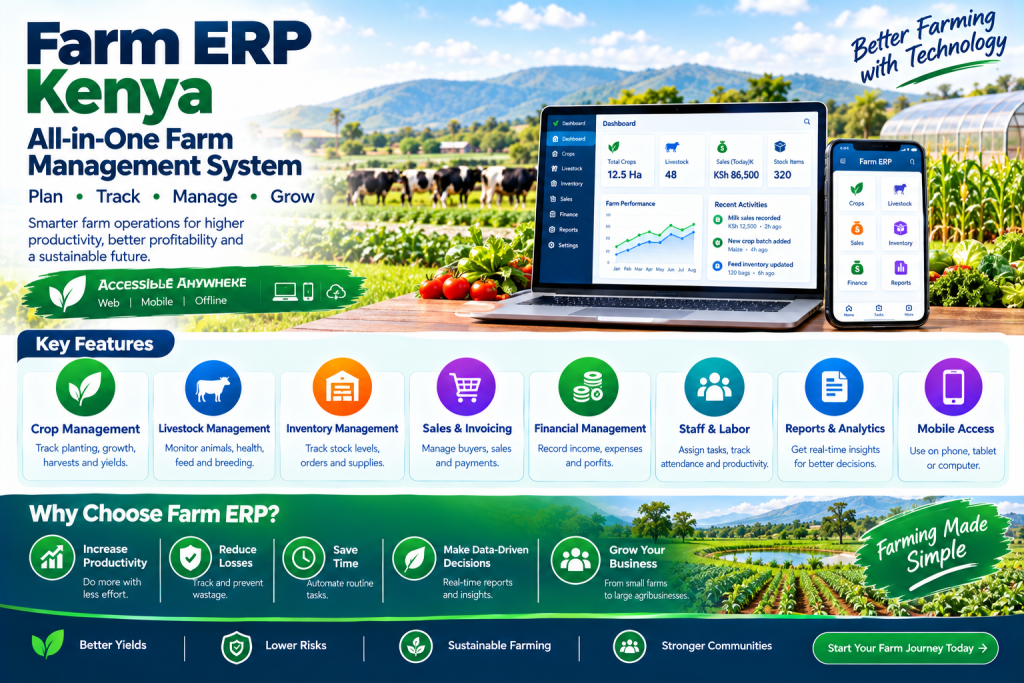
Farm ERP Kenya solutions have moved from a novelty discussed at agribusiness conferences to the operational backbone of the country’s most serious farming enterprises, and the shift is happening faster than most industry observers predicted. As farms grow into genuine businesses — multiple sites, dozens of workers, several enterprises running simultaneously, and investors or banks expecting professional reporting — the simple apps, notebooks, and spreadsheets that served a five-acre plot simply cannot carry the load. This is precisely the gap a full farm ERP Kenya system is built to fill: one integrated platform where production, livestock, inventory, finance, human resources, and sales all live together, speaking to each other in real time instead of sitting in disconnected silos that someone must manually reconcile every month. The farms that have made this transition describe it in the same language businesses used a generation ago when they moved from paper ledgers to integrated business software — not as a technical upgrade, but as a change in what kind of organisation the farm actually is.
The Kenyan context makes this transition particularly urgent. Agriculture here is dominated by complexity that generic business software was never designed to handle: biological assets that grow and die, perishable inventory that loses value daily, seasonal labour forces that swell and shrink, rain-dependent production calendars, and value chains that stretch from a rural field to an export cold store within days. A generic accounting package can record that you bought fertiliser; only a purpose-built farm ERP Kenya system can connect that purchase to the specific block it was applied on, the workers who spread it, the crop that consumed it, the harvest it contributed to, and the profit or loss that block ultimately delivered. That end-to-end traceability — from input invoice to market payment — is the defining capability of enterprise resource planning for agriculture, and it is what this guide examines in full: what a farm ERP actually is, which modules matter, how it differs from everything cheaper, which farms genuinely need it, what it costs, and how to implement one without paralyzing operations.
Table of Contents
ToggleWhat Exactly Is a Farm ERP?
ERP stands for enterprise resource planning, and the name describes the ambition precisely: a single system that plans and tracks every resource the enterprise deploys — land, crops, animals, people, money, materials, and machines. A farm ERP Kenya provider builds is therefore not a larger version of a simple record-keeping app but a different category of software entirely: a modular platform in which every department of the agribusiness operates inside the same database, so that an event recorded in one module automatically updates every other module it touches. Harvest a field, and the inventory of produce rises, the labour costs of that field accumulate, the finance module books the expected revenue, and the sales module makes the stock available to customers — with no re-entry anywhere.
The modularity is what makes this scale. A typical farm ERP Kenya deployment begins with two or three essential modules and expands as the business grows, because the platform is designed from the ground up to absorb new functions without migration or disruption. This is the architectural difference between software that farms outgrow and software that grows with farms — and it is why enterprises that anticipate expansion choose ERP foundations early rather than trying to bolt them on after the business has already outgrown three simpler tools.
It is equally important to be clear about what a farm ERP is not. It is not an accounting package with a few farming fields added; it is not a weather and agronomy app with a notebook attached; and it is not a dashboard that displays data someone enters elsewhere. A genuine farm ERP Kenya system is operational software — the place where work is assigned, executed, recorded, and priced — with intelligence layered on top of operations rather than beside them. The distinction matters because buyers who mistake reporting tools for ERP systems end up with dashboards full of manually maintained numbers that drift from reality within weeks; the ERP, by contrast, cannot drift, because its numbers are produced by the work itself.
The final defining trait is the single source of truth. In organisations running separate tools for crops, accounts, stores, and staff, the same fact — a tonne of fertiliser, a week of labour, a batch of day-old chicks — exists in three places with three different values, and every report becomes a negotiation between versions. In a properly implemented farm ERP Kenya system, that fact exists exactly once, in the transaction that created it, and every report in the organisation draws from it. This is an unglamorous technical property with enormous human consequences: meetings stop debating whose numbers are right and start deciding what to do, which is the entire point of enterprise software.
Why Kenyan Agribusiness Is Moving to ERP
The first driver is scale itself. Kenya’s commercial farming sector has consolidated and professionalised rapidly over the past decade — flower estates expanding, horticulture exporters contracting thousands of smallholders, poultry integrators coordinating hundreds of outgrowers, and investor-funded ventures launching multi-site operations from day one. At this scale, the informal coordination methods that run a family farm collapse completely, and the enterprises that survive are the ones that industrialised their information flows through a farm ERP Kenya platform before the chaos could compound.
The second driver is the financing environment. Kenyan agricultural lenders and investors have raised their standards dramatically: they want auditable cost-per-unit figures, production histories, and traceability documentation before releasing capital, and they want reporting during the loan, not just before it. An agribusiness running on a farm ERP Kenya system produces this evidence as a by-product of normal operations, while one running on scattered records spends weeks reconstructing approximations — and increasingly, that difference decides who gets financed at all.
The third driver is compliance and export access. Supermarkets, certification bodies, and export markets demand documented spray records, residue timelines, labour conditions, and traceability from plot to pallet. Meeting those standards manually is possible at tiny scale and impossible at commercial scale; a farm ERP Kenya implementation generates the compliance trail automatically from the same records the farm keeps for its own management, converting an audit burden into a competitive credential that wins contracts.
The fourth driver is the leadership model of modern Kenyan agribusiness: professional managers running farms for owners and investors who are rarely on site. This structure lives or dies on information quality — a manager reporting verbally is a manager reporting selectively, however honest — and the transparent, timestamped visibility of a farm ERP Kenya system realigns incentives across the whole organisation. Workers know activities are logged against their names, managers know owners see live dashboards, and owners make decisions on evidence rather than on the most recent and most polished story.
The fifth driver is simply the failure cost of the alternatives. At commercial scale, untracked inventory becomes systematic shrinkage, unrecorded costs become invisible losses, missed treatment schedules become biological disasters, and unreconciled sales become leakage — and each of these failures at commercial volumes costs more per month than the ERP subscription costs per year. The arithmetic of a farm ERP Kenya adoption is therefore not really an investment case against zero; it is an investment case against the ongoing, compounding cost of running a complex enterprise on systems designed for a simple one.
Core Modules of a Farm ERP System
Production and Field Management
The production module is the heart of any agricultural ERP: plots, blocks, greenhouses, and paddocks mapped and versioned, with every activity — planting, spraying, irrigating, scouting, harvesting — recorded against them with dates, quantities, workers, and inputs. This is the module that answers the questions generic software cannot: what did block four cost per kilogram last season, which variety earned most on which soil, and which field is due for its next spray window. In a mature farm ERP Kenya deployment, the production history becomes the farm’s most valuable intellectual asset, compounding in value every cycle it is maintained.
Livestock Management
For animal enterprises, the livestock module tracks individual animals or batches through their full lifecycle: births and purchases, weights and growth curves, feeds consumed, treatments and vaccinations, breeding records, production output, and mortality. Alerts for due vaccinations, expected calvings, and withdrawal periods before sale turn biological calendars into automated safeguards. The livestock module of a farm ERP Kenya system also computes the numbers that decide herd economics — cost per litre, cost per kilogram of gain, feed conversion per batch — at a precision that manual systems never approach.
Inventory and Procurement
Farm inputs are the classic leakage point of agricultural businesses: purchased, stored, issued, and sometimes vanishing with no one able to say exactly where. The inventory module of a farm ERP Kenya system records every receipt into store and every issue to a field, animal group, or worker, maintains live balances with reorder alerts, and prices every use against the activity that consumed it. Procurement workflows extend this control upstream — requisitions, approvals, supplier records, and purchase orders — so that spending is authorised and documented before it happens rather than discovered after.
Finance and Accounting
The financial module is where the ERP earns its name, because it does not sit beside operations the way an external accounting package does — it is fed by them. Sales, purchases, labour, and input consumption flow in automatically, producing enterprise-level profit and loss, cost-per-unit tracking, cash flow views, and receivables management without a separate bookkeeping effort. When an agribusiness runs its books inside a farm ERP Kenya platform, the accounts stop being a monthly reconstruction and become a live reflection of the operation — which is what makes real-time management financially possible.
Human Resources and Labour
Labour is among the largest costs in Kenyan agriculture and among the least managed, and the HR module exists to change exactly that: worker records, contracts, task assignments, timesheets, piece-work captures, payroll computation, and statutory deductions, all linked to the fields and enterprises the work served. Farms that run labour through a farm ERP Kenya module gain two capabilities simultaneously — accurate costing of every activity, and a productivity record per worker that makes supervision, reward, and retention decisions evidence-based for the first time.
Sales and Distribution
The sales module manages the commercial end: customer records, orders and contracts, pricing and discounts, deliveries, invoices, and payment tracking, with produce availability drawn live from harvest records and inventory. For agribusinesses supplying institutions, exporters, or retail chains, this module of a farm ERP Kenya system becomes the order-to-cash backbone — and because it shares one database with production, it can promise delivery dates based on what the farm will actually have, rather than on optimistic estimates.
Assets, Equipment, and Maintenance
Tractors, irrigation systems, vehicles, cold rooms, and structures are capital-intensive assets whose downtime and depreciation quietly shape profitability. The asset module tracks each machine’s location, usage hours, service schedules, repair history, and running costs, allocating them accurately to the activities they served. Operations that manage machinery inside a farm ERP Kenya platform consistently discover that scheduled maintenance costs a fraction of breakdown-driven harvesting delays — and the data makes that case to management every budgeting cycle.
Reporting and Business Intelligence
The final module is the layer that converts all of the above into decisions: dashboards, trend analysis, yield and cost comparisons across seasons and sites, budget-versus-actual tracking, and one-click reports for owners, boards, lenders, and auditors. This is where the integration investment of a farm ERP Kenya system pays its ultimate dividend — because intelligence built on fragmented data is guesswork with better graphics, while intelligence built on unified operational data is genuinely predictive.
Farm ERP vs Spreadsheets and Accounting Software
The honest comparison begins by conceding what the cheaper tools do well: spreadsheets are free, infinitely flexible, and universally understood, and a disciplined farm can run surprisingly far on them. Accounting packages, similarly, do bookkeeping superbly. The problem is never the tools’ individual quality — it is their separation. When crops live in one file, accounts in another, and stores in a third, every connection between them must be maintained by human re-entry, and human re-entry at commercial volume is where accuracy, timeliness, and ultimately trust in the numbers all die. This structural fragmentation is what a farm ERP Kenya platform exists to eliminate, and no amount of spreadsheet discipline substitutes for it at scale.
The second difference is operational versus historical. Spreadsheets and accounting packages record what already happened; an ERP is where work is planned, assigned, and executed, which means its records are created by the operation itself rather than reconstructed after it. A farm manager planning next week’s irrigation, harvest labour, and deliveries does it inside the farm ERP Kenya system, where the plan immediately becomes the tasks workers see and the records finance will later read. Tools that only look backward cannot participate in running the farm forward — and that participation is the entire value proposition.
The third difference is growth behaviour. A spreadsheet system has a complexity ceiling that arrives quietly: file versions multiply, formulas break silently, the one person who understands the structure becomes indispensable, and eventually the whole edifice becomes too fragile to trust. An ERP absorbs growth structurally — new fields, sites, employees, and enterprises are records, not new architecture. Enterprises that begin their professionalisation with a farm ERP Kenya foundation avoid the painful mid-growth migration that catches businesses which scaled first and systematised later.
The fourth difference is accountability. A shared spreadsheet has no reliable identity — anyone can edit anything, and nothing is attributable. An ERP records who did what, when, and where, as a structural property of every transaction. For Kenyan agribusinesses employing managers, supervisors, and seasonal crews, this auditability is not surveillance for its own sake; it is the mechanism by which a farm ERP Kenya deployment converts trust from an assumption into a verified, improvable quantity — and it is the single feature owners cite most often when explaining why they would never return to the old way.
Which Kenyan Farms and Agribusinesses Benefit Most
Large Commercial Crop Farms
Farms beyond roughly one hundred acres — grain estates, commercial horticulture blocks, flower units — are the classic ERP constituency: multiple managers, seasonal labour forces, machinery fleets, and buyers demanding documentation. At this scale the question is not whether to systematise but how completely, and the operations that industrialised earliest through a farm ERP Kenya platform now operate with per-block profitability data their competitors still estimate.
Horticulture Exporters and Their Outgrower Networks
Export horticulture combines the highest documentation standards in agriculture with the most complex coordination challenge — hundreds of contracted smallholders whose plots, spray records, and harvests must be traceable to every consignment. This is the environment where a farm ERP Kenya system functions as both management tool and market passport: the same records that coordinate outgrowers satisfy the GlobalG.A.P-style audits that keep European shelves open.
Dairy and Poultry Integrated Businesses
Animal enterprises with continuous daily production — milk collections, egg grading, chick placements — generate data volumes that overwhelm manual systems within weeks, and their economics depend on precisely the per-unit cost tracking ERP does natively. A dairy or poultry integrator running a farm ERP Kenya platform knows its cost per litre and per egg daily, prices contracts accurately, and catches production dips within days rather than at the month’s reconciliation.
Cooperatives and Aggregation Enterprises
Cooperatives live on member trust, and member trust lives on transparency: deliveries weighed correctly, payments computed understandably, input loans recorded disputably-or-not. A cooperative operating its member ledger, input credit, and payments through a farm ERP Kenya system gives every stakeholder the same numbers — and the groups that digitised this way report not just fewer disputes but stronger borrowing positions, because lenders can audit the cooperative’s books in hours.
Multi-Site Agribusiness Groups
The fastest-growing category is the group operation: an agribusiness running several farms, several enterprises, or both, under one management. Multi-site consolidation is where simpler tools fail absolutely and where a farm ERP Kenya deployment delivers its most dramatic relative advantage — every site visible side by side, best practices transferable through data, and consolidated reporting that once took accountants weeks produced on demand.
How to Choose the Right Farm ERP in Kenya
Agricultural Depth Before Feature Count
The first filter is whether the vendor genuinely understands agriculture or has generalised business software with farming labels attached. Probe with operational questions: How does it handle piece-work labour? Can it compute cost per kilogram at block level? Does it model biological assets and perishable inventory? A credible farm ERP Kenya provider answers these from product reality; a generalist answers with promises of customisation, which is a different and more expensive proposition.
Offline and Mobile Reality
Field operations happen where networks fail, so the platform must capture data fully offline and sync reliably when connectivity returns. Test this specifically during evaluation — in an actual no-signal location, not in a demonstration — because the difference between claimed and real offline capability is the difference between a farm ERP Kenya system your field teams adopt and one they quietly abandon every time the bars disappear.
Fit to Your Enterprise Mix and Structure
Farms are heterogeneous, and rigid software forces operations into templates that never quite match. Walk your three most complex recurring processes — your trickiest labour pattern, your most complicated inventory flow, your most demanding report — through the candidate system before committing. The right farm ERP Kenya choice flexes to how your business actually runs; the wrong one will have you changing your business to suit its limitations within a year.
Integration Openness and Ecosystem
Your ERP will not be the only system the business touches — mobile money, banking, weather services, weighbridges, and eventually sensors and traceability platforms. An open, documented API is therefore a strategic property, not a technical detail: the farm ERP Kenya systems that will matter in five years are the ones already exchanging data with the surrounding digital ecosystem today.
Vendor Stability and Local Support
ERP is a decade-long relationship, not a purchase, so evaluate the vendor as seriously as the product: years in operation, installed base in Kenya, support structure and hours, implementation methodology, and customer references at your scale. Ask every shortlisted farm ERP Kenya provider for three customers you can call without their staff present — what those farmers say about support responsiveness after go-live is worth more than any demonstration.
Transparent Total Cost
Finally, demand the complete cost picture in writing: licences or subscriptions, per-user and per-module pricing, implementation and data migration fees, training, annual support, and the realistic cost of the second and third years. A farm ERP Kenya selection made on transparent five-year total cost is almost never regretted; one made on first-year price alone frequently is, after the deferred costs surface in the experience rather than the quotation.
Implementing a Farm ERP: A Step-by-Step Roadmap
Step 1: Audit and Design Before You Buy
Successful implementations begin months before any software is selected, with an honest audit of current processes, records, and pain points, followed by a written design of how the business should run. This document — processes first, software second — becomes the specification against which every farm ERP Kenya option is evaluated, and it prevents the most expensive implementation failure of all: digitising a disorganised operation and calling the result a system.
Step 2: Phase the Rollout Deliberately
Do not switch everything at once. The proven sequence runs core first — production records, inventory, and basic finance — then adds labour, sales, and advanced modules once the foundation is habitual. A phased farm ERP Kenya rollout builds credibility through early wins and gives the organisation time to change its habits in digestible instalments, while the big-bang approach that attempts everything simultaneously routinely stalls in month two and gets abandoned in month four.
Step 3: Migrate Data Honestly, Not Completely
Old records should be migrated selectively: opening balances, active contracts, current inventory, and enough history to calibrate — not every faded notebook of the past decade. The teams that over-migrate drown the new system in unreliable legacy data; the teams that migrate selectively start their farm ERP Kenya deployment with a clean baseline and build history forward from a known-trusted day one.
Step 4: Train for Real Work, Then Supervise the First Month
Training succeeds when it happens on the farm’s actual transactions — today’s harvest, this week’s spray, this month’s payroll — rather than on demonstration scenarios, and when every user is trained on exactly what their role requires. Then supervise the first thirty days closely: daily entry reviews, immediate correction of bad habits, and visible celebration of good ones. The first month of a farm ERP Kenya implementation sets the data culture for the decade that follows, and it deserves disproportionate leadership attention.
Step 5: Review, Refine, and Expand
After the first full production cycle, conduct a formal review: what is being used, what is being skipped, where the data has gaps, and which reports are actually informing decisions. Fix processes, retire unused complexity, and only then activate the next module tier. Enterprises that treat their farm ERP Kenya platform as a living system reviewed each season report steadily deepening adoption, while those that implemented once and never revisited typically run at a fraction of the system’s real capability for years.
Integrations That Multiply the Value
The first integration tier is the physical farm: soil moisture probes, weather stations, water meters, and cold-chain loggers feeding readings directly into the platform, converting dashboards from manually updated summaries into live instruments. Every year the hardware becomes cheaper and the standards more universal, and the farm ERP Kenya deployments that planned for device integration from the start are absorbing this wave at a fraction of the effort their retrofitting competitors spend.
The second tier is the financial ecosystem: M-Pesa and card payment reconciliation flowing automatically against sales invoices, bank feeds matching payments to receivables, and accounting exports reaching external accountants and lenders in standard formats. This tier turns the ERP from a recording system into a transactional one — and it is where a farm ERP Kenya platform stops describing the business and starts operating it, shortening the path from customer order to confirmed cash.
The third tier is the market and compliance ecosystem: traceability records feeding certification audits, produce quality data shared with buyers, and eventually marketplace connections where verified farm records unlock preferential financing and contract terms. The direction of the entire agricultural economy is toward data-verified trading, and the enterprises whose histories already live inside an integrated farm ERP Kenya system will be first through every door that economy opens.
Costs, Pricing, and Return on Investment
Farm ERP pricing in Kenya follows a few recognisable models: subscription per user per month, tiered by farm size or module set, or enterprise licensing for larger groups — with implementation, training, and data migration usually quoted separately. Small and mid-sized operations should expect a meaningful annual commitment well above simple app pricing, because they are buying organisational infrastructure rather than a utility. When comparing options, model the total five-year cost of each farm ERP Kenya candidate at your projected scale, and treat any quotation that cannot state those totals plainly as a quotation that plans to find its revenue in your experience.
The return arrives through four measurable channels, and it is worth naming them because they are the lines to watch after go-live. Shrinkage reduction: inventory control typically recovers several percent of input spending that was previously leaking. Yield and quality gains: disciplined scheduling and alerting prevent the missed treatments and late interventions that silently cap production. Financing access: auditable records unlock credit terms and investor confidence that undocumented competitors cannot reach. And labour productivity: task-based management measurably raises output per worker while cutting the supervision hours. Across these channels, a well-run farm ERP Kenya deployment commonly pays back its first-year cost within one to two production cycles — and every cycle thereafter compounds the advantage.
The honest comparison is not against zero but against the status quo’s invisible invoice: the shrinkage nobody traces, the financing declined for missing records, the manager’s knowledge that resigns, and the buyer contracts lost to undocumented traceability. Totalled across a year at commercial scale, that invoice dwarfs the subscription of a farm ERP Kenya system — which is why the boards of Kenya’s most sophisticated agribusinesses now treat the ERP line item not as software spending but as the cheapest insurance they buy on the entire operation.
Data Security, Ownership, and Governance
Enterprise data deserves enterprise-grade scrutiny. Verify, rather than assume, the security posture of any platform you entrust with the business’s operational history: encryption in transit and at rest, backup frequency and disaster recovery, data-centre standards, and access-control granularity down to role level. A reputable farm ERP Kenya provider answers these questions in a document; a hesitant answer is itself the finding.
Ownership and exit are the second pillar: the data must belong to the agribusiness, exportable in usable formats at any time, with no hostage terms on departure. Run the exit test during evaluation — request a sample export and inspect it — because the credible farm ERP Kenya vendors pass it without hesitation, and the ability to leave cleanly is the strongest guarantee of fair treatment while you stay.
Internal governance completes the picture: individual logins rather than shared credentials, role-based permissions that show each person only what their work requires, two-factor authentication for administrators, and prompt revocation on staff departure. With these basics, the records inside a farm ERP Kenya platform are safer than any paper archive in the country’s history — and unlike a filing cabinet, they are also searchable, analysable, and permanently useful.
Frequently Asked Questions
What is the difference between a farm ERP and ordinary farm management software?
Farm management software records what happened on the farm; an ERP runs the business — assigning work, controlling inventory, computing payroll, issuing invoices, and producing consolidated financials from the same transactions. If you need coordination across production, stores, labour, and money under one system with one set of numbers, you have crossed from an app into the territory a farm ERP Kenya platform was built for.
How large must a farm be before an ERP makes sense?
There is no fixed acreage — the trigger is organisational complexity: multiple enterprises, several managers or sites, twenty or more workers, or investors and lenders demanding consolidated reporting. Below that threshold, simpler tools suffice; at or beyond it, the losses of fragmentation typically exceed the cost of a farm ERP Kenya deployment within a single season.
How long does implementation take?
A focused deployment on core modules — production, inventory, and finance — typically goes live within two to three months, with additional modules phased over the following cycles. The timeline depends less on the software than on process readiness, which is why the audit-first approach described above is the strongest predictor of a fast, clean farm ERP Kenya go-live.
Can a farm ERP handle both crops and livestock in one system?
Yes — that multi-enterprise integration is precisely the ERP advantage: shared inventory, unified labour, and consolidated financials across every line of the business, with per-enterprise profitability computed automatically. When evaluating options, demonstrate your actual mixed operation end to end, because the depth of multi-enterprise support separates genuine agricultural ERP from generic systems wearing a farm ERP Kenya label.
What happens to my historical records when we migrate?
Selected history — opening balances, active records, and enough past data to calibrate — is migrated during implementation, while deep archives can often be attached as reference records or retained in the old format. Insist on a written data-migration plan from your farm ERP Kenya vendor before signing, specifying exactly what moves, in what format, verified by whom — because the quality of that plan predicts the quality of everything that follows it.