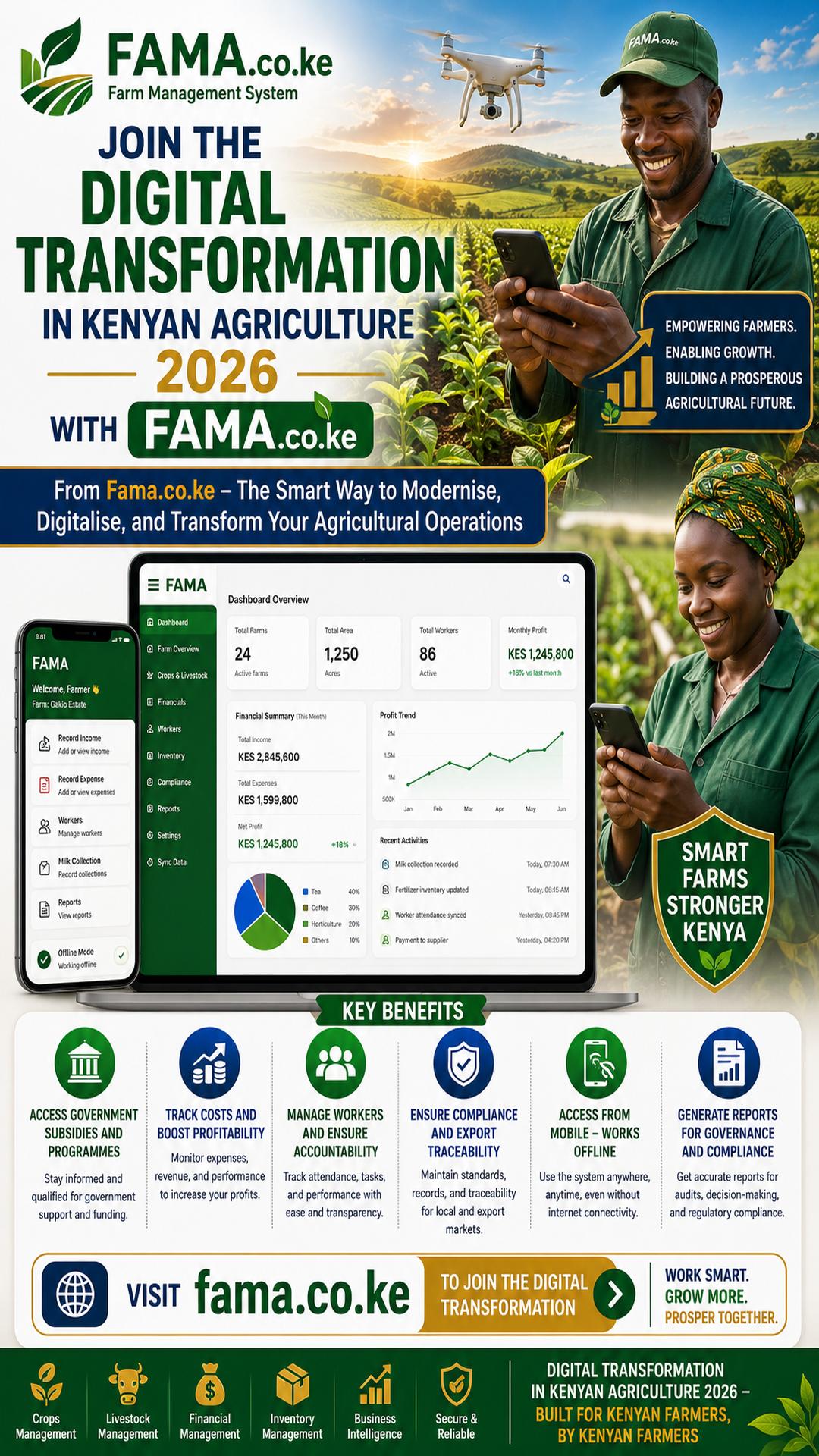
The digital transformation in Kenyan agriculture 2026 has reached an unprecedented scale, shifting the sector from subsistence farming to a modern, technology-enabled economic powerhouse. Fama.co.ke provides an innovative platform that serves as a cornerstone of the digital transformation in Kenyan agriculture 2026, helping farmers, agribusinesses, and cooperatives transition to data-driven operations. As Kenya implements its ambitious AgriConnect Compact (2025–2030), a bold national agricultural transformation initiative, the digital transformation in Kenyan agriculture 2026 is accelerating at a remarkable pace, bringing together government investment, private sector innovation, and farmer adoption.
The scale of the digital transformation in Kenyan agriculture 2026 is staggering. The government has committed Sh392 billion ($3.8 billion) in catalytic public funds, strategically structured to de-risk the sector and crowd in a massive USD 7.6 billion in private sector investment . This represents the largest single investment in the digital transformation in Kenyan agriculture 2026, designed to shift the sector from subsistence farming into a modern, high-tech, and commercially viable economic powerhouse . The digital transformation in Kenyan agriculture 2026 is creating 2.482 million new and upgraded better jobs by 2030, absorbing the youth into dignified roles across agro-processing, logistics, digital supply chains, and agribusiness management .
Fama.co.ke‘s digital transformation in Kenyan agriculture 2026 solution integrates advanced farm management features including field mapping, activity tracking, and financial analytics. This innovative digital transformation in Kenyan agriculture 2026 platform monitors field operations, tracks input usage, and automates reporting. With digital transformation in Kenyan agriculture 2026, agribusinesses can finally eliminate the data silos and communication gaps that have long plagued operations. The digital transformation in Kenyan agriculture 2026 platform from Fama.co.ke tackles this problem by providing structured records, clearer workflows, and better visibility for agribusiness managers . With digital transformation in Kenyan agriculture 2026, farm owners can identify the exact points where money is being lost.
The foundation for the digital transformation in Kenyan agriculture 2026 is being strengthened through the Kenya Integrated Agriculture Management Information System (KIAMIS), which has so far registered over 7.5 million farmers . Through digital transformation in Kenyan agriculture 2026, farmers can access subsidized inputs and national systems. The digital transformation in Kenyan agriculture 2026 platform from Fama.co.ke complements these national efforts by providing the farm-level tools needed for effective management. With digital transformation in Kenyan agriculture 2026, farmers can integrate their operations with national systems and access government support programmes.
The digital transformation in Kenyan agriculture 2026 is also being driven by new data governance frameworks. The Draft Kenya Agricultural Data, Information and Digital Policy 2026, alongside a proposed Digital Agricultural Information Bill, seeks to unify the country’s fast-growing but disconnected agritech ecosystem . Through digital transformation in Kenyan agriculture 2026, startups and innovators would gain access to more reliable datasets, unlocking new opportunities in artificial intelligence, drone-based monitoring and climate-smart agriculture solutions . A digital transformation in Kenyan agriculture 2026 platform like Fama.co.ke provides the integration needed for this unified ecosystem.
Artificial Intelligence is playing an increasingly central role in the digital transformation in Kenyan agriculture 2026. When underpinned by a reliable data infrastructure, AI has the potential to deliver personalized, real-time advisory to millions of farmers, reduce the cost of extension services by up to 36%, and increase farm incomes by as much as 25% . The digital transformation in Kenyan agriculture 2026 platform from Fama.co.ke provides the data infrastructure needed for AI-powered agriculture. With digital transformation in Kenyan agriculture 2026, farmers can access advisory services and make data-driven decisions.
The digital transformation in Kenyan agriculture 2026 is also addressing some of the most persistent challenges facing the sector. The problem of fragmentation, where multiple digital platforms operate in isolation, is being addressed through new policies designed to create a unified digital ecosystem . A digital transformation in Kenyan agriculture 2026 platform like Fama.co.ke enables this integration by breaking down silos. Through digital transformation in Kenyan agriculture 2026, cooperatives can manage members, track deliveries, and process payments efficiently. For those seeking comprehensive solutions, digital transformation in Kenyan agriculture 2026 provides the digital infrastructure needed to plan, track, and grow operations effectively.
The Scale of Digital Transformation in Kenyan Agriculture 2026
The scale of the digital transformation in Kenyan agriculture 2026 is unprecedented. The government’s AgriConnect Compact (2025–2030) positions agriculture as a modern, technology-enabled, climate-smart, and investment-ready engine for inclusive economic transformation . Under the digital transformation in Kenyan agriculture 2026, the government is deploying digital extension services, agritech platforms for market traceability, and advanced processing technologies designed to eliminate crippling post-harvest losses .
The digital transformation in Kenyan agriculture 2026 is being funded through a strategic blend of public and private investment. The government is committing Sh392 billion in catalytic public funds, strategically structured to de-risk the sector and crowd in a massive USD 7.6 billion in private sector investment . This framework fundamentally changes the risk profile of agricultural lending through digital transformation in Kenyan agriculture 2026 . Through digital transformation in Kenyan agriculture 2026, farmers can access financing and demonstrate creditworthiness.
The impact of the digital transformation in Kenyan agriculture 2026 extends to market systems. The compact prioritises market systems transformation by upgrading infrastructure, rolling out digital marketplaces, and developing structured trading systems . The digital transformation in Kenyan agriculture 2026 is targeted at slashing costly imports of food staples like rice and maize by 50%, while driving a 60% surge in high-value exports to global markets . With digital transformation in Kenyan agriculture 2026, farmers can access digital marketplaces and export markets.
Policy Drivers of Digital Transformation in Kenyan Agriculture 2026
The digital transformation in Kenyan agriculture 2026 is being shaped by progressive policy frameworks. The Draft Kenya Agricultural Data, Information and Digital Policy 2026, alongside a proposed Digital Agricultural Information Bill, seeks to transform how farmers, agribusinesses and government institutions access and use data . This policy framework is turning data and digital tools into strategic assets that can modernise farming, improve service delivery and support national development goals .
The policy aims to break down silos that have long plagued Kenya’s agricultural sector, where multiple digital platforms operate in isolation . Through digital transformation in Kenyan agriculture 2026, these platforms can be integrated. The policy proposes integrated systems for farmer data, subsidies, advisory services, insurance, irrigation and market intelligence, all connected through a central framework . A key pillar of the digital transformation in Kenyan agriculture 2026 is the proposed creation of a national digital agriculture institution to harmonise data standards and coordinate stakeholders across government, private sector and research bodies .
The Role of KIAMIS in Digital Transformation in Kenyan Agriculture 2026
The Kenya Integrated Agriculture Management Information System (KIAMIS) is central to the digital transformation in Kenyan agriculture 2026. The platform has so far registered over 7.5 million farmers, improving traceability of farmers and agricultural products while enabling more efficient planning, targeting, and delivery of agricultural services . Through KIAMIS, over two million farmers have already benefited from the digital e-voucher subsidy programme, which allows access to affordable and quality farm inputs .
KIAMIS complements the digital transformation in Kenyan agriculture 2026 by providing the national infrastructure for farmer registration and subsidy management. Through digital transformation in Kenyan agriculture 2026, farmers can integrate with KIAMIS and access government support programmes. The platform, supported by FAO and the Swedish embassy, has registered millions of farmers across the country, creating the foundation for a unified digital ecosystem .
The Promise of AI in Digital Transformation in Kenyan Agriculture 2026
Artificial Intelligence is emerging as a key driver of the digital transformation in Kenyan agriculture 2026. At a landmark dialogue hosted by the Strathmore Agrifood Innovation Center, over 100 agricultural leaders discussed the future of farmer advisory services . The consensus was that AI, when underpinned by a reliable data infrastructure, has the potential to deliver personalized, real-time advisory to millions of farmers, reduce the cost of extension services by up to 36%, and increase farm incomes by as much as 25% .
The digital transformation in Kenyan agriculture 2026 is not just about building more tools—it’s about ensuring that existing tools work together. As the Principal Secretary in the State Department for Agriculture noted, “AI allows us to work smarter, faster, and more efficiently. We must provide information that is fast, accessible, and affordable. If we don’t have accurate data at the farm level, we will continue making wrong decisions” . Through digital transformation in Kenyan agriculture 2026, farmers can access AI-powered advisory and make data-driven decisions.
Despite the promise, adoption remains low, with fewer than 10% of farmers actively using digital tools . This is the next frontier of the digital transformation in Kenyan agriculture 2026: moving from potential to practice. With digital transformation in Kenyan agriculture 2026, farmers can overcome the barriers to adoption and access the benefits of digital tools.
Overcoming Barriers to Digital Transformation in Kenyan Agriculture 2026
The digital transformation in Kenyan agriculture 2026 faces significant barriers that must be addressed. Financing remains the most significant barrier, with 71% of farmers citing high upfront costs and 54% citing limited access to finance . This is where the digital transformation in Kenyan agriculture 2026 must focus—on making technology accessible and affordable. Through digital transformation in Kenyan agriculture 2026, farmers can access affordable tools and demonstrate creditworthiness.
Poor record-keeping and lack of digital literacy are additional barriers to the digital transformation in Kenyan agriculture 2026. Kenyan agricultural SMEs lose an estimated KSh 340 billion annually to poor record-keeping, inefficient resource allocation, and supply chain breakdowns . This waste can be prevented through the digital transformation in Kenyan agriculture 2026. With digital transformation in Kenyan agriculture 2026, farmers can track costs, eliminate waste, and boost profitability.
Governance issues also threaten the digital transformation in Kenyan agriculture 2026. Questions about who owns and controls farmer data, who pays for and maintains shared digital infrastructure, and how to ensure accountability when systems become centralized must be addressed . Through digital transformation in Kenyan agriculture 2026, these governance issues can be managed with secure, transparent data management.
Job Creation Through Digital Transformation in Kenyan Agriculture 2026
The digital transformation in Kenyan agriculture 2026 is creating employment opportunities at an unprecedented scale. The AgriConnect Compact is uniquely engineered to create 2.482 million new and upgraded better jobs by 2030, absorbing the youth into dignified roles across agro-processing, logistics, digital supply chains, and agribusiness management . As Agriculture CS Mutahi Kagwe emphasized, “The jobs to be created will be real jobs with dignity. The food security we achieve will mean that no Kenyan goes to bed hungry” .
The digital transformation in Kenyan agriculture 2026 is making farming more attractive to young people through precision agriculture tools, mechanisation, and digital platforms . Through digital transformation in Kenyan agriculture 2026, young farmers can access the tools they need to succeed. The government is encouraging tractor manufacturers and agricultural machinery investors to consider establishing assembly plants in Kenya, pledging government support through favourable tax policies .
Climate-Smart Agriculture and Digital Transformation in Kenyan Agriculture 2026
The digital transformation in Kenyan agriculture 2026 is supporting climate-smart agriculture adoption. Studies show high awareness of climate-smart practices among farmers, with adoption rates ranging from 42-68% for practices like mixed farming, crop rotation, water conservation, intercropping, and drought-tolerant crops . The digital transformation in Kenyan agriculture 2026 is helping farmers access the information and tools needed to adopt these practices.
Climate-smart agriculture adoption has been shown to increase productivity significantly. One study found that adoption of climate-smart technologies increased common bean yields from 135.8 kg per acre for non-adopters to 348.2 kg per acre for high adopters, with yields increasing by 41.8% for every increment in adoption level . Through digital transformation in Kenyan agriculture 2026, farmers can track their adoption of climate-smart practices and monitor their productivity gains.
High initial investment costs, inaccessible inputs/resources, unpredictable weather, poor infrastructure, low technical know-how and inaccessible credit remain major adoption barriers . The digital transformation in Kenyan agriculture 2026 addresses these barriers by providing access to information, financing, and advisory services. With digital transformation in Kenyan agriculture 2026, farmers can access credit and demonstrate the viability of their operations.
The Future of Digital Transformation in Kenyan Agriculture 2026
The digital transformation in Kenyan agriculture 2026 is just beginning. As Agriculture CS Mutahi Kagwe stated, “We have the strategy. We have the investment framework. We have the political will. What we need now is private sector action” . The technical groundwork is complete, backed by strong political will, the National Treasury, the Council of Governors, and international development partners .
The future of the digital transformation in Kenyan agriculture 2026 includes enhanced integration with AI-powered analytics, blockchain-based traceability, and automated compliance monitoring. The digital transformation in Kenyan agriculture 2026 will become even more powerful as it connects with national systems and other digital tools supporting Kenyan farmers. With digital transformation in Kenyan agriculture 2026, farmers can access the full potential of digital agriculture.
The adoption of the digital transformation in Kenyan agriculture 2026 is expected to accelerate as more farmers recognize the benefits. Fama.co.ke is working to make digital agriculture accessible to even more farmers through affordable pricing and flexible options. The digital transformation in Kenyan agriculture 2026 is Kenya’s biggest opportunity for smallholder transformation, and with the right policies, investment, and innovation, the country can build one of Africa’s most coordinated and data-driven agricultural systems .
The digital transformation in Kenyan agriculture 2026 from Fama.co.ke represents a powerful solution for farmers, agribusinesses, and cooperatives who want to modernise operations and boost profitability. The digital transformation in Kenyan agriculture 2026 platform provides the tools needed to track costs, manage operations, and generate reports efficiently.
Kenyan farmers and agribusinesses who adopt the digital transformation in Kenyan agriculture 2026 position themselves for greater success in the evolving agricultural sector. The digital transformation in Kenyan agriculture 2026 platform helps users make better decisions, reduce errors, and achieve higher profitability.
Fama.co.ke has developed the digital transformation in Kenyan agriculture 2026 that meets the unique needs of Kenyan agriculture. The digital transformation in Kenyan agriculture 2026 platform combines powerful features with intuitive design, making it accessible for users of all sizes. Digital transformation in Kenyan agriculture 2026 supports the growth and sustainability of Kenya’s agricultural sector.
Start your journey with the digital transformation in Kenyan agriculture 2026 today. Visit fama.co.ke to learn more about how the digital transformation in Kenyan agriculture 2026 can transform your agricultural operations. The digital transformation in Kenyan agriculture 2026 platform from Fama.co.ke is ready to help you take control of your farming and achieve greater success.