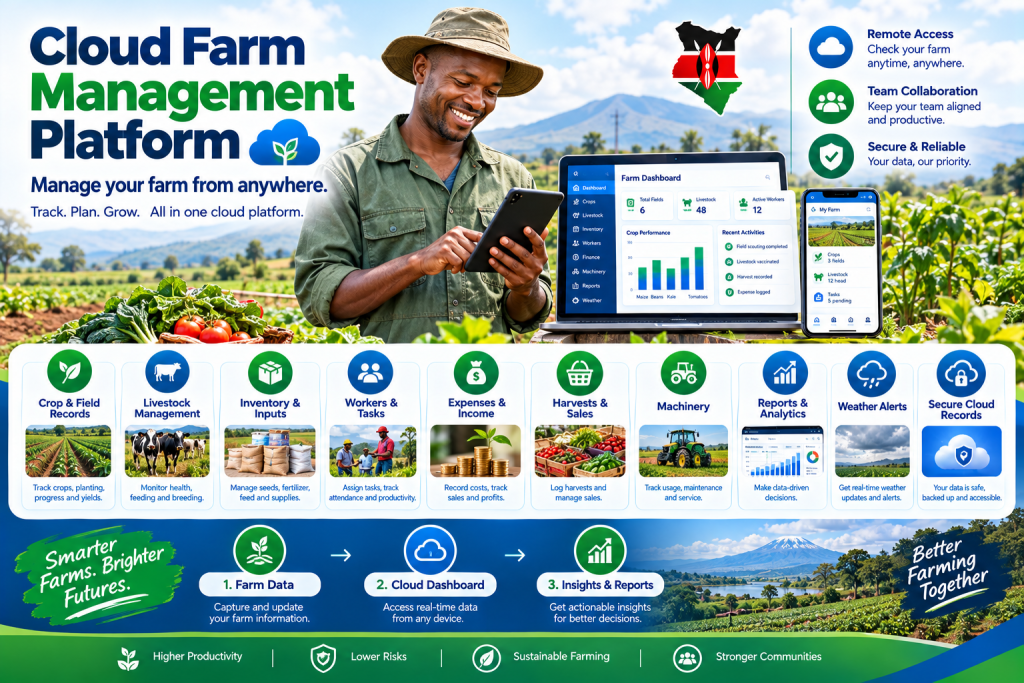
A cloud farm management platform has quietly become the operating system of modern agriculture, replacing the notebooks, spreadsheets, and memory-based management that held farms back for generations.
On a cloud platform, every record a farm produces — planting dates, livestock treatments, input purchases, worker activities, sales, and finances — lives securely online, accessible within seconds from any phone, tablet, or computer, anywhere in the world.
The shift matters because farming has become a data business: the difference between a profitable season and a struggling one is increasingly decided by who can see their numbers clearly and act on them first.
This guide explains everything about adopting a cloud farm management platform: what it actually is, how it differs from the desktop software and paper systems of the past, which features genuinely matter, what it costs, how to implement one without disrupting operations, and how to choose well among the options on the market.
Whether you manage five acres or five thousand, employ two workers or two hundred, or simply want to stop losing money to forgotten records and untracked expenses, understanding the modern cloud farm management platform is the first step toward running your farm as the business it truly is.
What Exactly Is a Cloud Farm Management Platform?
A cloud farm management platform is software hosted on remote servers and delivered over the internet, rather than installed on a single office computer. The farm’s data — every record, photo, receipt, and report — is stored in professionally managed data centres and synced continuously across every device the farm uses.
This architecture means the platform is never tied to one machine: a farm manager logs activities from a phone in the field, the owner reviews the dashboard from a laptop in town, and an accountant pulls financial reports from another continent, all working from the same live, identical dataset.
Accessing a cloud farm management platform works exactly like accessing email or mobile banking: open an app or a browser, log in, and the entire farm is there.
There is nothing to install, nothing to update manually, and nothing to back up yourself — the provider handles all of it invisibly.
When the software improves, improvements appear for everyone automatically; when a device is lost or damaged, the data survives untouched and simply logs in from the replacement.
Functionally, a full-featured cloud farm management platform bundles the essential modules of farm administration into one connected system: field and crop records, livestock registers, inventory and input tracking, financial accounts, task and labour management, harvest logs, and reporting dashboards.
Because the modules share one database, entering data once makes it flow everywhere — a purchase of fertiliser simultaneously updates inventory, the expense ledger, and the cost record of the field where it was used.
The clearest way to understand the value is to contrast it with what it replaces. Paper records cannot be searched, summed, or shared; spreadsheets live on one device, break silently, and die with the person who built them; and memory-based management collapses entirely as farms grow beyond one person’s attention.
A cloud farm management platform solves all three failures at once — records become searchable, centralised, and permanent, which is why the transition to cloud tools now resembles what happened when businesses moved from paper ledgers to accounting software a generation ago.
Why Farms Are Abandoning Paper and Spreadsheets
The first force driving the shift is growth itself. Every farm that expands past the founder’s personal attention span hits the same wall: too many fields, animals, workers, and transactions to track mentally, and the cracks begin costing real money — inputs used but never recorded, sales collected but never banked, treatments given but never repeated on schedule.
This is the point at which serious operators adopt a cloud farm management platform, because the alternative is hiring supervision to compensate for missing records, which costs more every month than the software ever will.
The second force is distance. Modern farm ownership rarely matches farm location: owners live in cities or abroad while operations run rurally, and the old solutions — weekly visits, verbal reports, and trust — leak money on every trip not made.
A cloud farm management platform closes that distance permanently, giving the owner the same live view of the farm from a thousand kilometres away as from the farmhouse veranda, with photographs and timestamps replacing assurances.
The third force is finance. Banks, investors, insurers, and buyers have all raised their documentation standards, and loans, premiums, and contracts now flow toward farms that can produce credible records on demand.
A farm running on a cloud farm management platform can generate production histories, profit-and-loss statements, and traceability reports in minutes — while a farm running on paper spends weeks reconstructing what it can, and often simply fails the assessment.
The fourth force is a quieter one: continuity. Farms are multi-decade, often multi-generational enterprises, and the knowledge in any owner’s or manager’s head is an asset that walks out the gate whenever they do.
Farms that have institutionalised their operations inside a cloud farm management platform own their history permanently — every lesson, every cost, every yield pattern survives staff changes and generational handovers intact, which is a form of wealth most farms never capture.
Core Features Every Good Platform Should Include
Farm and Crop Records
The foundation module captures everything that happens on the land: plots and their histories, planting dates and varieties, input applications with quantities, irrigation events, scouting observations, and harvests with weights and grades.
A well-structured cloud farm management platform makes each entry taggable to a specific plot, date, worker, and crop, so the question “what exactly happened on block three last season?” has a precise, instant answer instead of a recollection.
Livestock Management
For animal operations, the platform should track every animal individually or every batch as a unit: births, purchases, weights, treatments, vaccinations, breeding records, feed consumption, mortality, and production — milk litres, egg counts, or weight gain.
The best implementations of livestock modules in a cloud farm management platform add automatic alerts for due vaccinations, expected calving or farrowing dates, and withdrawal periods before sale, turning the calendar from a mental burden into an automated safety net.
Inventory and Input Control
Seed, fertiliser, chemicals, feed, fuel, and spare parts are where farm money quietly leaks. A proper inventory module inside a cloud farm management platform records every stock purchase and every issuance to a field, animal group, or worker, keeping balances live and exposing wastage and pilferage immediately rather than at the end of the season when the money is already gone.
Financial Tracking
Income and expenses should be recorded against enterprises — dairy, maize, poultry, horticulture — so the platform can answer the question every farm owner eventually asks: which venture actually makes money? A capable cloud farm management platform produces per-enterprise profit and loss, cash-flow views, and receivables tracking, and exports clean reports that satisfy banks, accountants, and tax authorities without a separate bookkeeping effort.
Tasks, Labour, and Team Management
Work on a farm is a schedule, and the platform should treat it that way: tasks assigned to workers with deadlines, completion confirmed from the field with photos and timestamps, and labour hours accumulating against the cost of the field or enterprise they served.
Farms that run their daily operations through the task module of a cloud farm management platform report the fastest supervision gains of any feature — because work that is assigned and confirmed digitally no longer depends on the owner standing over it.
Dashboards and Reports
The final feature is the one that turns records into decisions: live dashboards showing stock levels, cash position, production trends, and alerts, plus one-click reports for any period, enterprise, or plot.
The reporting layer is where a cloud farm management platform repays every minute of data entry — because the reports most farms need at the bank, at the board meeting, or at the buyer’s office are the reports it generates without anyone rebuilding a spreadsheet.
The Major Benefits of Moving to the Cloud
Your Farm in Your Pocket, Everywhere
The defining benefit is access: the complete, current picture of the farm available from any location with a connection. Owners travelling, managers rotating between sites, and investors monitoring from abroad all work from the same live data through a cloud farm management platform — a capability that changes management behaviour profoundly, because decisions stop waiting for physical presence.
Decisions Made on Today’s Data, Not Last Season’s Guesses
Traditional farm management reconstructs reality weeks after it happens; cloud tools present it as it happens. When feed stocks, input costs, milk yields, and sales are visible daily through a cloud farm management platform, problems get caught while they are cheap — a dipping yield, a draining store, an unpaid invoice — rather than discovered at season’s end when they are history.
One Source of Truth for the Whole Team
Miscommunication between owners, managers, agronomists, and workers is one of the largest hidden costs in agriculture, and it disappears when everyone works from one system.
A cloud farm management platform with role-based permissions gives each person exactly the view and tools their role requires, while the underlying data stays unified — so the owner sees everything, the manager sees operations, and the worker sees only today’s tasks.
Lower Cost Than Traditional Software
Desktop farm software of the past carried heavy licence fees, installation contracts, upgrade charges, and IT support requirements. The subscription model of a modern cloud farm management platform inverts that economics: modest monthly or annual fees, no installation, no upgrade costs, no server to maintain — with the total cost of ownership typically a fraction of what the previous generation of software demanded.
Security That No Office Computer Can Match
Farm data stored on one laptop faces theft, crash, fire, and failure with no recourse; the same data in a professionally managed cloud environment carries encryption, redundancy, and automatic backups as standard.
For most farms, moving records into a cloud farm management platform is the single largest upgrade in data security they will ever make — because the provider’s data centre protects information better than any farm office realistically can.
Scales With the Farm, Effortlessly
A paper system works for five acres and collapses at fifty; most software buckles when a farm adds a second site. A cloud platform simply grows: new fields, new animals, new workers, and new locations are added as entries, not as infrastructure projects.
Farms that begin with a cloud farm management platform early scale without a system change later — which is precisely the habit that separates smoothly expanding agricultural businesses from those that outgrow their records every two years.
Who Needs a Cloud Farm Management Platform?
Smallholder and Small Commercial Farmers
At small scale, the platform’s job is discipline and clarity: one place for costs, activities, and reminders, replacing the scatter of notebooks and mental notes.
A smallholder running a cloud farm management platform from a single phone gains the cost-per-crate and profit-per-plot visibility that was once available only to large estates — and that visibility is what converts subsistence habits into commercial results.
Commercial Farms and Estates
At commercial scale, the platform becomes the coordination layer for teams: multiple managers, dozens of workers, several enterprises, and constant reporting obligations.
Operations of this size adopt a cloud farm management platform primarily for control and accountability — every input issued, task assigned, and harvest weighed is attributed, timestamped, and visible, which is what allows a large farm to run on systems rather than on the owner’s permanent presence.
Cooperatives and Aggregation Groups
Cooperatives managing member deliveries, input loans, and shared equipment need transparency above all, because distrust is what tears groups apart.
A shared cloud farm management platform gives every stakeholder visibility of volumes, payments, and balances in real time, and the groups that digitise their records this way consistently report fewer disputes, faster audits, and stronger credit access.
Investors, Lenders, and Absentee Owners
Anyone with capital in a farm they do not personally operate needs credible, current information — and periodic verbal reports are no longer acceptable to professional capital.
Farms reporting through a cloud farm management platform give their investors and lenders live dashboards and auditable histories, which is why more financing agreements now include platform reporting as a condition of the loan.
Farm Managers, Agronomists, and Consultants
Service professionals advising multiple farms multiply their effectiveness with cloud tools: every client’s records, histories, and alerts available in one login, with recommendations grounded in data rather than impressions.
Consultants who run their client portfolios through a cloud farm management platform deliver measurably better advice — and the farms they serve retain them longer, because the advice is demonstrably working in the numbers.
Cloud Platform vs Desktop Software: An Honest Comparison
The traditional alternative — software installed on a farm office computer — still exists, and it is worth understanding exactly where each model wins.
Desktop software can work without any internet connection and, once bought, belongs to the purchaser indefinitely; for a farm with permanently reliable power, one location, one user, and no reporting obligations, it can technically suffice.
But those conditions describe almost no real farm, which is why the market has shifted decisively toward the cloud farm management platform model in under a decade.
The comparison becomes one-sided wherever the realities of agriculture intrude. Field data needs to be captured in the field, not transcribed later at the office; owners need visibility from wherever they are; teams need simultaneous access; and hardware fails in farm environments with depressing regularity.
Every one of these realities is a strength of the cloud farm management platform and a weakness of the desktop installation — and the offline capability now built into quality cloud apps has eliminated the last genuine desktop advantage.
Total cost seals the argument. Desktop software prices hide in upgrade cycles, single-machine licences, backup routines, and the eventual crash that ends the data’s life; cloud pricing is transparent, maintenance-free, and protected by professional infrastructure.
Over a five-year horizon, the honest ledger shows the cloud farm management platform cheaper in nearly every scenario — before counting the value of the mobile access and live reporting the desktop model simply cannot offer.
There is one final, decisive difference: longevity of the asset. Desktop data lives and dies with the machine and the person maintaining it; cloud data outlives devices, staff, and even the software provider if export tools are used properly.
A farm’s records represent decades of accumulated intelligence, and entrusting them to a cloud farm management platform with proper export guarantees is the only arrangement in which that intelligence reliably survives the decades it is meant to serve.
How to Choose the Right Platform for Your Farm
Ease of Use Decides Everything
The most sophisticated platform is worthless if the people who must feed it find it tedious. Before choosing, run a real trial: hand the app to the person who will actually use it daily — often a field supervisor, not the owner — and watch whether a full day’s logging feels natural or like a chore.
The platforms that succeed long-term as a cloud farm management platform are consistently the ones designed for thumbs, short attention windows, and real field conditions, not for software reviewers.
Offline Capability Is Non-Negotiable
Rural connectivity is improving everywhere but remains unreliable in exactly the places farms operate. The correct standard is an app that records fully offline — entries, photos, and tasks — and syncs automatically when a signal returns.
A cloud farm management platform without genuine offline mode will bleed records silently every time the network drops, so test this specific capability in the field before committing, not in the demonstration video.
Local Relevance and Support
Software is a service, and service is judged after the sale: when something breaks, when a question arises, when a feature is needed.
Choose a cloud farm management platform backed by support that understands your region’s crops, payment systems, languages, and working hours — because a help desk in another timezone, answering in another context, turns every small problem into a week of waiting.
Fit and Flexibility for Your Enterprise
Farms are diverse, and rigid software forces its structure onto operations that do not fit it. The right cloud farm management platform flexes to your mix — dairy and horticulture, crops and livestock, one site or several — either through configurable templates or modules you activate as needed.
During evaluation, walk through your three most common daily activities in the system and confirm each can be recorded the way your farm actually works.
Transparent Pricing and Data Ownership
Read the two documents most buyers skip: the pricing page and the data terms. Pricing should be published, predictable, and tiered sensibly by scale; data terms should state plainly that the farm owns its data, that it is exportable in usable formats at any time, and that it is not sold or monetised. A cloud farm management platform that is unclear on either point is telling you something — and the farms that heeded that signal early avoided the lock-in problems that trapped an earlier generation of software buyers.
Implementing a Platform Without Disrupting Operations
Step 1: Audit What You Currently Track
Begin with an honest inventory of every record the farm keeps today — notebooks, receipts, spreadsheets, WhatsApp messages, mental notes — and decide what the new system must capture from day one.
This audit prevents the most common implementation failure: importing chaos into the cloud. A cloud farm management platform rewards farms that define their processes first and configure the software second, and the audit is where that definition happens.
Step 2: Start With Core Modules, Not Everything
Launch with the modules that deliver immediate, visible value — records, inventory, and finances — and defer advanced features until the basics are habitual.
Farms that attempt to activate every module in week one overwhelm their teams and abandon the effort in month two; farms that phase their cloud farm management platform rollout build momentum through early wins, and momentum is what carries adoption through the uncomfortable first weeks.
Step 3: Train the Team on Real Work
Training succeeds when it happens on the farm’s actual tasks — logging today’s real activities, issuing today’s real inputs — rather than on demonstration examples. Schedule hands-on sessions for every user, keep them short and practical, and review the first week’s entries together daily.
The teams that embrace a cloud farm management platform fastest are the ones whose training respected their intelligence and their time; the ones that resist were usually handed a manual instead of a purpose.
Step 4: Review, Correct, and Expand
After the first full production cycle, sit down with the reports: find the data gaps, the mislabelled entries, the unused features, and fix the process — not just the data.
A well-implemented cloud farm management platform is a living system that improves each season it runs, and the quarterly review habit is what turns it from a record-keeping tool into a genuine management instrument over the years.
Integrations: Connecting Your Platform to the Wider Digital Farm
Weather Data and Advisories
The most valuable integration for most farms is weather: location-specific forecasts, rain records, and growing-degree information flowing directly into the platform’s planning views.
When a cloud farm management platform layers weather history over yield records, patterns emerge that no manual analysis would find — which fields lose most in dry spells, which planting windows have paid best — and the planning that follows is simply better.
Sensors and IoT Devices
Soil moisture probes, weather stations, water-level sensors, and cold-chain loggers increasingly feed their readings straight into farm software, turning dashboards from manually updated summaries into live instruments. Every year, more of these devices arrive on the market speaking standard protocols, and the platforms that accept their data turn a cloud farm management platform into the central nervous system of an increasingly instrumented farm.
Drones, Satellite Imagery, and Remote Sensing
Aerial and satellite imagery — crop health maps, stress detection, acreage verification — is becoming a standard input into serious farm management, and the workflow that matters is integration: images and indices landing inside the same system as the field records they explain.
A farm whose cloud farm management platform displays imagery alongside its planting and input history can connect what it sees from above with what it did on the ground, which is where remote sensing finally becomes practical rather than decorative.
Payments, Marketplaces, and Accounting
The commercial integrations are where records meet money: mobile money and card payments reconciling automatically against sales, marketplace listings drawing from live stock levels, and accounting exports flowing cleanly to accountants and banks.
A cloud farm management platform connected at this level does not just record the business — it participates in it, shortening the path from sale to cash and from records to credit.
Costs, Pricing, and the Return on Investment
How Platforms Are Priced
Most platforms price by subscription — monthly or annual — with tiers based on farm size, number of users, or modules activated; entry tiers for small farms are typically modest, while enterprise tiers with advanced features and support scale upward.
Some providers charge per user, some per acre, some per site, so the comparison that matters is total annual cost at your actual size.
When evaluating any cloud farm management platform, model the price for the farm you will be in two years, not the farm you are today, because migration costs later exceed any subscription difference now.
The Hidden Costs to Ask About
Beyond the subscription, ask what else the total bill includes: onboarding and data migration fees, training charges, support tiers, SMS notification costs, and hardware requirements for field use.
Reputable providers of a cloud farm management platform answer all of these plainly; the ones that do not are deferring the costs into your experience rather than their pricing. A clear total-cost picture before signing is worth more than any headline discount.
The Return: Where the Money Actually Comes Back
The returns arrive through four channels, and it is worth naming each. Waste reduction: inventory and input tracking typically recover several percent of input spending that was previously leaking.
Loss prevention: timely alerts — vaccinations, reorders, payment due dates — prevent the individual failures that each cost multiples of a year’s subscription. Price capture: records support better negotiating with buyers and lenders. And time: the hours once spent reconstructing figures for reports are hours returned to actual management.
Every credible deployment of a cloud farm management platform pays for itself through at least two of these channels within the first production cycle.
The Payback Timeline in Practice
For most commercial farms, the honest payback window is one to two seasons: the first cycle proves the visibility, the second converts it into changed decisions, and the changed decisions show up in the margin.
The farmers who report the fastest payback from their cloud farm management platform are consistently those who entered data seriously from week one — because the software only returns what the records feed it, and half-used platforms return half-valued insight.
The Cost of Not Having Records
Finally, weigh the alternative honestly. Farms without systems pay continuously: in pilferage that cannot be traced, in financing declined for missing histories, in the broker margins accepted because better buyers could not be documented for, and in the manager’s knowledge that walks away.
When the true cost of the status quo is totalled, the subscription fee of a cloud farm management platform is revealed as the smaller number — often by a wide margin — and the only real question becomes how quickly the transition can be done well.
Data Security, Privacy, and Ownership: What to Verify
How Your Data Is Actually Protected
Professional cloud agriculture platforms protect data with encryption in transit and at rest, redundant storage across multiple locations, automatic backups, and access controls far stronger than any farm office achieves on its own.
Still, verify rather than assume: ask any cloud farm management platform provider directly about their encryption standards, backup frequency, and data-centre locations, and treat a vague answer as the red flag it is.
Who Owns the Data — and Can You Leave?
The ownership question is the one that decides long-term safety: the farm’s records must belong to the farm, exportable in standard formats at any time, not held hostage by proprietary formats or exit fees.
Before committing to a cloud farm management platform, run the exit test — request a sample data export and check it opens and reads sensibly — because the ability to leave is the strongest guarantee you will never be mistreated by the provider you stay with.
Privacy, Permissions, and Access Control
Within the farm, security means precision: the worker who logs feed deliveries has no reason to see the owner’s financial dashboards, and the accountant needs the books without the agronomy details.
Role-based permissions in a quality cloud farm management platform enforce these boundaries automatically, and reviewing permissions quarterly is a small habit that keeps the system both trusted by staff and safe from accidents.
Practical Risks and Sensible Defences
The realistic risks are mundane: weak passwords shared among staff, departing employees whose access was never revoked, and devices left logged in.
The defences are equally mundane and equally effective — individual logins, two-factor authentication for administrators, prompt access revocation, and device screen locks. A cloud farm management platform secured by these basics is, in practice, safer than any paper system ever was, because paper had no passwords at all.
The Future of Cloud Farm Management
Artificial Intelligence Moves From Promise to Practice
The next leap is already arriving: machine-learning models trained on farm records that predict yields, forecast disease pressure, recommend optimal planting windows, and flag anomalies before humans notice them.
Farms feeding quality data into a cloud farm management platform today are, without extra effort, building the training sets that will make these predictions accurate for their specific soil, climate, and practices — early data discipline is quite literally tomorrow’s advantage.
Offline-First Design and Edge Computing
Connectivity independence is deepening: the newest generation of farm apps records, calculates, and even advises entirely offline, syncing opportunistically when networks allow.
This offline-first architecture means a cloud farm management platform will function fully in the remotest conditions, and the distinction between “cloud” and “offline” software will effectively disappear — leaving farms with the best of both models permanently.
The Platform Becomes an Ecosystem
The end-state already visible on the horizon is the platform as marketplace and gateway: financing offered against verified records, insurance priced from actual farm data, buyers matched to certified produce, and input suppliers integrated into inventory reordering.
The farms whose histories live inside a cloud farm management platform will be first in every one of these queues — because in an ecosystem built on data, the farms with the best data get the best terms, and that advantage compounds every season it is maintained.
Common Implementation Mistakes to Avoid
Buying More System Than the Farm Needs
The overbuying error is seductive because it feels like ambition: activating every module, tracking every conceivable metric, and building dashboards nobody reads. The result is data entry burden without decision value, and teams quietly rebel.
The disciplined path is choosing a cloud farm management platform for the decisions it will actually change this season, and expanding only when a genuine new decision appears — the system should chase the farm’s needs, never the reverse.
Winning the Software, Losing the Team
The implementation killer is not technical but human: software imposed without explanation, training rushed, and the people closest to the data left feeling surveilled rather than supported. Adoption succeeds when workers understand what the records are for, see problems solved through them, and feel the system is theirs.
The owners who succeed with a cloud farm management platform treat rollout as leadership work — communicating purpose, celebrating early wins, and correcting gently — while the ones who fail treat it as an IT purchase and discover that in agriculture, the technology was never the hard part.
Frequently Asked Questions
Do I need reliable internet to use a cloud farm management platform?
No — quality platforms are built offline-first for exactly this reality: entries, photos, and tasks are recorded on the device and sync automatically whenever a connection appears.
Before committing, test the offline behaviour of the cloud farm management platform you are evaluating in a genuine no-signal area, because a platform that merely claims offline support and one that truly records offline are very different products in daily use.
How much does a cloud farm management platform cost?
Small-farm tiers typically run on modest monthly subscriptions, mid-sized commercial operations pay more as users and modules grow, and enterprise deployments are custom-priced — with the honest comparison being total annual cost at your real scale, including onboarding, training, and support.
Model the price for where your farm will be in two years, and treat any cloud farm management platform whose total costs cannot be stated plainly before signing as one that plans to find its revenue in your experience instead.