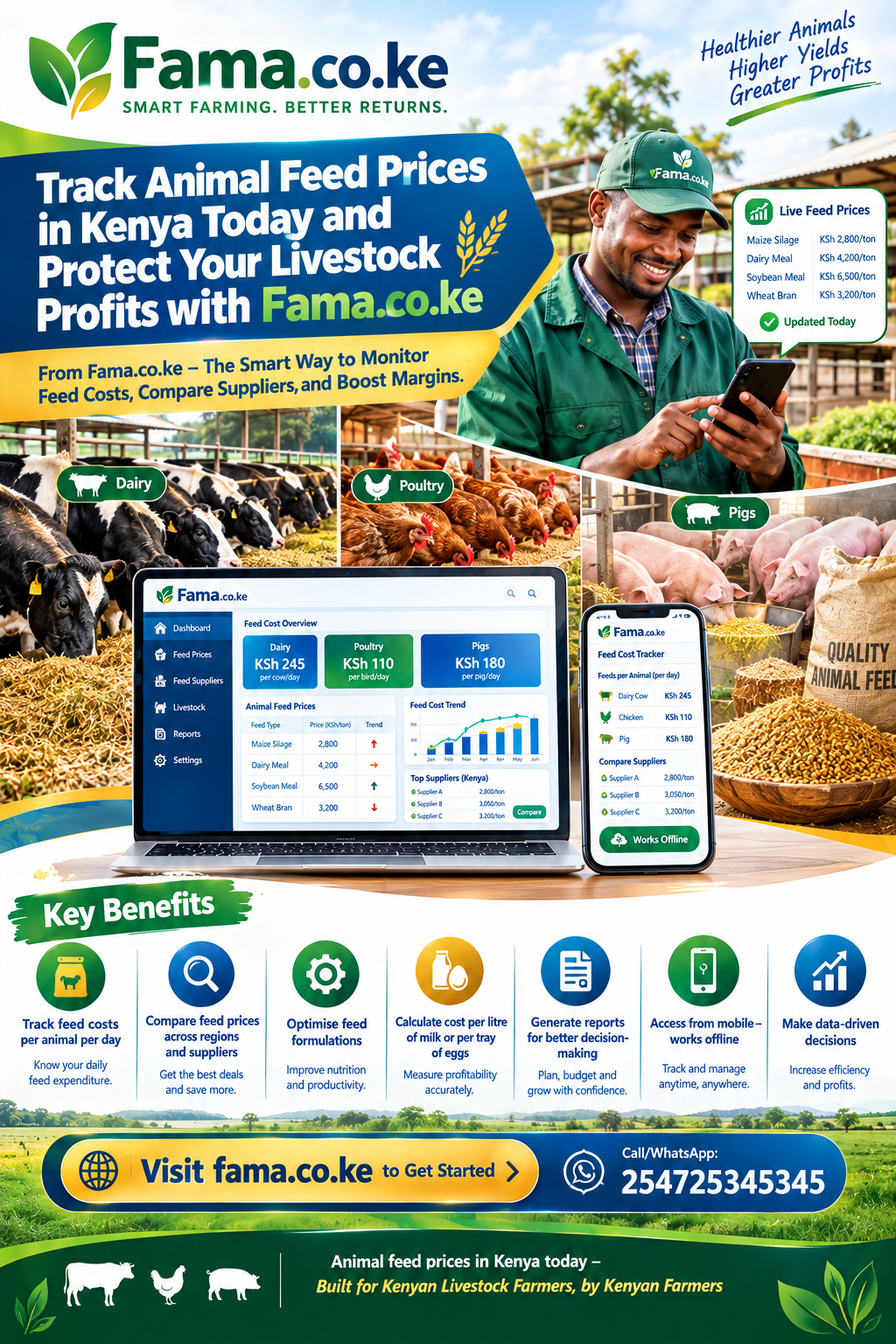
Animal feed prices in Kenya today have become the single most critical cost variable determining whether livestock farmers remain profitable or are forced to abandon production altogether. Fama.co.ke provides an innovative farm management platform that helps farmers track animal feed prices in Kenya today, monitor feed consumption, and make data-driven decisions that protect margins. The Kenya animal feed subsector is a troubled one, with feed prices on an unabated upward trajectory and a finger-pointing contest between feed producers, the Association of Kenya Feed Manufacturers (AKEFEMA), and farmers, leaving the customer to pay the ultimate price. Animal feeds have gone up by between 50 and 94 percent since 2014, an unprecedented rise that has locked hundreds of thousands of farmers out of feeds which are key in complementing dwindling pasture. Understanding animal feed prices in Kenya today has never been more important for dairy, poultry, and pig farmers seeking to keep their enterprises viable.
The current landscape of animal feed prices in Kenya today reflects a complex interplay of maize shortages, new taxes, and a weakening shilling that has pushed feed costs to historic levels. According to animal feed retailers, the price of feed is scheduled for a price hike as maize prices—the main component in most animal feeds—have increased from Sh2,800 for a 90kg bag two months ago to Sh3,300. This rise has been driven by a shortage of maize in the country and a recently introduced cess on grains delivered to Nairobi, where most millers are headquartered, by the Kenya Revenue Authority that took effect on 1st March. Further, the government has imposed a 15% tax on rice bran, another key component in animal feeds imported into the country from neighbouring Uganda and Tanzania. These compounding factors have pushed animal feed prices in Kenya today higher across all categories.
Understanding animal feed prices in Kenya today requires awareness of the sharp variations across different feed types and regions. At the moment, Layers mash goes for Sh3,150 for a 70-kilogramme bag, Kienyeji mash retails at Sh1,800 per 70 kilogramme, and chick mash goes for Sh3,300 for a 70-kilogramme sack, which has been more than triple the price they retailed at four years ago. A 70-kilogram bag of layer mash is currently selling for between Sh4,000 and Sh5,000 across various parts of the country, up from Sh3,800 in April. These figures demonstrate the scale of the challenge facing farmers as they navigate animal feed prices in Kenya today.
The root cause of elevated animal feed prices in Kenya today is the acute shortage of raw materials. Maize constitutes up to 30 per cent of dairy meal, 70 per cent in poultry ration, and close to 50 per cent of pig feed, making it the most important component of any animal feed ration. Cottonseed cake is up 70 per cent to Sh60 a kilogram, Soya now sells for Sh120 compared to Sh70 in March last year. Sunflower cake has also had a double-digit price hike to Sh35 compared to Sh25. A 40-kilogram bag of wheat bran will now set you back Sh1,000—a Sh200 price rise from last year. These raw material costs directly determine animal feed prices in Kenya today at the retail level.
For dairy farmers specifically, animal feed prices in Kenya today have created a cost crisis that is becoming increasingly difficult to absorb. In Trans Nzoia, prolonged drought has damaged maize and fodder supplies, forcing dairy farmers to buy increasingly expensive feed while milk production falls. Dairy meal prices have risen from about Sh2,500 to around Sh3,000 per bag, while farmers are simultaneously dealing with lower-quality fodder. Feed and other expenses can consume up to 80 per cent of farm income, leaving little room for reinvestment, veterinary care, or expansion. The Kenya Dairy Board has estimated the cost of producing a litre of milk at between Sh30 and Sh37, while farmers continue to face rising animal feed prices in Kenya today.
The poultry sector has been hit hardest by animal feed prices in Kenya today. Chicken feed prices have risen by at least 37 per cent in the last four years according to a new report by the Competition Authority of Kenya, driving farmers to make their own feeds. This has led to the price of chicken feed in Kenya being almost double that in South Africa and Brazil. A 50kg bag of layers mash has more than doubled from Sh1,850 to Sh4,200 in the last five years, while egg prices have stagnated at Sh280–300 per tray. This has squeezed the profit margins for farmers. Today more and more farmers are opting to make their own meals, leaving feed companies battling with waning sales. In the last three years alone, 30 feed makers have gone out of business and with them over 1,000 jobs have been lost.
The competition issue is central to animal feed prices in Kenya today. Kenya imports most of its soybean meal and sunflower cake and some of its maize for making chicken feed from Tanzania, Uganda, Malawi, and Zambia. These imports are controlled by four large companies leading to higher prices because they own the entire feed-making process. They import, mill, and make chicken feed. According to the Competition Authority of Kenya, if the country had a more open and competitive feed-making market it would save farmers over three billion shillings every year. These savings on the cost of feed would have meant lower egg and poultry prices and created more jobs boosting the economy. This structural market concentration directly impacts animal feed prices in Kenya today.
The government has intervened to cushion farmers from soaring animal feed prices in Kenya today through the Food Systems Resilience Programme, which supplies subsidized fodder at Ksh250 per bale and silage at Ksh270 per unit, with the government covering the remaining cost. The programme is increasingly viewed as a long-term investment rather than short-term relief, designed to mitigate livestock losses where forage is depleted. The Ministry of Agriculture and Livestock Development has restructured the subsidy into a revolving fund model, shifting from one-off emergency grants to a sustainable, market-oriented approach. The government has also approved duty-free imports of yellow maize and is considering additional measures to ease the milk shortage linked to inadequate pasture and high animal feed prices in Kenya today.
Current Animal Feed Prices in Kenya Today by Category
Understanding animal feed prices in Kenya today requires examining the specific costs across different feed categories, as each livestock sector faces distinct pricing pressures.
Dairy Meal Prices
Dairy meal prices have risen from about Sh2,500 to around Sh3,000 per bag, with a 70kg bag of dairy meal retailing at roughly KSh3,400, against KSh2,500 in August 2022. This 36 per cent increase over four years has squeezed farmers who respond by milking less and selling herd. A 70kg bag of dairy meal is currently retailing at Sh2,300 from some suppliers, though prices vary by brand and region. The cost of producing a litre of milk at between Sh30 and Sh37 means that dairy meal prices in Kenya today directly determine whether milk production remains viable.
Poultry Feed Prices
A 70-kilogram bag of layer mash is currently selling for between Sh4,000 and Sh5,000, up from Sh3,800 in April. Layers mash goes for Sh3,150 for a 70-kilogramme bag from some retailers, while chick mash goes for Sh3,300 for a 70-kilogramme sack. A 70-kilogram bag of growers mash now sells for Sh4,800, a 50-kilogram bag of starter crumbs costs Sh4,600, and layers mash has crossed Sh3,900 for a 50-kilogram bag. These prices represent more than triple what they were four years ago, making poultry feed prices in Kenya today the single largest obstacle to profitable egg and chicken production.
Pig Feed Prices
Pig feed prices have also surged, with a 70-kilogram bag of pig mash now retailing for Sh2,400 compared to last year. For pigs, sow and weaner feed costs Sh2,500 and lactator Sh2,800 from some suppliers. The cost of pig feed has increased from Sh2,800 to Sh3,400 per 70kg bag, which has increased the cost of production over the last year. These rising pig feed prices in Kenya today are forcing some farmers to reduce herd sizes or abandon production entirely.
Kienyeji and Indigenous Poultry Feed
Kienyeji mash retails at Sh1,800 per 70 kilogramme, significantly cheaper than commercial layer or broiler feeds. This price differential reflects the simpler formulation required for indigenous breeds and makes kienyeji production more accessible to smallholders. However, even kienyeji feed prices in Kenya today have risen substantially, with maize husks sold at Sh1,500 per 50-kilogramme sack and omena averaging Sh50 per kilogramme in most markets.
Factors Driving Animal Feed Prices in Kenya Today
Maize Shortages and Raw Material Scarcity
The most significant factor affecting animal feed prices in Kenya today is the acute shortage of maize and other raw materials. Since January 2025, the price of maize—which accounts for nearly 40% of standard feed composition—has skyrocketed by 45%. A 90kg bag of maize has doubled from last year’s price, now costing Sh5,500 to Sh6,000 for human consumption. Since feed manufacturers compete directly with human consumption for maize and other raw materials, when maize production falls, households need grain for food, millers compete for supplies, and livestock producers face higher feed costs.
New Taxes and Cess on Raw Materials
Government taxation policies have directly contributed to rising animal feed prices in Kenya today. A recently introduced cess on grains delivered to Nairobi by the Kenya Revenue Authority has increased costs for millers. The government has also imposed a 15% tax on rice bran imported from neighbouring Uganda and Tanzania. While a Finance Bill 2026 proposal to exempt raw materials used in manufacturing animal feeds from VAT could reduce costs if passed, current tax policies continue to elevate animal feed prices in Kenya today.
Currency Depreciation and Import Costs
The weakening Kenyan shilling against the dollar has made imported raw materials significantly more expensive. Kenyan feed manufacturers who rely on imported raw materials have had to pay steeper prices for imports as the shilling continues to weaken. The strengthening of the global trade currency has seen traders having to part with a quoted price of Sh119.99 per dollar—a 10.4 per cent increase from this time last year. Premix micronutrients providing required nutritional value are sourced from outside Africa, and traders are sourcing soya as far out as Zambia. These import dependencies make animal feed prices in Kenya today highly sensitive to currency fluctuations.
Energy and Electricity Costs
Rising energy costs have directly impacted animal feed prices in Kenya today. The Energy and Petroleum Regulatory Authority increased electricity prices by 15.7 percent, and the slashing of state subsidy has seen fuel prices surge to a historic Sh179.30 per litre—up 20 shillings. These overhead costs are passed on to farmers through higher animal feed prices in Kenya today. Industry players blame the rise on an acute shortage of raw materials, high import duty, and prohibitive cost of energy.
Structural Market Concentration
The concentration of feed imports and manufacturing among four large companies has reduced competition and inflated animal feed prices in Kenya today. These companies own the entire feed-making process—they import, mill, and make chicken feed. The Competition Authority of Kenya has noted that a more open and competitive feed-making market would save farmers over three billion shillings every year. This structural issue means that animal feed prices in Kenya today are higher than they would be in a competitive market.
Impact of Animal Feed Prices in Kenya Today on Different Sectors
Dairy Sector Impact
The dairy industry is confronting a cost crisis that is becoming increasingly difficult for farmers to absorb. Formal milk deliveries to processors fell 3.7 per cent from 84.4 million litres in June to 81.3 million litres in July 2026, with government officials attributing the decline largely to prolonged dry conditions and pressure on pasture and animal feed. One farmer with 23 dairy cows has seen production decline from more than 700 litres a day to about 460 litres after prolonged drought destroyed much of its maize crop. Another farmer reports that milk production from six cows had fallen from about 180 litres daily to roughly 80 litres as drought reduced both the quantity and quality of Napier grass and maize.
Poultry Sector Impact
The poultry sector is the largest consumer of livestock feeds, accounting for 56 per cent of national feed production. AKEFEMA Chairman Joseph Karuri noted that feed accounts for more than 70 percent of egg production costs, meaning that rising animal feed prices in Kenya today directly threaten the sustainability of poultry farming. The price of poultry eggs across key retail markets in Nairobi has surged by up to 20 per cent over the past month amid rising feed costs and stronger seasonal demand. Farm gate prices are currently averaging Sh400 per tray and Sh450 at market price. A tray of eggs currently retails for between Sh400-500, and feed manufacturers and egg wholesalers say these prices will be held at least until grain from Kenya’s maize basket, Rift Valley, comes into the pipeline in October.
Pig Sector Impact
Pig farmers are facing a dual crisis of rising animal feed prices in Kenya today and disease outbreaks. One farmer reported losing tens of piglets because of a swine fever outbreak, with the cost of pig feed increasing from Sh2,800 to Sh3,400 per 70kg bag, which has increased the cost of production over the last year. These compounding pressures are forcing some pig farmers to exit the sector entirely.
How Fama.co.ke Helps Farmers Navigate Animal Feed Prices in Kenya Today
Track Feed Costs Against Production Revenue
Fama.co.ke helps farmers calculate the true cost of feeding their livestock, enabling them to determine whether current animal feed prices in Kenya today allow profitable production. By tracking feed costs per animal per day against milk, egg, or meat revenue, farmers can make informed decisions about feeding strategies and herd management.
Monitor Market Trends and Supplier Prices
The platform provides tools to track animal feed prices in Kenya today across different regions and suppliers, helping farmers identify the most cost-effective sources for their feed requirements. Farmers can compare prices across counties and feed types, and plan purchases strategically.
Optimise Feed Formulation and Usage
Fama.co.ke helps farmers explore alternative feeding strategies, including homemade feed formulations that can cut feed costs significantly. Farmers are opting for black soldier fly larvae, azolla, duckweed, omena, or homemade feed formulations which cut down the need for expensive feeds by up to 75 per cent. The platform tracks the performance of different feed formulations and helps farmers identify which deliver the best returns at current animal feed prices in Kenya today.
Generate Financial Reports and Feed Budgets
The platform generates reports that show feed costs per unit of production, helping farmers understand which feeding strategies deliver the best returns relative to animal feed prices in Kenya today. With proper record-keeping, farmers can identify cost-saving opportunities and improve margins even when feed prices are volatile.
The Outlook for Animal Feed Prices in Kenya Today
The outlook for animal feed prices in Kenya today remains challenging but with some potential for relief. From October, significant maize supplies are expected to soften feed prices and in turn egg prices, as grain from Kenya’s maize basket, Rift Valley, comes into the pipeline. However, Kenya still remains a net importer of most constituents crucial to feed formation, meaning that structural pressures on animal feed prices in Kenya today will persist.
The government’s push for contracted yellow maize farming by local farmers aims to arrest the growing cost of animal feeds and mitigate the cost of importing the grain. The global scarcity and high cost of imported yellow maize—the critical material in animal feed mix—has seen half of small-scale millers shut their businesses and major processors operate at half capacity. The state’s open window for import of duty-free yellow maize has seen millers have difficulties in purchasing the required 99.1 per cent GMO-free yellow maize. KALRO has developed a drought-resistant variety of yellow maize seed for distribution to farmers, which could reduce reliance on imports over time.
The Association of Kenya Feed Manufacturers estimates that Kenya requires about 55 million metric tonnes of animal feed annually but produces only around 40 per cent of that requirement. Closing this gap through increased domestic production of feed ingredients is essential to moderating animal feed prices in Kenya today. Researchers at KALRO are already promoting drought-tolerant maize varieties, including Ukamez, designed to mature earlier and withstand increasingly unpredictable weather.
Farmers using Fama.co.ke to track animal feed prices in Kenya today and manage their feed costs will be best positioned to navigate this uncertainty. By understanding their break-even point and monitoring market trends, they can make informed decisions that protect profitability regardless of market conditions.
Animal feed prices in Kenya today are influenced by maize shortages, new taxes, currency depreciation, energy costs, and structural market concentration. For farmers seeking to maximise profitability, proper record-keeping and market intelligence are essential. Fama.co.ke provides the tools needed to track feed costs, monitor market trends, and make data-driven decisions that protect profitability.
Kenyan farmers who use Fama.co.ke to track animal feed prices in Kenya today position themselves for greater success in the evolving livestock sector. The platform helps farmers make better decisions, reduce losses, and achieve higher returns.
Fama.co.ke has developed farm management software that meets the unique needs of Kenyan livestock farmers. The platform combines powerful features with intuitive design, making it accessible for farmers of all sizes.
Start your journey with Fama.co.ke today. Visit fama.co.ke to learn more about how farm management software can help you track animal feed prices in Kenya today and optimise your livestock operations.
Frequently Asked Questions About Animal Feed Prices in Kenya Today
What is the current price of dairy meal in Kenya?
Dairy meal prices have risen from about Sh2,500 to around Sh3,000 per bag, with a 70kg bag retailing at roughly KSh3,400, against KSh2,500 in August 2022. Prices vary by brand and region, with some suppliers offering 70kg bags at Sh2,300.
Why are animal feed prices so high in Kenya today?
Animal feed prices are high due to maize shortages, new taxes including a cess on grains delivered to Nairobi and a 15% tax on imported rice bran, currency depreciation making imports expensive, rising electricity and fuel costs, and market concentration among four large companies controlling feed imports and manufacturing.
What is the price of layer mash in Kenya?
A 70-kilogram bag of layer mash is currently selling for between Sh4,000 and Sh5,000, up from Sh3,800 in April. A 50kg bag of layers mash has more than doubled from Sh1,850 to Sh4,200 in the last five years.
How can farmers reduce feed costs in Kenya?
Farmers can reduce feed costs by making their own homemade feed formulations, using alternatives like black soldier fly larvae, azolla, duckweed, and omena, which cut the need for expensive feeds by up to 75 per cent. The government is also supplying subsidized fodder at Ksh250 per bale.
What is the price of pig feed in Kenya?
A 70-kilogram bag of pig mash now retails for Sh2,400 compared to last year. For pigs, sow and weaner feed costs Sh2,500 and lactator Sh2,800. The cost of pig feed has increased from Sh2,800 to Sh3,400 per 70kg bag in some regions.