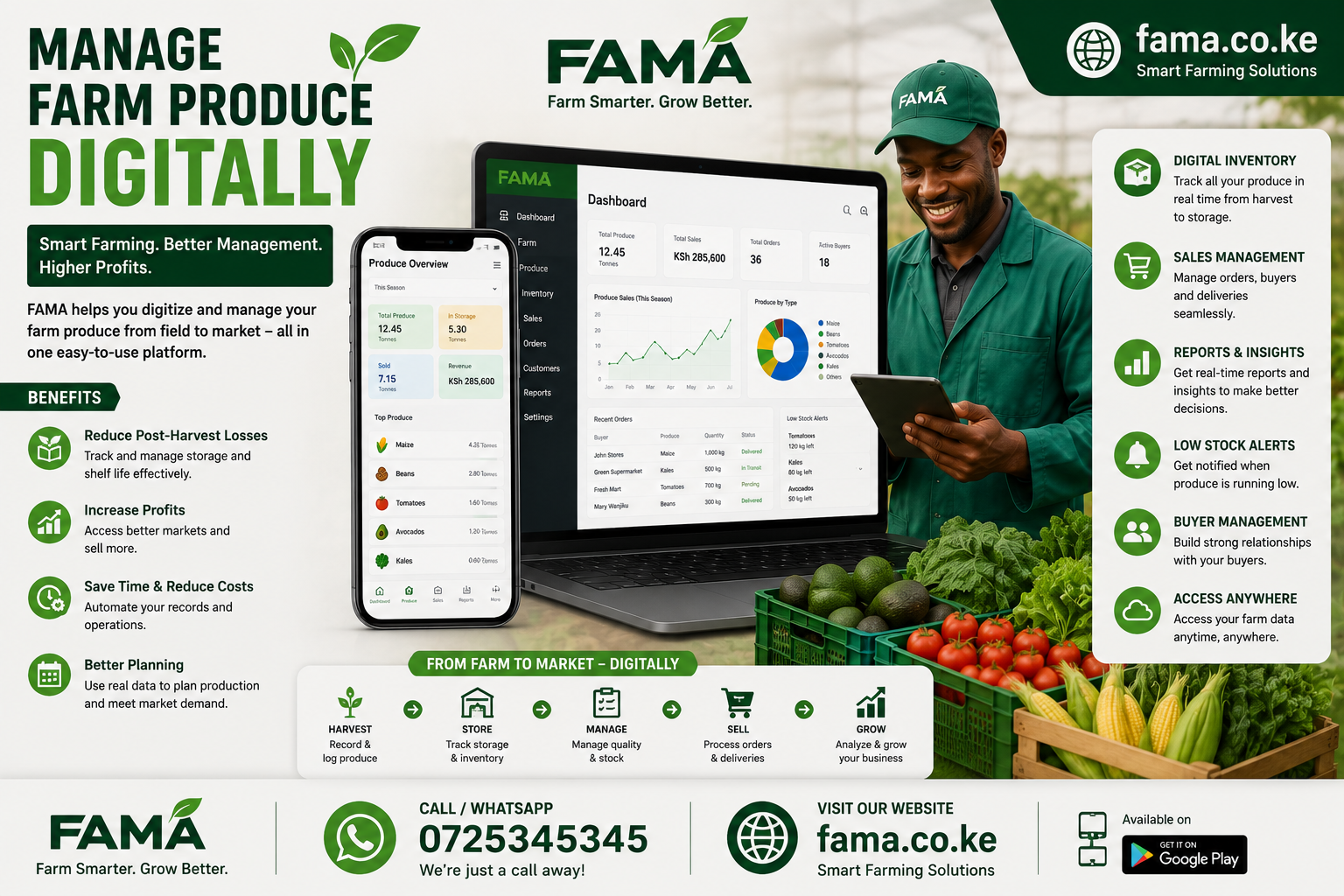
Modern agriculture requires more than planting, harvesting, and selling. Farmers need accurate information about production, inventory, labour, expenses, sales, buyers, and available produce. When these records are scattered across notebooks, spreadsheets, receipts, and mobile messages, it becomes difficult to understand what is happening across the farm.
Manage farm produce digitally can provide a structured approach to organizing agricultural information. Instead of depending entirely on handwritten records, farm owners and managers can create a central system where important activities are recorded consistently.
For Kenyan farms, this approach can be particularly useful when operations involve several fields, workers, suppliers, crops, storage points, buyers, and farming periods. A centralized system makes it easier to follow produce from production through storage and eventual sale while connecting operational activity with financial information.
FAMA provides a farm-management workspace covering crop and livestock records, inputs, stock, machinery, labour, harvests, production, sales, accounting, and reporting.
Manage farm produce digitally: Why Digital Produce Records Matter
Agricultural produce represents both physical stock and financial value. A farm may have vegetables ready for collection, harvested maize in storage, milk awaiting collection, eggs available for sale, or livestock prepared for a buyer. Without organized records, management may struggle to determine exactly what is available.
Manage farm produce digitally by connecting production information with inventory and sales records. This creates a clearer picture of quantities produced, quantities sold, remaining stock, and related income.
Digital records also reduce dependence on memory. When a manager needs information about a previous harvest, the relevant details can be retrieved from the system rather than reconstructed from several documents.
This becomes increasingly important as a farm grows. More land, workers, crops, buyers, and production cycles create more information. A structured digital environment gives every activity a recognizable place within the overall operation.
Manage farm produce digitally: Connecting Harvests With Farm Operations
Harvesting is not an isolated activity. It is the result of land preparation, planting, input application, labour, machinery, irrigation, crop care, and other activities. Understanding the final harvest therefore requires access to the records surrounding production.
Manage farm produce digitally by connecting harvest information with earlier farm activities. A manager can review what was planted, where it was planted, which inputs were used, and what quantities were eventually harvested.
This creates a more useful historical record for future planning. If a particular farming period performed better than another, management can investigate the activities behind that outcome.
FAMA provides harvest and production functionality alongside fields, leases, inputs, machinery, staff, sales, and accounting records, allowing farm information to exist within a connected workspace.
Manage farm produce digitally: Improving Produce Inventory Control
Once produce leaves the field, inventory management becomes critical. Farmers need to know what has been harvested, where it is stored, how much remains available, and what quantities have already been committed or sold.
Manage farm produce digitally by maintaining structured stock information. Instead of treating harvest quantities as isolated numbers, farmers can connect available produce with sales and inventory activity.
This is especially valuable for farms handling multiple products. A mixed farm may have vegetables, grains, eggs, milk, livestock, fruits, or other products moving through different channels.
Accurate inventory records help management identify shortages, excess stock, slow-moving products, and opportunities for timely sales. They can also make conversations with buyers more precise because available quantities are based on recorded information rather than estimates.
Manage farm produce digitally: Reducing Dependence on Paper Records
Paper records remain common on farms because they are familiar and inexpensive to start with. However, paper becomes difficult to manage when records multiply. A farm may have separate books for inputs, harvests, workers, sales, expenses, stock, machinery, and suppliers.
Manage farm produce digitally by moving important information into a centralized application. The goal is not simply to eliminate paper. It is to make information easier to organize, retrieve, compare, and use.
FAMA describes its farm-management system as a central workspace for crop and livestock records, inputs, stock, machinery, labour, salaries, harvests, production, sales, and accounting.
When records are centralized, managers spend less time searching for information and more time interpreting it. This can improve the speed at which farm decisions are made.
Manage farm produce digitally: Tracking Produce From Field to Market
The journey from production to market contains several stages. Produce may be harvested, graded, weighed, stored, transported, delivered, invoiced, and finally paid for. Losing visibility at any stage can create reconciliation problems.
Manage farm produce digitally by creating a consistent record of these activities. The farm can maintain information about quantities and sales while connecting financial transactions with operational records.
This approach makes it easier to compare what was harvested against what was eventually sold. If there is a difference, management can investigate whether the variance resulted from spoilage, internal consumption, wastage, stock adjustments, or incomplete sales records.
The resulting information can support stronger accountability throughout the produce chain and help the farm understand where value is being lost.
Manage farm produce digitally: Supporting Better Harvest Planning
Harvest planning becomes easier when previous production information is readily available. Historical records can reveal patterns involving crop quantities, farming periods, input usage, labour requirements, and sales.
Manage farm produce digitally by making previous records accessible when planning upcoming activities. Rather than relying only on assumptions, managers can review actual farm history.
For example, previous harvest records can help identify which periods produced higher quantities. Sales records can reveal which products generated stronger revenue. Input records can help managers understand the resources associated with different production activities.
FAMA’s platform includes farming periods, harvests, production, inputs, sales, and reporting, creating a foundation for reviewing operational information over time.
Manage farm produce digitally: Managing Produce Quantities More Accurately
Quantity errors can affect both operations and finances. Recording that a farm harvested 500 kilograms when the actual quantity was 450 kilograms can distort inventory, sales expectations, and profitability calculations.
Manage farm produce digitally by establishing consistent procedures for recording quantities. Staff should know who records harvests, when measurements are taken, what units are used, and how adjustments are documented.
Consistency is particularly important where different products use different measurement methods. One product might be measured in kilograms, another in crates, another in litres, and livestock may be recorded by head or group.
A well-organized system helps maintain clearer records and reduces ambiguity when information is reviewed later.
Manage farm produce digitally: Connecting Produce With Buyers
A successful harvest only becomes commercially valuable when produce reaches an appropriate market. Buyer records therefore form an important part of agricultural management.
Manage farm produce digitally by linking produce information with sales activity. Farmers can have a clearer understanding of which products were sold, the quantities involved, and the financial value associated with transactions.
Buyer information can also support follow-up activities. When records are organized, a farm can distinguish between completed sales, outstanding transactions, regular customers, and new buyers.
This creates a more professional approach to agricultural commerce. Instead of treating each sale as an isolated event, the farm can build a historical record that supports future business decisions.
Manage farm produce digitally: Monitoring Produce Sales
Sales represent one of the most important stages of the agricultural cycle because they convert produce into revenue. However, sales records need to be connected with production and inventory information.
Manage farm produce digitally by comparing harvested quantities with quantities sold and remaining stock. This can give management a more complete view of the commercial performance of each farming period.
FAMA includes sales, buyers, harvests, accounting, income, expenses, and reports within its farm-management environment.
When sales and production information are reviewed together, managers can investigate whether revenue matches expectations and identify unusual differences between physical produce and recorded transactions.
Manage farm produce digitally: Controlling Produce Wastage
Produce can lose value because of spoilage, poor storage, delayed transportation, damage, overproduction, or weak market coordination. Although technology cannot eliminate every source of loss, better records can make problems more visible.
Manage farm produce digitally by recording harvested quantities and subsequent stock movements. If the farm repeatedly experiences differences between harvested and sold quantities, management can investigate the pattern.
Digital records can also support better timing. If a farm knows how much produce is available and which buyers are interested, it can coordinate sales more effectively.
For perishable crops, visibility is particularly valuable because delays can reduce commercial value quickly. The objective is to turn information into action before preventable losses become significant.
Manage farm produce digitally: Improving Farm Cost Visibility
Produce management should not focus only on quantities. Farmers also need to understand how much it costs to produce and sell those quantities.
Manage farm produce digitally by connecting operational records with expenses. Input purchases, labour, machinery, fuel, repairs, and other costs can influence the eventual profitability of agricultural products.
FAMA’s accounting functionality supports income, expenses, cashbook entries, profit-and-loss reporting, and related farm records.
This gives managers an opportunity to move beyond simply asking how much was harvested. They can also ask what resources were consumed and whether the resulting sales generated an acceptable financial outcome.
Such information can guide decisions about future production.
Manage farm produce digitally: Using FAMA for Centralized Farm Records
FAMA is designed around the idea of keeping farm records in one accountable workspace. Its published platform covers crops, livestock, inputs, stock, machinery, labour, salaries, harvests, production, sales, and accounting.
Manage farm produce digitally by using a centralized environment where farm teams can record information as activities happen.
The system also provides role-based access for different farm responsibilities. Owners, managers, accountants, store keepers, and supervisors can work with information relevant to their roles.
This structure can improve accountability because responsibilities are not concentrated entirely in one person’s notebook or spreadsheet. Instead, the farm can establish a repeatable record-keeping process.
Manage farm produce digitally: Giving Farm Managers Faster Information
Farm managers frequently need answers quickly. They may need to know how much stock remains, which inputs are available, what has been harvested, which workers were involved, or how much has been sold.
Manage farm produce digitally by making relevant information available from a central workspace. This reduces the need to contact several people before basic operational questions can be answered.
Faster access to information does not automatically produce better decisions, but it gives managers a stronger foundation for making them.
FAMA’s published workflow describes a process in which teams record activities, balances and totals are updated, and management can review reports.
That workflow can make daily farm administration more structured.
Manage farm produce digitally: Managing Farm Produce Across Multiple Fields
Large or expanding farms may have several fields with different crops, farming periods, or ownership arrangements. Treating all production as one undifferentiated figure can make management difficult.
Manage farm produce digitally by keeping field and farming-period information organized. Managers can then evaluate production according to the area or activity responsible for it.
FAMA supports owned fields, rented leases, crops, farming periods, inputs, harvests, and reports.
This makes it possible to structure records around the way the farm actually operates. A manager can distinguish activities associated with different areas instead of combining everything into one general farm record.
Such organization becomes increasingly valuable as agricultural operations become more complex.
Manage farm produce digitally: Strengthening Produce Accountability
Accountability is essential whenever multiple people handle agricultural products. Workers may harvest, store keepers may receive produce, drivers may transport it, and sales staff may deliver it to buyers.
Manage farm produce digitally by assigning responsibility to specific activities and keeping consistent records.
When a quantity changes, management should be able to determine why. A stock reduction may result from a sale, spoilage, transfer, internal use, or correction. Without a record, the difference may simply appear as unexplained loss.
A structured system creates a stronger culture of accountability. Employees understand that activities are recorded, while managers gain better visibility into how produce moves through the farm business.
Manage farm produce digitally: Coordinating Farm Labour
Labour contributes directly to production. Workers prepare land, plant crops, apply inputs, harvest produce, sort products, clean facilities, feed livestock, and perform many other tasks.
Manage farm produce digitally by connecting labour information with operational activities. This can help management understand where labour resources are being used.
FAMA supports staff records, attendance, salaries, advances, allowances, casual labour, and related payroll information.
When labour and production information are organized together, managers can better understand the human resources associated with different activities. This can support future scheduling and cost analysis.
It also reduces reliance on separate notebooks for employee administration and farm operations.
Manage farm produce digitally: Connecting Inputs to Produce
Seeds, fertilizer, feed, chemicals, packaging materials, and other inputs represent important farm resources. Knowing what was purchased is useful, but knowing where those resources were used is even more valuable.
Manage farm produce digitally by connecting input purchases and usage with farm operations. Managers can review quantities purchased, stock remaining, and resources consumed.
FAMA specifically supports input purchases, supplier details, stock balances, and usage records.
This creates a stronger connection between expenditure and production. When a farming period ends, the farm can review both the resources consumed and the produce generated.
Such information can improve budgeting and future purchasing decisions.
Manage farm produce digitally: Making Farm Reporting More Useful
Reports are valuable when they answer practical questions. A farm manager may want to know production levels, stock value, expenses, sales, labour costs, or profitability for a particular period.
Manage farm produce digitally by ensuring that daily records eventually contribute to meaningful reports.
FAMA provides printable and exportable reports and includes management information covering farm operations, stock, labour, harvests, production, sales, and financial activity.
This is important because reporting should not become a separate administrative project. Ideally, information recorded during normal farm activities should form the foundation of later reporting.
The result is a more continuous relationship between daily work and management oversight.
Manage farm produce digitally: Supporting Farm Profitability Analysis
Revenue alone does not demonstrate profitability. A farm can generate substantial sales while still facing high input, labour, machinery, lease, transport, or operating costs.
Manage farm produce digitally by bringing production, sales, income, and expenses into a connected management process.
FAMA’s accounting functionality includes income, expenses, cashbook entries, profit-and-loss information, and farm reporting.
This allows management to ask deeper questions about agricultural performance. Which activities generated the strongest returns? Which expenses increased? Which farming periods were more efficient? Which products deserve greater attention?
Reliable answers depend on reliable records, making organized data a core part of financial management.
Manage farm produce digitally: Improving Stock Reconciliation
Stock reconciliation compares recorded inventory with actual physical quantities. Differences may indicate spoilage, unrecorded sales, incorrect measurements, damage, internal use, or recording mistakes.
Manage farm produce digitally by making stock movements easier to document. Every significant change should have an identifiable reason.
For a farm dealing with high-value or fast-moving produce, frequent reconciliation can prevent small errors from becoming major losses.
Digital records also make reconciliation easier to review. Management can investigate historical movements rather than relying solely on a current physical count.
This encourages stronger inventory discipline throughout the farm operation.
Manage farm produce digitally: Helping Owners Monitor Farms Remotely
Farm owners are not always physically present on the farm. Some live in another town, manage multiple properties, travel frequently, or delegate daily responsibilities to farm managers.
Manage farm produce digitally by maintaining centralized records that can be reviewed without requiring the owner to inspect every physical notebook.
A digital management environment can provide greater visibility into operations, provided that staff enter accurate information.
This can be especially useful for absentee owners who need to monitor production, stock, expenses, sales, and other activities through structured reports.
The objective is not to replace physical farm supervision. Instead, digital records complement physical oversight by providing an information trail.
Manage farm produce digitally: Creating Consistent Farm Workflows
Digital transformation works best when it changes processes rather than simply replacing paper with screens. Farms need clear procedures for who records purchases, who issues stock, who records harvests, who confirms sales, and who reviews reports.
Manage farm produce digitally by defining these responsibilities clearly.
FAMA supports different roles, including farm owners, farm managers, accountants, store keepers, and supervisors.
This role-based structure can help farms distribute responsibilities without losing central visibility.
Once workflows become consistent, new employees can also learn procedures more easily because the farm has a defined way of recording activities.
Manage farm produce digitally: Supporting Poultry and Livestock Produce
Digital produce management is not limited to crop farms. Livestock and poultry operations also generate valuable production records.
Manage farm produce digitally by recording animal groups, production, feed usage, sales, buyers, and related financial activities.
FAMA supports livestock and poultry operations, including animals, groups, health work, production, buyers, sales, feed stock, egg production, and related records.
For poultry businesses, daily egg production can become an important commercial indicator. For livestock operations, production and sales information can help management understand performance across different groups.
The same digital principles therefore apply across multiple agricultural business models.
Manage farm produce digitally: Managing Farm Produce During Peak Seasons
Peak seasons can dramatically increase the amount of information a farm needs to handle. Harvest quantities rise, temporary workers may be added, storage activity increases, buyers become more active, and transportation requirements may grow.
Manage farm produce digitally by preparing records before peak activity begins.
A farm should establish product lists, units, fields, staff responsibilities, buyers, storage procedures, and sales workflows ahead of time. This reduces confusion when activity becomes intense.
Digital records can then capture transactions as they occur rather than waiting until the season ends.
FAMA’s daily workflow is designed around recording activities and using those records for calculations and reports.
Manage farm produce digitally: Making Agricultural Data Easier to Retrieve
The value of a record increases when it can be retrieved at the right time. Farmers may need information from last season when planning the next crop or responding to a buyer.
Manage farm produce digitally by keeping historical information organized within the farm workspace.
Instead of searching through physical files, managers can use structured records to locate relevant operational information.
Historical information can support comparisons between farming periods, suppliers, products, fields, workers, and sales activity.
This turns farm data into an operational asset rather than a collection of old records that are rarely used.
Manage farm produce digitally: Supporting Smarter Farm Decisions
Good agricultural decisions depend on understanding what has already happened. Planting decisions, purchasing decisions, labour allocation, machinery use, and sales strategies can all benefit from reliable historical information.
Manage farm produce digitally by giving decision-makers a clearer information base.
For example, a manager can compare production against costs, examine inventory levels before purchasing more inputs, or review sales history before negotiating with buyers.
Digital systems do not replace agricultural experience. Instead, they complement experience with organized evidence.
The combination of practical farming knowledge and accurate operational records can produce stronger decision-making than relying on memory alone.
Manage farm produce digitally: Connecting Farm Accounting With Production
Agricultural accounting becomes more useful when financial records are connected with actual farm activities. Expenses should have operational meaning, while sales should be connected with the products that generated revenue.
Manage farm produce digitally by connecting operational and financial records in one environment.
FAMA describes its system as bringing farm operations and financial records into one structured platform. Its accounting features include income, expenses, cashbook entries, payroll, profit-and-loss reporting, and exports.
This helps reduce the distance between the farm office and financial management.
Managers can therefore evaluate agricultural activities not only by physical output but also by financial performance.
Manage farm produce digitally: Building a Reliable Digital Farm Routine
Technology delivers the most value when it becomes part of everyday farm work. Recording information only at the end of the month creates opportunities for forgotten transactions and inaccurate estimates.
Manage farm produce digitally by encouraging teams to record activities as they happen.
A purchase should be entered when received. Stock should be updated when issued. Labour activity should be recorded according to the farm’s procedure. Harvests should be recorded after measurement. Sales should be documented when completed.
This routine creates cleaner information over time.
FAMA’s published workflow specifically describes recording activities first, followed by calculations and reporting.
Manage farm produce digitally: Improving Farm Management Transparency
Transparency becomes increasingly important when a farm has several people involved in operations. Owners need visibility, managers need accurate information, accountants need financial records, and store keepers need inventory data.
Manage farm produce digitally by giving different responsibilities a structured place within the same farm environment.
Role-based access can help ensure that users work according to their assigned responsibilities. FAMA provides role-based access and tenant-isolated farm records as part of its platform design.
This can strengthen internal controls while allowing the farm team to work from shared operational information.
Transparency is particularly useful when ownership and daily management responsibilities are handled by different people.
Manage farm produce digitally: Preparing Farms for Sustainable Growth
Growth increases the complexity of farm administration. A farm that begins with a few fields may eventually add leased land, machinery, livestock, poultry, additional workers, more suppliers, and multiple buyers.
Manage farm produce digitally by establishing organized records before complexity becomes overwhelming.
A scalable record process helps the farm maintain control as operations expand.
FAMA supports multiple operational areas within one workspace, including leases, inputs, machinery, staff, harvests, inventory, livestock, sales, and accounting.
The benefit is not simply having more features. It is having related farm activities organized within a common management structure.
Manage farm produce digitally: Choosing a Practical Digital Agriculture Platform
Farm software should match the actual workflow of the business. A solution that looks impressive but does not support the farm’s daily records may create additional work.
Manage farm produce digitally by selecting a system that addresses practical requirements such as crops, harvests, stock, labour, inputs, sales, accounting, and reporting.
FAMA is positioned as a farm-management system for Kenyan farm teams, with modules covering these operational areas.
Before adopting any system, a farm should identify its current record problems, define who will use the platform, determine which information must be captured, and establish a consistent operating procedure.
The technology should support the farm’s process rather than force the farm into an unsuitable process.
Manage farm produce digitally: Turning Farm Records Into Business Intelligence
The long-term value of agricultural data comes from using it to understand the business. Individual records become more useful when they can be compared across periods.
Manage farm produce digitally by building a history of production, inventory, inputs, expenses, labour, sales, and other activities.
Over time, these records can help reveal recurring patterns. Managers may discover that certain activities require more resources than expected, that specific products perform better commercially, or that particular periods consistently create inventory challenges.
Such insights can influence future planning.
The farm therefore moves from merely recording what happened to using accumulated information as a management resource.
Manage farm produce digitally: Taking the Next Step With FAMA
For farms struggling with scattered records, the first step is to identify the information currently being recorded and where it is stored. The next step is to organize that information into practical categories such as fields, crops, inputs, stock, workers, machinery, harvests, buyers, sales, income, and expenses.
Manage farm produce digitally by moving toward a centralized management workflow.
FAMA offers a farm-management environment designed around these areas, with role-based access, operational records, reporting, and tenant-isolated farm accounts.
Farm owners can explore the FAMA Farm Management System to understand how the platform organizes fields, leases, inputs, machinery, staff, harvests, livestock, accounting, and reporting.
The goal is straightforward: create reliable farm records, make produce easier to track, connect operations with finances, and give decision-makers better information for running a modern agricultural business.