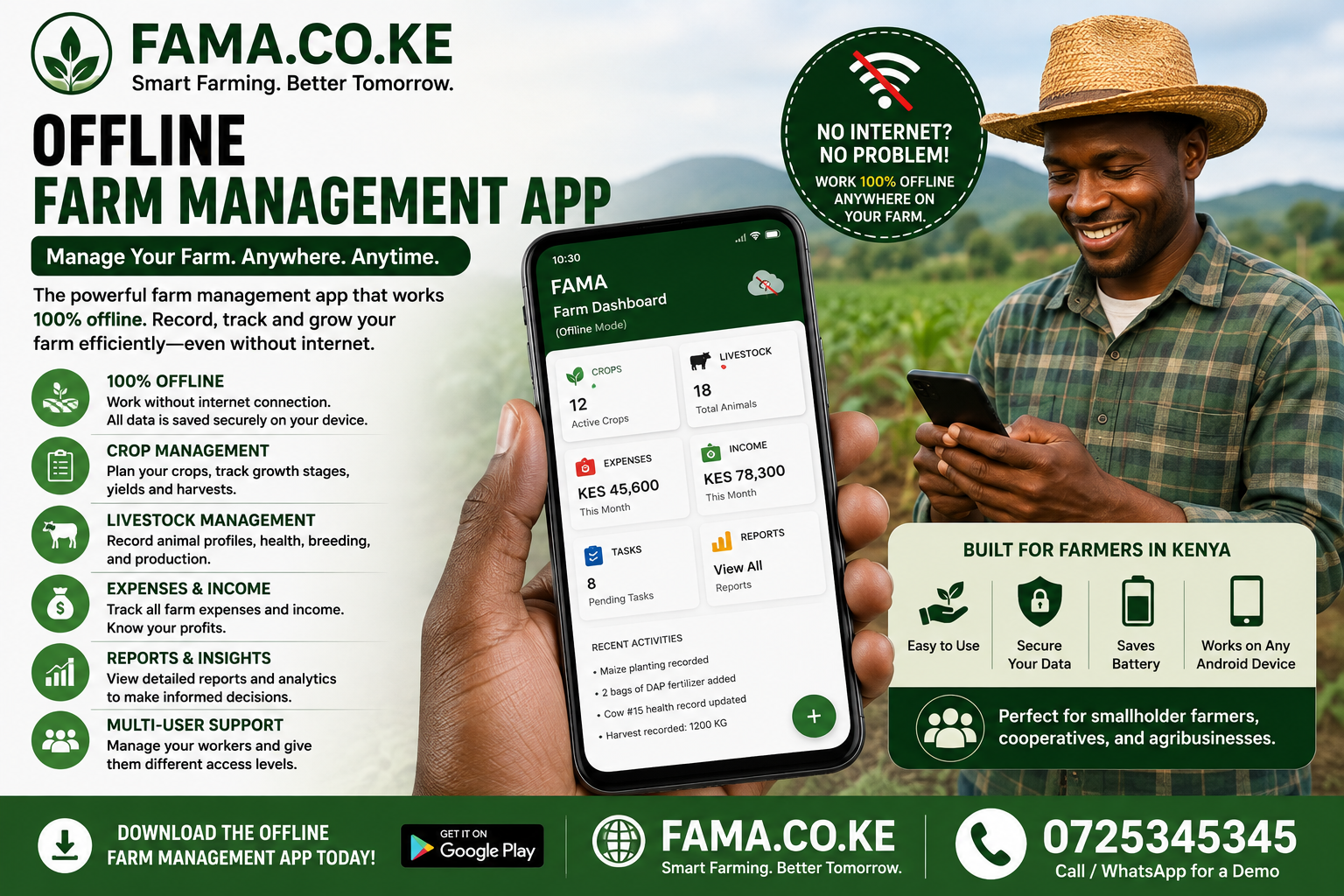
An offline farm management app can help farmers record important farm activities even when reliable internet connectivity is unavailable. Farming does not always happen in areas with strong network coverage, yet farmers still need to record planting, harvesting, expenses, livestock activities, workers, inputs, and production information.
A farm management solution that supports offline data entry can allow farmers and farm managers to continue working without depending on a constant internet connection. Information can be stored on the device and synchronized when connectivity becomes available.
For Kenyan farmers managing small farms, large commercial farms, greenhouses, livestock operations, or multiple agricultural projects, offline functionality can make digital farm recordkeeping more practical.
offline farm management app – What Is an Offline Farm Management App?
An offline farm management app is a digital farming tool designed to allow users to capture and manage farm information even when the device has limited or no internet connectivity.
Instead of stopping farm administration whenever the network disappears, users can continue recording information directly from a phone or tablet.
Depending on the platform, farmers may record:
- Crops planted
- Planting dates
- Harvest quantities
- Farm expenses
- Labour activities
- Farm inputs
- Sales
- Livestock records
- Equipment
- Field activities
- Farm tasks
When internet connectivity becomes available, stored information can be synchronized with the central system where supported.
offline farm management app – Why Offline Functionality Matters in Agriculture
An offline farm management app is useful because agricultural activities often take place away from offices and urban centres.
A farmer may be working in a remote field where mobile internet is unreliable. Waiting for connectivity before recording information can lead to forgotten details or incomplete records.
Offline functionality allows the farmer to capture information when the activity happens.
For example, after harvesting a particular field, a farmer can record the quantity immediately rather than trying to remember the figure later.
Accurate information captured at the right time can improve the quality of farm records.
offline farm management app – Recording Farm Activities Without Internet
An offline farm management app can allow agricultural workers to continue recording daily activities during connectivity interruptions.
Common activities may include:
- Fertilizer application
- Spraying
- Irrigation
- Planting
- Weeding
- Harvesting
- Livestock feeding
- Animal treatment records
- Farm inspections
- Labour assignments
This is particularly useful for farms with several workers who need to capture information from different locations.
Once the device reconnects, the information can be synchronized according to the system’s capabilities.
offline farm management app – Managing Harvest Records
An offline farm management app can simplify the recording of harvest information.
Farmers may need to know how much produce was harvested from individual fields, greenhouses, orchards, or livestock operations.
Records can include:
- Crop name
- Field
- Harvest date
- Quantity
- Unit of measurement
- Quality information
- Destination
- Buyer
- Selling price
Recording these details close to the point of harvest can reduce errors associated with delayed data entry.
offline farm management app – Recording Farm Expenses
An offline farm management app can also help farmers keep track of expenses.
Farm operations may involve spending on:
- Seeds
- Fertilizer
- Pesticides
- Animal feed
- Labour
- Transport
- Equipment
- Irrigation
- Packaging
- Repairs
When expenses are recorded immediately, farm managers can develop a clearer understanding of operational costs.
Over time, these records can help farmers compare expenditure against sales and production.
offline farm management app – Managing Farms in Areas With Poor Connectivity
An offline farm management app can be particularly valuable in agricultural areas where internet availability is inconsistent.
Farmers should not have to abandon digital recordkeeping simply because a connection temporarily becomes unavailable.
Offline capabilities can provide continuity while connectivity services remain useful for synchronization, communication, updates, and other online activities.
For connectivity and technology solutions that may support rural digital operations, SpaceKits is another resource Kenyan businesses can explore.
offline farm management app – Managing Multiple Farm Locations
An offline farm management app can help managers overseeing multiple farms or fields maintain more organized records.
A farming business may operate different plots in different locations, each with separate crops, workers, activities, and production schedules.
Field-level records can help managers understand what is happening at each location.
When information is eventually synchronized, management can have a broader overview of the farming operation.
offline farm management app – Recording Crop Production
An offline farm management app can support crop production records from planting through harvesting.
Farmers can organize information about different production cycles and compare expected output with actual harvests.
Useful records may include:
- Crop variety
- Planting date
- Field size
- Input application
- Expected harvest
- Actual harvest
- Production challenges
This information can help farmers identify patterns and make better plans for future seasons.
offline farm management app – Supporting Farm Workers
An offline farm management app can also help farm managers organize labour activities.
Workers may be assigned tasks such as planting, harvesting, irrigation, spraying, pruning, feeding livestock, or maintaining equipment.
Digital task records can make it easier to determine which activities have been completed and which still require attention.
This can improve coordination, particularly on farms with several workers operating simultaneously.
offline farm management app – Managing Farm Equipment
An offline farm management app can be used to organize information about agricultural equipment.
Farmers may need records for:
- Tractors
- Pumps
- Sprayers
- Irrigation equipment
- Harvesting machines
- Tools
- Storage equipment
Recording maintenance activities and equipment usage can help managers identify machines that require servicing.
Proper equipment records can also help reduce unexpected operational interruptions.
offline farm management app – Working With Mobile Devices
An offline farm management app becomes especially convenient when farmers can use it from smartphones or tablets.
Mobile access means information can be captured directly from fields, greenhouses, livestock areas, warehouses, or collection centres.
The simpler the data-entry process, the more likely workers are to use the system consistently.
A practical interface should minimize unnecessary typing and make frequently used activities easy to record.
offline farm management app – Synchronizing Records When Online
An offline farm management app may store records locally until an internet connection becomes available.
Synchronization can then transfer the information to a central system, depending on the platform’s design.
This approach can provide farmers with the flexibility of offline work while still benefiting from centralized digital records.
Users should understand how synchronization works, particularly when several people are entering information from different devices.
offline farm management app – Improving Farm Record Accuracy
An offline farm management app can improve record accuracy by allowing information to be entered at the time an activity takes place.
Delayed recordkeeping can result in missing dates, incorrect quantities, forgotten expenses, or incomplete activity histories.
Digital forms can also encourage users to provide consistent information.
For example, a system may require a crop, quantity, date, or field before allowing a record to be saved.
offline farm management app – Supporting Smallholder Farmers
An offline farm management app does not have to be limited to large commercial agricultural companies.
Smallholder farmers can also benefit from organized digital records.
A farmer with a few acres can record production, expenses, inputs, sales, and farm activities in one place.
As the farm grows, the same records can provide a useful historical reference for understanding how the business has developed.
offline farm management app – Supporting Greenhouse Operations
An offline farm management app can be useful for greenhouse operators who need detailed records of production cycles.
Greenhouse records may cover:
- Planting
- Seedlings
- Irrigation
- Fertilizer
- Pest control
- Harvesting
- Labour
- Sales
Maintaining these records can help managers compare different greenhouse cycles and identify areas for improvement.
This can be particularly valuable when several greenhouses are producing different crops at the same time.
offline farm management app – Managing Livestock Activities
An offline farm management app can also support livestock farmers.
Records can cover animals, feeding, breeding, health-related activities, production, and sales where applicable.
A farm worker can capture information while working with animals rather than waiting to return to an office.
This can create a more complete history of farm activities.
offline farm management app – Tracking Produce From Farm to Market
An offline farm management app can help connect production records with the movement of produce.
After harvesting, farmers may need to record quantities sent to collection centres, warehouses, processors, or buyers.
Combining farm and sales information can provide a clearer picture of the journey from production to market.
For delivery and logistics-related activities, Dexa can provide complementary digital resources.
offline farm management app – Supporting Agricultural Transport Records
An offline farm management app can help managers organize information related to produce transportation.
Farm businesses may need to coordinate vehicles, drivers, collection points, and delivery destinations.
Recording transportation details can help managers understand logistics costs and delivery patterns.
Where farms require professional drivers for agricultural transport, Dereva provides a relevant driver-focused resource.
offline farm management app – Monitoring Farm Profitability
An offline farm management app can provide information needed to assess farm profitability.
Profitability depends on both income and expenditure.
Farm managers can compare:
Total Sales – Total Farm Costs = Operating Result
Keeping detailed records of expenses and sales makes this calculation more meaningful.
Farmers can identify which crops, activities, or production cycles provide stronger financial results.
offline farm management app – Creating Better Farm Reports
An offline farm management app can turn daily farm records into useful reports when the data is synchronized and processed.
Reports may cover:
- Production
- Expenses
- Sales
- Labour
- Inputs
- Harvests
- Inventory
- Farm activities
These reports can help farm owners understand what is happening without relying entirely on handwritten notebooks.
offline farm management app – Managing Farm Inventory
An offline farm management app can help farmers keep track of agricultural inputs and other inventory.
Inventory may include seeds, fertilizers, pesticides, animal feed, packaging materials, spare parts, and tools.
Knowing what is available can help managers plan purchases and avoid unnecessary shortages.
Records can also help identify items that are being consumed faster than expected.
offline farm management app – Planning Future Farming Activities
An offline farm management app can support planning by providing access to historical records.
Farmers can review previous planting dates, harvest quantities, expenses, labour requirements, and production results.
Historical information can provide useful guidance when preparing for another production cycle.
Instead of relying only on memory, farmers can use previous records as a reference.
offline farm management app – Why Farmers Should Digitize Their Records
An offline farm management app can make the transition from paper-based records to digital management easier.
Traditional notebooks can be useful, but they may become difficult to search as the volume of information increases.
Digital records can provide faster access to information and make it easier to organize activities across different farms.
Farmers should choose a solution that matches their technical skills and operational requirements.
offline farm management app – Managing Farm Business Growth
An offline farm management app can become more valuable as an agricultural business expands.
A farm that starts with one field may eventually have multiple fields, workers, crops, warehouses, vehicles, and customers.
Managing all these activities from disconnected notebooks can become increasingly difficult.
Digital organization provides a foundation for scaling farm operations while keeping important records accessible.
offline farm management app – Choosing the Right Farm Management Solution
An offline farm management app should be evaluated based on the actual needs of the farm.
Before choosing a solution, consider:
- Offline data entry
- Synchronization
- Mobile accessibility
- Farmer records
- Crop management
- Harvest tracking
- Expense recording
- Sales tracking
- Reporting
- User management
- Ease of use
The best system is not necessarily the one with the largest number of features. It should be practical for the people who will use it every day.
offline farm management app – Benefits for Farm Managers
An offline farm management app can give farm managers better visibility into daily operations.
Instead of waiting for workers to submit paper records, managers can work with structured digital information.
This can make it easier to identify incomplete activities, review production figures, monitor expenses, and prepare reports.
Better visibility can support faster decision-making.
offline farm management app – Benefits for Agricultural Cooperatives
An offline farm management app can also support groups of farmers working through cooperatives or agricultural organizations.
Field officers can collect information from farmers even when connectivity is temporarily unavailable.
Information can later be synchronized for centralized analysis.
This can help organizations collect more consistent data across different farms and locations.
offline farm management app – Digital Farming in Kenya
An offline farm management app is part of the broader move toward digital agriculture in Kenya.
Technology can help farmers organize information, monitor production, improve planning, and manage agricultural businesses more efficiently.
However, successful digital adoption depends on more than software. Farmers also need appropriate devices, training, reliable workflows, and support.
A solution should therefore be selected with the realities of the farm environment in mind.
offline farm management app – Frequently Asked Questions
offline farm management app – Can I Use Farm Software Without Internet?
If the selected platform supports offline functionality, users can enter information without an active internet connection. Data can then be synchronized when connectivity becomes available, subject to the software’s capabilities.
offline farm management app – Can Farmers Use It on a Phone?
Many modern farm management platforms are designed with mobile users in mind. A smartphone-based system can make it easier to capture information directly from the farm.
offline farm management app – What Farm Records Can Be Stored?
Depending on the platform, records can include crops, harvests, expenses, inputs, labour, livestock, sales, inventory, and other operational information.
offline farm management app – Why Is Offline Access Important?
Offline access is useful when farmers work in locations where internet connectivity is inconsistent. It allows important information to be captured immediately rather than waiting for a connection.
offline farm management app – Is Digital Farm Management Suitable for Small Farms?
Yes. Small farms can use digital records to organize expenses, production, harvests, and sales. The system can then grow alongside the farm.
offline farm management app – Final Conclusion
An offline farm management app can make digital farm recordkeeping more practical for farmers working in locations where internet connectivity is not always reliable.
By allowing information to be captured during actual farm activities, farmers can maintain more timely records of crops, harvests, expenses, labour, inputs, livestock, equipment, and sales.
The ability to work offline can be particularly valuable for farms operating in rural areas, large agricultural properties, greenhouses, remote fields, and locations with intermittent connectivity.
When connectivity becomes available, synchronization can allow information to move into a centralized system, depending on the platform.
For Kenyan farmers looking to organize agricultural operations digitally, Fama can be explored as a starting point for farm management technology.
offline farm management app – Start Managing Your Farm Digitally
Good farm management begins with accurate information. Whether you manage crops, livestock, greenhouses, multiple farms, or an agricultural cooperative, keeping reliable records can support better planning and decision-making.
Explore Fama for farm management solutions and related Kenyan digital services from Vega, Prim, Dexa, Dereva, Zama, SpaceKits, ZamaCore, KayaPro360, Wito, RentalDesk, Pawa, Zivo, ZES, and Kenya Website Experts.