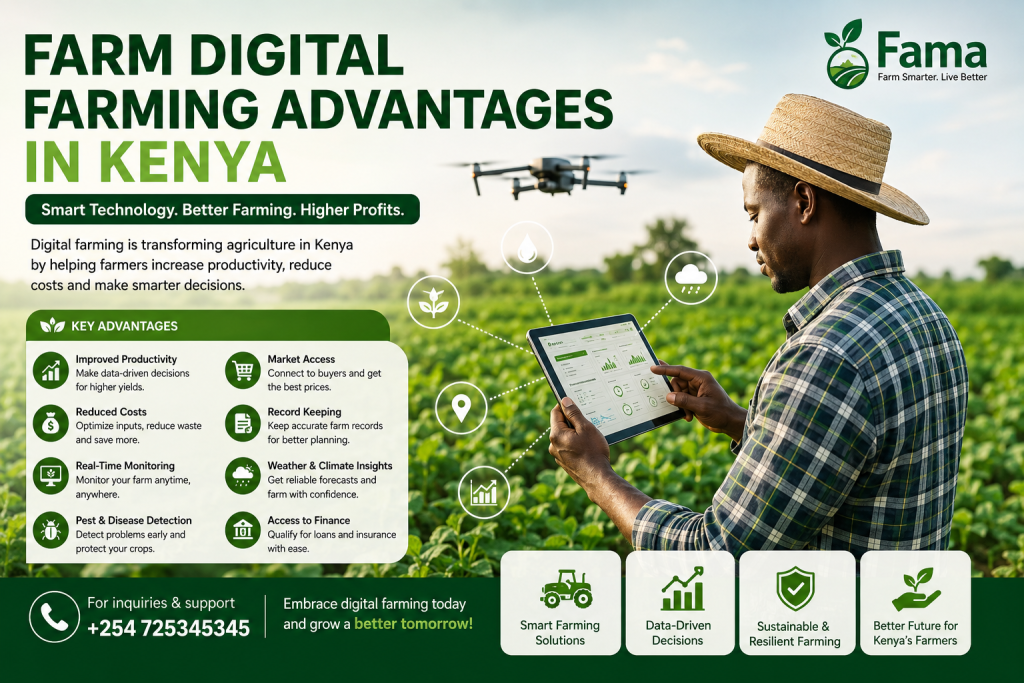
Why Use Farm Software in Kenya?
Agriculture remains the backbone of Kenya’s economy. Millions of farmers across the country depend on farming for income, food security, and employment. However, farming in Kenya is becoming increasingly complex due to changing weather patterns, rising production costs, labor management challenges, pest outbreaks, and the need for better record keeping. This is why many farmers are now turning to farm software in Kenya to improve efficiency, profitability, and decision-making.
Farm software helps farmers manage their operations digitally. Instead of relying on notebooks, memory, or scattered spreadsheets, farmers can use a centralized system to monitor crops, livestock, expenses, sales, workers, inventory, and overall farm performance. Whether you own a small farm, medium-sized agribusiness, dairy farm, poultry farm, horticultural farm, or large commercial enterprise, farm software can transform how you operate.
At Fama.co.ke, we understand the unique challenges facing Kenyan farmers and provide innovative farm management solutions designed specifically for local agricultural needs.
The Growing Need for Farm Software in Kenya
Traditional farming methods have served farmers for decades, but the agricultural sector is changing rapidly. Farmers now need accurate data and timely information to remain competitive.
Some common challenges faced by Kenyan farmers include:
- Poor record keeping
- Difficulty tracking expenses
- Inaccurate production forecasts
- Labor management issues
- Inventory losses
- Crop disease monitoring challenges
- Market price fluctuations
- Financial management difficulties
- Livestock tracking problems
- Compliance and reporting requirements
Using farm software in Kenya helps solve these challenges by providing real-time visibility into farm operations.
What Is Farm Software?
Farm software is a digital platform that helps farmers manage various aspects of agricultural operations. It serves as a centralized system for collecting, organizing, and analyzing farm data.
A comprehensive farm software solution may include:
- Crop management
- Livestock management
- Financial tracking
- Expense management
- Revenue tracking
- Employee management
- Inventory management
- Equipment management
- Farm planning
- Reporting and analytics
- Weather monitoring
- Farm budgeting
- Sales management
By integrating all these functions into one system, farmers gain better control over their operations.
Benefits of Using Farm Software in Kenya
Improved Farm Record Keeping
One of the biggest advantages of farm software in Kenya is accurate record keeping.
Many farmers struggle to maintain reliable records. Information is often stored in notebooks that can get lost, damaged, or become difficult to organize.
Farm software enables farmers to record:
- Crop planting dates
- Harvest dates
- Fertilizer applications
- Pesticide applications
- Livestock treatments
- Feed purchases
- Sales transactions
- Labor expenses
- Equipment maintenance
Having these records available at any time improves transparency and accountability.
Better Financial Management
Profitability depends on understanding farm finances.
Without proper records, farmers often struggle to determine:
- Total production costs
- Actual profits
- Revenue streams
- Cash flow trends
- Return on investment
Farm software automatically tracks financial transactions and generates detailed reports.
Farmers can easily monitor:
- Income
- Expenses
- Debts
- Payments
- Operational costs
- Profit margins
This allows for better budgeting and financial planning.
Enhanced Decision Making
Data-driven decisions are more effective than guesswork.
Farm software in Kenya provides valuable insights into farm performance through dashboards and reports.
Farmers can analyze:
- Crop yields
- Livestock productivity
- Production costs
- Sales trends
- Input usage
- Labor efficiency
These insights help identify opportunities for improvement and growth.
Efficient Crop Management
Crop production requires careful planning and monitoring.
Farm software helps farmers manage:
- Planting schedules
- Irrigation schedules
- Fertilizer applications
- Pest control programs
- Harvest planning
- Yield tracking
This improves productivity and reduces losses.
Improved Livestock Management
Livestock farmers can benefit significantly from farm software.
The system can track:
- Animal identification
- Breeding records
- Vaccination schedules
- Health records
- Milk production
- Feed consumption
- Weight monitoring
- Sales records
This helps farmers maximize animal productivity and maintain healthy herds.
How Farm Software Increases Productivity
Productivity is critical for successful farming.
Farm software increases productivity by automating routine tasks and reducing administrative work.
Instead of spending hours searching through paperwork, farmers can quickly access information from a single dashboard.
Benefits include:
- Faster reporting
- Improved planning
- Reduced paperwork
- Better coordination
- Improved resource allocation
- Reduced errors
The result is more time spent on productive farming activities.
Farm Software Helps Reduce Costs
Reducing operational costs is a priority for every farmer.
Farm software identifies areas where money is being wasted.
Examples include:
Input Cost Monitoring
Farmers can track expenditures on:
- Seeds
- Fertilizers
- Chemicals
- Feed
- Veterinary services
This helps prevent overspending.
Labor Cost Management
Labor expenses represent a significant portion of farm costs.
Farm software helps monitor:
- Employee attendance
- Daily tasks
- Productivity
- Payroll records
This ensures labor resources are utilized efficiently.
Inventory Loss Prevention
Many farms lose money due to poor inventory control.
Farm software tracks inventory levels for:
- Seeds
- Fertilizers
- Chemicals
- Animal feeds
- Farm supplies
This minimizes wastage and theft.
Better Farm Planning
Successful farming requires careful planning.
Farm software in Kenya enables farmers to create detailed plans for:
- Planting seasons
- Harvest schedules
- Resource allocation
- Labor deployment
- Equipment usage
- Financial budgets
Planning reduces uncertainty and improves operational efficiency.
Real-Time Farm Monitoring
Modern farm software provides real-time monitoring capabilities.
Farm managers can instantly view:
- Farm activities
- Inventory levels
- Financial performance
- Livestock records
- Crop progress
This enables quick responses to emerging issues.
Why Kenyan Agribusinesses Need Farm Software
Agribusinesses operate on a larger scale and face more complex management challenges.
Farm software helps agribusinesses manage:
- Multiple farms
- Large workforces
- Extensive inventories
- Supplier relationships
- Customer databases
- Financial reporting
This improves operational control and scalability.
Farm Software Supports Sustainable Agriculture
Sustainability is becoming increasingly important in agriculture.
Farm software promotes sustainable practices by helping farmers monitor:
- Water usage
- Fertilizer application
- Chemical usage
- Soil health
- Resource utilization
This reduces environmental impact while maintaining productivity.
Digital Transformation of Kenyan Agriculture
Kenya is experiencing rapid digital transformation.
Farmers are increasingly adopting technologies such as:
- Mobile applications
- Digital payments
- Precision agriculture
- GPS systems
- Smart irrigation
- Farm software
Farm software is becoming a critical tool for modern agricultural management.
Farmers who embrace digital solutions are better positioned to compete in today’s agricultural market.
Farm Software Improves Traceability
Consumers and buyers increasingly demand traceability.
Farm software helps farmers maintain detailed production records.
This makes it easier to demonstrate:
- Product origin
- Production methods
- Input usage
- Harvest information
- Quality standards
Traceability can improve market access and customer confidence.
Why Small-Scale Farmers Need Farm Software
Some farmers assume that farm software is only suitable for large commercial operations.
However, small-scale farmers can also benefit significantly.
Advantages include:
- Better expense tracking
- Improved budgeting
- Easier record keeping
- Better yield monitoring
- Improved planning
- Enhanced profitability
Even a small farm can achieve substantial gains through better management practices.
Managing Multiple Farms with Farm Software
Many agricultural investors operate multiple farms across different locations.
Managing these operations manually can be difficult.
Farm software provides centralized control over:
- Farm activities
- Employee management
- Financial performance
- Production records
- Inventory management
This improves oversight and decision-making.
The Future of Farm Management in Kenya
The future of agriculture is data-driven.
Farmers who adopt farm software today position themselves for long-term success.
As technology continues to evolve, farm software will become even more powerful through:
- Artificial intelligence
- Predictive analytics
- Automated reporting
- Smart farming integrations
- Advanced forecasting
Kenyan farmers who embrace these innovations will enjoy greater productivity, profitability, and sustainability.
Essential Features to Look for in Farm Software in Kenya
Not all farm management systems are the same. When choosing farm software in Kenya, farmers should evaluate the features available and how well they address their operational needs.
A good farm software solution should include:
Farm Financial Management
Financial management is one of the most important aspects of farming. A farm software platform should help farmers:
- Track income and expenses
- Generate profit and loss reports
- Monitor cash flow
- Manage budgets
- Analyze financial performance
- Record farm transactions
Accurate financial records help farmers make informed business decisions and secure financing from lenders when needed.
Inventory Management
Inventory management helps prevent shortages and wastage.
Farm software should enable farmers to track:
- Seeds
- Fertilizers
- Agrochemicals
- Animal feeds
- Equipment parts
- Packaging materials
Knowing inventory levels in real time helps avoid operational disruptions and unnecessary purchases.
Employee and Labor Management
Labor management can be challenging, especially for medium and large farms.
Farm software allows managers to:
- Assign tasks
- Monitor attendance
- Track productivity
- Manage payroll records
- Evaluate employee performance
This improves accountability and workforce efficiency.
Reporting and Analytics
Reports are critical for measuring farm performance.
Farm software generates reports on:
- Crop yields
- Livestock productivity
- Revenue
- Expenses
- Inventory levels
- Employee performance
These reports help identify strengths and areas requiring improvement.
Farm Software for Crop Farmers in Kenya
Crop farmers face numerous challenges including weather uncertainty, pest infestations, rising input costs, and fluctuating market prices.
Farm software helps crop farmers by providing tools for:
Crop Planning
Farmers can plan:
- Planting schedules
- Field activities
- Input requirements
- Harvest timelines
Better planning improves resource utilization and productivity.
Yield Monitoring
Tracking yields allows farmers to understand farm performance over time.
Farm software helps compare:
- Different crop varieties
- Different seasons
- Different farming methods
- Different field sections
This information helps farmers adopt best practices.
Input Management
Inputs represent a significant portion of production costs.
Farm software tracks:
- Fertilizer usage
- Seed usage
- Chemical applications
- Irrigation activities
This reduces waste and improves efficiency.
Farm Software for Dairy Farmers in Kenya
The dairy industry is one of Kenya’s most important agricultural sectors.
Dairy farmers can use farm software to monitor:
- Milk production
- Breeding schedules
- Veterinary treatments
- Feed consumption
- Animal health
- Sales records
Accurate records help maximize milk production and improve herd performance.
Milk Production Tracking
Farm software records daily milk yields for individual cows.
This helps identify:
- High-performing animals
- Production trends
- Health issues
- Breeding opportunities
Health Management
Animal health directly affects productivity.
Farm software can store:
- Vaccination schedules
- Treatment records
- Disease history
- Veterinary visits
This ensures animals receive timely care.
Farm Software for Poultry Farmers
Poultry farming requires close monitoring of flock performance.
Farm software can track:
- Bird populations
- Mortality rates
- Feed usage
- Egg production
- Vaccinations
- Sales records
This improves profitability and operational efficiency.
Feed Management
Feed is often the largest cost in poultry farming.
Farm software helps farmers monitor:
- Feed inventory
- Feed consumption
- Feed costs
- Feed efficiency
This enables better cost control.
Production Monitoring
Farmers can monitor:
- Egg production
- Growth rates
- Mortality trends
- Revenue performance
This information supports better management decisions.
Farm Software for Horticulture Farmers
Kenya’s horticulture sector continues to grow rapidly.
Farm software supports horticultural operations by helping farmers manage:
- Greenhouses
- Irrigation systems
- Crop schedules
- Labor activities
- Harvest planning
This improves productivity and product quality.
Harvest Planning
Proper harvest planning helps farmers:
- Meet market demand
- Reduce post-harvest losses
- Improve logistics
- Increase profits
Farm software provides visibility into crop maturity and harvest schedules.
Farm Software for Mixed Farming Operations
Many Kenyan farmers engage in both crop and livestock farming.
Managing multiple enterprises can be difficult without proper systems.
Farm software provides a centralized platform for:
- Crop management
- Livestock management
- Financial management
- Inventory management
- Employee management
This simplifies farm administration and improves overall performance.
Improving Profitability Through Farm Software
Every farmer wants to improve profitability.
Farm software contributes to higher profits by:
Increasing Efficiency
Automation reduces administrative workload and improves productivity.
Reducing Costs
Better tracking reduces waste and unnecessary spending.
Improving Decision Making
Data-driven decisions lead to better outcomes.
Enhancing Resource Management
Efficient use of land, labor, equipment, and inputs increases returns.
Improving Market Readiness
Better records improve credibility with buyers, exporters, investors, and financial institutions.
Farm Software and Agricultural Financing
Access to financing remains a challenge for many farmers.
Banks and lenders often require detailed records before approving loans.
Farm software helps farmers maintain:
- Financial statements
- Production records
- Expense reports
- Revenue records
These records strengthen loan applications and improve access to financing.
Why Farm Software Is a Smart Investment
Some farmers view farm software as an expense.
In reality, it is an investment that can generate significant returns through:
- Improved productivity
- Better record keeping
- Reduced losses
- Enhanced profitability
- Better planning
- Increased efficiency
Over time, the value generated often exceeds the cost of implementation.
Common Mistakes Farmers Make Without Farm Software
Farmers who rely entirely on manual processes often experience:
- Lost records
- Inaccurate financial data
- Poor inventory control
- Missed vaccination schedules
- Inefficient labor management
- Poor production planning
Farm software helps eliminate these challenges.
Why Fama.co.ke Is the Ideal Farm Software Solution in Kenya
Fama.co.ke is designed to meet the practical needs of Kenyan farmers and agribusinesses.
The platform helps farmers manage:
- Crops
- Livestock
- Employees
- Inventory
- Finances
- Production records
- Farm activities
Whether you are a smallholder farmer, dairy farmer, poultry farmer, horticultural producer, cooperative society, agricultural investor, or commercial farming enterprise, Fama.co.ke provides the tools needed to run a more efficient and profitable farm.
Benefits of using Fama.co.ke include:
- Easy-to-use interface
- Centralized farm management
- Accurate record keeping
- Better financial tracking
- Improved productivity
- Real-time reporting
- Enhanced decision making
- Scalable solutions for growing farms
Frequently Asked Questions About Farm Software in Kenya
What is farm software?
Farm software is a digital platform that helps farmers manage crops, livestock, finances, inventory, employees, and farm activities from one centralized system.
Why is farm software important in Kenya?
Farm software helps farmers improve productivity, profitability, record keeping, planning, and operational efficiency.
Can small-scale farmers use farm software?
Yes. Farm software benefits farms of all sizes by simplifying record keeping and improving management practices.
Does farm software help increase profits?
Yes. Farm software helps reduce costs, improve productivity, minimize waste, and support better decision-making.
Can farm software manage livestock and crops together?
Yes. Modern farm software solutions like Fama.co.ke support both crop and livestock management within one system.
Is farm software suitable for dairy farming?
Absolutely. Dairy farmers can use farm software to monitor milk production, animal health, breeding, and feed management.
How does farm software improve record keeping?
Farm software stores all farm information digitally, making records easier to organize, access, and analyze.
Can farm software help with budgeting?
Yes. Farmers can track expenses, revenues, and profitability while creating budgets for future operations.
Conclusion
The agricultural sector in Kenya is evolving rapidly, and farmers who embrace technology are gaining a significant competitive advantage. Using farm software in Kenya enables farmers to improve record keeping, increase productivity, reduce costs, manage resources efficiently, and make smarter business decisions.
Whether you operate a dairy farm, poultry farm, horticultural enterprise, mixed farm, or large commercial agribusiness, farm software provides the tools necessary for sustainable growth and long-term success.
As farming becomes increasingly data-driven, adopting a reliable farm management solution is no longer optional—it is essential. Farmers who invest in technology today will be better positioned to maximize profits, improve efficiency, and build resilient agricultural businesses for the future.
If you are looking for a reliable farm management solution tailored for Kenyan agriculture, visit Fama.co.ke today and discover how modern farm software can transform your farming operations.
For inquiries, demonstrations, or more information about farm software in Kenya,
contact us today on +254 725345345 and take the first step toward smarter, more profitable farming.