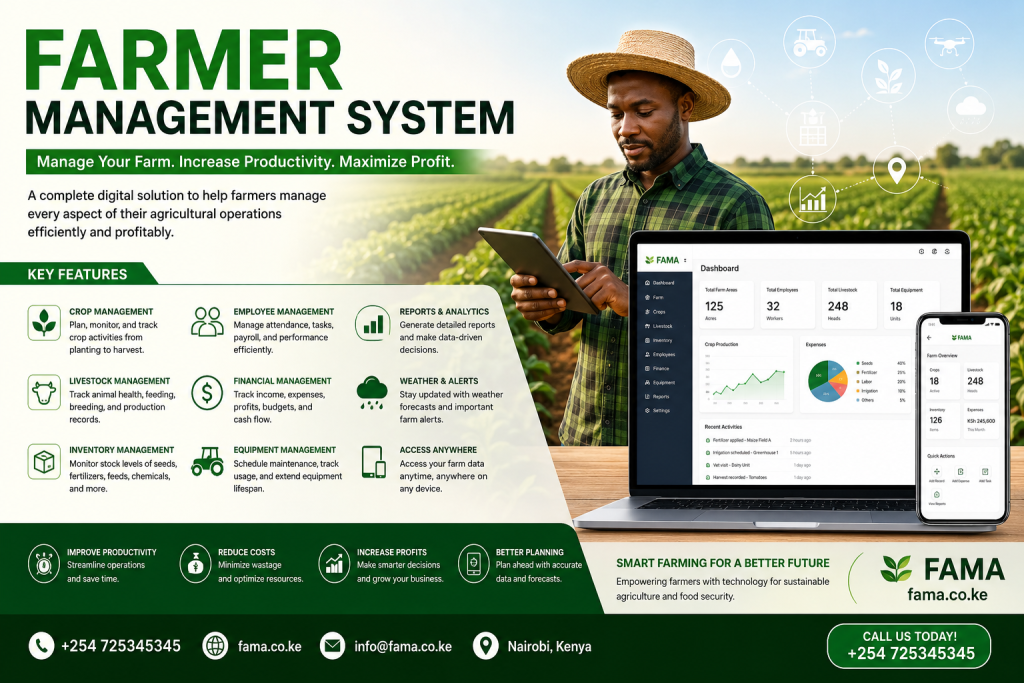
What is a Farm Management System?
Agriculture is changing rapidly. Traditional farming methods are gradually being complemented by modern technologies that enable farmers to make smarter decisions, improve productivity, and maximize profits. One of the most important innovations transforming agriculture today is the Farm Management System (FMS).
If you’ve ever wondered What is a Farm Management System, you’re not alone. Thousands of farmers, agribusiness owners, cooperatives, and agricultural investors are now searching for better ways to organize farm operations using digital technology.
A Farm Management System is software designed to help farmers plan, monitor, record, analyze, and optimize every activity taking place on a farm. Instead of relying on notebooks, spreadsheets, or memory, farmers use one centralized platform to manage crops, livestock, workers, machinery, finances, and production records.
For farmers in Kenya and across Africa, adopting a Farm Management System means reducing losses, improving efficiency, increasing yields, and making informed decisions based on real-time farm data.
At FAMA (Fama.co.ke), we understand that every successful farm begins with proper management. Whether you operate a small family farm, commercial plantation, dairy farm, poultry operation, or mixed farming enterprise, having the right farm management solution can significantly improve your operations.
What is a Farm Management System?
Simply put, What is a Farm Management System?
A Farm Management System is a digital platform that helps farmers manage all farm activities from one location. It records every operation taking place on the farm and provides reports that support better decision-making.
Instead of manually recording expenses, fertilizer applications, harvests, livestock treatments, employee attendance, and equipment maintenance, everything is stored digitally.
The software becomes the central brain of the farm.
A modern Farm Management System typically helps farmers manage:
- Crop production
- Livestock management
- Farm finances
- Inventory
- Employees
- Equipment
- Farm inputs
- Harvest records
- Sales
- Compliance documentation
- Farm reports
- Planning
- Scheduling
- Performance analysis
The goal is simple:
Help farmers increase productivity while reducing operational costs.
Why Farm Management is Becoming More Important
Agriculture today is far more complex than it was twenty years ago.
Farmers face challenges such as:
- Climate change
- Rising fertilizer costs
- Labour shortages
- Disease outbreaks
- Water scarcity
- Market price fluctuations
- Government regulations
- Export compliance
- Increasing customer quality standards
Managing all these factors manually becomes extremely difficult.
A Farm Management System allows farmers to organize operations efficiently while reducing human errors.
Instead of reacting to problems after they occur, farmers can identify trends early and make proactive decisions.
Evolution of Farm Management
Years ago, farm records looked something like this:
- Exercise books
- Printed ledgers
- Handwritten notebooks
- Receipts stored in boxes
- Manual payroll
- Paper maps
- Verbal communication
Today, farms are increasingly becoming digital businesses.
Modern farms use:
- Cloud software
- Mobile applications
- GPS
- Digital inventory
- Automated reports
- Financial dashboards
- Weather integration
- Worker attendance systems
This digital transformation has made Farm Management Systems essential for competitive farming.
Why Every Farmer Needs a Farm Management System
Many farmers believe management software is only suitable for large commercial farms.
That is no longer true.
Smallholder farmers also benefit enormously because they need to monitor limited resources carefully.
Whether you manage:
- 2 acres
- 20 acres
- 200 acres
- 2,000 acres
Proper management improves profitability.
A Farm Management System helps answer important questions such as:
- Which crop is most profitable?
- Which field performs best?
- How much fertilizer was used?
- Which worker harvested the most?
- Which livestock require treatment?
- What is the total production cost?
- Which customers owe payments?
- Which inputs are almost finished?
Without proper records, answering these questions accurately becomes difficult.
Core Components of a Farm Management System
Understanding What is a Farm Management System also requires understanding its major components.
1. Farm Planning
Planning is the foundation of successful farming.
The system helps farmers create seasonal plans including:
- Planting schedules
- Irrigation plans
- Fertilizer programs
- Labour allocation
- Machinery scheduling
- Harvest timelines
Instead of making decisions randomly, everything follows a structured plan.
2. Crop Management
Crop production involves hundreds of activities.
A Farm Management System records:
- Land preparation
- Seed varieties
- Planting dates
- Fertilizer applications
- Herbicide spraying
- Pest management
- Disease control
- Irrigation
- Harvest dates
- Crop yields
Each field has its own history, making future planning much easier.
3. Livestock Management
For livestock farmers, management software tracks:
- Animal identification
- Breeding
- Vaccination
- Deworming
- Feeding
- Milk production
- Weight gain
- Health records
- Mortality
- Sales
This ensures every animal receives proper care.
4. Financial Management
Every farm is a business.
A Farm Management System records:
- Expenses
- Income
- Loans
- Supplier payments
- Customer payments
- Budgets
- Cash flow
- Profitability
Farm owners always know the financial health of their business.
5. Inventory Management
Keeping track of farm inputs is critical.
The system monitors:
- Seeds
- Fertilizers
- Chemicals
- Animal feeds
- Fuel
- Packaging materials
- Spare parts
- Veterinary drugs
It alerts users before stock runs out.
6. Employee Management
Managing workers becomes much easier.
The software records:
- Attendance
- Daily activities
- Payroll
- Productivity
- Assigned tasks
- Leave
- Performance
Managers can monitor labour efficiency in real time.
7. Equipment Management
Farm machinery requires regular maintenance.
The system tracks:
- Tractors
- Harvesters
- Irrigation pumps
- Generators
- Vehicles
- Sprayers
Maintenance schedules reduce unexpected breakdowns.
Key Features of a Modern Farm Management System
Different software solutions offer different capabilities, but the best Farm Management Systems usually include:
Farm Dashboard
A dashboard gives farmers a quick overview of:
- Current farm activities
- Pending tasks
- Weather conditions
- Expenses
- Income
- Harvest progress
- Inventory status
Everything is visible from one screen.
Mobile Accessibility
Modern farmers spend most of their time in the field.
Cloud-based Farm Management Systems allow users to:
- Record activities
- Upload photos
- Check inventory
- View reports
- Approve tasks
All from a smartphone.
Real-Time Reporting
Reports help farmers understand performance.
Examples include:
- Profit reports
- Crop yield reports
- Worker productivity
- Inventory reports
- Livestock performance
- Sales reports
Better reports lead to better decisions.
Cloud Storage
Instead of losing paper records, cloud systems securely store information online.
Benefits include:
- Automatic backups
- Secure access
- Multiple users
- Remote management
- Reduced paperwork
Data Analytics
Modern Farm Management Systems analyze farm data and identify trends.
Examples include:
- Best-performing crops
- Most profitable seasons
- High-cost activities
- Fertilizer efficiency
- Labour productivity
This helps improve future planning.
Benefits of Using a Farm Management System
Farmers adopting digital management often experience significant improvements.
Some major benefits include:
Better Decision Making
Every decision becomes data-driven.
Instead of guessing:
- Production costs
- Yield estimates
- Profit margins
Farmers use actual numbers.
Increased Productivity
Well-organized farms achieve:
- Better planting schedules
- Faster harvesting
- Efficient labour allocation
- Reduced delays
This increases overall productivity.
Lower Operational Costs
Waste decreases because farmers know exactly:
- What is available
- What is needed
- Where resources are being used
This minimizes unnecessary purchases.
Improved Record Keeping
Good records support:
- Bank financing
- Government compliance
- Organic certification
- Export markets
- Insurance claims
Digital records are easier to retrieve than paper documents.
Better Communication
Managers can assign work instantly.
Employees know:
- Their responsibilities
- Deadlines
- Field locations
- Daily targets
This improves coordination across the farm.
Enhanced Traceability
Consumers increasingly want to know where food comes from.
A Farm Management System records every stage of production, creating complete traceability from planting to harvest and eventually to the customer.
This is especially important for farms supplying supermarkets, exporters, processors, and institutional buyers.