Table of Contents
ToggleWhat Is a Farm Management System?
Agriculture has transformed significantly over the last decade. Traditional farming methods are gradually being replaced by digital solutions that help farmers make informed decisions, reduce losses, increase productivity, and maximize profits. One of the most important innovations leading this transformation is the farm management system.
If you have ever wondered what is a farm management system, this comprehensive guide explains everything you need to know. Whether you operate a small family farm, a medium-sized commercial farm, or a large agricultural enterprise, implementing a farm management system can dramatically improve your operations.
At Fama.co.ke, we understand the challenges farmers face every day. Our farm management system is designed specifically to help Kenyan farmers simplify farm operations, monitor performance, and make data-driven decisions.
Understanding a Farm Management System
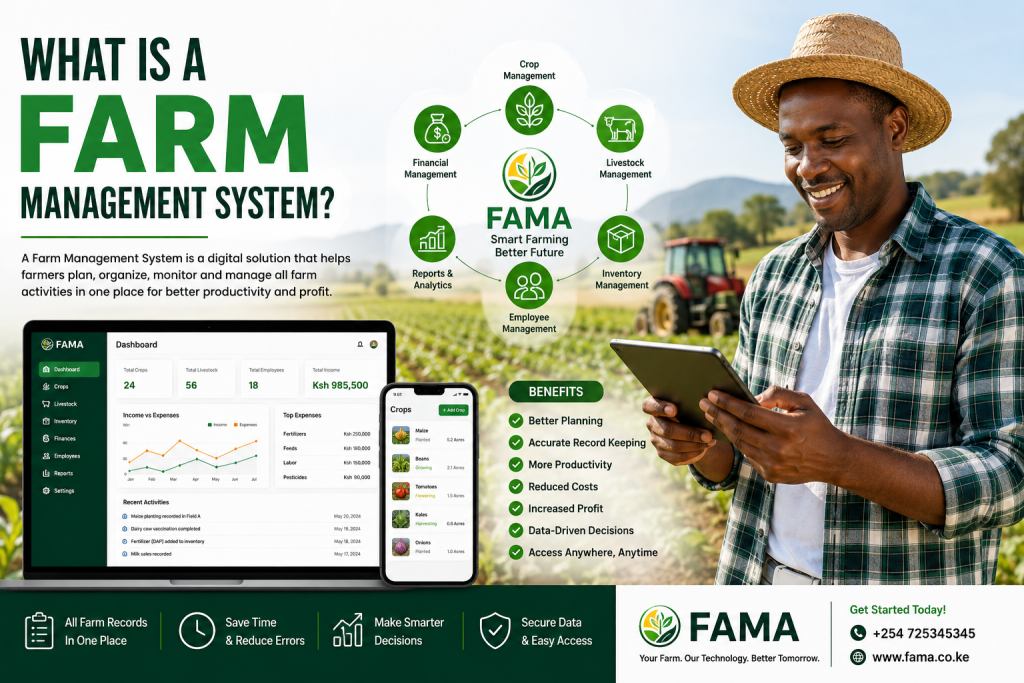
A farm management system is software that helps farmers organize, monitor, manage, and optimize every activity taking place on a farm. Instead of relying on notebooks, spreadsheets, or memory, farmers use a centralized digital platform to manage farm records and operations.
A modern farm management system combines technology with agricultural best practices to provide better visibility into daily farm activities.
The system helps farmers manage:
- Crop production
- Livestock management
- Farm finances
- Employee management
- Machinery tracking
- Inventory control
- Farm expenses
- Harvest planning
- Sales records
- Supplier management
- Customer management
- Weather monitoring
- Farm reports
Rather than handling each activity separately, a farm management system integrates everything into one easy-to-use platform.
Why Modern Farming Needs a Farm Management System
Agriculture today is becoming more competitive. Farmers must deal with:
- Rising production costs
- Climate change
- Pest outbreaks
- Labor shortages
- Market fluctuations
- Input price increases
- Record keeping requirements
- Financial management
Without proper organization, managing all these factors becomes difficult.
A farm management system simplifies these challenges by providing real-time information that helps farmers make better decisions.
Instead of guessing:
- How much fertilizer was used
- Which field performed best
- Which animals require vaccination
- How much profit was made
The farm management system provides accurate records instantly.
How Does a Farm Management System Work?
A farm management system collects data from every farm activity.
Farmers simply enter information into the software whenever an activity occurs.
For example:
Planting maize:
- Date planted
- Seed variety
- Field location
- Seed quantity
- Fertilizer applied
- Labor involved
After planting, the farmer records:
- Irrigation
- Pest control
- Herbicide application
- Crop inspections
- Growth stages
When harvesting:
- Harvest date
- Yield quantity
- Quality grade
- Selling price
- Buyer information
The farm management system automatically stores this information and generates useful reports.
Main Objectives of a Farm Management System
Every farm management system is designed to help farmers achieve several objectives.
Improve Productivity
The biggest goal of a farm management system is increasing farm productivity.
Farmers know:
- What works
- What doesn’t
- Which crops perform better
- Which inputs generate better yields
This information improves future planning.
Reduce Farm Costs
Many farms lose money because expenses are poorly monitored.
A farm management system records every expense including:
- Seeds
- Fertilizers
- Chemicals
- Fuel
- Equipment repairs
- Employee salaries
- Transport costs
With detailed reports, farmers identify unnecessary spending.
Increase Profitability
Knowing production costs allows farmers to calculate actual profits.
The farm management system compares:
- Total expenses
- Harvest quantity
- Selling price
- Gross income
- Net profit
This helps farmers improve profitability every season.
Improve Record Keeping
Record keeping remains one of the biggest challenges among farmers.
A farm management system eliminates paper files by storing information securely in one location.
Farmers can retrieve records anytime.
Better Decision Making
Instead of relying on assumptions, farmers use historical data to make better decisions.
The farm management system provides insights that improve planning and reduce risks.
Key Features of a Farm Management System
A professional farm management system includes numerous features that support day-to-day farm operations.
Crop Management
Crop management helps monitor every farming activity from land preparation to harvesting.
The farm management system records:
- Planting dates
- Seed varieties
- Fertilizer schedules
- Spraying records
- Irrigation schedules
- Crop inspections
- Harvest quantities
This creates complete crop histories.
Livestock Management
Livestock farmers also benefit from a farm management system.
It manages:
- Animal registration
- Breeding records
- Vaccination schedules
- Milk production
- Weight tracking
- Feed consumption
- Veterinary treatments
- Animal sales
Everything is stored digitally.
Farm Financial Management
Financial management determines whether a farm is profitable.
A farm management system tracks:
- Income
- Expenses
- Purchases
- Sales
- Loans
- Supplier payments
- Customer balances
This simplifies accounting.
Inventory Management
Every farm has inventory.
Examples include:
- Seeds
- Fertilizers
- Chemicals
- Animal feeds
- Veterinary medicines
- Packaging materials
The farm management system monitors stock levels and alerts farmers before supplies run out.
Equipment Management
Farm equipment requires regular maintenance.
The farm management system tracks:
- Tractors
- Irrigation pumps
- Generators
- Harvesters
- Vehicles
Maintenance schedules reduce unexpected breakdowns.
Employee Management
Labor is one of the highest farm expenses.
The farm management system manages:
- Employee attendance
- Daily tasks
- Payroll
- Productivity
- Overtime
- Casual labor
This improves workforce efficiency.
Benefits of Using a Farm Management System
Thousands of farms worldwide have adopted digital farming.
Below are the biggest advantages.
Better Farm Planning
A farm management system helps farmers prepare planting calendars, budgets, labor schedules, and harvesting plans.
Everything becomes organized.
Accurate Record Keeping
Digital records are more reliable than notebooks.
Farmers avoid losing important information.
Faster Reporting
Generating reports manually takes time.
The farm management system creates reports instantly.
Reports include:
- Crop performance
- Financial statements
- Inventory reports
- Employee reports
- Livestock reports
Improved Productivity
Since every activity is monitored, inefficiencies are identified early.
This increases production.
Better Cash Flow Management
Knowing incoming and outgoing cash helps farmers plan investments.
The farm management system improves financial discipline.
Easier Compliance
Many organizations require farm records for:
- Certification
- Audits
- Loans
- Insurance
- Export requirements
A farm management system keeps all records ready.
Types of Farms That Need a Farm Management System
Many people assume only large farms require software.
That is incorrect.
A farm management system benefits almost every farming operation.
Examples include:
Dairy Farms
Manage:
- Milk production
- Breeding
- Veterinary care
- Feed usage
- Income
Poultry Farms
Track:
- Egg production
- Feed
- Mortality
- Vaccination
- Sales
Crop Farms
Manage:
- Planting
- Fertilizer
- Harvest
- Irrigation
- Pest control
Greenhouse Farms
Monitor:
- Humidity
- Temperature
- Irrigation
- Crop growth
- Harvest schedules
Mixed Farms
A farm management system combines crop and livestock management within one platform.
This makes management much easier.
Manual Farm Management vs Farm Management System
| Manual Management | Farm Management System |
|---|---|
| Paper records | Digital records |
| Difficult reporting | Automatic reports |
| Time consuming | Fast data access |
| High risk of data loss | Secure storage |
| Hard to monitor finances | Real-time financial tracking |
| Limited planning | Smart planning tools |
| Manual calculations | Automated calculations |
| Difficult inventory management | Inventory automation |
Why Kenyan Farmers Are Adopting Farm Management Systems
Across Kenya, agriculture is becoming more commercial and technology-driven. Farmers are increasingly recognizing that keeping accurate records and monitoring daily operations is essential for long-term success.
A farm management system enables Kenyan farmers to:
- Increase yields through better planning.
- Reduce unnecessary expenses.
- Track farm activities from anywhere.
- Improve accountability among workers.
- Make informed decisions based on real data.
- Prepare reports for lenders, investors, and partners.
From dairy farms in Central Kenya to maize farms in the Rift Valley and horticultural farms supplying export markets, digital farm management is becoming a key competitive advantage.
Why Choose Fama.co.ke?
At Fama.co.ke, we provide a powerful farm management system designed to meet the needs of modern farmers in Kenya. Our platform helps simplify farm operations, improve record keeping, monitor finances, and increase productivity through an easy-to-use interface.
Whether you manage crops, livestock, or mixed farming enterprises, Fama offers tools that help you stay organized and make better decisions every season.
Contact us today:
Phone: +254 725345345
Advanced Guide to Farm Management Systems
Choosing the Right Farm Management System
Investing in agricultural technology is a significant decision for any farmer. Selecting the right software should be based on your current needs, future expansion plans, and the type of farming you practice. A system that works well for a dairy farm may not be ideal for a horticultural business or a mixed farming enterprise.
Before making a decision, farmers should evaluate the size of their operations, the number of employees, the amount of data they generate, and the level of automation they require. Ease of use is equally important. A complicated platform that requires extensive technical knowledge may discourage daily use, reducing its overall value.
Scalability should also be considered. As a farming business grows, the software should be capable of handling more fields, livestock, users, financial records, and operational activities without requiring a complete replacement.
Customer support is another essential factor. Reliable technical assistance ensures that any issues are resolved quickly, minimizing downtime during critical farming periods.
Digital Record Keeping Improves Farm Performance
One of the greatest strengths of modern agricultural software is its ability to maintain detailed digital records. Information that was once scattered across notebooks, receipts, and spreadsheets is organized in one secure location.
Comprehensive records allow farmers to review previous seasons and identify patterns that may not have been obvious. They can compare crop yields between years, evaluate the effectiveness of different fertilizers, monitor changes in production costs, and identify the most profitable enterprises.
Historical records are equally valuable when applying for agricultural loans, crop insurance, government support programs, or certifications that require documented farming practices.
Instead of spending hours searching through paperwork, farmers can retrieve years of information within seconds.
Improving Financial Management
Financial management is often overlooked in agriculture, yet it plays a crucial role in determining long-term sustainability.
Successful farming requires much more than producing high yields. Farmers must understand whether their operations are generating sufficient profit after accounting for all production costs.
A comprehensive management platform allows farmers to monitor:
- Daily income
- Operational expenses
- Seasonal budgets
- Cash flow
- Outstanding payments
- Supplier invoices
- Customer balances
- Equipment maintenance costs
- Loan repayments
Regular financial reporting enables farmers to identify areas where unnecessary spending can be reduced while increasing investments in profitable activities.
Having accurate financial information also simplifies tax preparation and business planning.
Better Planning for Future Seasons
Planning is one of the biggest advantages technology brings to agriculture.
Rather than making decisions based on memory or assumptions, farmers can analyze historical performance before preparing for the next season.
Previous production records help answer important questions such as:
- Which crop varieties produced the highest yields?
- Which fields consistently underperformed?
- Which months experienced the highest pest pressure?
- How much fertilizer was required for optimal production?
- Which suppliers offered the best prices?
- Which markets generated the highest profits?
These insights improve planning and reduce costly mistakes.
Managing Labor Efficiently
Labor represents a major operational cost on many farms. Without proper supervision, productivity may decline while labor expenses continue to rise.
Digital workforce management makes it easier to organize employees by assigning daily tasks, tracking attendance, monitoring completed work, and recording wages.
Managers gain greater visibility into workforce performance and can identify opportunities to improve efficiency without increasing staffing costs.
Clear task allocation also reduces misunderstandings among workers and improves accountability.
Inventory Control
Agricultural operations rely heavily on inventory.
Seeds, fertilizers, pesticides, veterinary medicines, irrigation supplies, animal feed, fuel, packaging materials, and spare parts all represent valuable business assets.
Poor inventory management often results in:
- Overstocking
- Stock shortages
- Expired products
- Theft
- Unnecessary purchases
An organized inventory system provides accurate stock levels and keeps track of incoming and outgoing supplies.
Alerts can notify farm managers when inventory reaches minimum levels, allowing purchases to be planned before operations are affected.
Equipment Maintenance
Agricultural machinery is expensive to purchase and maintain.
Unexpected equipment breakdowns during planting or harvesting seasons can result in significant financial losses.
Keeping detailed maintenance records helps ensure machinery remains in good working condition.
Scheduled servicing extends equipment lifespan while reducing repair costs and downtime.
Maintenance records may include:
- Service dates
- Parts replaced
- Fuel consumption
- Repair history
- Operating hours
- Inspection schedules
Preventive maintenance is almost always less expensive than emergency repairs.
Data-Driven Decision Making
Modern farming increasingly depends on data rather than assumptions.
Collecting operational information allows farmers to evaluate performance objectively.
For example, production data can reveal that one maize variety consistently produces higher yields under similar conditions than another. Financial records may show that one enterprise contributes more profit than others despite requiring fewer resources.
Making decisions based on reliable information reduces uncertainty and improves overall farm performance.
Data-driven farming also supports long-term strategic planning.
Cloud Technology in Agriculture
Cloud computing has transformed many industries, including agriculture.
Instead of storing records on a single computer, cloud-based systems securely store information online.
This provides several advantages:
- Access from multiple devices
- Automatic data backup
- Reduced risk of data loss
- Easier collaboration
- Real-time updates
- Improved security
Farm managers can review operations whether they are at home, traveling, or visiting different farm locations.
Employees working in different departments can update records simultaneously without duplicating information.
Mobile Accessibility
Many farmers spend most of their day away from an office.
Mobile applications allow them to manage farm activities directly from smartphones or tablets.
Using mobile devices, managers can:
- Record field activities
- Capture livestock information
- Upload photographs
- Review financial reports
- Check inventory
- Approve purchases
- Monitor daily progress
This flexibility improves productivity while reducing paperwork.
Integration with Modern Agricultural Technologies
Agriculture continues evolving through technological innovation.
Modern software increasingly integrates with advanced technologies including:
GPS Mapping
Field boundaries can be mapped accurately, improving land management and resource allocation.
Drones
Drone imagery helps identify crop stress, pest infestations, irrigation issues, and nutrient deficiencies before they become severe.
Soil Sensors
Sensors monitor soil moisture, temperature, and nutrient levels, supporting better irrigation and fertilization decisions.
Weather Monitoring
Weather forecasts assist farmers in planning planting, spraying, irrigation, and harvesting activities.
Internet of Things (IoT)
Connected devices automatically collect operational data from equipment, irrigation systems, greenhouses, and livestock facilities.
Automation reduces manual data entry while increasing accuracy.
Artificial Intelligence in Modern Farming
Artificial Intelligence (AI) is becoming an increasingly valuable tool in agriculture.
AI systems analyze large amounts of farm data and provide recommendations based on historical trends and predictive models.
Potential applications include:
- Yield prediction
- Disease detection
- Pest identification
- Irrigation scheduling
- Fertilizer recommendations
- Weather risk assessment
- Harvest forecasting
These capabilities help farmers make informed decisions while improving resource efficiency.
Sustainability and Environmental Protection
Modern farming should balance productivity with environmental responsibility.
Technology supports sustainable farming by helping farmers optimize resource use and reduce waste.
Better planning leads to:
- Reduced water consumption
- Improved fertilizer application
- Efficient pesticide use
- Lower fuel consumption
- Reduced greenhouse gas emissions
Sustainable practices not only protect the environment but also improve long-term profitability.
Common Challenges During Implementation
Although adopting digital systems offers many advantages, farmers may experience several initial challenges.
Resistance to Change
Some employees may prefer traditional record-keeping methods and require time to adapt.
Proper training and continuous support help overcome this challenge.
Data Entry
Historical information often needs to be entered before the software becomes fully useful.
Although this requires effort initially, it provides valuable long-term benefits.
Staff Training
Employees should understand how to use the software correctly.
Regular training sessions improve confidence and encourage consistent usage.
Internet Connectivity
Cloud-based platforms require reliable internet access for synchronization.
Fortunately, expanding mobile internet coverage across Kenya continues to improve accessibility in rural areas.
Best Practices for Successful Adoption
Organizations achieve the greatest benefits when implementation follows a structured approach.
Recommended practices include:
- Define clear business objectives.
- Train all users thoroughly.
- Keep records updated daily.
- Review reports regularly.
- Back up important information.
- Monitor performance indicators.
- Continuously improve operational processes.
- Encourage staff participation.
Consistency is more important than complexity. Small improvements made every day accumulate into substantial long-term gains.
Why Fama.co.ke Is the Ideal Partner
Managing a successful agricultural business requires accurate information, efficient planning, and reliable technology. Fama.co.ke provides a comprehensive platform designed to simplify day-to-day farm operations while supporting long-term growth.
The platform enables farmers to organize production activities, monitor finances, manage inventory, maintain equipment records, supervise employees, and generate detailed reports—all from one centralized system.
Whether you operate a small family farm or a large commercial enterprise, adopting digital management practices can improve productivity, reduce operational inefficiencies, and support better decision-making throughout every production cycle.
Frequently Asked Questions
Is this type of software suitable for small farms?
Yes. Small-scale farmers benefit from improved organization, financial tracking, and better planning just as much as larger agricultural enterprises.
Can it manage both crops and livestock?
Yes. Many modern platforms are designed to support mixed farming operations, allowing crop and livestock activities to be managed together.
Is technical knowledge required?
Most modern agricultural management platforms are designed with user-friendly interfaces, making them suitable even for users with limited computer experience.
Is data secure?
Reputable cloud-based solutions employ secure servers, encrypted connections, regular backups, and access controls to protect business information.
Can reports be generated automatically?
Yes. Most platforms generate financial summaries, production reports, inventory records, employee reports, and operational analyses with minimal effort.
Conclusion
Agriculture is becoming increasingly data-driven, competitive, and technology-focused. Farmers who embrace digital tools are better positioned to improve productivity, control costs, make informed decisions, and build resilient businesses that can adapt to changing market conditions and environmental challenges.
Replacing paper records with organized digital information creates greater visibility across every aspect of the farming operation. From production planning and financial management to inventory control and workforce supervision, centralized management improves efficiency while reducing unnecessary errors.
Whether you are growing crops, raising livestock, operating greenhouses, or managing a diversified agricultural enterprise, investing in the right management solution lays the foundation for sustainable growth and long-term success.
For farmers looking to modernize their operations, Fama.co.ke offers reliable solutions tailored to the needs of Kenyan agriculture.
Contact Fama.co.ke today
Phone: +254 725345345
Take the next step toward smarter, more organized, and more profitable farming with a solution designed to help your agricultural business thrive.