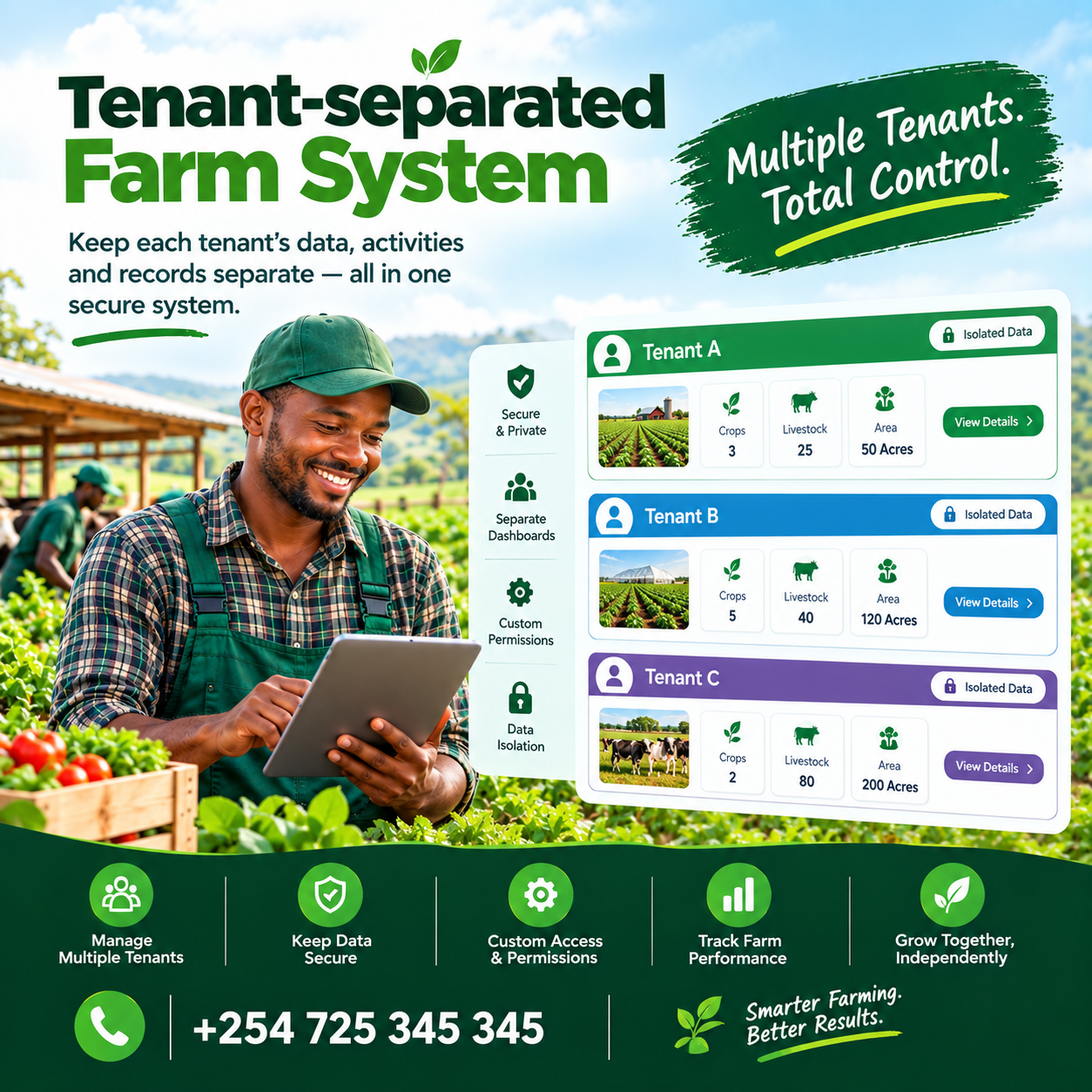
Tenant-separated farm system is the architecture that keeps one farm’s data completely isolated from every other farm sharing the same software platform — and it is the single most important technical question a farmer can ask before trusting a cloud provider with their records. Modern farm software serves thousands of farms from the same application, running on the same servers, in the same data centres.
That shared infrastructure is what makes powerful software affordable: the costs of servers, security, and engineering spread across every subscriber. But sharing an application raises an obvious question — whose data is whose, and what stops one farm’s information from ever touching another’s?
The answer is tenancy separation. Each farm is a “tenant” on the platform — a logically or physically sealed compartment holding its records, its users, its documents, and its history. Done properly, the isolation is absolute: no query, no report, no administrator on another farm’s account can reach yours.
Done badly, it is a privacy problem waiting to surface. Yields, costs, buyer prices, herd genetics, and contracts are commercially sensitive — and a farm whose tenant-separated farm system architecture is weak has effectively posted its business intelligence on a shared wall.
This guide explains the concept in full: what tenant separation actually is, the three architectures behind it, what it protects, how to verify it before subscribing, how it relates to data ownership and Kenya’s data protection law, and the questions that separate genuinely isolated platforms from marketing claims.
Table of Contents
ToggleWhat a Tenant-Separated Farm System Actually Is
At its core, a tenant-separated farm system is a cloud platform where many farms share one application while sharing none of their data. Each subscribing farm is a tenant — a distinct customer with its own sealed space inside the system.
The tenant model is the standard architecture of modern software-as-a-service, powering everything from banking apps to accounting platforms worldwide. Every tenant logs into the same application and experiences it as their own private system.
The separation happens in the data layer, invisible to users but decisive for security. Every record — every sale, every animal, every worker entry — carries its tenant identity, and the platform’s access rules enforce that identity at every read and every write.
A properly built tenant-separated farm system enforces the boundary everywhere: in the application’s logic, in the database’s structure, in the API’s rules, and in the backup’s organisation. Isolation is a property of the whole architecture, not a setting on one screen.
The practical test of tenancy is simple to state: there is no circumstance, no query, no report, and no role under which one farm’s data becomes visible to another farm’s account. That standard is what the rest of this guide helps farms verify.
It is worth distinguishing two different boundaries that often get confused. Tenant separation governs the wall between your farm and other farms; user permissions govern the walls inside your own farm — what your workers, supervisors, and managers can each see. Both matter, and they are different systems.
Why Tenant Separation Matters So Much
The first reason is commercial secrecy. Farm data is business intelligence: a farm’s yields per block, cost per crate, buyer prices, and contracted volumes reveal exactly how it wins its markets. A weak tenant-separated farm system exposes that intelligence to whoever else shares the platform.
Competitors who learn your costs can underbid you. Buyers who learn your volumes can squeeze your prices. Suppliers who learn your scale can adjust theirs. This is why data isolation is not an abstract technical virtue — it is commercial protection.
The second reason is privacy law. Kenya’s Data Protection Act 2019 gives every person whose data the farm holds — workers, buyers, family members — rights over that data, and makes the farm responsible for keeping it safe. A breach in a shared platform without proper tenant-separated farm system isolation is a legal exposure, not merely an embarrassment.
The third reason is trust in the numbers. Records that might leak are records that managers hesitate to keep accurate — and hesitant record keeping degrades every decision the system feeds. The sealed compartment is what makes honest data comfortable.
The fourth reason is ransomware and breach containment. In properly separated architectures, an incident affecting one tenant’s space does not automatically cascade into every other tenant’s space. The walls limit the blast radius — a property a genuine tenant-separated farm system shares with bank-grade platforms.
The fifth reason is exit freedom. Tenant separation and data portability travel together: a farm whose data lives in its own sealed compartment can export it whole, while data tangled across shared structures resists clean extraction.
The Three Architectures Behind Tenant Separation
Shared Database, Shared Schema
The most economical architecture stores every tenant’s records in one database and one table structure, with a tenant identifier on every row. The application’s logic filters strictly by that identifier — each farm sees only its own rows.
This “pool” model is what most mainstream tenant-separated farm system platforms run, and it works well at scale when the enforcement is rigorous: every query filtered, every API call authenticated, every report bounded by tenant. Its weakness is that isolation depends entirely on the code being correct — one unfiltered query is one crossed boundary.
Shared Database, Separate Schemas
The middle architecture gives each tenant its own schema — its own set of tables inside the shared database. The walls sit at the schema level rather than in filtered rows, which hardens isolation meaningfully.
A tenant-separated farm system on this model makes cross-tenant access structurally harder: the database itself partitions tenants, so a code mistake must defeat a structural boundary, not just a missing filter.
Isolated Database Per Tenant
The strongest architecture gives each farm its own database entirely — full silo isolation. One tenant’s compromise cannot reach another tenant’s data at the storage level, and each farm’s data can be backed up, restored, and exported as a discrete unit.
The trade-off is cost: siloed tenant-separated farm system platforms carry higher infrastructure expenses, which appear in pricing. For farms holding highly sensitive operations — competitive export ventures, investor-backed estates — the premium often purchases exactly the assurance they need.
What the Architectures Mean for Farmers
All three architectures can be secure; they differ in how isolation is enforced and what it costs. The farmer’s practical position is not to demand a specific architecture but to verify that whichever one the platform uses is implemented rigorously — with encryption, strict access control, and documented enforcement.
What Tenant Separation Actually Protects
The first protected asset is operational data: your yields, your herd records, your input consumption, your worker productivity — the operational picture of your farm. In a genuine tenant-separated farm system, that picture belongs to you alone.
The second is financial data: revenue, costs, margins, buyer terms, and debt positions. This is the most sensitive category the farm holds, and the one whose exposure damages negotiation position fastest.
The third is personal data: your workers’ names, national IDs, salaries, and attendance — data the farm holds in trust and answers for legally. Proper tenant isolation is a tenant-separated farm system‘s structural answer to that trust.
The fourth is documents and evidence: contracts, certificates, delivery notes, photos, and audit records. Their confidentiality and integrity both depend on the walls holding.
The fifth is your future options. A farm inside a properly separated compartment can leave cleanly, export completely, and carry its history to a new platform — freedom that tangled data architectures quietly surrender.
How to Verify Tenant Separation Before Subscribing
The Questions to Ask Every Provider
The verification conversation takes ten minutes and separates serious platforms from casual ones. Ask directly: how is data separated between customers — shared tables with filtering, separate schemas, or separate databases?
Ask whether any platform administrator can view farm data, and under what controls. Ask where the tenant-separated farm system data is hosted, which country’s jurisdiction it sits under, and whether it is encrypted at rest and in transit.
Ask what happens on cancellation: is the tenant compartment deleted, on what timeline, and can a full export be produced first? And ask whether the provider has ever suffered a cross-tenant data incident — a question serious providers answer factually and casual ones deflect.
The Tests That Prove Isolation
Beyond questions, the trial offers proof. Create a second test account with a different email and confirm — through every screen, report, and export — that nothing from your main account appears anywhere in it.
Check the export: a clean tenant-separated farm system produces a complete, coherent export of your farm alone, which is both the portability proof and the isolation proof in one document.
Watch provider behaviour during support sessions too: a competent support team works within your tenant, asks permission to view sensitive screens, and explains what they can and cannot see. That discipline at support level reflects the architecture beneath it.
The Documentation That Should Exist
Serious platforms publish a security page, a privacy policy naming the data controller and processor roles, and — at the professional end — certifications or attestations of their security practices. Their absence is a finding, not a footnote: a tenant-separated farm system provider that cannot describe its own isolation in writing is asking farms to trust claims nobody has written down.
Tenant Separation vs Data Ownership: Related but Different
Tenant separation is about walls; data ownership is about title. A platform can isolate data perfectly while its terms claim rights over it — and the two questions must be asked separately.
Ownership questions are contractual: who owns the records, does the provider analyse or monetise them, and can the farm export everything at any time. The strongest position is explicit written ownership plus unrestricted export, tested during the trial.
Isolation questions are architectural: how the walls are built and enforced. A farm should demand strong answers to both — a tenant-separated farm system with clear ownership terms is the complete protection; either half alone leaves a gap.
The practical rule: read the data terms before signing, ask the architecture questions before subscribing, and test the export before committing. All three take minutes, and together they close the entire gap between trusting a platform and verifying one.
Backups, Recovery and Isolation
Tenant separation shapes backup quality in a way farms rarely consider. In siloed or schema-separated architectures, each farm’s backup is a discrete unit — restorable alone, exportable alone, and verifiable alone.
In pooled architectures, backups are typically taken across the shared database, with per-tenant restoration handled through filtering. The restoration is still farm-specific, but it depends on the same per-tenant logic as everything else — which is why the enforcement quality of a tenant-separated farm system matters in recovery as much as in daily use.
The farm’s verification questions extend to recovery: how often are backups taken, how quickly can a farm’s data be restored, and has the provider ever tested a full tenant-level restore? Platforms that rehearse recovery answer confidently; platforms that never have, hesitate.
Recovery testing is the one drill no farm should skip: ask the provider to demonstrate a recent restore, or at minimum to confirm the last tested date in writing. The tenant-separated farm system whose backups are isolated, encrypted, and rehearsed is the platform that survives the incidents its competitors merely discuss.
Access Control Inside Your Own Tenant
The tenant wall protects your farm from other farms; access control protects the farm from confusion inside its own compartment. Both layers belong in a complete security picture.
Role-based access assigns each user a view matched to their role: workers see their own tasks and entries, supervisors see their crews, managers see operations, and financials stay with the owner. This internal layering is standard in any mature tenant-separated farm system.
Audit trails complete the internal layer: every entry attributed to its author, every change logged, every export recorded. The farm that can answer “who did what, when” inside its own walls holds the same accountability standards the tenant walls enforce against the outside.
Strong authentication closes the picture: individual logins per person — never shared credentials — and two-factor authentication offered for owner and manager accounts. The tenant-separated farm system taken seriously by its provider will offer all of this by default.
Tenant Separation and Kenya’s Data Protection Act
Kenya’s Data Protection Act 2019 applies directly to farms that hold personal data — which every farm employing workers does. The farm is a data controller, the software provider is typically a data processor, and the obligations run through both roles.
The Act requires lawful processing, purpose limitation, security safeguards, and respect for data subject rights — workers’ rights to access and correct their own information. A farm whose records live in a properly isolated tenant-separated farm system meets the security expectations far more credibly than one holding the same data in shared spreadsheets.
Providers processing personal data on the farm’s behalf carry their own obligations — processing only on instruction, safeguarding the data, and assisting with rights requests. The professional tenant-separated farm system provider documents these roles in its terms rather than leaving them implicit.
Registration with the Office of the Data Protection Commissioner applies to controllers and processors above the statutory thresholds, and growing agribusinesses should assess their position as their operations scale. The practical guidance for farms is simple: hold only the personal data you need, keep it in systems that protect it, and choose providers whose tenant-separated farm system architecture and terms support your compliance rather than complicate it.
Multi-Farm Operations: One Tenant or Several?
Farms operating multiple sites face a genuine architectural choice, and understanding it prevents expensive reconfiguration later. The question is whether all sites live inside one tenant compartment or each site runs as its own tenant.
One tenant with multiple sites suits integrated operations: consolidated dashboards, shared inventory, unified payroll, and group-level reporting — the model most multi-site agribusinesses choose. The tenant-separated farm system handles the sites as divisions within one sealed compartment.
Separate tenants per site suit genuinely independent operations: different ownership structures, different managers with full autonomy, or ventures whose data must remain strictly compartmentalised from each other. Each site gets its own walls, its own users, and its own export.
The consolidation trade-off is real and worth stating plainly: separate tenants means separate logins, separate dashboards, and manual consolidation at group level — while one tenant means one view, with internal permissions doing the compartmentalising. Operations that expect group reporting should confirm, before subscribing, that their tenant-separated farm system platform handles multi-site inside one tenant cleanly.
The third option — a group account with per-site sub-tenants — exists on some enterprise platforms and combines both benefits: group visibility with site-level isolation. Where a growing group anticipates this need, it belongs in the platform evaluation from the start, not in a migration two years later.
Who Needs Tenant Separation Most
Commercial farms competing on price and efficiency need it most urgently, because their data is their competitive intelligence and its exposure is a market disadvantage. Operations bidding for contracts, negotiating with buyers, or benchmarking against neighbours should treat tenant-separated farm system isolation as non-negotiable.
Investor-backed and partnership farms need it structurally, because their data serves governance — board reporting, investor updates, audited accounts — and confidentiality obligations run with it. The sealed compartment is what makes cloud records boardroom-safe.
Farms handling worker personal data at scale — payrolls, IDs, biometric attendance — carry the Act’s obligations most heavily, and their provider choice is part of their compliance posture. A documented tenant-separated farm system with clear controller-processor terms is the defensible choice.
Exporters and certification-holding farms complete the priority list: audits, traceability files, and compliance documents live in their systems, and their buyers’ confidence depends on that data’s integrity and confidentiality. For this group, verification of the tenant-separated farm system architecture is a supplier-assurance exercise, not just an IT question.
Tenant-Separated Systems vs Mixed and Local Alternatives
The comparison set includes three alternatives, each with its own trade-offs. On-premise software — installed on the farm’s own computer — offers full physical control at the cost of backups, updates, and access from anywhere becoming the farm’s own responsibility.
Shared or “community” tools — spreadsheets in shared drives, messaging groups — offer convenience and carry the weakest isolation of all: access control is informal, attribution is absent, and leakage happens without any architecture to stop it.
The genuine tenant-separated farm system occupies the professional middle: cloud convenience and anywhere access, with isolation engineered by specialists and verified by the farm. For most operations, it is the strongest practical security position available.
The honest comparison across the three runs on control, convenience, and cost together. On-premise maximises control and costs capability; shared tools maximise convenience and cost security; and the well-verified tenant-separated farm system maximises the balance — which is why the market has moved decisively to it.
How to Choose a Platform With Real Tenant Separation
The selection discipline combines everything this guide has covered into four steps. First, ask the architecture questions and read the security and privacy documentation — before any demonstration.
Second, run the isolation tests during the trial: the second-account check, the export check, and the support-behaviour observation. Third, read the data terms for ownership, export rights, deletion timelines, and controller-processor roles.
Fourth, verify recovery: backup frequency, restore testing, and the provider’s incident history and notification commitments. The tenant-separated farm system that passes all four steps has been verified as thoroughly as any bank-grade service a farm deals with.
Where a provider resists the questions, treat the resistance as the answer. Platforms built with genuine separation welcome the scrutiny, because it is exactly the scrutiny their engineers designed for — and the tenant-separated farm system that flunks its first audit rarely improves after the subscription starts.
Common Mistakes Farms Make With Data Isolation
The first mistake is assuming isolation instead of verifying it — trusting the words “secure” and “private” in marketing without ever asking how the separation is built. The questions in this guide exist because the assumption is what breaches are made of.
The second is sharing logins, which destroys attribution and quietly defeats both the tenant walls and the role walls inside them. Every user on a tenant-separated farm system should be a named person with their own credentials — no exceptions.
The third is ignoring the exit test until departure day, discovering then that export is partial, slow, or paid. The export capability belongs in the trial, and the tenant-separated farm system that exports cleanly during it will export cleanly whenever leaving matters.
The fourth is treating provider support access as unlimited — handing credentials freely during troubleshooting instead of using the platform’s own support mechanisms and permission controls. Support discipline is part of the farm’s security posture, not an exception to it.
The fifth is confusing internal permissions with tenant isolation — assuming that because workers cannot see financials, no farm can see another farm’s data. The two walls are different systems, and a complete tenant-separated farm system verification confirms both.
The Future of Farm Data Isolation
The direction of the market is toward stronger verification: independent security audits, published certifications, and privacy features becoming standard sales criteria rather than technical footnotes. Farms asking the questions in this guide are accelerating that shift.
The deeper wave is data rights maturing across the agricultural economy — buyers, lenders, and certification schemes increasingly expecting documented data governance from the farms they deal with. The operations whose tenant-separated farm system arrangements are already verified and documented will meet that expectation with evidence in hand.
Encryption and regional hosting will keep improving as defaults, and farm-level control over what leaves the tenant — for analytics, for integrations, for AI — will become a configurable choice rather than a platform decision. The farms choosing verified platforms today are choosing the foundation that future will be built on.
Frequently Asked Questions
What is a tenant-separated farm system?
A cloud platform where many farms share one application while each farm’s data lives in its own sealed compartment — logically or physically separated from every other farm. In a genuine tenant-separated farm system, no query, report, or account under any circumstances reaches one farm’s data from another farm’s side.
Can other farms see my data on a shared platform?
Not on a properly implemented platform — the tenant walls make cross-farm access structurally impossible, verified through a second test account during the trial. Any tenant-separated farm system provider should explain exactly how their separation works, and hesitation to answer is itself the finding.
What questions should I ask a farm software provider about data separation?
How data is separated between customers, whether any administrator can view farm data and under what controls, where data is hosted and whether it is encrypted, what happens on cancellation, and whether a full export is available. These five questions expose a tenant-separated farm system‘s true quality in minutes.
Does Kenya’s Data Protection Act apply to my farm’s records?
Yes — any farm holding personal data such as worker names, IDs, and salaries is a data controller with security obligations under the Data Protection Act 2019, and the software provider acts as its processor. Choosing a properly isolated tenant-separated farm system with documented processor terms is the practical foundation of that compliance.
Is my data safe in the cloud compared to my own computer?
Usually safer: professional data centres carry encryption, backups, and security that a farm office cannot match, provided the platform’s tenant separation is genuine. The verified tenant-separated farm system protects data better than a laptop that can be stolen, a hard drive that can fail, or a store room that can flood.
I run several farms — should each have its own tenant or share one?
Integrated operations benefit from one tenant with multiple sites inside it — consolidated dashboards and shared resources — while fully independent ventures suit separate tenants for strict compartmentalisation. Confirm your tenant-separated farm system platform’s multi-site capability before subscribing, because the choice is expensive to reverse later.
How is tenant separation different from user permissions?
Tenant separation is the wall between your farm and other farms; user permissions are the walls between roles inside your own farm. Both matter and both must be verified — a complete tenant-separated farm system confirms the outer walls during trial and designs the inner walls before launch.
What happens to my data if I cancel my subscription?
It should be exportable in full first, then deleted from the provider’s systems on a stated timeline — both points confirmed in writing before signing. The tenant-separated farm system that passes the exit test during the trial is the one whose departure terms you will never need to argue about.