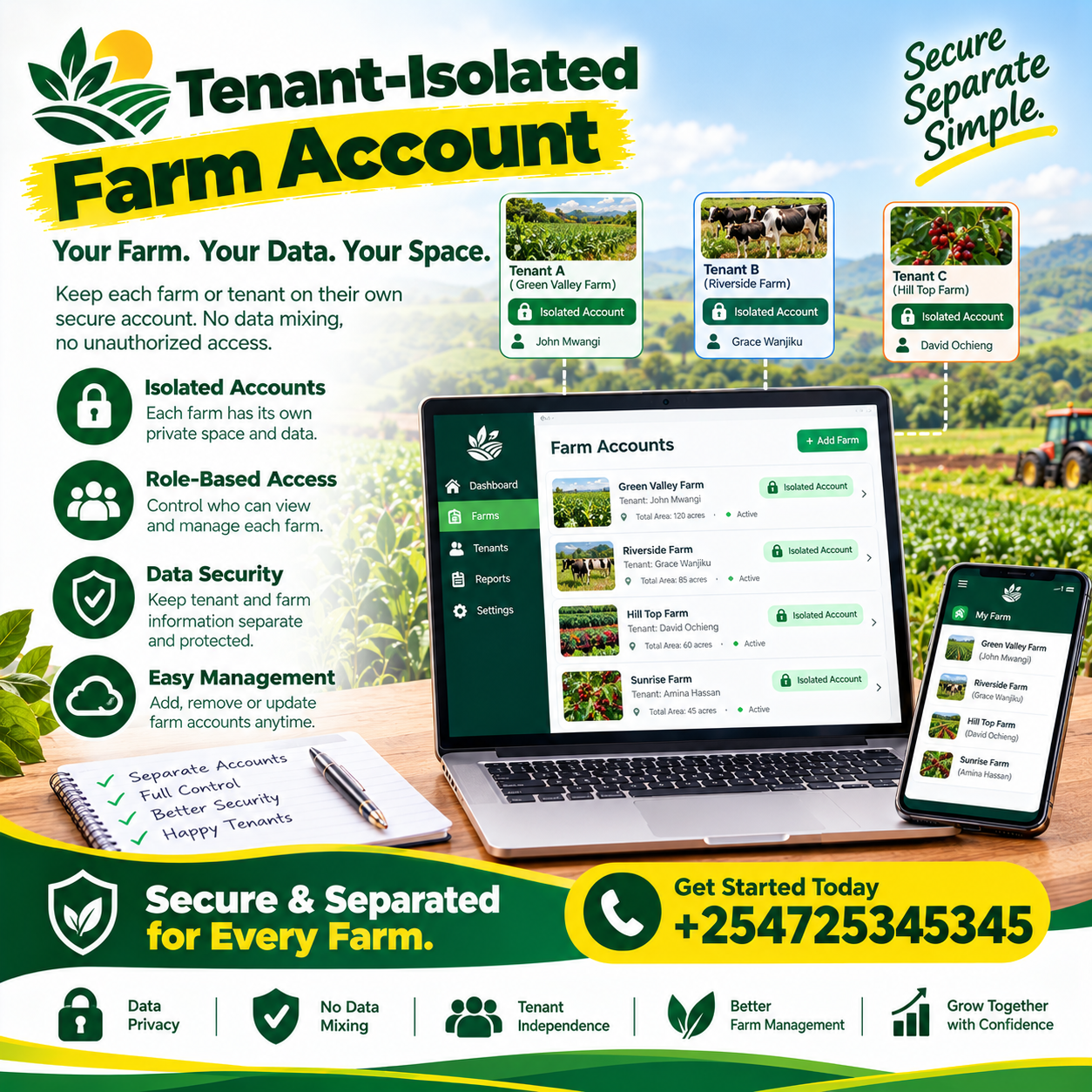
Tenant-isolated farm account is a farm’s own sealed space inside a cloud platform — an account whose data belongs entirely to that one farm, walled off from every other account the platform serves. The concept sounds technical, but its consequence is simple: your farm’s records are yours alone, no matter how many other farms share the software.
The question behind the concept is one every farmer should ask. When thousands of farms run on the same application, the same servers, and the same database — what stops one farm’s costs, yields, and buyer prices from ever touching another’s?
The answer, on a properly built platform, is account isolation. Each farm is a tenant — a separate compartment with its own data, its own users, and its own history — and nothing crosses the walls between compartments.
This matters far beyond privacy. Farm records are competitive intelligence: what a farm spends per crate, earns per litre, and contracts per season is exactly the information rivals, buyers, and brokers would value most.
It also matters to a growing group the industry rarely discusses: people who manage more than one farm. Consultants with client farms, family members overseeing several plots, investors with portfolio farms, and estate managers running inherited land — all of whom need many farms under one login without any farm’s data bleeding into another’s.
This guide explains the tenant-isolated farm account in full: what it is, what it protects, who needs it most, how it differs from role permissions, how multi-farm management works on isolated accounts, how to verify isolation before subscribing, and the mistakes that quietly defeat it.
What a Tenant-Isolated Farm Account Actually Is
At its core, a tenant-isolated farm account is one farm’s private workspace inside a shared cloud application. The farm signs up, receives its own account, and everything it records — crops, herds, stores, workers, sales, finances — lives inside that account and nowhere else.
The word “tenant” is the industry’s term for a paying customer on a multi-customer platform. Every subscriber is a tenant, and every tenant’s data is separated from every other tenant’s by the platform’s architecture.
Separation can be built several ways — filtered records, separate database schemas, or fully separate databases per farm — and the technical details matter less than the guarantee they produce: no query, report, export, or administrator session under one farm’s account can reach another farm’s data.
A genuine tenant-isolated farm account also carries its own boundaries internally: its own user list, its own roles, its own audit trail, and its own settings. The account is a complete farm world, self-contained and self-governed.
The distinction from older ways of sharing software is worth stating. In the shared-spreadsheet era, “isolation” meant a file copy — easily forwarded, easily edited, easily leaked. In the messaging-group era, it meant nothing at all. Account isolation is the first form of farm data separation that is enforced by architecture rather than by hope.
One clarification prevents most confusion. Account isolation governs the wall between farms; role permissions govern the walls inside a single farm — what a worker, supervisor, or manager can see within their own account. Both layers exist, both matter, and they answer different questions.
What Account Isolation Protects
The first protected asset is commercial intelligence. A farm’s cost structures, margins, and buyer terms are its negotiating weapons — and in a true tenant-isolated farm account, no other subscriber can ever see them.
The second is production data. Yields per block, mortality per flock, feed conversion per herd — the operational fingerprints that reveal how a farm actually performs. Competitors who obtain them can benchmark against you; a sealed account ensures they cannot.
The third is personal data. Worker names, national IDs, salaries, and attendance records are held in trust and protected by Kenya’s Data Protection Act — and an isolated account is the structural form of that protection on a shared platform.
The fourth is documents and evidence. Contracts, leases, certificates, delivery notes, and audit files live inside the account — and their confidentiality is only as strong as the walls around it. A tenant-isolated farm account keeps that evidence compartment-complete.
The fifth is the farm’s future flexibility. Isolated data exports cleanly, migrates cleanly, and survives the platform relationship cleanly — because it was never tangled with anyone else’s.
The sixth is trust in the numbers themselves. Managers record honestly when records are private, and honest records are what every decision, audit, and loan application downstream depends on. Isolation is not just security — it is the precondition for data quality.
Who Needs Tenant-Isolated Accounts Most
Farm Managers Running Multiple Client Farms
The professional farm manager is the clearest constituency. One consultant may serve five, ten, or twenty client farms — each expecting complete confidentiality from the others, each with its own workers, and each with its own finances.
For this manager, the tenant-isolated farm account model is the only workable one: a separate account per client farm, switched between as the day’s visits change, with no client ever able to see another’s numbers. It is the digital equivalent of the locked filing cabinet each client expects.
The confidentiality obligation here is not courtesy — it is professional duty. A manager who lets one client’s costs appear in another client’s view has breached the trust the entire practice rests on, which is why serious agricultural consultants now treat account isolation as a selection criterion for their software.
Family Partnerships and Shared Ownership
Families holding several parcels — the homestead farm, the father’s acres, the siblings’ joint block — need separation as much as any consultancy. Family finances are where informality does its deepest damage, and the tenant-isolated farm account structure gives each holding its own records while the family coordinator moves between them.
The arrangement prevents the quiet frictions that joint family farming produces: whose inputs were used on whose block, which parcel earned what, and who owes the shared account what. Separate accounts make the answers factual.
Investors and Portfolio Farm Owners
Capital invested across several farm ventures needs reporting per venture — and venture owners, co-investors, and auditors each expect their farm’s figures to be visible only to them. Portfolio owners running each investment as a tenant-isolated farm account get per-farm statements that satisfy governance without cross-exposure.
The structure also protects the investor’s own negotiating position: when one portfolio farm’s performance is weak, the other ventures’ strong numbers stay out of every conversation about the weak one.
Cooperatives and Aggregation Hubs
A cooperative managing member programs, demonstration plots, and its own commercial farm needs each function separated — member data especially, which carries legal confidentiality obligations. Hub operations running isolated accounts per function hold the cleanest position under the Data Protection Act.
Growing Single Farms
Even a one-farm operation benefits, because today’s single farm is frequently tomorrow’s second site. The farm that starts on a tenant-isolated farm account can add its next venture as another isolated account later — or consolidate deliberately — without ever untangling mixed data.
Account Isolation vs Role Permissions: The Two Walls
The two separation layers confuse people because they both use the word “access” — but they guard different boundaries, and mature platforms implement both.
Account isolation is the outer wall: it separates your farm from every other farm on the platform. No role configuration inside your account affects it, and no role configuration inside another farm’s account breaches it.
Role permissions are the inner walls: they separate the owner from the workers, the manager from the storekeeper, and the supervisor from the financials — inside one tenant-isolated farm account.
The two layers fail differently when missing. Without the outer wall, rival farms see your business. Without the inner walls, your own workers see everything. A complete platform needs both, verified separately.
The verification questions differ accordingly. For the outer wall: can any other subscriber reach my data under any circumstance? For the inner walls: exactly what does each role inside my account see, record, and approve?
Farms evaluating software should run both checks during any trial — the outer wall with a second test account, the inner walls with the farm’s real role structure — because a platform that passes one has proven nothing about the other.
Multi-Farm Management on Isolated Accounts
The multi-farm use case is where account isolation earns its deepest value, and modern platforms have built the workflows to serve it.
One Person, Many Accounts
The standard pattern gives the manager or owner a single personal login that holds memberships across several farm accounts. Switching between farms takes one tap, and each farm opens as its own complete, isolated world.
The manager consulting three client farms experiences this as three separate mornings: the first farm’s dashboard, tasks, and crews — then a switch — then the second farm’s entirely different picture. No client’s context ever leaks into another’s view.
What Stays Separate
Everything stays separate by design: each account holds its own workers, its own stores, its own herds and blocks, its own financials, and its own audit trail. A tenant-isolated farm account never shares a worker, a product, or a shilling with a sibling account unless the platform’s sharing features are deliberately used.
The separation extends to compliance too: each account’s statutory records, payroll history, and registration data stand alone, so a query or audit on one farm’s employment never implicates another’s.
What Can Be Deliberately Shared
Deliberate sharing is the complement to isolation, and good platforms support it in controlled forms: a consultant granted access by multiple farm owners sees each farm through the permissions its owner granted — nothing more.
A group owner may hold admin rights across several family accounts while each account’s internal roles remain untouched. The tenant-isolated farm account structure supports these controlled bridges without ever opening the walls by default.
The principle that keeps the model safe is consent: sharing happens when a farm’s owner grants it, at the level granted, revocable at any time. Isolation is the default state; access is the exception, documented and deliberate.
Consolidated Views Without Consolidated Data
The question multi-farm managers ask next is whether they can see a group picture without merging the underlying data. The professional answer is aggregate reporting: totals and comparisons computed across accounts the manager legitimately oversees — without any farm’s line items becoming visible to another.
Group dashboards of this kind let a portfolio owner compare ventures, and a consultant benchmark clients — while each tenant-isolated farm account keeps its detail sealed. The comparison layer sits above the walls; it never removes them.
Where a platform cannot produce aggregate views without merging accounts, managers should treat that as a design limitation to weigh — because merged data is the one outcome the whole model exists to prevent.
How to Verify Account Isolation Before Subscribing
The Questions to Ask
The verification takes minutes and separates serious platforms from casual ones. Ask how data is separated between customers — filtered records, separate schemas, or separate databases. Ask whether any platform administrator can view farm data, and under what controls.
Ask where data is hosted, whether it is encrypted at rest and in transit, and which jurisdiction governs it. Ask what happens to a tenant-isolated farm account on cancellation — full export first, deletion on what timeline. And ask whether the provider has ever had a cross-account incident.
The Tests That Prove It
The trial offers the proof questions alone cannot. Create a second account under a different email and check, through every screen and report, that nothing from the first account appears anywhere in it.
Export from the trial account and inspect the file: a clean export containing only that account’s data is both the portability test and the isolation test in one. A tenant-isolated farm account that exports whole, and only itself, has passed the practical exam.
Watch support behaviour too: a disciplined support team works inside the farm’s own account, asks before viewing sensitive screens, and states plainly what they can and cannot see. That conduct at support level mirrors the architecture beneath it.
The Documentation That Should Exist
Serious platforms publish a security page, a privacy policy naming controller and processor roles, and data terms that state ownership, export rights, and deletion timelines in writing. A provider unable to describe its tenant-isolated farm account isolation on paper is asking farms to trust what nobody has written down.
Data Ownership and Export: The Account as Property
Isolation answers who can see the data; ownership answers who owns it — and both questions belong in the subscription decision.
The strong position is explicit written ownership: the farm owns its records, the provider processes them on the farm’s instruction, and nothing is analysed, shared, or monetised beyond the service itself. These terms should be readable in the platform’s data agreement before signing.
Export is ownership’s practical test. Every tenant-isolated farm account should export completely — records, history, documents, and user data — in usable formats, at any time, without fees or obstacles. The export capability should be tested during the trial, not discovered on departure day.
Deletion completes the lifecycle. On cancellation, the account’s data should be exported by the farm, then deleted from the provider’s systems on a stated timeline — with confirmation available. The account that leaves cleanly is the account whose isolation was real from the start.
Farms that verify ownership and export before subscribing report a quiet confidence afterward: the platform relationship becomes replaceable, and replaceable relationships get better service. The tenant-isolated farm account whose exit is tested is the one whose treatment never needs testing.
Security, Backups and Recovery Per Account
Isolation shapes security outcomes directly, and the per-account view is where the benefits show.
Incident containment is the first benefit. In a properly isolated architecture, a problem affecting one account’s space does not cascade into every other account — the walls limit blast radius, exactly as they do on banking platforms.
Backups are the second. Isolated accounts back up and restore as discrete units — one farm’s data restorable without touching another’s. Farms should ask every tenant-isolated farm account provider how often backups run, how fast a single account can be restored, and when the last restore was tested.
Access control is the third: individual logins per person, role-based views inside the account, and two-factor authentication offered for owner and manager logins. The account that enforces these internally matches the strength of its outer walls.
Audit trails are the fourth: every entry attributed, every change logged, every export recorded — so the account’s own history is as accountable as its contents are private. This is the standard posture of a professional tenant-isolated farm account, and it should be visible in the trial, not promised in the brochure.
How to Choose a Platform With Genuine Account Isolation
The selection discipline compresses this guide into four steps, each runnable in a trial period.
First, ask the architecture and administration questions, and read the security page and data terms — before any demonstration. Second, run the isolation tests: the second-account check, the export check, and the support-conduct observation.
Third, design the farm’s inner structure: roles, permissions, and approval flows configured against the farm’s real hierarchy, tested with the real crew. Fourth, verify the multi-farm workflow if it applies: switching, per-farm dashboards, and aggregate views that compare without exposing.
The tenant-isolated farm account that passes all four steps has been verified as thoroughly as any financial service a farm relies on — and the one that resists the checks has answered the selection question by its resistance.
Where two platforms tie on features, isolation quality should break the tie. Features are copied between competitors within seasons; architecture and data governance are built over years — and they are the parts a farm cannot fix after subscribing.
Implementing a Multi-Account Setup Without Disruption
The implementation follows the same discipline as any farm software rollout, extended across accounts.
Begin with the account map: every farm that will hold an account, who owns each, who manages each, and which memberships the coordinating person will hold. This one-page map is the specification for the whole tenant-isolated farm account structure.
Build accounts in sequence, not in parallel: one farm fully set up — structure, users, opening balances, first records — before the next begins. Sequential builds catch configuration lessons early, and each subsequent account goes live faster than the last.
Protect identity at every layer: named logins per person per account, roles matched to real responsibilities, and no shared credentials anywhere — because attribution is what makes every account’s records trustworthy.
Supervise each account’s first month closely, as any single-farm rollout deserves, and then standardise: the routines, review rhythms, and reconciliation habits that worked in the first account become the template the rest inherit. The tenant-isolated farm account structure scales cleanly precisely because each account repeats a proven pattern.
Common Mistakes That Defeat Account Isolation
The first mistake is sharing logins across people — the habit that erases attribution inside an account and makes the audit trail meaningless. Every user on every tenant-isolated farm account should be a named person, full stop.
The second is assuming isolation rather than verifying it — trusting the words “secure” and “private” in marketing without ever running the second-account test. The assumption is what breaches are made of.
The third is over-granting memberships — the coordinating person accepting admin rights on accounts where they only need view access, which widens their own exposure and every farm’s. Memberships on a tenant-isolated farm account should match genuine responsibility, nothing more.
The fourth is skipping the exit test until departure day, discovering then that export is partial or paid. The export belongs in the trial, every time.
The fifth is confusing the two walls — assuming that because internal roles hide financials, the outer isolation is equally strong, or vice versa. Both walls are separate systems, and a complete verification confirms each on its own terms.
The Future of Farm Account Isolation
The market’s direction is toward verification as standard: independent audits, published certifications, and data governance becoming a sales criterion farms ask about — the same maturing the banking and accounting software sectors passed through years earlier.
The deeper wave is verified data as a currency across agriculture: buyers auditing supplier records, lenders reading platform discipline as management quality, and certification schemes expecting documented governance from the farms they deal with. Operations whose tenant-isolated farm account arrangements are already verified will meet that economy with evidence in hand.
Account portability will keep improving too — standard export formats, faster migrations, and farm-level control over what leaves the account for analytics or integrations. The farms choosing verified platforms today are choosing the foundation that future will run on.
Frequently Asked Questions
What is a tenant-isolated farm account?
A farm’s own sealed workspace inside a shared cloud platform — with its own data, users, and history, walled off from every other account the platform serves. In a genuine tenant-isolated farm account, no query, report, or session under one farm’s account can reach another farm’s data.
Can other farms see my data on the same platform?
Not on a properly implemented platform — the account walls make cross-farm access structurally impossible, and a second test account during the trial proves it in minutes. Any tenant-isolated farm account provider should explain exactly how their separation works, and hesitation to answer is itself the finding.
How is account isolation different from user roles?
Account isolation is the outer wall between farms; user roles are the inner walls between people inside one farm. Both matter and both must be verified separately — a complete tenant-isolated farm account confirms the outer wall with a test account and designs the inner walls around the farm’s real hierarchy.
I manage several farms — does each need its own account?
Yes, where confidentiality matters — which it does for client farms, family holdings, and investment ventures alike. One personal login holding memberships across multiple tenant-isolated farm account workspaces lets you switch between farms while each stays completely sealed from the others.
Can I see a group summary across my farms without merging their data?
On well-built platforms, yes — aggregate dashboards compute comparisons across accounts you legitimately oversee, while each farm’s detail stays sealed. Confirm this capability before subscribing, because a tenant-isolated farm account structure that forces data merging to compare farms defeats its own purpose.
How do I verify a provider’s isolation claims?
Ask the architecture questions, read the security page and data terms, then run the tests: a second account checked for leaks, an export inspected for completeness, and support conduct observed. A tenant-isolated farm account that passes all three has been verified, not merely promised.
Who owns the data inside my farm account?
You should — with the provider processing it only on your instruction, and nothing analysed or shared beyond the service. Confirm the ownership terms in writing, and test the full export of your tenant-isolated farm account during the trial as the practical proof.
What happens to my farm’s data if I cancel?
It should export completely first, then be deleted from the provider’s systems on a stated timeline with confirmation available. The tenant-isolated farm account whose exit terms are tested at trial is the one whose departure never needs arguing.
Is cloud data really safer than my own computer?
Usually far safer — professional encryption, backups, and access control exceed anything a farm office maintains, provided the account isolation is genuine. The verified tenant-isolated farm account protects data better than any laptop that can be stolen or hard drive that can fail.
Do backups work per account or across all farms?
On properly isolated platforms, per account: each farm’s data backs up and restores as a discrete unit, without touching any other farm. Ask every tenant-isolated farm account provider how often backups run and when the last single-account restore was tested.
Can a consultant see several client farms from one login?
Yes — with a membership granted by each farm’s owner, at the level each owner chooses, revocable at any time. This consent-based access across tenant-isolated farm account workspaces is the professional standard for agricultural consultancy, and it never opens one client’s data to another.
What is the biggest mistake farms make with account isolation?
Assuming it instead of verifying it — and sharing logins, which erases attribution inside the account and defeats the audit trail the isolation exists to support. Named logins for every person, plus the trial-day tests, are what keep a tenant-isolated farm account as secure in practice as it is on paper.