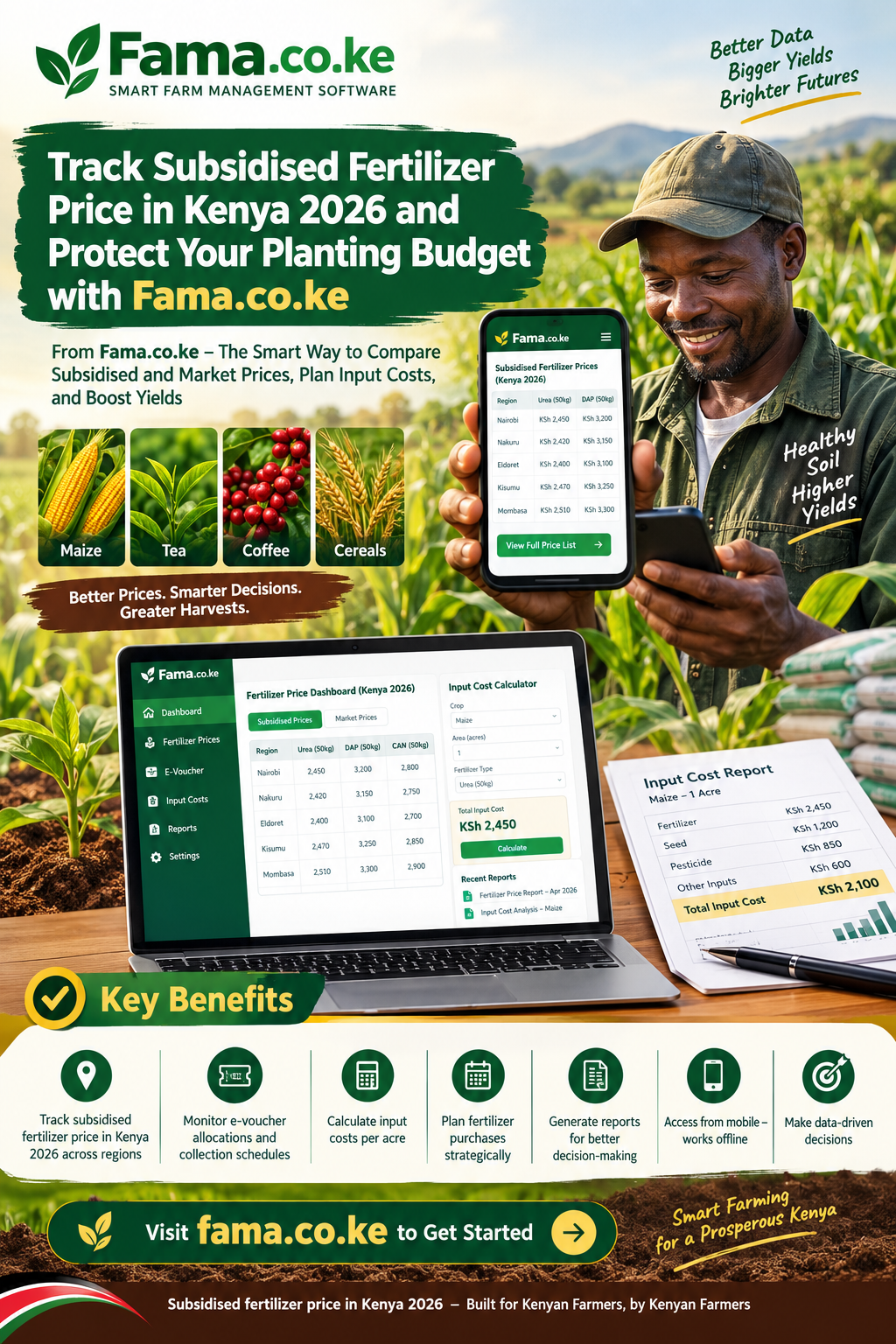
Subsidised fertilizer price in Kenya 2026 has become the single most important number for millions of farmers planning their planting budgets, with the government slashing the cost of a 50-kilogram bag to Sh2,000 in a move expected to boost food production and ease the burden of high input costs. Fama.co.ke provides an innovative farm management platform that helps farmers track subsidised fertilizer price in Kenya 2026, monitor input costs per acre, and make data-driven decisions that protect margins. President William Ruto announced the fresh reduction in August 2026, cutting the cost from Sh2,500 to Sh2,000 as the government seeks to encourage farmers to increase food production and strengthen national food security. Understanding subsidised fertilizer price in Kenya 2026 is not just about knowing a number—it is about knowing how to access the subsidy, what documentation you need, and how to plan your entire planting season around the most affordable inputs Kenya has seen in years.
The current landscape of subsidised fertilizer price in Kenya 2026 reflects a dramatic turnaround from the crisis levels of recent years. Farmers gathered at the NCPB Maragua depot to collect their subsidized fertilizer recalled how the same 50-kilo bag previously retailed at Sh7,000 before the price was reduced to Sh2,500 and subsequently to the current Sh2,000. For Njeri Ngugi, a maize farmer in Kaharati, Murang’a South, the savings are transformative. She has already saved Sh3,000, which she has allocated to purchase certified maize seeds while the rest goes to labour and transportation. This is what subsidised fertilizer price in Kenya 2026 means in practical terms—money freed up for other critical farm expenses.
Fama.co.ke‘s platform helps farmers navigate subsidised fertilizer price in Kenya 2026 by providing tools to track input costs, monitor subsidy allocations, and calculate break-even points per acre. With the government’s expanded subsidy programme reaching over six million farmers across the country, understanding subsidised fertilizer price in Kenya 2026 has become essential for both smallholders and commercial producers. The government has begun distributing two million bags of subsidized fertilizer, providing relief to over six million farmers, with the consignment delivered to 354 National Cereals and Produce Board depots nationwide, as well as to cooperative societies and certified Kenya Tea Development Agency depots.
The journey to the current subsidised fertilizer price in Kenya 2026 reflects a multi-year government commitment to reducing input costs. The price reduction to Sh2,000 represents the third phase of the subsidy programme, following Sh2,500 in Phase Two in 2023 and higher rates before that. The government has argued that cheaper inputs would lower production costs and enable farmers to plant more acreage. Agriculture Cabinet Secretary Mutahi Kagwe confirmed that under the new intervention, a 50-kilogram bag of subsidized fertilizer will retail at Sh2,000, down from Sh2,500, alongside a 50 percent subsidy on certified maize seed that reduces the price from about Sh300 to Sh150.
For farmers seeking to benefit from subsidised fertilizer price in Kenya 2026, registration with the Kenya Integrated Agricultural Management Information System (KIAMIS) is mandatory. The digital farmer registry, supported by the Food and Agriculture Organization and the Swedish embassy, has registered millions of farmers across the country, with fertilizer allotments based on self-reported land area cultivated. Once registered, farmers receive an e-voucher via SMS and can then retrieve their allotment from the nearest government depot or registered agro-vet agent. This subsidised fertilizer price in Kenya 2026 access mechanism ensures that the subsidy reaches genuine farmers rather than middlemen.
The government has strengthened measures to prevent diversion of subsidised fertilizer, with Principal Secretary for Agriculture Dr. Paul Ronoh warning unscrupulous dealers and collaborators selling government-subsidized fertilizer above the approved price that they will be arrested and charged. During the flagging off of 99,000 metric tonnes of fertilizer at the Port of Mombasa, Dr. Ronoh directed the Kenya Tea Development Agency to expedite distribution within the month and intensify farmer sensitization ahead of the El Nino rains. This enforcement directly protects subsidised fertilizer price in Kenya 2026 for farmers who have registered and redeemed their e-vouchers.
Regional variations in subsidised fertilizer price in Kenya 2026 remain minimal because the subsidy applies uniformly across NCPB depots. However, the open market price for unsubsidised fertilizer varies significantly, with a 50kg bag of planting fertilizer retailing at between Sh6,000 and Sh6,500 without subsidy. This gap between the subsidised price and the commercial market price creates a strong incentive for farmers to register and access the subsidy. With subsidised fertilizer price in Kenya 2026, farmers can access DAP at Sh1,800 to Sh2,500 per bag compared to Sh6,000 in agrovets, CAN at Sh1,950 to Sh2,875 compared to Sh4,200, and NPK at Sh3,000 to Sh3,500 compared to commercial rates exceeding Sh4,000.
For farmers looking to maximize the benefit of subsidised fertilizer price in Kenya 2026, proper record-keeping is essential. Tracking input costs against expected yields and market prices enables farmers to determine their break-even point and make informed decisions about crop choices and acreage. The savings from the subsidy are substantial. Teresia Nyambura, a farmer from Saba Saba, has been able to purchase 3 bags of planting fertilizer and 3 for top dressing, and she expects even higher yields than what she harvested last season. From her acre piece of land, Nyambura harvested five 90-kilogram bags of maize, attributing this to subsidized fertilizer alongside other recommended farming practices. With subsidised fertilizer price in Kenya 2026, farmers across the country are achieving better yields and improving their household food security.
Fama.co.ke provides the digital infrastructure to turn subsidised fertilizer price in Kenya 2026 into actionable business data. The platform captures the cost of every bag of fertilizer, tracks application rates per field, and calculates the true cost per kilogram of produce. Reports generated from this data show input costs per hectare, crop performance trends, and profitability that guide purchasing decisions. When subsidised fertilizer price in Kenya 2026 is this favourable, farmers who track their numbers can plan their planting season with confidence rather than hope.
Current Subsidised Fertilizer Price in Kenya 2026 by Type
Understanding subsidised fertilizer price in Kenya 2026 requires examining the specific costs across different fertilizer types. Each formulation has its own pricing structure, and the subsidy applies uniformly to both planting and top-dressing fertilizer. A 50-kilogram bag of subsidised fertilizer now retails at Sh2,000, down from Sh2,500, representing a Sh500 reduction.
DAP Fertilizer
DAP fertilizer, used at planting for maize and other cereals, is sold at Sh1,800 to Sh2,500 per 50kg bag under the subsidy programme, compared to current market prices of Sh3,000 to Sh3,300. The government has set the subsidised price for DAP at Sh2,800 per bag in some distribution phases, saving farmers up to Sh3,200 compared to commercial rates. The dramatic reduction in subsidised fertilizer price in Kenya 2026 for DAP reflects the government’s commitment to making planting inputs affordable.
CAN Fertilizer
CAN fertilizer, used for top-dressing maize and other crops, is sold at Sh1,950 per 90kg bag or Sh2,875 per 50kg bag under the subsidy. Without subsidy, a 50kg bag of CAN retails at between Sh4,200 and Sh4,700. The saving of over Sh1,800 per bag makes top-dressing affordable for smallholders who previously could not afford adequate nitrogen application. This represents a significant reduction in subsidised fertilizer price in Kenya 2026 for top-dressing inputs.
UREA Fertilizer
UREA fertilizer is sold at Sh2,700 per 50kg bag under the subsidy. The recommended application of 50kg per acre aids crop growth and development, and the subsidised price ensures farmers can afford the recommended quantities. UREA is particularly important for top-dressing cereals, and the subsidised fertilizer price in Kenya 2026 makes it accessible to all registered farmers.
NPK Fertilizer
NPK fertilizer is sold at Sh3,000 per 50kg bag under the subsidy. This compound fertilizer, containing nitrogen, phosphorus, and potassium, is essential for crops requiring balanced nutrition. The subsidised fertilizer price in Kenya 2026 for NPK represents a significant saving compared to commercial rates of over Sh4,000 per bag.
MOP Fertilizer
MOP fertilizer is sold at Sh2,500 per 50kg bag under the subsidy. Muriate of Potash provides potassium for crops such as potatoes and vegetables. The subsidised fertilizer price in Kenya 2026 for MOP ensures that farmers growing potassium-demanding crops can access affordable inputs.
Sulphate of Ammonia
Sulphate of Ammonia is also available under the subsidy programme, providing another option for farmers requiring nitrogen and sulphur. The subsidised fertilizer price in Kenya 2026 applies uniformly to all registered farmers purchasing through NCPB depots and designated distribution points.
How to Access Subsidised Fertilizer Price in Kenya 2026
The process of accessing subsidised fertilizer price in Kenya 2026 is straightforward for registered farmers. Follow these steps to ensure you benefit from the programme.
Step 1: Register with KIAMIS
The first step to access subsidised fertilizer price in Kenya 2026 is registration with the Kenya Integrated Agricultural Management Information System. This digital registry captures your details, land size, and crop plans. Registration can be done through the Ministry of Agriculture offices at the county level, where agricultural officers assist farmers in the process.
Step 2: Obtain Your E-Voucher
Once registered, you will receive an e-voucher via SMS. This voucher details the maximum allocated quantity depending on the acreage you declared during registration. The e-voucher is your key to accessing the subsidised fertilizer price in Kenya 2026 at NCPB depots and designated collection points.
Step 3: Visit the Nearest NCPB Depot
With your e-voucher and original identity card, visit the nearest NCPB depot to redeem your allocation. The government has directed NCPB to open depots on weekends and public holidays to ensure farmers can access fertilizer conveniently. Over 354 NCPB depots nationwide are stocked with subsidised fertilizer at the subsidised fertilizer price in Kenya 2026.
Step 4: Make Payment
Payment for subsidised fertilizer at the subsidised fertilizer price in Kenya 2026 is made through M-Pesa or bank deposit. Cash payments are not accepted at NCPB depots. The e-voucher system ensures that payments are verified and fertilizer is released only to registered farmers.
Step 5: Collect and Store Fertilizer Safely
After payment, collect your fertilizer and store it in a dry, ventilated area. Proper storage prevents caking and maintains fertilizer quality until application time. Farmers accessing the subsidised fertilizer price in Kenya 2026 should plan collection dates to align with their planting schedule.
Factors Driving Subsidised Fertilizer Price in Kenya 2026
Government Subsidy Programme
The primary factor determining the subsidised fertilizer price in Kenya 2026 is the government’s subsidy programme. Through this initiative, the government absorbs a significant portion of the market price, allowing farmers to purchase fertilizer at Sh2,000 per 50kg bag instead of Sh6,000 to Sh6,500. The subsidy programme has been expanded to reach over six million farmers, with government figures showing that more than 32 million bags of fertilizer had been distributed across four seasons.
Global Supply Chain and Import Costs
The subsidised fertilizer price in Kenya 2026 is influenced by global supply chain conditions, even with government support. The delay in fertilizer distribution in early 2026 was occasioned by the Middle East conflict, which forced vessels to take longer routes through South Africa to reach Mombasa. Kenya imports most of its fertilizer, and global price movements, shipping costs, and currency fluctuations all affect the total cost that the government subsidises. However, the subsidy programme insulates farmers from these shocks by ensuring the subsidised fertilizer price in Kenya 2026 remains stable at Sh2,000 per bag.
Government Budget Allocation
The government has allocated significant resources to maintain the subsidised fertilizer price in Kenya 2026. The budget allocation for the fertilizer subsidy programme has increased substantially, with the government investing billions to ensure farmers can access affordable inputs. This investment reflects the government’s recognition that affordable fertilizer is essential for national food security and agricultural productivity.
Distribution Infrastructure
The subsidised fertilizer price in Kenya 2026 depends on efficient distribution infrastructure. The government has engaged transporters and the Kenya Railway Corporation to ensure fertilizer is delivered faster and more efficiently to depots across the country. The Standard Gauge Railway is being used to transport fertilizer to NCPB depots, ensuring timely distribution ahead of planting seasons.
Registration and Verification
The requirement for registration and e-voucher verification affects access to the subsidised fertilizer price in Kenya 2026. While the registration process ensures the subsidy reaches genuine farmers, it also creates a barrier for those unfamiliar with the system. The government has shifted agro-dealer registration to county governments to ease farmer access, and is working with commercial banks to introduce an instant payment system that ensures agro-dealers are paid immediately once farmers redeem fertilizer vouchers.
Impact of Subsidised Fertilizer Price in Kenya 2026 on Farming
Increased Food Production
The reduction in subsidised fertilizer price in Kenya 2026 is expected to boost food production significantly. President Ruto urged farmers to take advantage of the expected October short rains to increase food production and strengthen national food security. With cheaper inputs, farmers can plant more acreage and apply recommended quantities of fertilizer, leading to higher yields. The government expects that the subsidised fertilizer price in Kenya 2026 will contribute to a bumper harvest and reduce the need for maize imports.
Reduced Production Costs
The subsidised fertilizer price in Kenya 2026 directly reduces production costs for farmers. For Njeri Ngugi, the Sh3,000 saved per bag has been reallocated to certified maize seeds, labour, and transportation. For Teresia Nyambura, the ability to purchase 3 bags of planting fertilizer and 3 for top dressing has given her confidence in achieving higher yields. The reduced input costs mean more of what farmers earn from their harvest can remain as profit. This is the transformative impact of the subsidised fertilizer price in Kenya 2026.
Improved Access for Smallholders
Previously, a single 50-kilogram bag of fertilizer was out of reach for most smallholders, who would pool resources to buy one bag and share amongst themselves. With the subsidised fertilizer price in Kenya 2026 at Sh2,000, individual farmers can afford their own bags. This improved access is particularly significant for women farmers and youth who often lack the capital to purchase inputs at market rates.
National Food Security
The subsidised fertilizer price in Kenya 2026 has national food security implications. The government has announced plans to import 25 million 90-kilogram bags of maize to replenish national reserves following poor rainfall and crop failure. However, if the subsidy programme succeeds in boosting local production, Kenya could reduce its reliance on imports. The subsidised fertilizer price in Kenya 2026 is therefore a strategic investment in the nation’s ability to feed itself.
Farmer Confidence and Optimism
Farmers across the country have welcomed the subsidised fertilizer price in Kenya 2026 with optimism. Wilson Nduati, an avocado farmer from Ndutumi, observed that the reduced price would enable farmers to allocate more resources to other farm inputs and take better care of their farms. He increased the number of bags from last season to 8 and believes this will increase his avocado yields even more. “Any reduction in prices gives us hope that we can plant, improve production and even make more profits from our ventures,” he said. This optimism is a direct result of the subsidised fertilizer price in Kenya 2026.
How Fama.co.ke Helps Farmers Navigate Subsidised Fertilizer Price in Kenya 2026
Track Input Costs Per Acre
Fama.co.ke helps farmers calculate the true cost of their fertilizer inputs, enabling them to determine whether the subsidised fertilizer price in Kenya 2026 allows profitable production. By tracking input costs per acre against expected yields and market prices, farmers can make informed decisions about fertilizer application rates and crop choices.
Monitor Subsidy Allocations
The platform provides tools to track subsidy allocations, e-voucher status, and collection schedules. Farmers can monitor their subsidised fertilizer price in Kenya 2026 entitlements and plan collection dates to align with planting schedules.
Optimise Fertilizer Application
Fama.co.ke helps farmers plan fertilizer application based on crop requirements and soil conditions, ensuring that every bag of subsidised fertilizer delivers maximum return. By tracking application rates per field and correlating with yield data, farmers can identify the optimal application rate for their specific conditions.
Generate Financial Reports and Budgets
The platform generates reports that show input costs per hectare, helping farmers understand which crops and practices deliver the best returns relative to the subsidised fertilizer price in Kenya 2026. With proper record-keeping, farmers can identify cost-saving opportunities and improve margins even when other input prices are volatile.
Strategies to Maximize the Benefit of Subsidised Fertilizer Price in Kenya 2026
Register Early
To benefit from the subsidised fertilizer price in Kenya 2026, register with KIAMIS early. Early registration ensures your e-voucher is processed in time for the planting season, avoiding last-minute delays at NCPB depots.
Plan Your Fertilizer Requirements
Calculate your fertilizer requirements before visiting the depot. Consider your acreage, crop choice, and recommended application rates. This planning ensures you purchase the right quantity and type of fertilizer at the subsidised fertilizer price in Kenya 2026.
Buy Both Planting and Top-Dressing Fertilizer
The subsidy applies uniformly to both planting and top-dressing fertilizer. Take advantage of the subsidised fertilizer price in Kenya 2026 to purchase all your fertilizer requirements in one transaction, saving transport costs and ensuring you have adequate supplies throughout the season.
Store Fertilizer Safely
Proper storage preserves fertilizer quality and ensures it is ready for application when needed. Store subsidised fertilizer in a dry, ventilated area away from moisture and direct sunlight. This protects your investment in the subsidised fertilizer price in Kenya 2026.
Combine with Certified Seeds
The government has also subsidised certified maize seed by 50 percent, reducing the price from about Sh300 to Sh150 per kilogramme. Combining subsidised fertilizer with subsidised certified seeds maximizes the return on your investment at the subsidised fertilizer price in Kenya 2026.
Track Your Inputs
Use Fama.co.ke to track your fertilizer purchases, application rates, and crop yields. This data helps you refine your farming practices and make better decisions in future seasons when accessing the subsidised fertilizer price in Kenya 2026.
The Outlook for Subsidised Fertilizer Price in Kenya 2026
The outlook for the subsidised fertilizer price in Kenya 2026 remains positive, with the government demonstrating a strong commitment to supporting farmers. The price has been reduced progressively from Sh7,000 to Sh2,500 and now to Sh2,000, with farmers expressing hope that it could fall further to Sh1,500 or Sh1,000. The government has put in place a robust plan for next year’s fertilizer subsidy to cushion farmers against any disruptions beyond its control.
As more farmers register and access the subsidy, the subsidised fertilizer price in Kenya 2026 is expected to contribute to increased food production, reduced imports, and improved household food security. The government’s continued investment in the subsidy programme reflects its recognition that affordable inputs are the foundation of a productive agricultural sector. Farmers using Fama.co.ke to track the subsidised fertilizer price in Kenya 2026 and manage their input costs will be best positioned to navigate this favourable landscape and achieve profitable harvests.
Subsidised fertilizer price in Kenya 2026 has transformed from a question of affordability to a question of access. The Sh2,000 per 50kg bag price represents the lowest cost farmers have seen in years, and the government’s expanded distribution network ensures that registered farmers across all 47 counties can access the subsidy. For farmers seeking to maximise profitability, proper record-keeping and market intelligence are essential. Fama.co.ke provides the tools needed to track input costs, monitor subsidy allocations, and make data-driven decisions that protect profitability.
Kenyan farmers who use Fama.co.ke to track the subsidised fertilizer price in Kenya 2026 position themselves for greater success in the evolving agricultural sector. The platform helps farmers make better decisions, reduce input waste, and achieve higher returns.
Fama.co.ke has developed farm management software that meets the unique needs of Kenyan farmers. The platform combines powerful features with intuitive design, making it accessible for farmers of all sizes.
Start your journey with Fama.co.ke today. Visit fama.co.ke to learn more about how farm management software can help you track the subsidised fertilizer price in Kenya 2026 and optimise your farm input management.
Frequently Asked Questions About Subsidised Fertilizer Price in Kenya 2026
What is the current subsidised fertilizer price in Kenya 2026?
A 50-kilogram bag of subsidised fertilizer now retails at Sh2,000, down from Sh2,500. The price applies uniformly to both planting and top-dressing fertilizer. This represents a reduction from Sh7,000 before the subsidy programme began.
How do I access subsidised fertilizer price in Kenya 2026?
Register with the Kenya Integrated Agricultural Management Information System (KIAMIS), obtain an e-voucher via SMS, and visit the nearest NCPB depot with your original identity card. Payment is made through M-Pesa or bank deposit. Over 354 NCPB depots nationwide are stocked with subsidised fertilizer.
What is the subsidised price for DAP fertilizer in Kenya 2026?
DAP fertilizer is sold at Sh1,800 to Sh2,500 per 50kg bag under the subsidy programme, compared to current market prices of Sh3,000 to Sh3,300. The government has set the subsidised price for DAP at Sh2,800 per bag in some distribution phases.
What is the subsidised price for CAN fertilizer in Kenya 2026?
CAN fertilizer is sold at Sh1,950 per 90kg bag or Sh2,875 per 50kg bag under the subsidy. Without subsidy, a 50kg bag of CAN retails at between Sh4,200 and Sh4,700.
When will subsidised fertilizer be available in 2026?
The government has begun distributing two million bags of subsidized fertilizer to 354 NCPB depots nationwide, as well as to cooperative societies and certified KTDA depots. NCPB depots have been directed to open on weekends and public holidays to ensure farmers can access fertilizer conveniently.