Introduction
Agriculture remains the backbone of Kenya’s economy, contributing significantly to employment, food security, and economic growth. However, modern farming faces numerous challenges including unpredictable weather patterns, rising input costs, labor shortages, pest infestations, and inefficient record management. These challenges have made it necessary for farmers to embrace technology-driven solutions. One of the most effective innovations in modern agriculture is a Smart Farm Management System.
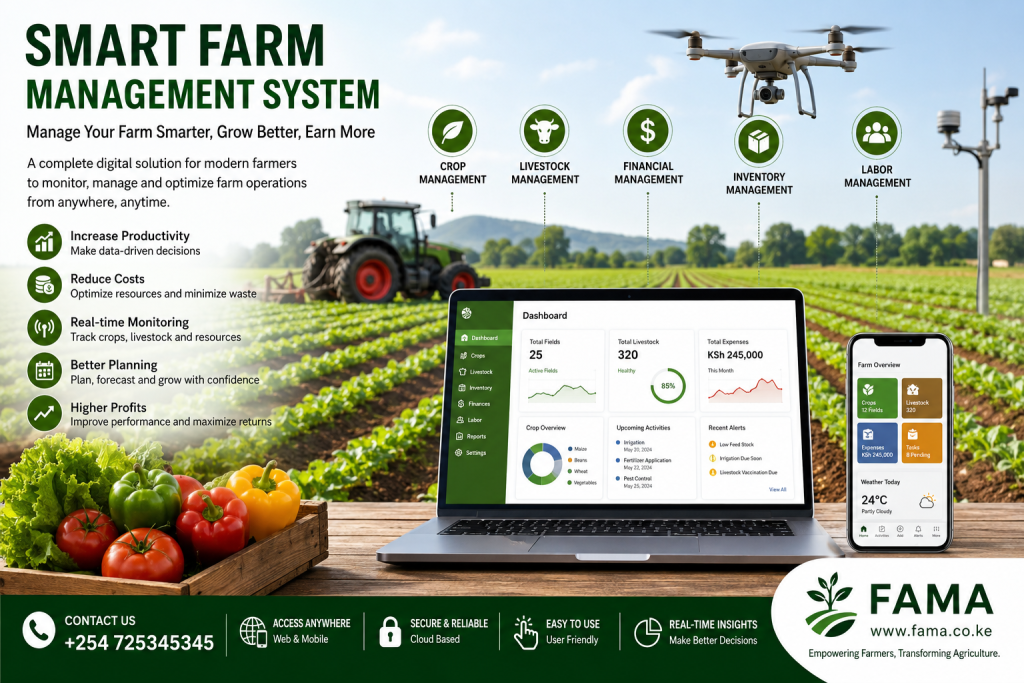
This system is a digital platform designed to help farmers monitor, manage, and optimize farm operations through data-driven decision-making. Whether you operate a small-scale farm, a medium-sized agricultural enterprise, or a large commercial farm, a Smart Farm Management System can improve productivity, reduce costs, and maximize profits.
At Fama.co.ke, we understand the importance of modern farming technologies in improving agricultural performance. A Smart Farm Management System provides farmers with real-time insights into farm activities, crop performance, livestock management, resource utilization, and financial tracking.
For inquiries about implementing a Smart Farm Management System, contact us at +254 725345345.
What is a Smart Farm Management System?
A Smart Farm Management System is an integrated software solution that combines farm planning, monitoring, analytics, automation, and reporting into one centralized platform. The system enables farmers to collect, analyze, and utilize data to make informed decisions regarding farm operations.
The Smart Farm Management System uses modern technologies such as:
- Cloud computing
- Mobile applications
- Internet of Things (IoT)
- GPS tracking
- Artificial Intelligence
- Data analytics
- Remote monitoring sensors
By leveraging these technologies, farmers can effectively manage crops, livestock, labor, inventory, finances, and equipment from a single dashboard.
Why Farmers Need a Smart Farm Management System
Traditional farming methods often rely on manual record-keeping and guesswork. While experience remains valuable, today’s competitive agricultural environment demands accurate data and timely information.
A Smart Farm Management System helps farmers:
- Increase productivity
- Improve efficiency
- Reduce operational costs
- Monitor farm performance
- Improve resource allocation
- Enhance profitability
- Make data-driven decisions
- Minimize losses
- Improve compliance and traceability
As farming becomes more complex, a Smart Farm Management System becomes an essential tool for sustainable agricultural success.
Key Features of a Smart Farm Management System
Crop Management
Crop management is one of the most important components of a Smart Farm Management System.
The system helps farmers track:
- Planting schedules
- Crop varieties
- Fertilizer application
- Irrigation schedules
- Growth stages
- Harvest projections
- Yield analysis
With a Smart Farm Management System, farmers can identify factors affecting crop performance and implement corrective measures promptly.
Livestock Management
For livestock farmers, a Smart Farm Management System simplifies animal monitoring and management.
Key livestock management capabilities include:
- Animal registration
- Breeding records
- Vaccination schedules
- Feed management
- Weight tracking
- Health monitoring
- Milk production records
The Smart Farm Management System ensures that farmers maintain accurate livestock records while improving animal health and productivity.
Farm Financial Management
Financial management is critical for every farming business.
A Smart Farm Management System helps farmers manage:
- Farm income
- Operational expenses
- Profitability reports
- Budget planning
- Cash flow tracking
- Sales records
- Purchase records
With accurate financial data, farmers can identify profitable activities and eliminate unnecessary expenses.
Inventory Management
Inventory control is often overlooked in agriculture.
A Smart Farm Management System tracks:
- Seeds
- Fertilizers
- Pesticides
- Animal feed
- Farm equipment
- Spare parts
The system helps prevent stock shortages and minimizes wastage through accurate inventory monitoring.
Labor Management
Labor costs represent a significant portion of farm expenses.
A Smart Farm Management System enables farmers to:
- Track employee attendance
- Assign tasks
- Monitor productivity
- Manage payroll
- Evaluate performance
This feature improves workforce efficiency while reducing labor-related challenges.
Benefits of Using a Smart Farm Management System
Increased Farm Productivity
One of the primary benefits of a Smart Farm Management System is improved productivity.
The system provides actionable insights that help farmers:
- Optimize planting schedules
- Improve irrigation management
- Reduce disease outbreaks
- Enhance livestock performance
- Increase yields
As a result, farmers achieve higher output from the same resources.
Better Decision Making
Data-driven farming leads to better outcomes.
A Smart Farm Management System collects valuable information and presents it in easy-to-understand reports and dashboards.
Farmers can make informed decisions based on:
- Historical data
- Current conditions
- Performance trends
- Predictive analytics
This reduces uncertainty and improves planning.
Reduced Operational Costs
A Smart Farm Management System helps reduce expenses by optimizing resource utilization.
Farmers can minimize:
- Water wastage
- Fertilizer overuse
- Feed losses
- Fuel consumption
- Labor inefficiencies
Lower operational costs contribute directly to higher profitability.
Improved Record Keeping
Accurate records are essential for successful farm management.
A Smart Farm Management System stores all farm data digitally, including:
- Crop records
- Livestock records
- Financial transactions
- Inventory data
- Employee information
Digital records eliminate paperwork and improve accessibility.
Enhanced Traceability
Consumers increasingly demand transparency in food production.
A Smart Farm Management System provides complete traceability from production to market.
Farmers can track:
- Inputs used
- Production activities
- Harvest dates
- Storage records
- Distribution channels
This improves food safety and market credibility.
Smart Farm Management System for Crop Farmers
Crop farmers face numerous challenges including pests, diseases, climate variability, and market fluctuations.
A Smart Farm Management System addresses these challenges by providing tools for:
Farm Planning
The system assists farmers in:
- Land preparation planning
- Crop rotation scheduling
- Resource allocation
- Production forecasting
Proper planning improves farm efficiency and profitability.
Irrigation Management
Water management is critical for crop production.
A Smart Farm Management System helps farmers:
- Monitor soil moisture
- Schedule irrigation
- Reduce water wastage
- Improve crop health
Efficient irrigation contributes to higher yields and lower costs.
Pest and Disease Monitoring
Early detection is essential for effective pest and disease control.
The Smart Farm Management System allows farmers to:
- Record pest incidents
- Monitor outbreaks
- Schedule treatments
- Analyze trends
This reduces crop losses and protects productivity.
Smart Farm Management System for Livestock Farmers
Livestock farming requires continuous monitoring and record management.
A Smart Farm Management System simplifies:
Dairy Farm Management
Dairy farmers can monitor:
- Milk production
- Feed consumption
- Breeding cycles
- Animal health
- Revenue generation
The Smart Farm Management System improves dairy farm efficiency and profitability.
Poultry Farm Management
Poultry farmers can track:
- Bird populations
- Feed usage
- Egg production
- Mortality rates
- Vaccination schedules
This enables better flock management and improved production outcomes.
Beef Production Management
A Smart Farm Management System helps beef farmers monitor:
- Weight gain
- Feeding programs
- Health records
- Breeding performance
Accurate data improves herd performance and profitability.
Role of IoT in Farm Systems
The Internet of Things has revolutionized modern agriculture.
IoT devices integrated into a Smart Farm Management System can collect real-time data from the farm.
Examples include:
- Soil moisture sensors
- Weather stations
- Livestock trackers
- Water level sensors
- Temperature monitors
This data helps farmers respond quickly to changing conditions and improve operational efficiency.
Mobile Access and Cloud Technology
Modern farmers require access to farm information anytime and anywhere.
A cloud-based Smart Farm Management System offers:
- Remote access
- Data security
- Automatic backups
- Multi-user access
- Real-time synchronization
Farmers can manage their operations directly from smartphones, tablets, or computers.
Smart Farm Management System and Sustainable Agriculture
Sustainability is becoming increasingly important in agriculture.
A Smart Farm Management System supports sustainable farming practices by helping farmers:
- Reduce resource wastage
- Optimize fertilizer application
- Improve water efficiency
- Reduce environmental impact
- Promote responsible farming practices
Sustainable agriculture benefits both farmers and future generations.
Choosing the Right Smart Farm Management System
When selecting a Smart Farm Management System, farmers should consider:
- Ease of use
- Scalability
- Mobile compatibility
- Data security
- Reporting capabilities
- Customer support
- Integration options
- Cost effectiveness
The right Smart Farm Management System should align with the farm’s goals and operational requirements.
Why Kenyan Farmers Are Adopting Smart Farm Management Systems
Kenyan agriculture is rapidly embracing digital transformation.
Farmers are increasingly adopting Smart Farm Management Systems because they offer:
- Better farm visibility
- Improved productivity
- Enhanced profitability
- Accurate reporting
- Simplified management
As technology becomes more accessible, Smart Farm Management Systems are expected to play a central role in the future of agriculture across Kenya.
How a Smart Farm Management System Improves Farm Profitability
Every farmer’s ultimate goal is profitability. A Smart Farm Management System helps achieve this by providing visibility into every aspect of farm operations.
Many farmers lose money because they cannot accurately track:
- Production costs
- Input utilization
- Labor expenses
- Equipment maintenance costs
- Market performance
- Crop yields
- Livestock productivity
A Smart Farm Management System eliminates these challenges by providing accurate reports and real-time analytics.
With a Smart Farm Management System, farmers can identify:
- Which crops generate the highest profits
- Which livestock units perform best
- Areas causing financial losses
- Opportunities for expansion
- Cost-saving measures
The result is a more profitable and sustainable farming enterprise.
Smart Farm Management System and Data-Driven Agriculture
Modern agriculture is becoming increasingly data-driven.
A Smart Farm Management System collects and analyzes farm data to help farmers make better decisions.
Data collected may include:
- Soil conditions
- Rainfall patterns
- Crop growth data
- Harvest records
- Livestock health information
- Financial transactions
- Labor performance
Using this information, a Smart Farm Management System helps farmers optimize operations and maximize output.
Instead of relying on assumptions, farmers can use actual farm data to improve productivity and profitability.
Precision Farming with a Smart Farm Management System
Precision farming is one of the fastest-growing agricultural practices worldwide.
A Smart Farm Management System supports precision agriculture by helping farmers apply resources where and when they are needed.
Precision farming benefits include:
- Improved crop yields
- Reduced fertilizer costs
- Efficient pesticide application
- Better water management
- Reduced environmental impact
A Smart Farm Management System ensures that every farming activity is based on accurate information and measurable outcomes.
Weather Monitoring and Forecasting
Weather remains one of the biggest risks in agriculture.
A Smart Farm Management System can integrate weather monitoring tools to provide valuable insights.
Farmers can receive information on:
- Rainfall forecasts
- Temperature changes
- Humidity levels
- Wind conditions
- Drought risks
Access to weather information allows farmers to plan:
- Planting schedules
- Irrigation activities
- Harvest operations
- Pest management programs
By reducing weather-related uncertainty, a Smart Farm Management System helps farmers minimize losses and improve productivity.
Equipment and Machinery Management
Farm machinery represents a significant investment.
A Smart Farm Management System helps farmers manage:
- Tractors
- Irrigation systems
- Harvesters
- Transport vehicles
- Generators
- Processing equipment
The system tracks:
- Maintenance schedules
- Fuel consumption
- Repair costs
- Equipment utilization
Proper machinery management extends equipment lifespan and reduces unexpected breakdowns.
Supply Chain Management
Agricultural success extends beyond production.
Farmers must effectively manage storage, transportation, and distribution.
A Smart Farm Management System helps monitor:
- Harvest volumes
- Storage conditions
- Delivery schedules
- Customer orders
- Market demand
This improves efficiency throughout the agricultural value chain.
Market Intelligence and Sales Tracking
A Smart Farm Management System enables farmers to monitor market trends and sales performance.
Farmers can track:
- Product demand
- Pricing trends
- Customer preferences
- Sales volumes
- Revenue generation
This information supports better marketing and sales decisions.
The Smart Farm Management System helps farmers identify the most profitable markets and maximize returns.
Compliance and Regulatory Management
Agricultural regulations continue to evolve.
A Smart Farm Management System helps farmers maintain compliance with:
- Food safety standards
- Export requirements
- Environmental regulations
- Quality assurance programs
- Traceability requirements
Digital record keeping simplifies audits and regulatory inspections.
Smart Farm Management System for Agribusinesses
Large agricultural enterprises require advanced management tools.
A Smart Farm Management System helps agribusinesses manage:
- Multiple farms
- Large workforces
- Extensive inventories
- Diverse production activities
- Financial operations
Centralized management improves efficiency across all business units.
Integration with Modern Agricultural Technologies
The best Smart Farm Management System integrates seamlessly with modern technologies.
Examples include:
GPS Technology
GPS integration enables:
- Field mapping
- Asset tracking
- Machinery monitoring
- Precision farming activities
Drone Technology
Drones can collect valuable farm data including:
- Crop health assessments
- Irrigation performance
- Pest infestation detection
- Field monitoring
A Smart Farm Management System consolidates this information into actionable insights.
Artificial Intelligence
AI-powered Smart Farm Management Systems can:
- Predict crop diseases
- Forecast yields
- Recommend optimal planting times
- Analyze farm performance
Artificial intelligence helps farmers make smarter decisions faster.
Common Challenges Solved by a Smart Farm Management System
Poor Record Keeping
Many farms struggle with incomplete records.
A Smart Farm Management System provides centralized digital records that are easy to access and update.
Resource Wastage
Farmers often waste:
- Water
- Fertilizers
- Seeds
- Feed
- Labor
A Smart Farm Management System helps optimize resource utilization and reduce waste.
Low Productivity
Low productivity can result from poor planning and limited information.
A Smart Farm Management System improves visibility into farm operations and identifies opportunities for improvement.
Financial Mismanagement
Financial challenges are common in agriculture.
A Smart Farm Management System provides detailed financial reports that support better budgeting and decision-making.
Features Every Smart Farm Management System Should Have
When evaluating a Smart Farm Management System, farmers should look for:
Real-Time Dashboards
Dashboards provide instant visibility into farm performance.
Mobile Accessibility
Farmers should access farm information from anywhere.
Automated Reporting
Reports should be generated automatically to save time.
Multi-Farm Support
Large operations may require management of multiple locations.
User-Friendly Interface
A Smart Farm Management System should be easy to learn and use.
Data Security
Farm information should remain secure and protected.
Cloud-Based Infrastructure
Cloud systems improve accessibility and reliability.
Why Fama.co.ke Recommends Smart Farm Management Systems
At Fama.co.ke, we believe technology is essential for modern agricultural success.
A Smart Farm Management System empowers farmers to:
- Increase yields
- Improve efficiency
- Reduce costs
- Enhance sustainability
- Improve profitability
Whether you are involved in crop farming, dairy farming, poultry farming, horticulture, aquaculture, or mixed farming, a Smart Farm Management System provides the tools needed for growth and success.
Future Trends in Smart Farm Management Systems
Agriculture continues to evolve rapidly.
Future Smart Farm Management System innovations may include:
- Advanced AI analytics
- Autonomous farm equipment
- Predictive maintenance
- Blockchain traceability
- Advanced remote sensing
- Machine learning recommendations
- Smart irrigation automation
- Real-time disease detection
Farmers who adopt Smart Farm Management Systems today position themselves for future success.
Frequently Asked Questions About Smart Farm Management Systems
What is a Smart Farm Management System?
This is a digital platform that helps farmers manage farm operations, monitor productivity, track finances, and optimize agricultural performance using technology and data analytics.
Who Can Use a Smart Farm Management System?
A Smart Farm Management System can be used by:
- Small-scale farmers
- Commercial farmers
- Dairy farmers
- Poultry farmers
- Horticulture farmers
- Agribusiness companies
- Agricultural cooperatives
Is a Smart Farm Management System Suitable for Kenyan Farmers?
Yes. A Smart Farm Management System is ideal for Kenyan farmers because it helps improve efficiency, productivity, and profitability while addressing common farming challenges.
Can a Smart Farm Management System Increase Profits?
Absolutely. By improving resource utilization, reducing waste, and enhancing decision-making, a Smart Farm Management System contributes significantly to farm profitability.
Does a Smart Farm Management System Require Internet Access?
Most cloud-based Smart Farm Management Systems perform best with internet access, although some offer offline functionality with later synchronization.
Can Livestock Farmers Use a Smart Farm Management System?
Yes. Livestock farmers can use a Smart Farm Management System to track breeding, feeding, vaccination schedules, health records, and production performance.
Building a Resilient Agricultural Enterprise in the Modern Era
Agriculture has evolved significantly over the past few decades. What was once considered a traditional activity has become a highly sophisticated industry driven by innovation, knowledge, and strategic planning. Success today requires more than fertile land and favorable weather conditions. It demands careful organization, continuous learning, effective resource allocation, and the ability to adapt to changing circumstances.
One of the key characteristics of successful agricultural enterprises is the ability to plan ahead. Long-term planning helps producers anticipate challenges, allocate resources efficiently, and establish realistic production targets. Planning also allows businesses to prepare for seasonal fluctuations, market changes, and unexpected disruptions that may affect operations.
Education plays a major role in improving agricultural performance. Producers who continuously seek knowledge are often better positioned to implement improved production methods and respond to emerging challenges. Training programs, workshops, agricultural exhibitions, and industry conferences provide valuable opportunities to learn from experts and exchange ideas with other stakeholders.
Market awareness is equally important. Understanding consumer preferences helps producers align their products with market demand. Consumer expectations continue to evolve, with increasing emphasis on quality, safety, consistency, and sustainability. Businesses that understand these trends are more likely to remain competitive and profitable.
Another important factor is diversification. Relying on a single source of income can expose businesses to unnecessary risks. Diversification creates additional revenue streams and helps reduce the impact of market fluctuations. Production enterprises that engage in multiple activities often enjoy greater financial stability and improved resilience during difficult periods.
Environmental stewardship has also become a critical consideration. Responsible management of natural resources contributes to long-term productivity and sustainability. Conserving water resources, maintaining soil health, protecting biodiversity, and minimizing waste help ensure that future generations can continue benefiting from agricultural activities.
Collaboration among stakeholders is another important driver of success. Producers, suppliers, distributors, researchers, financial institutions, and policymakers all contribute to the growth of the agricultural sector. Strong partnerships create opportunities for knowledge sharing, innovation, and market expansion.
Infrastructure development remains essential for sector growth. Reliable transportation networks, storage facilities, processing centers, and communication systems improve efficiency and reduce losses. Investments in infrastructure strengthen supply chains and enhance access to local and international markets.
Financial literacy is becoming increasingly important for agricultural entrepreneurs. Understanding budgeting, cash flow management, investment planning, and risk assessment enables business owners to make informed decisions. Financial discipline contributes to long-term sustainability and supports future expansion efforts.
Risk management should be a priority for every enterprise. Weather variability, market volatility, disease outbreaks, and supply chain disruptions can affect performance. Developing contingency plans and maintaining financial reserves can help organizations navigate periods of uncertainty more effectively.
Youth participation continues to shape the future of agriculture. Young entrepreneurs bring fresh perspectives, creativity, and enthusiasm to the industry. Their willingness to embrace innovation creates new opportunities for growth and transformation. Encouraging youth involvement contributes to job creation, economic development, and food security.
Women also play a vital role in agricultural development. Across many communities, women contribute significantly to production, processing, marketing, and household food security. Supporting women through access to training, resources, and financing helps strengthen the entire value chain.
The importance of quality assurance cannot be overstated. Maintaining high standards throughout production and distribution processes improves customer satisfaction and enhances market reputation. Quality-focused organizations often achieve stronger customer loyalty and better pricing opportunities.
Access to reliable information supports better decision-making. Timely information regarding market conditions, climate patterns, consumer trends, and industry developments enables stakeholders to respond proactively rather than reactively. Information empowers businesses to identify opportunities and mitigate potential challenges.
Innovation continues to drive progress throughout the sector. New approaches to production, processing, storage, and distribution help improve efficiency and productivity. Organizations that embrace innovation are generally better equipped to remain competitive in rapidly changing environments.
Export opportunities continue to expand for producers capable of meeting international standards. Global markets offer significant growth potential, particularly for high-quality products with strong traceability and consistent supply. Accessing these markets often requires investment in quality control, certification, and logistics capabilities.
Community engagement is another factor that contributes to sustainable growth. Enterprises that maintain positive relationships with surrounding communities often benefit from stronger support networks and improved social goodwill. Community partnerships can also create opportunities for training, employment, and local development initiatives.
Food security remains a global priority. Increasing populations and changing consumption patterns place additional pressure on production systems. Meeting future demand will require continued investment in innovation, infrastructure, education, and sustainable practices. Stakeholders across the value chain must work together to ensure stable and reliable food supplies.
Resource efficiency is becoming increasingly important as input costs continue to rise. Careful utilization of available resources helps reduce expenses while maintaining productivity. Efficient operations often achieve stronger financial performance and improved long-term sustainability.
The role of leadership should not be overlooked. Effective leaders inspire teams, establish clear objectives, and foster a culture of accountability. Strong leadership helps organizations navigate challenges, seize opportunities, and achieve strategic goals.
Customer relationships are another essential component of success. Understanding customer needs and maintaining consistent communication strengthens trust and encourages repeat business. Satisfied customers often become valuable advocates who contribute to business growth through referrals and positive recommendations.
Looking ahead, the future of agriculture will continue to be shaped by technological advancement, changing consumer expectations, environmental considerations, and global economic trends. Organizations that remain adaptable, innovative, and customer-focused will be well positioned to thrive in an increasingly competitive marketplace.
Ultimately, long-term success depends on a combination of sound management, continuous improvement, responsible resource utilization, and a commitment to excellence. By focusing on these principles, agricultural enterprises can build resilience, improve performance, and create lasting value for stakeholders throughout the value chain.
Strengthening Long-Term Growth and Competitiveness
Long-term growth does not happen by chance. It is the result of consistent effort, strategic thinking, and a willingness to adapt to changing circumstances. Organizations that focus on continuous improvement often achieve better outcomes than those that rely solely on past successes. Maintaining a forward-looking mindset allows decision-makers to identify opportunities before competitors and respond effectively to emerging challenges.
Building strong operational systems is essential for sustainable growth. Clear processes help improve efficiency, reduce errors, and ensure consistency across daily activities. Well-documented procedures also make it easier to train new team members and maintain performance standards as operations expand. Consistency creates a solid foundation upon which future growth can be built.
Workforce development remains a critical investment. Employees who possess the necessary skills and knowledge contribute significantly to organizational success. Providing opportunities for professional development helps improve productivity, motivation, and retention. A knowledgeable workforce is often better equipped to solve problems, implement improvements, and adapt to industry changes.
Communication is another important component of successful operations. Clear communication reduces misunderstandings and helps ensure that objectives are understood throughout the organization. Regular meetings, performance reviews, and feedback sessions encourage collaboration and alignment among team members. Effective communication strengthens relationships and supports a positive working environment.
Customer expectations continue to evolve, making service quality more important than ever. Organizations that prioritize customer satisfaction often enjoy stronger loyalty and long-term business relationships. Delivering reliable products and services while maintaining professional interactions helps build trust and credibility in the marketplace.
Reputation is one of the most valuable assets any organization can possess. A strong reputation attracts customers, business partners, investors, and talented employees. Maintaining high ethical standards, delivering consistent quality, and honoring commitments contribute to a positive public image. Over time, a trusted reputation becomes a powerful competitive advantage.
Adaptability is increasingly important in today’s dynamic business environment. Market conditions, consumer preferences, regulations, and economic factors can change rapidly. Organizations that remain flexible and open to new ideas are often better positioned to respond effectively. Adaptability supports resilience and helps ensure long-term viability.
Strategic partnerships can also accelerate growth and development. Collaborating with suppliers, distributors, educational institutions, financial organizations, and industry associations creates opportunities for shared learning and mutual benefit. Strong partnerships often lead to improved access to resources, expertise, and market opportunities.
Innovation should be viewed as an ongoing process rather than a one-time initiative. Continuous innovation encourages organizations to seek better ways of operating, serving customers, and creating value. Even small improvements can produce significant results over time. A culture that encourages creativity and problem-solving often experiences stronger performance and greater competitiveness.
Looking toward the future, organizations that embrace learning, invest in people, maintain high standards, and remain responsive to change will be best positioned for success. Sustainable growth requires patience, discipline, and commitment, but the rewards can be substantial. By focusing on excellence in every aspect of operations, businesses can strengthen their position, create lasting value, and achieve meaningful progress for many years to come.
Conclusion
The agricultural sector is undergoing a digital revolution, and farmers who embrace technology are gaining a significant competitive advantage. A Smart Farm Management System is no longer a luxury—it is becoming a necessity for modern farming operations.
By adopting this system, farmers can improve productivity, increase profitability, optimize resource utilization, strengthen record keeping, and make informed decisions based on accurate data. Whether managing crops, livestock, finances, labor, inventory, or equipment, a Smart Farm Management System provides a comprehensive solution for efficient farm management.
As agriculture becomes increasingly technology-driven, investing in a Smart Farm Management System is one of the smartest decisions a farmer can make. The ability to monitor, analyze, and optimize every aspect of farming operations creates opportunities for sustainable growth and long-term success.
If you are looking for a reliable Smart Farm Management System in Kenya, Fama.co.ke can help you implement the right solution for your farming needs. Modern farming requires modern tools, and a Smart Farm Management System is the foundation of efficient, profitable, and sustainable agriculture.
Contact us today to learn more about Smart Farm Management System solutions that can transform your farm operations.
Call/WhatsApp: +254 725345345
Empowering Kenyan Farmers Through Smart Farm Management Technology.