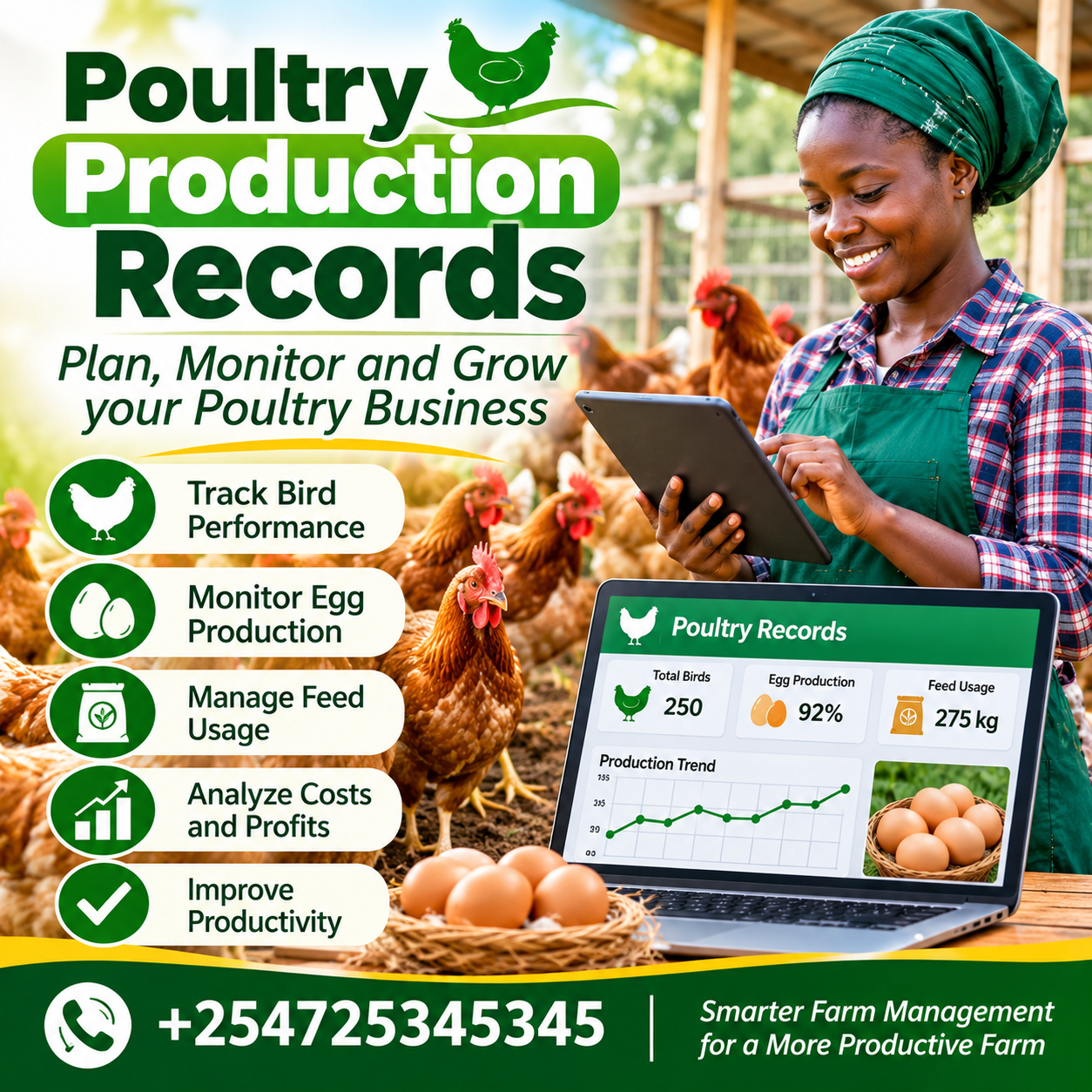
Poultry production records are the daily numbers that tell you what each bird, each egg and each kilo of chicken actually costs and earns: feed in, eggs out, deaths, treatments, sales and everything between. Kenyan poultry keeping looks simple from outside the run, yet it dies quietly from invisible arithmetic. The farms that last are the ones that count.
Ask a layer farmer what an egg costs to produce and most will answer with the price they sell it for. That gap — between what a thing costs and what we hope it earns — is where small poultry businesses go under. Farmers who maintain poultry production records know their cost per egg to the shilling, and price accordingly.
This guide walks through the whole discipline for Kenyan conditions: what to record daily, how to track a batch from day-old chicks to sale, how feed and water numbers predict profit, and how health logs protect the flock. Treated seriously, poultry production records become the difference between keeping chickens and running a poultry business.
Whether you keep fifty kienyeji birds free-range in Kisumu, three hundred layers in Kiambu, or broiler batches for the holidays in Nakuru, the principles hold. Keep your poultry production records short enough for a twice-daily glance and honest enough to decide when a batch stops making money.
Chickens forgive almost nothing slowly: feed wastage, missed vaccines and hidden mortality all compound within weeks. With poultry production records, the small losses surface while they are still small.
The chapters below move from principle to practice: the economics of thin margins, the daily entry, batch tracking, feed and water, production numbers, health logs, the systems, and the money. If you adopt only one habit from this guide, make it the daily two minutes — everything else grows from it.
Why Guessing Is the Most Expensive Ingredient in the Feed Store
Poultry margins are thin and fast. A bag of layers mash wasted, a week of low egg production, or a spike in mortality can erase a month’s profit before it is noticed. This is why poultry production records matter more in poultry than in almost any other livestock: the feedback loops run in days, not seasons.
Feed is the whole story. Seventy percent or more of the cost of an egg or a broiler is feed, which means the business is essentially a feed conversion operation. Farmers who log feed issued against production achieved in poultry production records can see their conversion ratio slip days before the bank balance does.
Mortality is the second silent invoice. Two birds dying per week in a flock of three hundred sounds like noise until the arithmetic is annualised — and it is never just the bird; it is every shilling of feed and vaccine already invested in it. Flocks tracked through poultry production records expose losses while they are still explainable.
Then there is the market side. Egg prices swing with supply, festivals and school calendars, and a farm that cannot connect its production dates to its sales dates keeps missing the good windows. Sellers who align laying schedules with demand, using poultry production records, sell into the spikes instead of the slumps.
Finally, expansion. Every poultry farmer eventually faces the question: should I double the flock? Answering it from memory is gambling; answering it from a year of measured feed conversion, mortality and margins is a business case. Lenders and family partners both read poultry production records far more easily than they read enthusiasm.
What a Good Entry Contains: Two Minutes, Twice a Day
A useful daily entry has six numbers: birds alive, feed given, water situation, eggs collected or weights gained, birds treated, and anything unusual. That is two minutes with a pencil at the run or the deep-litter house. Complete poultry production records are built from entries this small, not from monthly essays.
Batch identity comes first. Every group of chicks enters as a batch with a date, a source, a count and a house or run, and everything recorded afterwards hangs on that identity. Farms that keep poultry production records batch by batch can compare one supplier’s chicks against another’s within a single cycle.
Record feed by bag and by type: starter, grower, finisher, layers mash, or the home-mixed ration with its recipe. Vague notes like “fed the birds” hide the conversions that decide everything. Precise poultry production records let you calculate kilos of feed per egg or per kilo of gain, the two most powerful numbers in poultry.
Treatments and vaccinations deserve exact lines: what was given, to whom, at what age, in what dose, and the withdrawal period before sale or egg use. These lines protect both the flock and the consumer. Careful poultry production records are also what buyers, auditors and vets ask for first.
Close each week with a five-minute summary: mortalities, feed used, production achieved, and anything spent or sold. Weekly summaries catch the errors that daily entries miss, and monthly comparisons catch the weekly ones. Layered like this, poultry production records stay light while remaining complete.
Keep the pencil where the work happens: a board or book hanging at the house door beats a file in the bedroom every time. Entries made with cold hands at the run are imperfect but true; entries made warmly at night are tidy and wrong.
Batch Tracking: From Day-Old Chicks to Market Day
Every poultry business is really a chain of batches, and each batch is a small business of its own with a start date, costs, risks and a final invoice. Tracking them separately is what turns chaos into accounts. Well-separated poultry production records show which batches paid and which merely kept the family in eggs.
The batch file opens at the hatchery or the agrovet: date received, supplier, breed, number delivered, number alive on arrival, and cost per chick. Those opening lines set the baseline for everything, including any compensation claim for dead-on-arrival birds. Opening entries in poultry production records are where supplier accountability begins.
Through the batch’s life, the record follows the numbers that matter for its type: weekly mortality, feed issued, weights sampled, and for layers, the age at point of lay and the production curve that follows. Batch-level poultry production records reveal whether a problem is one weak batch or the whole system.
Broiler batches end at the buyer’s gate, and the closing lines are where profit is finally proven: birds sold, average weight, price per kilo, transport, and the balance against total batch cost. Farmers who close every batch properly in poultry production records know their true margin per bird within a day of selling.
Layer flocks need their own version of closing: the cull decision. A hen past her peak eats the same as one in her prime but lays a fraction, and the file that shows each bird’s history turns culling from cruelty arithmetic into business arithmetic. Long-lived poultry production records make those decisions calm and defensible.
Feed and Water: The Numbers That Decide Everything
Feed conversion is the heartbeat of poultry economics, and it is only visible when both sides of the fraction are written down. Kilos of feed in, kilos of eggs or live weight out — over weeks, that ratio tells you whether the flock is thriving or the system is leaking. Tracked in poultry production records, it becomes the farm’s most honest performance review.
Watch the ratio’s early warnings. A broiler batch whose conversion slips from season’s best to merely average is announcing heat stress, disease or a bad feed delivery before anything visible happens. Farmers who graph conversions from poultry production records catch those announcements and act while correction is cheap.
Wastage deserves its own surveillance. Feed scattered by overflowing feeders, spilled by careless filling or eaten by rodents is feed bought and never converted. Simple experiments — feeder height adjustments, covered feed stores, evening removal — are only proven when before-and-after figures sit in poultry production records.
Home mixing adds a recipe dimension. Farms that mix their own mash save money until the formulation drifts and production quietly falls; without notes, the fall is a mystery. Recipe versions, ingredient costs and the production that followed each version belong in poultry production records so mixing becomes engineering instead of folklore.
Water is the forgotten feed. Birds drink roughly twice what they eat, and dirty, hot or interrupted water depresses intake within hours. Logging water issues — tank cleaned, line blocked, supply cut — beside production dips in poultry production records explains mysteries that feed alone never will.
Season changes the arithmetic too. Heat waves raise water needs and depress appetite; cold snaps raise feed demand. Comparing seasonal patterns across years in poultry production records lets a farm adjust feed types, timings and housing before the weather does it for them.
Eggs, Weights and the Production Line
For layers, the daily egg count is the pulse of the business, and it should be read as a percentage: eggs today against birds housed gives the lay rate every manager needs. Flat or falling curves in poultry production records are early warnings of feed, light, disease or stress problems.
Egg quality belongs beside egg quantity. Cracks, thin shells, double yolks, misshapes and dirty eggs each tell a different story — calcium, stress, age, nest hygiene — and sorting counts by category turns complaints into diagnosis. Grading notes in poultry production records also protect prices when buyers argue about quality.
For broilers and kienyeji meat birds, sample weights weekly. Weighing the same marked sample each week gives the growth curve without chasing every bird, and growth against feed tells the true story. Weekly weights, entered into poultry production records, let a farmer predict market day instead of hoping for it.
Lighting, nesting and collection times shape the numbers, so note the routine changes: lights added for the short days, nest boxes moved, collection switched from once to twice daily. Routine changes recorded in poultry production records make it possible to learn which adjustments actually moved production.
Hatching side-lines add a further layer: eggs set, fertility tested, hatchability achieved and chick quality graded. Those numbers connect the breeding side to the sales side. Hatcheries whose poultry production records track set-to-sell conversions know exactly which parent flocks earn their feed.
Finally, record the customers’ verdict where it appears: size preferences, colour preferences, complaints and repeat orders. Production is only half of poultry; the other half is what the market accepts. Notes in poultry production records linking production choices to buyer responses are worth more than any generic advice.
Health, Vaccination and Mortality: The Logs That Save Flocks
Poultry disease moves faster than memory. Newcastle, Gumboro, fowl pox and coccidiosis can reshape a flock within days, and the only defence is a vaccination calendar kept and followed. Scheduled against batch age and recorded in poultry production records, vaccination becomes a system rather than a rumour.
Every death should earn two lines: how many and what signs. Sudden deaths point one way, wasting deaths another, respiratory signs a third — and patterns across days are what turn a scary week into a treatable diagnosis. Mortality notes in poultry production records are the raw material every vet will ask for.
Treatments must be logged with their withdrawal periods, because a bird sold inside a withdrawal window is a legal and health problem, not just a moral one. Treated-batch flags in poultry production records keep tainted sales from happening by accident.
Biosecurity events belong here too: visitors, new birds introduced, wild bird contact, equipment shared between houses. Outbreaks are almost always traced to a movement that nobody wrote down. Farms whose poultry production records log movements can reconstruct an outbreak and close the actual gap.
Post-mortems, even informal ones, multiply the value of mortality lines. A bird opened and observed turns “three died” into “three died with white droppings and pale livers,” which is a different problem entirely. Findings noted beside the mortality entries in poultry production records build a private disease atlas for the farm.
Over seasons, the health file reveals the farm’s own rhythms: the month respiratory trouble returns, the batch age where coccidiosis strikes, the supplier whose chicks start weak. Those rhythms are invisible without history, and priceless with it. Long-run poultry production records become the farm’s earliest warning system.
Quarantine deserves a line as well. New birds, returning birds and sick birds each carry risk, and the days they spent isolated are part of the flock’s story. Quarantine dates, written beside the movements they relate to, close the loop that outbreaks exploit.
Different Systems, Different Ledgers
Deep-litter layer units are the classic Kenyan setup, and their ledger centres on lay rate, feed conversion and culling. The numbers repeat daily, which makes them easy to track and easy to neglect. Wall-chart poultry production records, filled in at the house door, keep such units honest with minimum effort.
Broiler batches are sprints: five or six weeks of feed, weight and mortality that end at a single sale. Their records are batch files with a beginning, a middle and a hard financial close. Farmers who run repeated broiler batches from poultry production records learn their true per-bird margin and stop being surprised at market day.
Kienyeji and free-range systems add variables the books usually ignore: scavenged feed, predation, broodiness and slow growth. Those variables are exactly why such systems need records — to prove whether the premium price covers the longer cycle. Free-range poultry production records should note scavenging conditions, losses to predators and hatching outcomes.
Incubation and hatchery side-lines run on different numbers: eggs set, turning schedules, candling results, hatch rates and chick sales. Every failed setting is expensive, and patterns in failure are only visible on paper. Hatchery poultry production records per setting turn bad hatches into correctable causes.
Multi-species smallholders — chickens alongside dairy, goats or crops — should resist merging everything into one page. Poultry numbers lose meaning when averaged with anything. Separate, clearly headed poultry production records, compared at a weekly review, keep each enterprise’s truth distinct.
Group projects, youth groups and church poultry units need shared formats and named responsibilities, because shared work without shared paper decays into argument. One sheet per week, one signature per day, one review per meeting. Well-run groups treat their poultry production records as the meeting’s first agenda item, not its appendix.
Where Poultry Meets Money: Margins, Loans and Market Leverage
Poultry profit is decided in arithmetic, and the arithmetic lives in the file. Feed costs, chick costs, medication, labour, transport and mortality losses set against egg and bird income — summed per batch and per month. Farms that maintain poultry production records at that level know their break-even price before they negotiate.
Break-even knowledge changes selling behaviour. A farmer who knows her cost per egg can refuse the exploitative midday price with confidence, store, or redirect supply, because the numbers say the loss is temporary. Sellers armed with poultry production records negotiate from position instead of desperation.
Growth decisions become calculable. Should the flock double? Should layers replace broilers this quarter? Should feed be home-mixed? Each question has a numerical answer hiding in the existing file, and expansion supported by poultry production records is the kind lenders and county programmes actually fund.
Loan applications for poultry fail most often on vague projections. A file showing real feed conversion, real mortality and real margins replaces guesses with evidence. Applicants whose poultry production records can project a new batch from six old ones present a business, not a wish.
Contracts with hotels, schools, shops and institutions all ask for consistency, and consistency is a recorded performance. A supplier who can show twelve months of steady lay rates and clean withdrawal practices wins tenders that bigger farms lose. Institutional buyers increasingly treat poultry production records as part of the product.
Insurance, compensation after culls, and disease schemes all require documentation of stock and losses. A current flock register with mortality history is exactly that. Farms whose poultry production records are complete move through claims in days instead of disputes in months.
Mistakes That Keep Poultry Farms Poor
The first mistake is recording money but not birds. A cashbook without mortality, feed conversion and lay rates explains purchases without explaining the farm. Production numbers are the spine of poultry production records; money is the muscle around them.
The second is averaging across batches. Mixing a strong batch with a weak one produces averages that describe nothing, hide problems and mislead decisions. Batch-by-batch poultry production records keep every cohort’s story clean and comparable.
The third is recording only the good months. Files that thin out during bad weeks delete exactly the evidence that would explain the bad year. Complete poultry production records are most valuable when the news is worst, and that is when discipline usually fails.
The fourth is ignoring withdrawal periods and treatment notes until an auditor, a buyer or an outbreak arrives. Those lines protect the family, the customers and the licence to operate. Farms that treat poultry production records as a compliance burden usually meet the inspector without them.
The fifth is keeping the numbers where only one person can read them. Poultry work is shared daily, and a file in one head fails during every absence. Write poultry production records plainly enough that whoever feeds and collects tomorrow can continue the file without a lecture.
Every one of these mistakes is a quiet tax on effort, and the file is the only audit that catches it. Fixing them costs minutes; not fixing them costs batches.
Start This Week, Not Next Batch
Begin today with a count: birds alive, feed in store, and the batch identities behind them. Write those three facts on one page and date it. That page is the seed of every set of poultry production records that now runs a profitable poultry unit.
From tomorrow, add the daily six: birds, feed, water, eggs or weights, treatments, and anything odd. Summarise each week in five minutes and each batch at its close. Within one cycle your poultry production records will already be pricing your eggs more accurately than the market does.
Frequently Asked Questions
How much time do poultry production records really take each day?
About two minutes, twice a day: birds alive, feed given, eggs or weights, treatments, and anything unusual. Weekly summaries add five minutes. A system that demands more than that will be abandoned within a month, and an abandoned file is worth less than no file at all.
What is the single most useful number in poultry keeping?
Feed conversion — kilos of feed per egg or per kilo of live weight. It bundles feed price, wastage, health and genetics into one figure that moves within days. Track it per batch, compare across batches, and most decisions make themselves.
Can free-range kienyeji systems really be recorded?
Yes, with simpler arithmetic: batch identity, monthly mortality, feed supplements issued, eggs collected, sales and losses to predators. The premium price for kienyeji birds is only provable as profit when the longer cycle and its losses are written down.
How do I use records to choose a chick supplier?
Compare batches from different suppliers on the same headings: mortality to four weeks, growth or lay performance, feed conversion and final margin. Two batches are enough to raise a question; three are enough to answer it. Suppliers respond quickly when farmers quote numbers.
Notebook, wall chart or app?
Wall charts win at the house door, notebooks survive the run, and apps add summaries, cost links and reminders. Many farms use a chart daily and transfer weekly. The best format is the one updated twice a day, every day, by whoever is actually there.
Notes
The ratios and routines above reflect common Kenyan poultry practice, and your own poultry production records will always outrank any textbook benchmark, because they describe your birds, your feed source and your market. Start with the daily six, keep it same-day, and let the numbers run the flock.
If you would rather keep poultry beside feed stores, sales, livestock and finances in one place, a dedicated farm management platform does exactly that. Moving your poultry production records into a searchable digital system is a one-afternoon job that pays you back at every batch close, every loan application and every price negotiation thereafter.