Poultry health management in Kenya is the discipline that separates thriving flocks from the heartbreak stories every farmer in this country has either lived or witnessed — the brooder full of chicks that died within a fortnight, the layers that never peaked, the broilers lost to an outbreak that swept through an entire village in a week. Disease is the single largest destroyer of poultry wealth in Kenya: outbreaks of Newcastle disease alone wipe out millions of birds every year, mostly among unvaccinated and poorly protected flocks, and the quieter losses — stunted growth from untreated parasites, poor laying from subclinical infection, mortality from preventable stress — bleed even more from the sector in aggregate.
The encouraging truth, however, is that the overwhelming majority of poultry losses are preventable, and prevention rests on three pillars that any farmer can master: a correct vaccination schedule executed properly, debeaking done at the right time for the right birds, and biosecurity practised daily rather than remembered during crises. This guide examines poultry health management in Kenya in full — the complete vaccination calendars for broilers and layers, the rules that make vaccines actually work, the science and practice of beak trimming, and the biosecurity measures that turn a farm into a fortress against the diseases circling it constantly.
The three pillars work together, and understanding how is the foundation of everything that follows. Vaccination prepares the bird’s immune system for specific diseases it will inevitably encounter; debeaking manages the behavioural problems — pecking, cannibalism, feed wastage — that cause losses no vaccine can prevent; and biosecurity keeps the pathogens themselves away from the flock, reducing the disease pressure that vaccines and management must otherwise fight.
A farm that vaccinates but ignores biosecurity is pouring water into a leaking tank; a farm that practises biosecurity but skips vaccination is one wild bird away from catastrophe; and a farm that does both but neglects debeaking watches its layers wound and kill each other while its feed bill inflates.
Complete poultry health management in Kenya therefore means all three, executed on schedule, recorded faithfully, and adjusted to your flock type — and this guide walks through each in the depth that a serious poultry enterprise deserves.
Why Poultry Health Management Decides Your Profits
The arithmetic of disease is brutal and asymmetric: prevention costs shillings, while treatment and loss cost thousands. A full vaccination programme for a flock of five hundred layers costs a few thousand shillings across the bird’s entire laying life — while a single Newcastle outbreak kills the whole investment, and a subclinical Gumboro infection that doesn’t kill but immunosuppresses quietly doubles your mortality from every other disease that follows.
Farmers who invest in structured poultry health management in Kenya are not buying insurance against a possibility; they are buying the difference between a flock that converts feed into protein profitably and one that burns that feed fighting infections it should never have faced.
The second reason is the invisible cost of subclinical disease, which most farmers underestimate most. Not every disease kills dramatically — the expensive ones often just weaken: a mild worm burden slows growth by ten percent across the whole flock; a low-grade respiratory infection shaves eggs off every hen’s laying curve; coccidiosis pressure that never becomes an outbreak still permanently stunts the chicks it visited in week three.
This silent tax is why disciplined poultry health management in Kenya pays even in years when nothing visibly goes wrong — the flocks that look healthy and perform at peak are usually the ones whose health was managed before performance ever dipped.
The third reason is the structure of the Kenyan poultry market itself. Buyers of day-old chicks, table eggs, and live birds increasingly favour suppliers with documented health programmes, because disease history follows a farm’s reputation through every market relationship. Hatcheries, institutional egg buyers, and live-bird traders all pay better and stay longer with farms whose poultry health management in Kenya records — vaccination histories, mortality data, treatment logs — demonstrate professional flock care, while undocumented farms compete for whatever price the informal market offers on the day.
The Complete Vaccination Schedule
Understanding the Foundation
Vaccination is the process of preparing a bird’s immune system to fight specific diseases before it meets them, and its success depends on matching the right vaccine, at the right age, by the right route, at the right intervals — the entire logic of any credible poultry health management in Kenya programme. The core diseases every Kenyan schedule must address are Newcastle disease, Gumboro (infectious bursal disease), infectious bronchitis, fowl pox, Marek’s disease, and fowl typhoid, with deworming and coccidiosis control managed alongside. The schedules below reflect the standard Kenyan practice for the main flock types — but always confirm your final programme with your local veterinarian, because disease pressure varies by region, and your vet knows what is circulating in your area.
The Broiler Vaccination Schedule
Broilers live fast and short — market-ready at five to six weeks — so their schedule is compressed but non-negotiable. The standard poultry health management in Kenya broiler calendar begins at the hatchery, where chicks should already be vaccinated against Marek’s disease and commonly against Newcastle and infectious bronchitis; on the farm, the first dose arrives around day seven — Newcastle plus IB, typically by eye drop or drinking water.
Day fourteen brings the first Gumboro vaccination, the single most critical injection of protection in the broiler’s short life, because Gumboro destroys the immune system’s factory and leaves the flock defenceless against everything else.
Day eighteen to twenty-one delivers the Gumboro booster where regional pressure demands it, and day twenty-one closes the schedule with the Newcastle booster — Lasota strain through drinking water — which carries the flock safely to slaughter.
Farmers who follow this compressed poultry health management in Kenya broiler programme consistently harvest flocks with mortality under five percent, while those who skip the day-fourteen Gumboro routinely learn its cost the hard way.
The Layer Vaccination Schedule
Layers run a marathon, and their schedule builds protection in stages across the rearing months before laying begins.
The standard poultry health management in Kenya layer calendar starts identically to broilers — Marek’s and NCD-IB at the hatchery, Newcastle-IB around day seven, first Gumboro at day fourteen, Gumboro booster at eighteen to twenty-one days, and Newcastle booster at day twenty-one.
The programme then extends: a second Gumboro dose around week four where pressure requires it; fowl pox at week six to eight by wing-web needle; fowl typhoid at week eight in endemic regions — which includes most of Kenya — by injection; and a Newcastle booster every eight to ten weeks through the rearing period.
The capstone arrives at weeks sixteen to eighteen, just before lay: an injected killed vaccine covering Newcastle and infectious bronchitis, which programmes the hen’s immunity for the productive months ahead and transfers antibodies into her eggs.
Farms that complete this full poultry health management in Kenya layer schedule before the first egg arrives consistently sustain laying percentages their under-vaccinated neighbours never see — because the protection was banked before the stress of production began.
Kienyeji and Free-Range Flocks
Improved kienyeji and free-range flocks face higher disease exposure than housed birds, not lower — they mingle with wild birds, drink from shared puddles, and meet neighbouring flocks at every ranging excursion.
The correct poultry health management in Kenya approach for these flocks follows the layer schedule with particular emphasis on Newcastle boosters every two to three months for life, since free-range birds face continuous challenge, plus fowl pox and fowl typhoid as priorities.
The most damaging myth in Kenyan poultry keeping — that kienyeji chickens are naturally resistant and need no vaccination — has destroyed more village flocks than any predator, and every farmer ranging birds outdoors should treat vaccination as their single most important management expense.
The Rules That Make Vaccines Work
A vaccine correctly stored but wrongly administered protects nobody, and the rules of administration are where most farm programmes quietly fail.
First, the cold chain is sacred: vaccines live and die by refrigeration, die faster at room temperature, and are dead on arrival when carried unrefrigerated from town to the farm — so every purchase for your poultry health management in Kenya programme must travel in a cool box with ice packs and go straight into a working fridge.
Second, drinking-water vaccination demands preparation: withhold water for two hours beforehand so birds drink eagerly, use clean water with no chlorine — add skim milk powder at two grams per litre to neutralise residue and protect the virus — and ensure all birds can drink within the hour.
Third, vaccinate only healthy flocks: vaccinating a stressed or already-infected flock fails to protect it and may spread the vaccine strain as disease, which is why any credible poultry health management in Kenya programme begins each vaccination day with a flock inspection.
Fourth, complete every course and respect every interval — half-vaccinated flocks are unprotected flocks with false confidence.
Routes of Administration
Different vaccines demand different delivery routes, and using the wrong one wastes the dose entirely. Eye-drop administration places a measured drop directly on the bird’s eye — the most accurate route for small flocks and the preferred method for Newcastle-IB in chicks.
Drinking-water vaccination suits larger flocks for suitable live vaccines, provided the water preparation rules above are followed exactly. Injection — subcutaneous at the neck or intramuscular in the breast — is reserved for killed vaccines such as the pre-lay layer dose and fowl typhoid, and wing-web stabbing applies to fowl pox.
Spray vaccination protects respiratory-tract surfaces and suits commercial-scale operations with proper equipment. Mastering the routes relevant to your flock is a core competency of poultry health management in Kenya, and every farmer should learn eye-drop and drinking-water techniques from a vet or extension officer before their first flock arrives.
The Cold Chain and Where to Buy Vaccines
Vaccine supply in Kenya runs through registered veterinary pharmacies, agrovet networks in every major town, county veterinary offices, and hatcheries supplying their customers — but availability is only half the purchase, because the vaccine’s viability depends entirely on the cold chain it experienced.
Buy from suppliers whose fridges you can verify, transport in insulated boxes with ice packs, and never buy vaccine that has been displayed on an open shelf — however reputable the shop appears. The poultry health management in Kenya programmes that fail most often fail not in the schedule but in the logistics: a vaccine left in a hot matatu for four hours is expensive coloured water, and the flock it was meant to protect remains fully susceptible to the disease it “received.”
Recording Vaccinations
Every vaccination must be recorded — the vaccine name, batch number, date, route, number of birds, and who administered it — because records are what turn a series of events into a managed programme.
Without records, no one can verify that the day-fourteen Gumboro was actually given, track which batches came from which suppliers, or investigate the outbreak that happened despite vaccination.
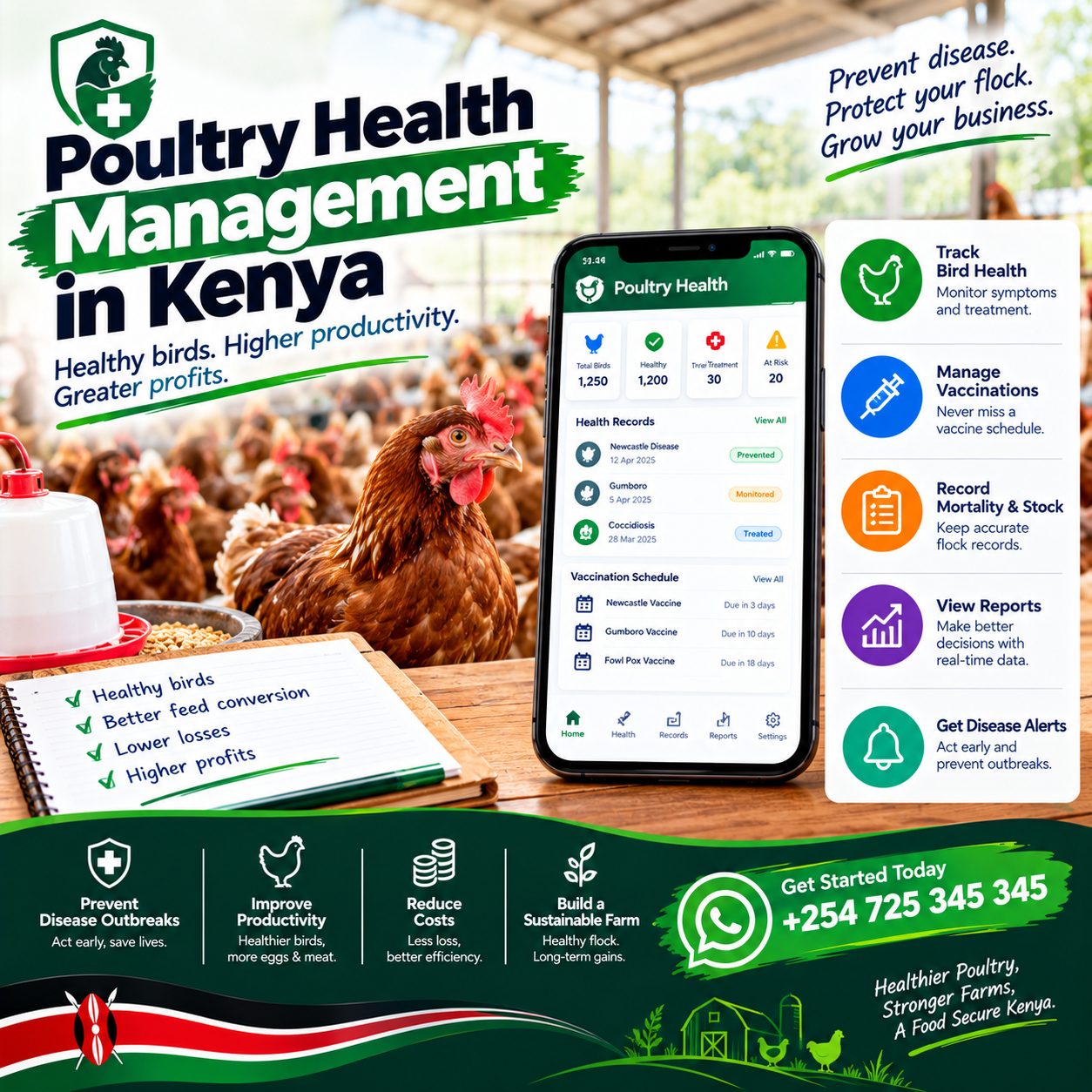
This is where digital record keeping has transformed poultry health management in Kenya practice: platforms that log every treatment and vaccination against each flock, raise alerts when the next dose falls due, and store the batch histories that audits and investigations demand.
Farms keeping vaccination records digitally catch their missed doses before the disease does — and the alert that reminds you a booster is due in three days is, in practice, the cheapest disease insurance available anywhere.
Common Vaccination Failures and Their Causes
When a vaccinated flock still breaks with disease, the failure almost always lies in one of a short list of causes, and knowing them is what separates professional poultry health management in Kenya practice from ritual.
The leading causes: broken cold chain somewhere between manufacturer and bird; expired product; wrong route or wrong dose; water treated with chlorine that killed a live vaccine before any bird drank it; vaccination of an already-infected or severely stressed flock; maternal antibody interference when doses are timed wrongly against the chick’s inherited immunity; and immune suppression from an uncontrolled Gumboro challenge earlier in the flock’s life.
When failure happens, work through this list systematically — and record the conclusion, so the same failure never repeats.
Debeaking: Purpose, Practice and Welfare
Why Debeaking Is Done
Debeaking — the partial removal of the beak tip, also called beak trimming — addresses two of poultry keeping’s most expensive behavioural problems: cannibalism and feed wastage.
In crowded flocks, pecking escalates from normal social behaviour into feather plucking, wound attack, and outright cannibalism that can kill dozens of birds in days; and a hen’s beak is a shovel that scoops feed out of troughs and onto the litter, where it becomes waste and breeding ground for disease.
A properly performed poultry health management in Kenya debeaking programme reduces mortality from pecking to near zero and cuts feed wastage measurably — which is why the commercial layer sector worldwide has practised it for decades, and why Kenyan layer farmers who skip it usually rediscover its purpose during their first cannibalism outbreak.
When and How to Debeak
Timing determines everything, and the two recognised windows serve different purposes. The primary debeak happens at seven to ten days of age, when the beak is small and soft, the chick’s stress response is minimal, and healing is rapid — this is the precision trim that professional poultry health management in Kenya practice treats as the standard.
The method uses a heated-blade debeaking machine: about one-third of the upper beak is removed, with the blade cauterising the cut instantly to prevent bleeding, and a light touch on the lower beak to keep it slightly longer than the upper.
A touch-up trim around four to six weeks serves flocks whose beaks regrow or whose rearing conditions demand reinforcement.
The skills involved are few but critical — hot enough blade, correct proportion removed, birds held firmly, and no bird returned to the flock while still bleeding — and every farmer should learn them from an experienced practitioner or have their first flocks trimmed by a technician.
Aftercare Matters
The days following debeaking decide whether the procedure is a minor event or a welfare setback, and proper aftercare is a formal part of professional poultry health management in Kenya practice.
Provide deeper feed in the troughs for a week, since trimmed beaks need softer access; ensure water levels are generous and easy to reach; add vitamin K and vitamin C to the drinking water for three days to support clotting and recovery; and never combine debeaking with another stress on the same day — no vaccination, no transport, no feed change.
During hot weather, schedule debeaking for the coolest hours of the day, and check the flock twice daily for a week, watching for any bird whose cut reopens or whose feeding visibly falters.
The Welfare Debate and Responsible Practice
Debeaking carries legitimate welfare controversy, and honest poultry health management in Kenya practice engages with it rather than dismissing it.
The procedure, done correctly at a young age, causes brief acute pain and, when over-trimmed, chronic problems — which is why the goal across the industry has shifted toward minimal trimming: removing the smallest fraction of beak that prevents cannibalism, performed by trained hands at the youngest viable age.
The deeper answer, however, is that severe debeaking need is often a symptom of management failure — overcrowding, poor lighting, inadequate diet, boredom — and farms that fix those root causes need only the lightest touch.
Farmers committed to the highest welfare standards manage pecking through space, enrichment, and nutrition, and reserve beak trimming for the situations where flock safety genuinely demands it.
Debeaking Kienyeji and Free-Range Flocks
The kienyeji question divides farmers, and the practical answer depends on the ranging system. Truly free-range birds spread over large areas rarely develop the crowding-driven pecking that necessitates trimming, so many successful kienyeji keepers skip debeaking entirely and manage behaviour through space.
Semi-confined kienyeji flocks — birds kept in sizable runs or rotated paddocks — sit in the middle, with debeaking reserved for flocks showing actual pecking behaviour.
The disciplined poultry health management in Kenya approach observes first and intervenes only on evidence: watch the flock, identify the triggers — density, light intensity, protein deficiency — fix what is fixable, and trim only when the alternative is wounded and dead birds.
Common Debeaking Mistakes
The mistakes are consistent across the country, and each carries a cost. Over-trimming — removing half the beak or cutting into sensitive tissue — causes lifelong feeding difficulty and chronic pain, which is why measured proportion is the first discipline of poultry health management in Kenya debeaking practice.
Debeaking during illness, transport stress, or extreme heat turns a minor procedure into a mortality event. Using a blunt or insufficiently hot blade crushes and tears instead of cutting and cauterising, causing bleeding that attracts the very pecking the procedure was meant to prevent.
And debeaking chicks too early — before seven days — interferes with early feeding and growth, while doing it too late in rearing creates a major stress event exactly when the pullet can least afford one.
Biosecurity: Building the Fortress Around Your Flock
What Biosecurity Really Means
Biosecurity is the complete set of practices that keep disease-causing organisms away from your flock — and it is the least glamorous, most neglected, and most cost-effective pillar of poultry health management in Kenya.
The logic is disarmingly simple: diseases enter farms on things that move — people, vehicles, feed, equipment, new birds, wild birds, water, wind-blown dust — and every one of those entry routes can be managed.
The farmer who internalises this stops thinking of biosecurity as a collection of chores and starts thinking of it as architecture: the deliberate design of a farm that pathogens cannot easily cross.
Vaccination defends the bird from inside; biosecurity defends the farm from outside — and the two together are what modern poultry health management in Kenya rests upon.
The Three Pillars: Isolation, Traffic Control, Sanitation
Every biosecurity measure on earth sorts into three pillars, and the professional way to build your programme is pillar by pillar. Isolation means keeping your birds physically separate from sources of infection: distance from neighbouring flocks, fencing, wild-bird proofing, and quarantine of anything new.
Traffic control means managing everything that moves onto, off of, and within the farm: people, vehicles, equipment, and feed deliveries. Sanitation means the cleaning and disinfection discipline that strips pathogens from everything the first two pillars cannot keep out.
A poultry health management in Kenya biosecurity programme assessed against these three pillars — honestly, measure by measure — reveals within an hour exactly where a farm’s real disease risks live, and the assessment itself is the natural first step for any farmer upgrading their defences.
Isolation and Perimeter Security
The perimeter is the farm’s first border, and it should be designed to be crossed only where you decide.
Fencing that excludes stray animals and informal visitors, a single controlled gate, and separation distances from neighbouring poultry keeps the casual disease traffic out — and in Kenya’s densely stocked poultry regions, the neighbour’s infected flock is statistically your most likely disease source, which makes perimeter discipline the foundation of poultry health management in Kenya for every farm within flying distance of another flock.
Wild-bird proofing belongs in the same pillar: open-sided houses screened with mesh against wild birds, feed stores sealed against them, and water sources protected from their droppings — because wild birds are the classic carriers of Newcastle and avian influenza across every distance.
Traffic Control: People, Vehicles and Equipment
People are the most efficient disease vectors on any farm, because they move between farms constantly and carry infection on their shoes, clothing, and hands.
The professional poultry health management in Kenya traffic regime is strict and simple: no unnecessary visitors; essential visitors change into farm-dedicated boots and overalls at the gate and pass through a footbath; workers never visit other poultry farms, live-bird markets, or slaughter points on working days; and anyone arriving from another farm — including the farmer returning from town — walks the disinfection line before reaching the birds.
Vehicles get their own rules: no vehicle drives to the poultry house, deliveries are received at the gate, and anything entering the farm gets disinfected.
Equipment follows the same logic — tools, crates, and sprayers stay farm-dedicated, and borrowed equipment is disinfected before it crosses the fence. Farms that enforce this regime report that their worst outbreaks never happened, which is precisely the point: the battles biosecurity wins are invisible.
The Footbath Discipline Done Right
The footbath is the most recognised biosecurity tool in Kenya and the most frequently wasted one, because a footbath that is not maintained is worse than none — it creates the appearance of protection while spreading contamination on wet boots.
Correct poultry health management in Kenya footbath practice uses an effective disinfectant at the correct dilution, changed on a fixed schedule or immediately when visibly dirty, positioned under a roof so rain cannot dilute it, preceded by a boot-scraping step that removes the organic matter which disables most disinfectants, and enforced without exception — because the footbath the owner skips is the footbath the workers abandon.
A practical upgrade many farms have adopted is a dry footbath alternative or boot-change station, which avoids the maintenance trap entirely.
All-In, All-Out and Batch Separation
The single most powerful structural biosecurity decision available to a poultry farm is the all-in, all-out system: one age group on the site at a time, stocked together and sold together, with cleaning and downtime between batches.
Mixed-age farms are permanent disease factories, because older birds carry and shed pathogens that young birds cannot resist, and every poultry health management in Kenya programme built on multiple ages simultaneously fights an uphill battle that single-age farms never face.
Where multiple ages are unavoidable, they should be separated by distance and worked in strict order — youngest flock first, oldest last — with dedicated boots and equipment per house, so the farm’s daily traffic never carries infection backward to its youngest birds.
Cleaning and Disinfection Between Batches
The downtime between batches is where the next batch’s health is won or lost, and the professional sequence is non-negotiable.
Remove all birds, then all litter and feed residue from the house; sweep and wash every surface — walls, floors, ceilings, feeders, drinkers — with detergent and water under pressure, because disinfectant applied to dirt disinfects nothing; allow the house to dry; then apply an approved disinfectant at the correct dilution, covering every surface, and let it stand for its full contact time.
Rest the house empty for at least two weeks where the production calendar allows, because time is itself a disinfectant.
Farmers who execute this full sequence through every poultry health management in Kenya batch cycle break the disease chains that continuous-stocking farms perpetuate indefinitely — and the cleaner start shows up in the next batch’s mortality figures within the first fortnight.
Water, Feed and Litter Hygiene
Water is the most overlooked disease highway on Kenyan farms, because birds drink from it constantly and contamination spreads through a shared drinker within hours.
Professional poultry health management in Kenya water discipline means clean water sources, drinkers scrubbed daily and disinfected between batches, water treatments where the source is doubtful, and samples tested where quality is uncertain.
Feed hygiene follows the same logic: store feed off the floor on pallets, in sealed and rodent-proof conditions, use oldest stock first, and never feed wet, mouldy, or stale feed — mycotoxins in mouldy feed cause more slow, invisible production loss than most farmers ever attribute to them.
Litter management completes the trio: keep it dry through ventilation and spill control, turn it where accumulation demands, and treat damp houses as the coccidiosis factories they become.
Rodent, Wild Bird and Predator Control
Rats and mice are not merely feed thieves — they are disease reservoirs that walk between houses, sheds, and farms carrying salmonella, pasteurella, and a catalogue of other pathogens, and their control is a formal component of any serious poultry health management in Kenya biosecurity programme.
The programme is permanent rather than episodic: bait stations positioned around stores and house perimeters and maintained on schedule; feed stores sealed so grain is inaccessible; vegetation cleared from around houses to remove rodent cover; and holes and gaps in structures blocked.
Wild birds are handled through the mesh screening and feed-store sealing described above, and predators — dogs, mongoose, hawks — through secure housing and vigilant perimeters, because a predator attack that kills three birds also wounds twenty and panics the flock into days of lost production.
Quarantine of New Birds
Every bird arriving from another farm is a potential disease passenger, and the quarantine rule is absolute: new stock — whether day-olds, pullets, or additions to a laying flock — is housed separately for at least two to three weeks, observed daily, and only then merged with the main flock.
The quarantine house should be worked last in the daily round, with its own equipment and, ideally, its own boots, so the farm’s routine never carries infection from the newcomers backward.
Farms that practise disciplined poultry health management in Kenya quarantine have repeatedly avoided the introductions that devastated their neighbours — because the sick bird that would have infected the whole flock shows itself in quarantine, where it costs one isolation pen instead of the entire business.
Dead Bird Disposal
Dead birds are concentrated packets of whatever killed them, and their handling is a biosecurity measurement in itself.
Professional poultry health management in Kenya practice removes carcasses from houses daily — never left overnight where they rot, attract scavengers, and contaminate litter — and disposes of them by deep burial, ideally with lime, or by incineration, in a dedicated disposal site positioned away from houses, water sources, and the prevailing wind toward the flock.
Mortality should also be counted and recorded daily, because the mortality trend is among the most valuable early-warning signals a farm possesses: a slow creep means something chronic, a spike means something acute, and either finding a week earlier is worth more than any treatment after the fact.
The Economics of Biosecurity
Biosecurity’s returns are invisible by design — the outbreaks that never happen leave no receipt — but the economics can be stated plainly.
A complete biosecurity upgrade for a medium farm — screening, footbaths and disinfectant, dedicated boots and overalls, rodent control, and quarantine facilities — costs less than a single average bird’s mortality bill from one moderate outbreak, and the farms that maintain these measures for years describe them as the cheapest insurance in agriculture.
The farmer weighing poultry health management in Kenya biosecurity investment against its cost is answering the wrong question: the correct comparison is against the certain, continuous losses that unprotected farms absorb every year, and against those, even the most complete programme is a rounding error.
The Major Diseases Every Kenyan Farmer Must Know
Newcastle Disease: The Ever-Present Threat
Newcastle disease is the most feared poultry disease in Kenya for good reason: it kills with terrifying efficiency, spreads through air, equipment, and wild birds, and sweeps through unvaccinated flocks with mortality that can exceed ninety percent.
The signs are dramatic — gasping and respiratory distress, greenish watery droppings, twisted necks and paralysis in surviving birds, and sudden heavy mortality — and by the time they appear, the outbreak is already beyond saving.
The entire defence is pre-emptive vaccination on schedule, and this is why every poultry health management in Kenya programme in this guide places Newcastle doses at fixed intervals from day one through the flock’s productive life. An outbreak on a vaccinated farm is rare and mild; on an unvaccinated farm it is a matter of when, not whether.
Gumboro: The Immune Destroyer
Infectious bursal disease — Gumboro — kills young chicks directly and, more damagingly, destroys the immune tissue that protects them from everything else, which is why farms that survive a Gumboro challenge often lose the following weeks to a procession of secondary infections.
The signs in chicks three to six weeks old are watery droppings, vent pecking, ruffled depression, and rapid mortality concentrated in exactly the age the broiler farmer most needs healthy birds.
The defence is precise timing: vaccination at day fourteen, with boosters where regional pressure demands, and this dose is the one no poultry health management in Kenya schedule ever omits.
Where a farm has suffered Gumboro, the hygiene overhaul between batches becomes doubly critical, because the virus survives in houses for months and punishes weak cleaning without mercy.
Coccidiosis and the Parasite Burden
Coccidiosis is the quiet killer of brooding: intestinal parasites that multiply in damp litter, damage the gut lining, and present as bloody droppings, ruffled chicks, and stunted growth — mortality where untreated, permanent growth setbacks where survived. Its management is environmental as much as medical: dry litter through ventilation and drinker discipline, anticoccidial strategies through feed or water where pressure builds, and the recovery periods between batches that break the parasite cycle. Alongside coccidiosis sit the worms — roundworms and tapeworms — which burden every range-kept flock and demand routine deworming from week eight onward in any honest poultry health management in Kenya programme. The parasite losses are the sector’s most underestimated drain, because they never kill dramatically — they just shrink every bird’s performance by a margin nobody measures until the records finally do.
Respiratory Disease Complex
Chronic respiratory disease and its infectious bronchitis partner produce the coughing, rattling, sneezing flocks that every Kenyan market knows — birds that rarely die in numbers but never perform either, because every breath spent fighting infection is metabolism not spent on growth or lay.
The triggers are management as much as microbes: ammonia from wet litter, dust, cold draughts on chicks, and overcrowding each open the respiratory door that the organisms then walk through.
The professional poultry health management in Kenya response is therefore two-layered: vaccination against the viral components on schedule, and environmental management — dry litter, fresh air without draughts, correct density — that removes the conditions respiratory pathogens need.
Flocks raised in clean air rarely cough; flocks in ammonia-soaked houses cough no matter what they were vaccinated against.
Records: The Thread That Ties Health Management Together
Health management without records is a programme run on memory, and memory fails exactly when stakes are highest.
Every treatment, vaccination, and mortality event belongs in a written or digital record tied to its flock and date, and the discipline pays in four directions: it ensures no vaccine dose is ever missed or repeated wrongly; it builds the flock histories that reveal which diseases recur on your farm and when; it provides the documentation buyers, hatcheries, and vets increasingly request; and it converts every outbreak or anomaly into a lesson the farm keeps permanently.
Modern poultry health management in Kenya practice runs these records digitally — platforms that log treatments against flocks, alert on due vaccinations, and store mortality trends automatically — and the farms that adopted them report that their health programmes tightened within a single cycle, because visibility changes behaviour as reliably in poultry houses as anywhere else.
The vaccination record deserves specific emphasis, because it is simultaneously a management tool and a legal-grade document.
Batch numbers recorded at vaccination become the evidence trail if a vaccine lot fails or a residue question arises; dated histories prove the pre-lay programme was complete when a laying problem needs diagnosis; and the alert function that reminds a busy farmer their week-eight fowl typhoid is due has, on thousands of Kenyan farms, been the difference between a protected flock and a vulnerable one.
Integrating poultry health management in Kenya records with the farm’s wider management system — feed, eggs, sales, finances — completes the picture: the farmer sees not just that a flock was vaccinated but what that protection earned in production, which is the connection that turns health spending from a cost into an investment with measurable returns.
Poultry Health Management by Farm Scale
Smallholder flocks of tens to hundreds of birds need the programme scaled to their reality: the full vaccination schedule, eye-drop and drinking-water techniques learned from a vet or extension officer, basic biosecurity centred on the rules that matter most at small scale — quarantine of new birds, footbaths, wild-bird screening, and dead-bird disposal — and records kept simply but kept.
The smallholder who runs a disciplined poultry health management in Kenya programme on even fifty birds loses a fraction of what the casual neighbour loses every year, and the discipline scales upward with the farm as it grows, which is precisely why building it early pays across the farm’s whole trajectory.
Commercial farms of thousands of birds need health management as industrial infrastructure: staff trained and drilled in biosecurity routines, vaccination programmes executed against calendars with batch-level records, mortality monitored daily against thresholds, and vets contracted on standing relationships rather than summoned during crises.
At this scale, a single biosecurity lapse — one visitor, one unwashed crate, one broken cold chain — carries the potential of losses that dwarf the entire annual health budget, which is why the farms that sustain commercial scale are, without exception, the farms that industrialised their poultry health management in Kenya discipline alongside their production.
Hatcheries and breeders carry the heaviest health obligations in the entire chain, because disease passed through breeding stock multiplies into every customer flock downstream.
Their programmes demand the full professional depth: closed flocks, intensive monitoring, egg hygiene, and vaccination regimes covering the diseases transmitted through eggs — and the farms buying from them should expect to see exactly this documentation.
Buyers evaluating a day-old chick supplier should treat visible poultry health management in Kenya discipline — records, biosecurity, vaccination history — as the primary quality signal, because the chick’s health programme effectively began months before it hatched, in the health of the flock that laid it.
Working With Vets, Suppliers and Extension Services
No serious health programme is built alone, and the Kenyan poultry farmer has more professional support available than commonly assumed.
Veterinarians — private practitioners in every major town, county veterinary officers, and poultry specialists attached to the larger hatcheries and feed companies — provide the services that transform programmes from generic to specific: designing vaccination calendars matched to local disease pressure, diagnosing outbreaks from field signs and laboratory samples, conducting post-mortems that turn mystery mortality into named causes, and advising on the biosecurity upgrades a specific farm actually needs.
Farmers who retain a vet on standing poultry health management in Kenya relationships — regular visits, phone access, scheduled programme reviews — consistently report faster outbreak response and lower total disease costs than those who call only when disaster has already arrived.
The supply side matters equally. Vaccines, dewormers, disinfectants, and vitamins should come from registered veterinary pharmacies with verified cold chains, and the feed supplier’s quality control — because mycotoxins and contamination arrive through feed — deserves the same scrutiny.
The farmers who build their poultry health management in Kenya supply relationships deliberately, verifying sources and holding suppliers to standards, never discover mid-outbreak that their vaccine was fake or their disinfectant was water — discoveries that have ended more Kenyan poultry businesses than any single pathogen.
Common Mistakes That Destroy Flock Health Programmes
The first mistake is the vaccination programme executed as ritual: doses given late, cold chains broken, water chlorinated, courses abandoned halfway — the forms observed while the protection quietly never materialises.
The disciplined alternative is treating every dose as an event with its own verification — product checked, cold chain confirmed, route correct, flock healthy, record written — because poultry health management in Kenya succeeds on execution, not intention, and every lapse in execution is a hole in the flock’s armour that disease eventually finds.
The second is biosecurity practised in crises and forgotten in calm: the footbath maintained during the outbreak and abandoned a month later, the quarantine enforced after the disaster and waived for the next convenient purchase.
Pathogens do not respect the farmer’s memory of last year’s losses, and the programmes that protect are the ones maintained in the quiet seasons when nothing threatens — because the outbreak that never starts is the one nobody remembers defending against.
Farmers who sustain their poultry health management in Kenya routines through calm periods are, in effect, the only farmers who have them at all.
The third is treating health as products alone — more vaccines, more medicines, more disinfectant — while the management conditions that cause disease remain untouched: damp litter, ammonia, overcrowding, dirty water, and chronic stress.
Every product works better in a well-managed house and worse in a broken one, which is why the best health programmes spend as much effort on ventilation, density, dry litter, and gentle handling as on the pharmacy shelf.
The flocks that thrive across Kenya belong to farmers who understood this balance early — that poultry health management in Kenya is, at its core, good husbandry reinforced by medicine rather than medicine substituted for husbandry.
The Future of Poultry Health Management
Technology is moving into the poultry house, and the direction is toward earlier detection and data-driven prevention.
Sensors monitoring temperature, humidity, and ammonia; cameras tracking bird behaviour and flagging the movement changes that precede visible disease by days; and platforms that correlate mortality trends with feed, weather, and management events — these are converging into health systems that warn before outbreaks rather than report after them.
Farms building disciplined digital records today are, in effect, training tomorrow’s early-warning systems on their own flocks, because every prediction model is only as good as the history that taught it — and poultry health management in Kenya practice is entering exactly that future, one recorded flock at a time.
Frequently Asked Questions
What is the complete vaccination schedule for broilers in Kenya?
The standard broiler programme runs: Marek’s and Newcastle-IB at the hatchery on day one; Newcastle-IB at day seven by eye drop or drinking water; first Gumboro at day fourteen; Gumboro booster at day eighteen to twenty-one where regional pressure demands; and the Newcastle booster at day twenty-one through drinking water.
Follow this calendar exactly, verify every cold chain, and record every dose — because the broiler’s five-week life leaves no room for a missed poultry health management in Kenya protection to be recovered later.
What is the vaccination schedule for layers in Kenya?
The layer programme extends the broiler foundation through rearing: Marek’s and NCD-IB at the hatchery, Newcastle-IB at day seven, Gumboro at day fourteen with a booster at eighteen to twenty-one days, Newcastle again at day twenty-one, fowl pox at weeks six to eight, fowl typhoid at week eight in endemic areas, Newcastle boosters every eight to ten weeks through rearing, and the injected killed Newcastle-IB vaccine at weeks sixteen to eighteen before lay.
This full poultry health management in Kenya schedule, completed before the first egg, is what sustains high laying percentages through the productive year.
When and how should I debeak my layers?
Debeak at seven to ten days of age using a heated-blade debeaker, removing about one-third of the upper beak with instant cauterisation, with a light touch-up around four to six weeks where regrowth demands it.
Support the procedure with vitamin K in the water for three days, deeper feed access for a week, and scheduling in cool hours away from other stresses — the full aftercare discipline that professional poultry health management in Kenya practice treats as inseparable from the trim itself.
Is debeaking necessary for kienyeji chickens?
Only where pecking and cannibalism are actually occurring or where birds are confined densely enough that they predictably will — truly free-range flocks with ample space rarely need it, while semi-confined kienyeji flocks should be observed and managed on evidence.
The responsible poultry health management in Kenya approach fixes crowding, lighting, and diet first, and reserves beak trimming for the flocks whose welfare genuinely requires it.
What are the most important biosecurity measures for a small farm?
The five that deliver most of the protection at small scale: quarantine every new bird for two to three weeks before merging; maintain a working footbath discipline at the house entrance with fresh disinfectant; screen houses against wild birds and seal feed stores against rodents; control visitors and prevent workers from contact with other flocks; and dispose of dead birds daily by deep burial away from houses and water.
These measures, applied without exception, constitute the core of poultry health management in Kenya at any scale — and every one of them costs less than a single week of a moderate outbreak.
How do I vaccinate chicks through drinking water correctly?
Withhold water for two hours so birds drink eagerly, prepare clean water free of chlorine by adding skim milk powder at roughly two grams per litre, dissolve the vaccine in the volume the flock will consume within one hour, and ensure enough drinker space for every bird to drink in that window.
Test the technique on your own flock before relying on it, because drinking-water vaccination is the workhorse route of Kenyan poultry health management in Kenya programmes and rewards precision with protection.
What should I do when birds start dying suddenly?
Act on three fronts the same day: remove and safely bury or burn all carcasses while securing a few fresh ones for post-mortem; isolate the affected house — stop all movement of birds, equipment, and people between houses immediately; and call your veterinarian or county veterinary officer with the flock’s age, signs, vaccination history, and mortality pattern.
The speed of this response, more than any treatment afterward, is what separates contained poultry health management in Kenya incidents from farm-destroying outbreaks.
How can I keep proper health records for my flock?
Record every vaccination and treatment — product, batch, date, route, birds covered, administrator — against each flock, count mortality daily with causes noted, and review the histories each cycle to catch patterns.
Digital platforms make this discipline practical, logging doses, alerting on due vaccinations, and storing batch histories automatically, which is why farms that migrated their poultry health management in Kenya records onto structured systems report tighter programmes within a single cycle — the records do the remembering, and the flock gets the protection on time.