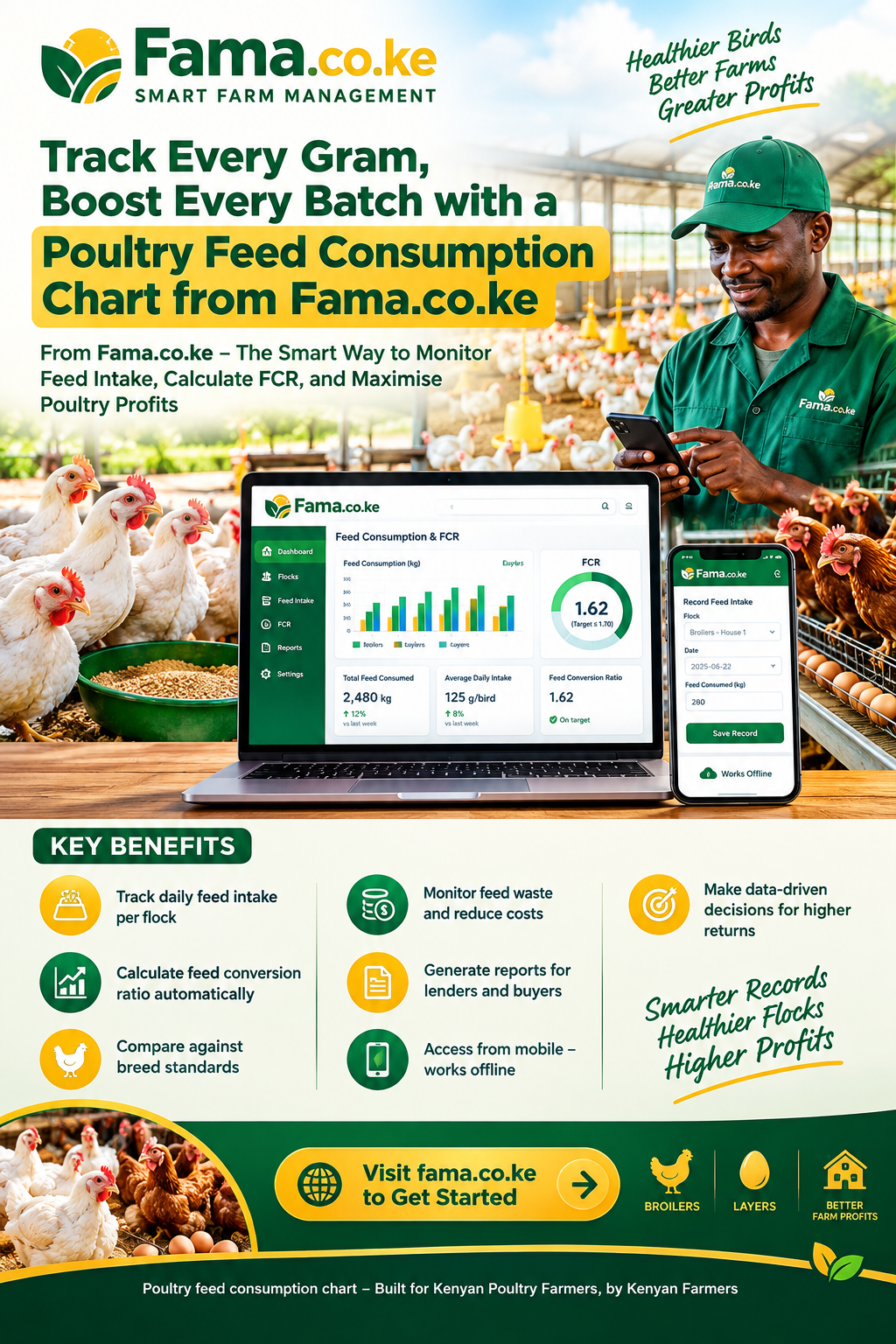
A poultry feed consumption chart is the single most important management tool for any poultry farmer seeking to control costs and maximise profitability, because feed accounts for 60 to 70 per cent of total production costs in every poultry enterprise. Fama.co.ke provides an innovative platform that serves as a comprehensive poultry feed consumption chart, helping farmers track daily feed intake, monitor conversion ratios, and calculate the true cost of feeding every bird in the flock. With commercial animal feed costs having risen by approximately 30 per cent and a 70-kilogram bag of layer mash now selling for between Sh4,000 and Sh5,000, the difference between profit and loss hinges on knowing exactly how much your birds eat and how efficiently they convert that feed into eggs or meat. This is why a poultry feed consumption chart is not merely a reference document—it is the foundation of profitable poultry farming.
The consequences of not following a proper poultry feed consumption chart are severe and documented across thousands of Kenyan farms. Underfeeding delays growth, reduces egg production, and lowers meat quality. Overfeeding wastes money on feed that birds cannot convert into income. Poorly designed feed troughs can result in 10 per cent of feed being wasted, and when feeders are half-filled, only 3 per cent of feed is wasted compared to two-thirds-full feeders where wastage is much higher. A poultry feed consumption chart from Fama.co.ke helps farmers identify the optimal feeding rates for every stage of production, eliminating the guesswork that leads to waste and lost profits.
Fama.co.ke‘s platform helps farmers master the poultry feed consumption chart by providing tools to record daily feed consumption per flock, calculate feed conversion ratios automatically, and compare actual intake against breed standards. Research shows that feed accounts for more than 70 per cent of egg production costs for small-scale poultry farmers and between 36 and 50 per cent of milk production costs. With a poultry feed consumption chart integrated into a digital management platform, farmers can finally see exactly where their feed money is going and which flocks are performing efficiently.
The financial case for using a poultry feed consumption chart is compelling. A broiler chick needs between 3.1 and 4 kilograms of feed to reach market weight in six weeks. A standard 50kg bag of feed can feed about 12 to 13 birds. With feed costing approximately KES 3,850 per 50kg bag for starter, KES 3,630 for grower, and KES 3,550 for finisher, the total feed cost per broiler bird reaches KES 225.70. A poultry feed consumption chart that tracks these figures per batch enables farmers to identify where costs can be reduced without sacrificing growth or egg production.
The broiler feed consumption chart is the most time-sensitive because broilers have a short production cycle and feed intake drives profitability. Recommended feed amounts per bird are 0.6 kg of starter, 1.25 kg of grower, and 1.25 kg of finisher, totalling 3.1 kg per bird. By week 3, broilers should weigh 700 to 900 grams; by week 4, they should be around 1.4 to 1.6 kilograms; and by end of week 6, they should reach 2 to 2.5 kilograms. A poultry feed consumption chart from Fama.co.ke tracks these milestones and alerts farmers when birds fall behind target weights.
The layer feed consumption chart follows a longer and steadier pattern. For growers of 8 to 20 weeks of age, farmers should provide 80 grams of growers mash per bird per day. For birds over 20 weeks of age, the feeding rate increases to 120 to 130 grams of layers mash per bird per day. Henry Njuguna, a Naivasha poultry farmer who keeps more than 1,600 layers, confirms these feeding rates: “For growers of 8-20 weeks of age, he gives 80gm of growers mash per bird per day. To birds of over 20 weeks of age he feeds 120-130gm per bird, per day of layers mash.” A poultry feed consumption chart that tracks these daily rates enables farmers to forecast feed requirements accurately and avoid costly stockouts or over-ordering.
The kienyeji chicken feed consumption chart differs from commercial breeds because indigenous chickens have different nutritional requirements and growth rates. For kienyeji layers, the recommended feeding programme is 35 grams of chick mash per day from day one until the end of week 8, 70 grams of growers mash per day from 9 weeks to point of lay, and 140 grams of layers mash per bird per day once laying begins at around 18 to 20 weeks. Following this poultry feed consumption chart can increase egg production from the typical 36 eggs per year to 250 or 300 eggs per year from each bird.
Feed conversion ratio is the metric that makes a poultry feed consumption chart so powerful. FCR is calculated by dividing total feed consumed by total weight gained or eggs produced. A good FCR for broilers is 1.8 to 2.0; above 2.5 means inefficiency and lost profits. For layers, the FCR is expressed as the ratio of feed intake to egg mass produced. Without a poultry feed consumption chart that tracks these ratios, farmers cannot identify whether poor performance is due to feed quality, management practices, or bird genetics.
For farmers managing multiple flocks and production systems, a poultry feed consumption chart provides the structure that manual systems cannot. The platform tracks broilers, layers, kienyeji, and breeding stock in one integrated system. With a poultry feed consumption chart, farmers can see at any moment which flocks are consuming above or below expected rates, which feed formulations deliver the best conversion, and which batches are most profitable.
Why Kenyan Poultry Farmers Need a Poultry Feed Consumption Chart
The adoption of a systematic poultry feed consumption chart is becoming increasingly essential as farmers face rising feed costs, tightening margins, and demands for documented production records from buyers and lenders. Without a proper chart and record-keeping system, farmers cannot calculate feed conversion, monitor waste, or demonstrate production efficiency.
The challenges facing poultry farmers without a feed consumption chart are numerous. Feed purchases are recorded in notebooks that get lost. Daily consumption is estimated rather than measured. Feed conversion is never calculated. Waste from poorly designed feeders goes undetected. Profitability per batch is unknown. A poultry feed consumption chart system addresses each of these gaps by providing structured records, automated calculations, and complete feed histories.
The scale of the feed cost challenge makes systematic management essential. A 70-kilogram bag of layer mash is currently selling for between Sh4,000 and Sh5,000, up from Sh3,800 in April. A 70-kilogram bag of growers mash now sells for Sh4,800, and a 50-kilogram bag of starter crumbs costs Sh4,600. Layers mash has crossed Sh3,900 for a 50-kilogram bag. A poultry feed consumption chart platform helps farmers navigate these costs by revealing exactly how much feed each flock requires and where savings can be found.
Key Features of a Poultry Feed Consumption Chart Platform
Daily Feed Intake Recording
A poultry feed consumption chart platform from Fama.co.ke records daily feed consumption per flock, per shed, and per age group. The platform captures morning, afternoon, and evening feedings, calculates daily totals, and tracks consumption trends over the production cycle. With a poultry feed consumption chart, farmers can identify abnormal intake within 24 hours rather than discovering problems weeks later.
Feed Conversion Ratio Calculation
A poultry feed consumption chart platform calculates feed conversion ratio automatically. The platform divides total feed consumed by total weight gained or eggs produced. It compares actual FCR against breed standards for Cobb 500, Ross 308, Lohmann Brown, and Hy-Line layers. With a poultry feed consumption chart, farmers can see at a glance whether their flocks are performing above or below expectations.
Age-Based Feeding Recommendations
A poultry feed consumption chart platform includes age-based feeding recommendations aligned with breed standards. The platform automatically calculates the expected feed intake for each day of age and alerts farmers when consumption deviates from the expected range. With a poultry feed consumption chart, farmers can ensure that every bird receives the right amount of feed at every stage of growth.
Feed Inventory and Cost Tracking
A poultry feed consumption chart platform tracks feed inventory and costs. The platform records every feed purchase with date, supplier, quantity, type, and cost. It maintains real-time inventory levels and alerts farmers when supplies are running low. With a poultry feed consumption chart, farmers can prevent stockouts and reduce waste from expired or spoiled feed.
Feed Waste Monitoring
A poultry feed consumption chart platform helps farmers identify and reduce feed waste. The platform tracks the difference between feed issued and feed consumed, revealing losses from spillage, poor feeder design, rodents, and birds. With a poultry feed consumption chart, farmers can implement corrective measures that recover 5 to 10 per cent of feed costs.
Batch Performance Analysis
A poultry feed consumption chart platform captures every production cycle as a discrete batch with its own feed consumption record. The platform tracks placement date, bird count, breed, source, and target harvest date. With a poultry feed consumption chart, all daily data rolls up into a live batch performance dashboard.
Mobile Accessibility and Offline Functionality
A poultry feed consumption chart platform from Fama.co.ke works on mobile devices and functions offline. The platform is designed for rural areas with connectivity challenges, allowing farm workers to record feed data in under 5 minutes per shed. Data syncs automatically when connectivity is restored.
Broiler Feed Consumption Chart: Week-by-Week Guide
The broiler feed consumption chart is the most time-sensitive because broilers have a short production cycle and feed intake drives profitability.
Week 1 to 2: Brooding Phase
During the first two weeks, broilers require broiler starter mash with 23 to 24 per cent protein. Chicks should receive glucose water before their first feed to restore energy after transport. Brooder temperature must be exactly 33°C on day 1, reducing gradually to 30°C by day 7. Feed is provided ad libitum, and by the end of week 1, chicks should weigh approximately 130 grams. The Newcastle vaccine is administered at day 7 via eye drop.
Week 3 to 4: Growth Phase
By week 3, broilers should weigh 700 to 900 grams. This is their fastest growth period. Farmers should switch to broiler finisher mash with 20 per cent protein at the start of week 3. Birds should receive 23 hours of light and 1 hour of darkness per day to drive feeding behaviour and growth. By week 4, birds should be around 1.4 to 1.6 kilograms. Ventilation becomes critical as larger birds produce more heat and ammonia.
Week 5 to 6: Finishing Phase
Week 5 to 6 is the finishing phase. Birds should reach 2 to 2.5 kilograms by the end of week 6. Feed should be withheld for 6 to 8 hours before slaughter to empty the crop and gizzard, improving carcass quality. Water should not be withheld until 2 hours before slaughter. Weigh a sample of birds at day 35 and day 42 to check progress against the poultry feed consumption chart.
Broiler Feed Cost Per Bird
The recommended feed amount per bird is 0.6 kg of starter, 1.25 kg of grower, and 1.25 kg of finisher, totalling 3.1 kg per bird. Feed cost per bird is approximately KES 46.20 for starter, KES 90.75 for grower, and KES 88.75 for finisher, totalling KES 225.70. For 500 chicks, feed costs reach KES 112,850; for 1,000 chicks, feed costs reach KES 225,700.
Layer Feed Consumption Chart: Age-by-Age Guide
The layer feed consumption chart follows a longer and steadier pattern, with feed intake increasing as birds grow and begin production.
Week 1 to 8: Chick Phase
Chicks receive chick mash with 22 per cent protein. Feed intake starts at approximately 15 grams per day in week 1 and increases to 35 to 40 grams per day by week 8. Total feed consumption during this phase is approximately 2.1 kilograms per chick by 8 weeks.
Week 9 to 18: Grower Phase
Growers receive growers mash with 16 to 18 per cent protein. Feed intake ranges from 45 to 80 grams per bird per day, depending on age and breed. For growers of 8 to 20 weeks of age, farmers should provide 80 grams of growers mash per bird per day. Overfeeding during the grower stage makes hens fat and poor layers, so accurate measurement is critical.
Week 19 Onward: Layer Phase
Layers receive layers mash with 16 to 17 per cent protein and high calcium at 3.5 to 4 per cent. For birds over 20 weeks of age, the feeding rate is 120 to 130 grams of layers mash per bird per day. Calcium is critical during lay—poor calcium produces thin shells, broken eggs, and egg-bound hens. Feed intake may increase to 140 grams per bird per day during peak production.
Layer Feed Cost Per Bird
A kilogram of layers feed is approximately Sh40. For a 70-kilogram bag costing between Sh4,000 and Sh5,000, the cost per bird per day is approximately Sh5 to Sh6.50. Over a 12-month laying cycle, feed costs per bird reach approximately Sh1,800 to Sh2,400.
Kienyeji Feed Consumption Chart: Indigenous Chicken Feeding Guide
The kienyeji chicken feed consumption chart differs from commercial breeds because indigenous chickens have different nutritional requirements and growth rates.
Chick Mash Phase (Day 1 to Week 8)
Give each chick 35 grams (2 tablespoons) of kienyeji chick mash a day. One chick will consume about 2 kilograms of chick mash from Day 1 to week 8. Chick mash helps the chick build a good body frame.
Growers Mash Phase (9 Weeks to Point of Lay)
Give each chicken 70 grams (4 tablespoons) of kienyeji growers mash each day. One chicken will consume about 7 kilograms of growers mash from 9 weeks until point of lay. Growers mash helps the chicken put on weight and lay eggs earlier.
Layers Mash Phase (From Point of Lay)
Give 140 grams (8 tablespoons) of kienyeji layers mash per bird per day when some of your chickens (2.5%) start to lay. This should be at around 18 to 20 weeks. Layers mash helps the chicken lay more good quality eggs.
Kienyeji Feed Cost Per Bird
Following this feeding plan can increase egg production from the typical 36 eggs per year to 250 or 300 eggs per year from each bird, making the investment in proper feeding highly profitable.
Feed Conversion Ratio: The Metric That Drives Profit
Feed conversion ratio is the metric that makes a poultry feed consumption chart so powerful. FCR is calculated by dividing total feed consumed by total weight gained or eggs produced.
Broiler FCR
A good FCR for broilers is 1.8 to 2.0. Above 2.5 means inefficiency and lost profits. A well-managed broiler flock reaches market weight in 6 weeks with an average slaughter weight of 2.5 kilograms and an FCR of 1.8:1. This means the bird consumed 1.8 kilograms of feed for every kilogram of weight gained.
Layer FCR
For layers, the FCR is expressed as the ratio of feed intake to egg mass produced. A layer consuming 120 grams of feed per day and producing 60 grams of egg mass has an FCR of 2.0. Breed standards for Lohmann Brown and Hy-Line layers provide benchmarks for expected FCR at different ages.
Improving FCR
Farmers can improve FCR by ensuring feed quality meets breed requirements, preventing feed waste from poorly designed feeders, maintaining optimal bird health, and culling inefficient birds. A poultry feed consumption chart platform tracks FCR over time and identifies trends that require intervention.
Common Mistakes in Using a Poultry Feed Consumption Chart
Even farmers committed to following a feed consumption chart make mistakes that undermine profitability. Understanding these pitfalls helps avoid them.
Not Weighing Feed Accurately
Estimating feed quantities by volume rather than weight leads to inaccurate records. Feed density varies by type and moisture content, so weighing is essential for accurate tracking.
Ignoring Feed Waste
Feed that is issued but not consumed represents pure loss. Poorly designed feeders, rodents, and wild birds can waste 5 to 10 per cent of feed. A poultry feed consumption chart should track both feed issued and feed consumed to reveal waste.
Failing to Adjust for Age
Feeding rates change as birds grow. A chart that does not account for age-based requirements leads to underfeeding or overfeeding, both of which reduce profitability.
Recording Feed After the Fact
Reconstructing feed records days or weeks later guarantees inaccuracy. Feed consumption must be recorded daily, preferably at the time of feeding.
Not Comparing Against Standards
A poultry feed consumption chart is only useful if actual consumption is compared against breed standards. Farmers should review this comparison weekly and investigate any deviations.
How Fama.co.ke Helps You Master the Poultry Feed Consumption Chart
Fama.co.ke provides the digital infrastructure to make feed consumption tracking simple, practical, and profitable.
Daily Feed Recording
The platform captures daily feed consumption per flock, per shed, and per age group. Workers can record feed data in under 5 minutes per shed using mobile devices.
Automatic FCR Calculation
The platform calculates feed conversion ratio automatically and compares it against breed standards. Farmers can see at a glance whether flocks are performing above or below expectations.
Age-Based Feeding Alerts
The platform sends alerts when feed consumption deviates from age-based recommendations. Early detection of feeding problems enables timely intervention.
Feed Inventory Management
The platform tracks feed inventory, alerts when supplies are running low, and helps farmers plan purchases. This prevents stockouts and reduces waste from expired feed.
Batch Performance Reports
The platform generates reports showing feed consumption, FCR, and profitability per batch. Farmers can compare batches and identify which management practices deliver the best results.
Offline Functionality
The platform works offline and syncs automatically when connectivity returns. This ensures that feed data is captured even in remote areas with poor network coverage.
The Financial Impact of Mastering the Poultry Feed Consumption Chart
The evidence that following a proper poultry feed consumption chart improves profitability is overwhelming and documented across multiple studies.
Reduced Feed Costs
Farmers who track feed consumption identify waste and reduce costs by 10 to 15 per cent. With feed representing 60 to 70 per cent of production costs, even small improvements deliver significant savings.
Improved FCR
Tracking FCR enables farmers to identify and replicate the management practices that deliver the best conversion. A 0.2 improvement in FCR for a 1,000-bird broiler flock saves 200 kilograms of feed per cycle, worth approximately KES 15,000.
Better Batch Planning
Accurate feed consumption records enable farmers to forecast feed requirements for future batches. This improves purchasing decisions and reduces emergency orders at premium prices.
Improved Access to Finance
A poultry feed consumption chart creates reliable records that build creditworthiness. Financial institutions require documented production records before lending. With verifiable feed and production data, farmers can access loans and insurance.
The Future of Poultry Feeding with Feed Consumption Charts
As technology continues to advance, poultry feed consumption charts will become increasingly digital and data-driven. The integration of AI-powered analytics, automated feed dispensing, and real-time conversion monitoring will make these tools even more powerful.
The adoption of digital poultry feed consumption charts is expected to accelerate as more farmers recognise the benefits. With continued investment in digital infrastructure and training, the poultry feed consumption chart will become standard equipment for poultry farmers across the country.
A poultry feed consumption chart from Fama.co.ke represents a powerful solution for farmers who want to control feed costs and maximise poultry profitability. The platform provides the tools needed to track daily intake, calculate FCR, monitor waste, and generate reports efficiently.
Kenyan poultry farmers who adopt a poultry feed consumption chart position themselves for greater success in the evolving agricultural sector. The platform helps farmers make better decisions, reduce feed waste, and achieve higher productivity.
Fama.co.ke has developed a poultry feed consumption chart platform that meets the unique needs of Kenyan farmers. The platform combines powerful features with intuitive design, making it accessible for farmers of all sizes. A poultry feed consumption chart supports the growth and sustainability of Kenya’s poultry industry.
Start your journey with a poultry feed consumption chart today. Visit fama.co.ke to learn more about how a poultry feed consumption chart can transform your poultry operations.
Frequently Asked Questions About Poultry Feed Consumption Chart
What is a poultry feed consumption chart?
A poultry feed consumption chart is a reference document and tracking tool that shows how much feed birds should consume at each stage of growth. Fama.co.ke‘s digital poultry feed consumption chart platform records daily intake, calculates FCR, and compares performance against breed standards.
How much feed does a broiler chicken eat per day?
A broiler chick needs between 3.1 and 4 kilograms of feed to reach market weight in six weeks. Recommended feed amounts per bird are 0.6 kg of starter, 1.25 kg of grower, and 1.25 kg of finisher, totalling 3.1 kg per bird. Daily consumption starts at around 15 grams in week 1 and reaches 150 to 200 grams in week 6.
How much feed does a layer chicken eat per day?
For birds over 20 weeks of age, the feeding rate is 120 to 130 grams of layers mash per bird per day. For growers of 8 to 20 weeks, provide 80 grams of growers mash per bird per day. Feed intake may increase to 140 grams per bird per day during peak production.
What is the feed conversion ratio for broilers?
A good FCR for broilers is 1.8 to 2.0. Above 2.5 means inefficiency and lost profits. A well-managed broiler flock reaches market weight in 6 weeks with an FCR of 1.8:1, meaning the bird consumed 1.8 kilograms of feed for every kilogram of weight gained.
How much does poultry feed cost in Kenya?
A 70-kilogram bag of layer mash is currently selling for between Sh4,000 and Sh5,000. A 70-kilogram bag of growers mash now sells for Sh4,800, and a 50-kilogram bag of starter crumbs costs Sh4,600. Feed cost per broiler bird reaches approximately KES 225.70.