Pig farming in Kenya beginners guide is the essential starting point for anyone looking to enter one of the country’s most profitable and rapidly growing livestock enterprises. Kenya’s pig sector has evolved from a niche activity into a vibrant subsector that now supports thousands of families across the country. Pork consumption continues rising as urbanisation brings lifestyle changes and a younger generation embraces pork as a preferred protein source. With Kenya producing approximately 23,000 metric tons of pork against a market demand of about 38,500 metric tons, a significant deficit exists that presents a genuine opportunity for new farmers to scale up production and capture steady returns. This pig farming in Kenya beginners guide provides the technical and financial roadmap you need to succeed.
The financial case for entering pig production is compelling. A single sow farrows 20 to 24 piglets annually, and each piglet raised to a market weight of 90 kilograms sells for 30,000 to 45,000 shillings depending on season and location. One sow therefore generates 600,000 to 1 million shillings in gross revenue per year, and a farmer with just five sows enters millionaire territory, grossing 3 to 5 million shillings annually. For beginners seeking a clear pig farming in Kenya beginners guide, these numbers demonstrate why pig production has become one of the most attractive livestock ventures in the country.
The market anchor for Kenyan pig farmers is Farmer’s Choice, headquartered at the Kahawa Sukari facility north of Nairobi. The company is the largest pork processor in East and Central Africa and operates a contract-grower scheme in which approved farmers raise pigs to specification and Farmer’s Choice collects, weighs, and pays at a published price per kilogram of dead weight. Recent contract pricing has run around KSh 147 per kilogram of dead weight, with a target live weight of 90 to 100 kilograms per pig. A typical seven-month finishing cycle delivers a net profit of approximately KSh 16,000 per pig after feed, veterinary, and housing depreciation costs are netted from the sale value. This pig farming in Kenya beginners guide will show you exactly how to reach those numbers.
Beyond Farmer’s Choice, the open market includes Choice Meats Limited, Kenchic, Alpha Fine Foods, butcheries supplying nyama choma joints in major towns, and a growing direct-to-consumer segment serving niche restaurants and hotels. Open-market prices fluctuate seasonally and by location, with a Nairobi butcher often paying slightly above the contract rate, though the absence of pickup logistics and irregular timing make the open market harder to plan around. A common approach for beginners learning through a pig farming in Kenya beginners guide is to run the bulk of production under a Farmer’s Choice contract and place selected animals into the open market for occasional yield optimisation.
The starting point for any newcomer is breed selection, and this pig farming in Kenya beginners guide recommends focusing on three breeds that dominate Kenyan commercial piggeries: the Large White, the Landrace, and the Pietrain, together with their hybrids. The Large White is the workhorse—fast growing, efficient in feed conversion, with large litter sizes and high carcass yield—and is the standard sow line for most commercial operations. The Landrace, originally Danish, is similarly productive with particularly strong mothering instincts, and sows can wean larger and more uniform litters in well-managed environments. The Pietrain, of Belgian origin, is the lean-meat specialist, producing extremely lean carcasses with high muscle-to-fat ratios favoured for high-end processed pork and bacon. Most Kenyan commercial piggeries operate a two- or three-line crossbreeding programme, and for most beginners, Large White, Landrace, or a cross of the two is the practical choice.
Housing is the second critical decision covered in this pig farming in Kenya beginners guide, and it directly determines disease risk and growth performance. Pigs need a dry, clean, well-drained sty with a concrete floor that is easy to clean and disinfect, adequate shade, good ventilation, and a wallow or cooling area for hot weather. Separate pens should be provided for the boar, farrowing sows, weaners, and finishers. Space requirements depend on the age and size of the pigs: weaners need 0.3 to 0.5 square meters per pig, growers need 0.6 to 0.8 square meters, and finishers need 0.8 to 1 square meter. For 10 growing pigs, plan for approximately 6 to 8 square meters of total space. Good ventilation, proper drainage, and dry flooring are equally important to prevent stress and disease, and overcrowding must be avoided because it reduces feed efficiency and increases disease risk.
Biosecurity is not optional in pig farming, and this pig farming in Kenya beginners guide treats it as the core of the enterprise rather than an afterthought. African Swine Fever is a viral disease with no vaccine and no cure that can kill an entire herd. Kenya has no effective treatment or commercially available vaccine for the ASF virus strains circulating in the country, making early detection, movement controls, and farm-level biosecurity critically important to limiting transmission. Essential biosecurity measures include controlling who enters the sty and providing a disinfectant footbath, quarantining any new animals before mixing them with your herd, never feeding untreated swill or waste from unknown sources, keeping visitors, vehicles, and other people’s pigs away especially during outbreaks, and disinfecting equipment and boots between pens. One ASF outbreak can erase years of profit, so beginners following this pig farming in Kenya beginners guide must implement biosecurity from day one.
Feeding is where 60 to 70 percent of your cost lives, making feed management the single most important factor determining whether your piggery is profitable. Feed should be planned by stage: creep feed for suckling piglets to start them eating before weaning, weaner meal after weaning at around 6 to 8 weeks, grower meal through the main growth phase, and finisher or sow meal to market weight or for breeding sows. Many farmers cut costs by home-mixing rations using maize germ, pollard, omena or fishmeal, and mineral premix, but the balance must be right or growth slows and you lose the time-and-feed you were trying to save. Clean water must be provided continuously because pigs drink a lot, and dehydration stalls growth. A pig consumes an average of 3 to 4 kilograms of feed per day, meaning 120 kilograms per month, and at a rice bran price of Sh500 per 70-kilogram bag, feed costs for two sows over nine months come to approximately Sh16,000.
The cost of starting a small pig unit is more accessible than many beginners expect. A small unit can start from roughly KES 40,000 to 100,000, covering weaners, a simple concrete sty, and initial feed. For a more structured beginning with two pregnant sows, a farmer with approximately Sh250,000 can construct a pig shed, source high-yielding sows, and cover feed and management costs through the first production cycle. A month-old pregnant Large White sow goes for an average of Sh45,000, while Duroc and Hampshire sows retail at around Sh40,000. This pig farming in Kenya beginners guide recommends starting with at least two sows to ensure genetic diversity and steady cash flow.
Breeding management follows a predictable cycle that beginners can master quickly. Gestation lasts about 114 days, or three months, three weeks, and three days. Litter size averages 8 to 12 piglets, with about two litters per sow per year. Farrowing must be kept clean and warm because piglet losses are highest in the first days, so good farrowing management directly raises the number of weaners you sell. Weaning usually occurs around 6 to 8 weeks, after which piglets move to weaner meal. KALRO’s Dairy Training Institute in Naivasha has developed improved pig breeds that mature in just 4 to 6 months at approximately 130 kilograms, compared to the 9-month growth period of older breeds, and a fully grown pig now fetches between Sh15,000 and 20,000, with farmers able to make up to Sh7,000 in profit per pig after production costs.
Health management extends beyond ASF. Worms must be controlled through regular deworming because internal parasites quietly slow growth. Mange and external parasites require treatment and clean pens. Swine erysipelas and respiratory issues are managed with hygiene and veterinary advice. KALRO is strengthening farmer capacity through a lead-farmer training model in which researchers and extension officers train selected farmers who then pass on knowledge to others, and the organisation is also working to link farmers with buyers and processors because stronger market linkages are essential if increased production is to translate into higher incomes.
Record-keeping is the discipline that separates profitable pig farmers from those who merely keep pigs, and this pig farming in Kenya beginners guide emphasises it from the very first day. Without records, a farmer cannot know the true cost per kilogram of pork produced, cannot identify sows that consistently produce small litters, and cannot detect disease outbreaks early. A Kakamega farmer who abandoned sugarcane and maize for pig rearing now makes a net profit of Sh16,000 from each pig after seven months, delivering 25 pigs per cycle for a net profit of Sh400,000, equivalent to a gross salary of about Sh57,150 per month. He achieves this because he strictly feeds commercial feeds offering uniform growth, maintains a healthy brood, and delivers according to contract specifications.
Marketing channels for pig farmers in Kenya are well-established. Farmers can sell to Farmer’s Choice, which slaughters up to 400 pigs per day and pays according to cold dressed weight after slaughter, or to Lytano slaughter house in Nairobi, Ndumboini in Kiambu, and Kabati in Murang’a, among others scattered across the country. A farmer selling at seven months receives between Sh15,000 and Sh25,000 per pig from butchers and other buyers. The open market price for pork ranges from Sh250 to Sh350 per kilogram at the farm gate, while piglets sell for between Sh2,000 and Sh3,500 depending on age. A Kirinyaga breeder who supplies an average of 50 pigs per week notes that veterinary services are easily accessible and pigs rarely get sick when managed properly.
The economics of commercial pig farming are further strengthened by the contract-grower model. A farm delivering 25 pigs per six-month collection earns roughly KSh 750,000 gross and around KSh 400,000 net per cycle. With the cost of raising a pig to maturity at about Sh10,000, a well-managed operation makes a profit of Sh5,000 from each pig at the end of six to seven months, though farmers feeding commercial or formulated meals make up to 34 percent more profit than those resorting to kitchen and other wastes with the hope of cutting production costs. Grade one pork fetches Sh215 per kilogram excluding bonuses, while a similar quantity of rank five earns Sh160 in major markets like Farmer’s Choice.
For beginners, the most important management decision is to treat pig farming as a business from the start. This means separating personal and business finances, recording every transaction, tracking feed conversion ratios per pig, monitoring sow productivity, and maintaining vaccination and treatment records. KALRO is promoting alternatives such as black soldier fly larvae, which can be produced locally using pig waste, to reduce reliance on imported protein sources like soya and fishmeal that remain a major obstacle to profitable pig farming. Farmers are also encouraged to formulate their own feeds using locally available ingredients to manage rising costs.
Urban and peri-urban pig farming is proving viable even on small plots. One farmer in Kayole keeps 140 pigs on a plot measuring approximately 25 by 60 feet, buying rice bran from Mwea Irrigation Scheme at Sh450 per 70-kilogram bag compared to Sh1,600 in Nairobi, and cabbage waste from Wakulima Market at Sh150 per bag. He invested Sh100,000 to buy the first three sows, which gave birth to 11 piglets each, and at seven months he sells pigs at between Sh15,000 and Sh25,000. He has employed two people and describes pig farming as a business that gave him returns he never thought possible within such a short time. This pig farming in Kenya beginners guide is designed to help you replicate that success with proper planning and disciplined management.
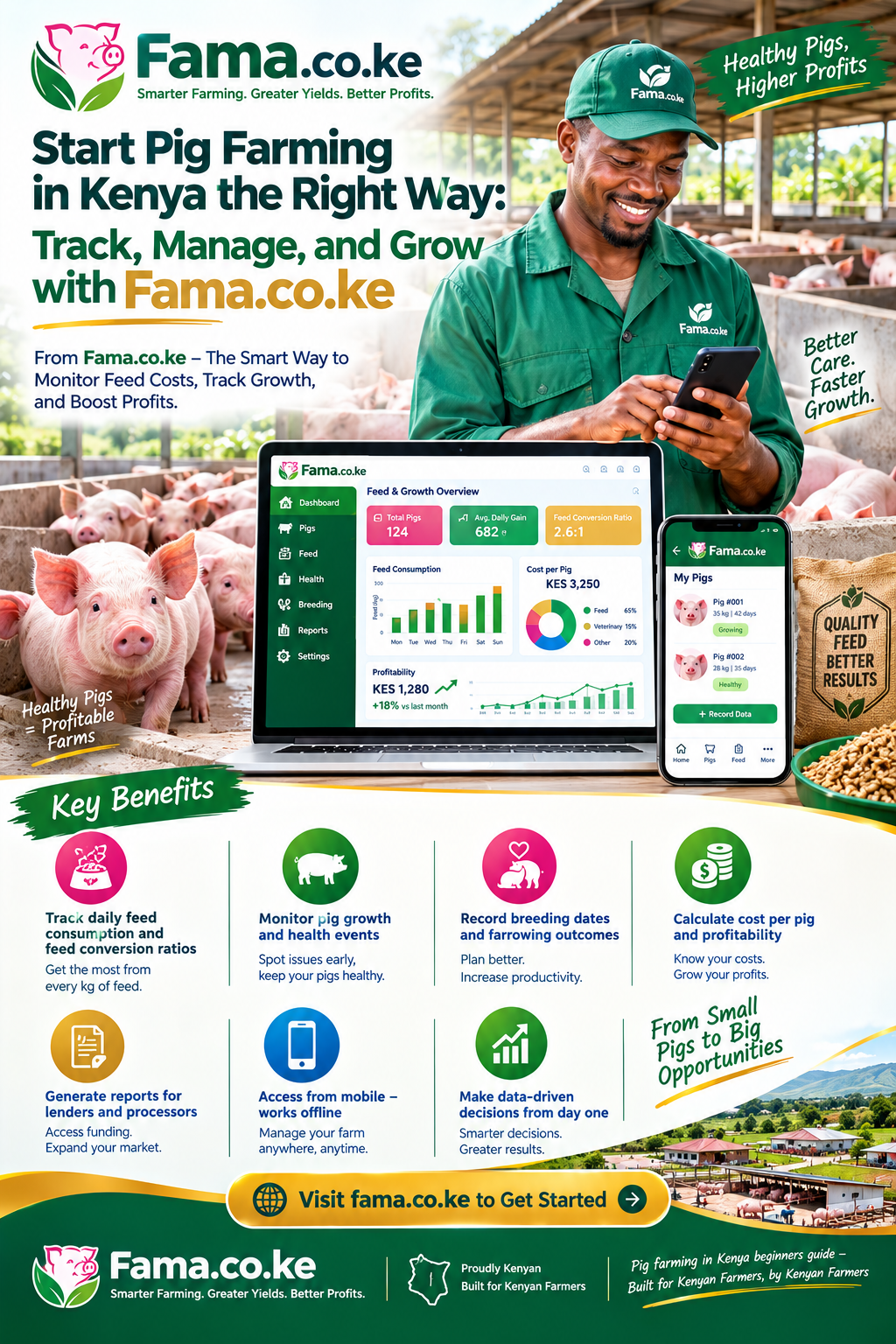
For farmers who want a complete digital system to track pig production, feed costs, health records, and sales, Fama.co.ke offers daily farm records software designed for Kenyan livestock farmers. The platform captures daily feed consumption, growth rates, health events, and sales transactions in one system that works offline and on basic smartphones. Reports generated from this data show cost per pig, feed conversion efficiency, and profitability trends that guide informed management. As this pig farming in Kenya beginners guide has shown, the strategies are known and proven. What separates profitable piggeries from struggling ones is consistent execution, supported by records that make progress visible and problems detectable before they become losses.
The future of pig farming in Kenya is bright. Pork consumption is expected to rise to 17,100 tonnes by 2026, and Kenyan pork is already finding demand in neighbouring Uganda and Tanzania, as well as in Gulf markets including the United Arab Emirates. Smallholder farmers make up about 80 percent of Kenya’s pig value chain, making the sector a significant source of employment, household income, and food security. With demand outstripping supply and processors actively seeking contracted farmers, beginners who enter the sector with proper knowledge and disciplined management have a genuine opportunity to build profitable, sustainable pig enterprises. For those seeking comprehensive digital tools to support their journey, pig farming in Kenya beginners guide from Fama.co.ke provides the infrastructure to plan, track, and grow a successful piggery. Visit fama.co.ke to learn more about how farm management software can support your pig farming venture, and use this pig farming in Kenya beginners guide as your roadmap to building a thriving pig enterprise. With the right knowledge, the right tools, and consistent effort, pig farming in Kenya beginners guide can transform from a question into a rewarding business reality.
Frequently Asked Questions About Pig Farming in Kenya Beginners Guide
What is the best pig breed for beginners in Kenya?
Large White, Landrace, or a cross of the two is the practical choice for most Kenyan farmers. Crossbreds combine fast growth, big litters, and good carcasses. Avoid unimproved local pigs for commercial farming because they grow too slowly to pay.
How much does it cost to start pig farming in Kenya?
A small unit can start from roughly KES 40,000 to 100,000, covering weaners, a simple concrete sty, and initial feed. For a more structured beginning with two pregnant sows, a farmer with approximately Sh250,000 can construct a pig shed, source sows, and cover feed through the first production cycle.
How long does it take for a pig to reach market weight?
Improved breeds mature in just 4 to 6 months at approximately 130 kilograms, compared to the 9-month growth period of older breeds. A typical finishing cycle delivers a net profit of approximately KSh 16,000 per pig after all costs are netted from the sale value.
What do pigs eat in Kenya?
Pigs are fed by stage: creep feed for suckling piglets, weaner meal after weaning, grower meal through the main growth phase, and finisher or sow meal to market weight. Many farmers home-mix rations using maize germ, pollard, omena or fishmeal, and mineral premix to reduce costs.
How do I prevent African Swine Fever in my piggery?
There is no vaccine or cure for ASF in Kenya. Biosecurity is the only effective safeguard: control who enters the sty, provide a disinfectant footbath, quarantine new animals, never feed untreated swill, keep visitors and vehicles away, and disinfect equipment between pens.