Introduction
Livestock farming is one of the most important agricultural activities in Kenya. Thousands of farmers depend on dairy cattle, beef cattle, goats, sheep, pigs, poultry, and other livestock for income and food security. However, managing animals without proper records often leads to losses, poor productivity, and inefficient farm operations. This is why many farmers are adopting a livestock record keeping system Kenya to improve management and maximize profits.
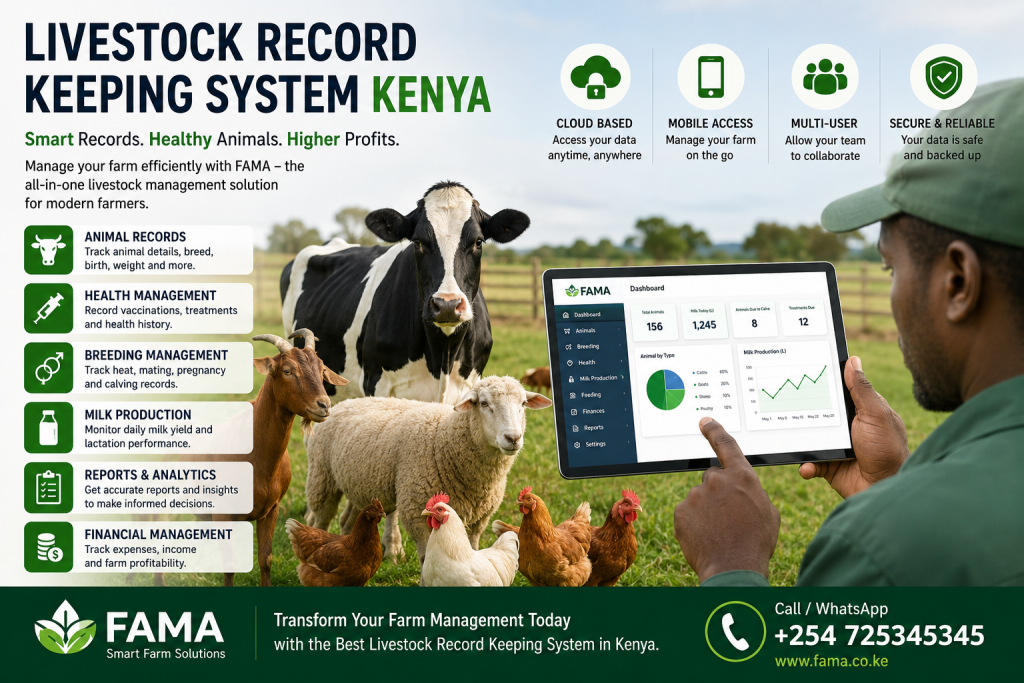
Traditional notebooks and memory-based records are no longer enough for modern farming. As farms grow and animal populations increase, keeping track of breeding, vaccinations, treatments, milk production, feeding schedules, and expenses becomes difficult. A digital livestock record keeping system Kenya simplifies these tasks and provides accurate information whenever needed.
At FAMA, we provide smart farm management solutions that help farmers organize their livestock records and make informed decisions. Contact us today on +254 725345345 for a customized livestock management solution.
What Is a Livestock Record Keeping System?
A livestock record keeping system is software designed to help farmers capture, organize, and analyze information about animals on their farms. Instead of relying on manual books and paperwork, farmers can store all important information digitally and access it from computers, tablets, or smartphones.
The system records information such as:
- Animal identification numbers
- Breed information
- Birth records
- Weight records
- Vaccination schedules
- Treatment history
- Feeding records
- Milk production records
- Breeding history
- Pregnancy monitoring
- Calving records
- Sales records
- Expenses and revenues
Using a livestock record keeping system Kenya allows farmers to monitor the health and performance of every animal with ease.
Why Livestock Records Are Important
Many farmers lose money because they do not maintain proper records. Without accurate information, it becomes difficult to:
- Monitor productivity.
- Identify profitable animals.
- Track diseases and treatments.
- Improve breeding programs.
- Control farm expenses.
- Predict future production.
A modern livestock record keeping system Kenya ensures that all farm information is available in one place, making management easier and more effective.
Challenges of Manual Livestock Records
Missing Information
Paper records are easily lost, damaged, or misplaced.
Human Errors
Writing mistakes and forgotten entries lead to inaccurate data.
Difficult Data Analysis
Manual records make it hard to analyze trends and compare performance.
Time Consumption
Searching through books and files wastes valuable time.
Limited Accessibility
Physical records cannot be accessed remotely.
Lack of Reports
Generating reports manually requires extra effort and increases chances of errors.
A digital livestock record keeping system Kenya solves these challenges and improves efficiency.
Features of a Livestock Record Keeping System Kenya
Animal Registration
Every animal receives a unique identification number. Information captured includes:
- Breed
- Date of birth
- Weight
- Gender
- Color
- Parent information
This enables easy tracking and management.
Health Management
Animal health records are essential for disease prevention.
The system stores:
- Vaccination history
- Deworming schedules
- Treatment records
- Disease history
- Veterinary visits
- Drug administration records
A livestock record keeping system Kenya ensures no treatment schedules are missed.
Breeding Management
Breeding records help improve herd quality.
Farmers can record:
- Heat detection dates
- Artificial insemination details
- Mating dates
- Pregnancy diagnosis
- Expected calving dates
- Birth information
This improves reproductive efficiency.
Milk Production Monitoring
For dairy farmers, milk records are critical.
The software tracks:
- Daily milk yield
- Weekly production
- Monthly production
- Lactation performance
- Individual cow performance
With a livestock record keeping system Kenya, dairy farmers can identify high-performing animals.
Feeding Management
Feed represents one of the largest farm expenses.
The system helps monitor:
- Feed types
- Feeding schedules
- Feed quantities
- Supplement usage
- Feed costs
Proper feeding management improves productivity and reduces wastage.
Weight Tracking
Weight records are useful for:
- Growth monitoring
- Disease detection
- Market preparation
- Performance evaluation
The software generates growth trends for individual animals.
Expense Management
Farm expenses include:
- Veterinary costs
- Feed expenses
- Labor costs
- Equipment costs
- Fuel expenses
- Utility expenses
A livestock record keeping system Kenya allows farmers to know where money is being spent.
Revenue Tracking
Income sources include:
- Milk sales
- Animal sales
- Meat sales
- Egg sales
- Manure sales
Monitoring revenue helps determine farm profitability.
Inventory Management
Farm inventory includes:
- Feeds
- Medicines
- Equipment
- Vaccines
- Supplements
The system helps monitor stock levels and avoid shortages.
Reporting and Analytics
One major advantage of a livestock record keeping system Kenya is automatic report generation.
Reports include:
- Animal inventory reports
- Breeding reports
- Milk production reports
- Health reports
- Expense reports
- Profit reports
- Growth reports
These reports support better decision-making.
Benefits of Using Livestock Record Keeping System Kenya
Improved Farm Productivity
Proper records help farmers identify areas that need improvement.
Better Animal Health
Vaccination and treatment schedules reduce disease outbreaks.
Increased Milk Production
Monitoring performance allows farmers to optimize feeding and breeding.
Reduced Losses
Disease management and proper planning minimize losses.
Higher Profits
Better decisions lead to increased revenues.
Efficient Farm Operations
Automation reduces paperwork and saves time.
Accurate Financial Management
Farmers understand their costs and profitability.
Easier Decision Making
Reliable information supports strategic planning.
Livestock Enterprises That Benefit from the System
Dairy Farming
Dairy farmers can monitor:
- Milk production
- Breeding cycles
- Animal health
- Feed management
Beef Farming
Beef farmers can track:
- Weight gain
- Feed efficiency
- Growth performance
- Market readiness
Goat Farming
Goat farmers can manage:
- Birth records
- Breeding history
- Vaccinations
- Production performance
Sheep Farming
Sheep farmers benefit from improved flock management and health monitoring.
Pig Farming
Pig farmers can track:
- Breeding schedules
- Growth rates
- Feed consumption
- Health records
Poultry Farming
Poultry farmers can manage:
- Egg production
- Vaccination schedules
- Feed usage
- Mortality records
Camel Farming
Camel farmers can record milk production, breeding, and treatments.
How Technology Is Transforming Livestock Farming in Kenya
Kenyan agriculture is increasingly embracing digital transformation. Modern software systems are replacing paperwork and helping farmers improve productivity and profitability.
A livestock record keeping system Kenya enables farmers to access information instantly, analyze trends, and make informed decisions. With smartphones becoming common in rural areas, digital livestock management is becoming easier and more affordable.
Forward-thinking farmers are now using technology to compete effectively and build sustainable agribusinesses.
Why Farmers Need Accurate Livestock Records
Successful livestock farming depends on information. Records help farmers answer important questions such as:
- Which animals produce the most milk?
- Which animals have fertility problems?
- How much money is spent on feed?
- Which treatments are most effective?
- Which animals are ready for sale?
- Is the farm making profits?
Without proper records, these questions become difficult to answer.
A modern livestock record keeping system Kenya provides these answers instantly and supports smarter farming.
Cloud-Based Livestock Record Keeping System Kenya
Modern farming requires flexibility and accessibility. A cloud-based livestock record keeping system Kenya allows farmers to access records from anywhere using computers, tablets, or smartphones.
Cloud technology offers several advantages:
- Real-time updates.
- Secure data storage.
- Automatic backups.
- Easy access from multiple locations.
- Reduced risk of losing records.
- Faster report generation.
Whether a farmer is on the farm, at the market, or attending agricultural exhibitions, important livestock information remains accessible.
Mobile-Friendly Livestock Management
Smartphone usage among Kenyan farmers has increased significantly. Mobile access enables farmers to record information immediately without waiting to return to the office.
Mobile accessibility allows farmers to:
- Record births instantly.
- Capture treatment records.
- Update milk production.
- Track feed usage.
- Monitor expenses.
- Generate reports.
A mobile-enabled livestock record keeping system Kenya helps farmers manage operations efficiently regardless of location.
Multi-User Access for Large Farms
Large livestock farms often involve multiple employees, managers, veterinarians, and accountants. A digital system allows authorized users to access information based on assigned roles.
Multi-user features include:
Administrator Access
Administrators control the entire system and manage user permissions.
Farm Manager Access
Managers supervise daily operations and monitor performance.
Veterinary Access
Veterinarians update treatment records and monitor animal health.
Finance Access
Accountants manage expenses, revenues, and financial reports.
Staff Access
Workers record feeding schedules, births, and routine activities.
This collaborative approach improves efficiency and accountability.
Financial Management Capabilities
Financial control is critical for profitable livestock farming.
A livestock record keeping system Kenya helps farmers monitor:
Daily Expenses
- Feed purchases
- Medication costs
- Fuel expenses
- Utility bills
- Labor costs
Income Sources
- Milk sales
- Animal sales
- Egg sales
- Meat sales
- Manure sales
Profit Analysis
The software automatically calculates:
- Total income
- Total expenses
- Gross profits
- Net profits
Farmers can quickly determine whether operations are profitable.
Data Security and Backup
Protecting farm records is essential.
Modern systems provide:
- Password protection.
- User permissions.
- Automatic backups.
- Secure databases.
- Recovery options.
This ensures that valuable farm information remains safe and available whenever needed.
Improving Breeding Programs
Breeding records are essential for improving livestock quality.
The system helps farmers:
- Monitor heat cycles.
- Track insemination dates.
- Identify conception rates.
- Record calving dates.
- Analyze breeding performance.
These records help improve herd genetics and increase productivity.
Disease Prevention and Health Monitoring
Disease outbreaks can cause major losses.
A livestock record keeping system Kenya helps farmers:
- Maintain vaccination schedules.
- Monitor treatment histories.
- Identify recurring diseases.
- Reduce mortality rates.
- Improve animal welfare.
Healthy animals result in higher productivity and profitability.
Increasing Dairy Productivity
Dairy farmers benefit greatly from digital record keeping.
The software enables monitoring of:
- Daily milk yield.
- Lactation periods.
- Feeding patterns.
- Breeding efficiency.
- Health status.
By analyzing production trends, farmers can identify high-performing animals and improve overall herd performance.
Reducing Operational Costs
Poor planning increases unnecessary expenses.
Digital livestock management helps reduce costs through:
- Efficient feed utilization.
- Better disease prevention.
- Reduced paperwork.
- Improved inventory management.
- Proper breeding schedules.
Cost reduction directly improves farm profits.
Common Mistakes Farmers Make Without Proper Records
Many livestock farmers focus on daily activities and overlook the importance of maintaining organized records. While this may seem manageable at first, it often creates problems that affect productivity and profitability in the long run.
Forgetting Treatment History
One of the most common challenges is forgetting when an animal was last treated or vaccinated. Missing important treatment schedules can expose animals to diseases and increase veterinary expenses. Organized records help ensure every treatment is documented and future schedules are easy to follow.
Inaccurate Feed Planning
Feed is one of the biggest expenses in livestock farming. Without proper documentation, farmers may overfeed or underfeed animals, leading to wastage or reduced productivity. Historical records help determine the right feeding programs and estimate future feed requirements more accurately.
Poor Breeding Decisions
Breeding without adequate records can result in low conception rates and poor genetic improvement. Farmers may unknowingly breed animals with undesirable traits or lose track of reproductive cycles. Detailed breeding information helps maintain healthy and productive herds.
Failure to Identify Productive Animals
Some animals contribute significantly more to farm income than others. Without performance records, it becomes difficult to identify the most productive animals for breeding or expansion purposes. Keeping production records helps farmers make better decisions when selecting animals.
Underestimating Expenses
Many farmers believe they are making profits simply because they sell milk, eggs, or animals regularly. However, without documenting expenses, it becomes impossible to determine actual profitability. Recording every cost gives a clear picture of business performance.
Building Sustainable Livestock Enterprises
Sustainability has become an important aspect of modern agriculture. Farmers are increasingly looking for ways to maximize production while conserving resources and minimizing losses.
Proper management practices contribute to sustainability by:
- Reducing unnecessary medication usage.
- Preventing feed wastage.
- Improving breeding efficiency.
- Lowering mortality rates.
- Enhancing resource utilization.
- Supporting environmental conservation.
Efficient farm management ensures long-term growth and resilience, especially during periods of changing weather patterns and fluctuating market prices.
Importance of Historical Farm Data
Historical information provides valuable insights into farm performance over time. By analyzing past records, farmers can recognize patterns and make informed decisions.
Historical data helps answer questions such as:
- Which seasons produce the highest milk yields?
- Which animals have consistently performed well?
- How have feed costs changed over the years?
- Which diseases occur frequently?
- What management practices have produced the best results?
Understanding these trends allows farmers to improve planning and reduce uncertainty.
Supporting Farm Expansion
As livestock businesses grow, managing operations becomes more complex. Expansion often involves:
- Increasing herd size.
- Hiring additional employees.
- Investing in equipment.
- Diversifying products.
- Opening new markets.
Organized information makes expansion easier by providing accurate figures and performance indicators. Farmers can confidently make investment decisions based on reliable data rather than assumptions.
Better Planning During Drought Seasons
Drought periods present serious challenges to livestock farmers. Reduced pasture availability and rising feed costs can affect productivity significantly.
Proper records help farmers prepare for difficult seasons by:
- Estimating feed requirements in advance.
- Monitoring water consumption.
- Identifying animals requiring special attention.
- Planning supplementary feeding programs.
- Evaluating previous drought management strategies.
Preparedness reduces losses and improves farm resilience during harsh conditions.
Enhancing Farmer Confidence
Successful farming requires confidence in decision-making. Having access to accurate information gives farmers peace of mind and enables them to respond quickly to challenges.
Instead of relying on guesswork, farmers can base decisions on facts and measurable results. This confidence supports long-term planning and encourages continuous improvement in farm operations.
Ultimately, organized farm information transforms livestock keeping from a traditional activity into a well-managed agribusiness capable of generating sustainable income and supporting future growth.
Supporting Commercial Livestock Farming
Commercial farms require accurate data to support expansion.
A livestock record keeping system Kenya helps commercial farmers:
- Manage thousands of animals.
- Monitor multiple farm locations.
- Generate performance reports.
- Analyze production trends.
- Improve business planning.
Technology provides a competitive advantage for modern agribusinesses.
Compliance and Traceability
Traceability is becoming increasingly important in livestock production.
Proper records help farmers:
- Demonstrate animal histories.
- Maintain vaccination records.
- Support food safety standards.
- Improve market access.
- Meet export requirements.
Reliable records increase customer confidence and market opportunities.
Why Choose FAMA Livestock Record Keeping System Kenya?
FAMA understands the needs of Kenyan farmers and provides practical solutions designed for local agricultural conditions.
Our system offers:
Easy Animal Registration
Manage all animal details from one platform.
Health Monitoring
Track vaccinations, treatments, and disease history.
Breeding Management
Monitor fertility and reproductive performance.
Milk Production Tracking
Measure productivity accurately.
Feed Management
Control feed usage and expenses.
Financial Reports
Monitor revenues, expenses, and profits.
Inventory Management
Manage medicines, feeds, and farm supplies.
Automatic Reports
Generate detailed reports instantly.
User-Friendly Interface
Easy to learn and use.
Scalability
Suitable for small farms and large commercial operations.
Who Needs a Livestock Record Keeping System Kenya?
This software is suitable for:
- Dairy farmers.
- Beef farmers.
- Goat farmers.
- Sheep farmers.
- Poultry farmers.
- Pig farmers.
- Camel farmers.
- Agricultural cooperatives.
- Livestock consultants.
- Veterinary professionals.
- Commercial ranches.
- Research institutions.
Future of Livestock Farming in Kenya
Agriculture is rapidly embracing technology. Farmers who adopt digital solutions are likely to enjoy:
- Better productivity.
- Lower costs.
- Improved decision-making.
- Increased profitability.
- Sustainable farm growth.
A livestock record keeping system Kenya is becoming an essential tool rather than a luxury. Farmers who embrace technology today position themselves for greater success tomorrow.
Frequently Asked Questions
Can small-scale farmers use the system?
Yes. The system is suitable for both small farms and large commercial operations.
Can I record different types of animals?
Yes. The software supports cattle, goats, sheep, pigs, poultry, camels, and other livestock.
Is my data secure?
Yes. Records are protected through secure databases and backup systems.
Can I generate reports?
Yes. Detailed reports are available for production, breeding, health, finances, and inventory.
Can multiple users access the system?
Yes. Managers, veterinarians, accountants, and farm workers can have different access levels.
Can the system grow with my farm?
Absolutely. The software is scalable and can accommodate increasing numbers of animals and farm operations.
Conclusion
Modern livestock farming requires accurate information, proper planning, and efficient management. Relying on notebooks and memory is no longer sufficient for farmers who want to maximize productivity and profitability. A reliable livestock record keeping system Kenya enables farmers to track animal health, breeding, milk production, feeding, expenses, revenues, and overall farm performance from a single platform.
Digital record keeping reduces losses, improves decision-making, enhances disease control, and supports sustainable farm growth. Whether you operate a dairy farm, beef ranch, goat farm, pig farm, poultry business, or mixed livestock enterprise, investing in the right technology can transform your operations and increase profitability.
At FAMA, we are committed to helping Kenyan farmers embrace smart agriculture through reliable livestock management solutions tailored to local needs. Our software is designed to simplify farm operations, improve productivity, and support long-term success.
For more information about the best Livestock Record Keeping System Kenya, contact us today:
FAMA
📞 +254 725345345
🌐 www.fama.co.ke
Take your livestock farming to the next level with modern technology and smarter farm management.