Integrated Farming: A Smart Solution for Modern Agriculture
Agriculture is rapidly evolving as farmers seek better ways to increase production while reducing costs and protecting the environment. One of the most effective approaches gaining popularity across Kenya and the world is integrated farming. This farming method combines different agricultural enterprises such as crop production, livestock keeping, fish farming, poultry farming, agroforestry, and organic manure production into one interconnected system.
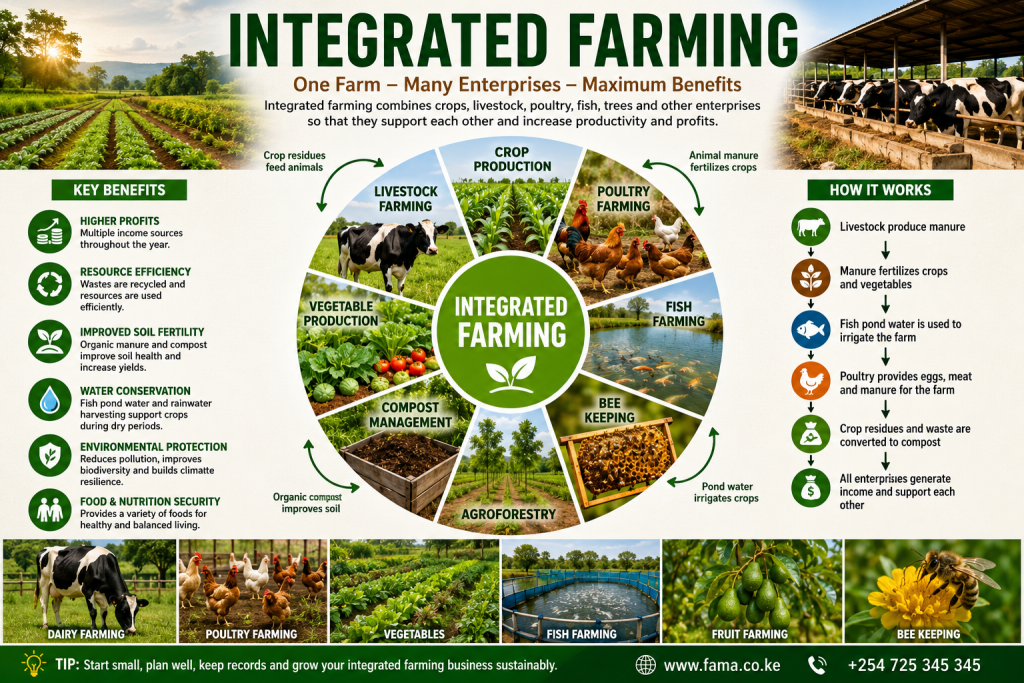
Integrated farming enables farmers to maximize every available resource on the farm. Instead of treating each enterprise separately, every activity supports another. Animal waste becomes fertilizer, crop residues become livestock feed, fish pond water irrigates crops, and crop waste is converted into compost. The result is a highly efficient farming system that minimizes waste while maximizing profits.
Whether you own a small family farm or a large commercial enterprise, integrated farming offers numerous economic and environmental benefits. Farmers who embrace integrated farming enjoy improved soil fertility, diversified income, reduced production costs, better food security, and increased resilience against climate change.
At FAMA (Farm Management System Africa), we help farmers manage every aspect of integrated farming through smart digital technologies. Our software allows farmers to monitor crops, livestock, farm workers, inventory, expenses, income, machinery, farm inputs, and production records from one centralized platform.
Visit FAMA.co.ke today or call +254 725345345 to discover how digital farm management can transform your integrated farming operations.
What is Integrated Farming?
Integrated farming is a farming system where multiple agricultural enterprises operate together in a mutually beneficial relationship. Instead of relying on one farming activity, farmers combine several enterprises to maximize efficiency and profitability.
A typical integrated farming model may include:
- Crop farming
- Dairy farming
- Poultry farming
- Fish farming
- Goat farming
- Sheep farming
- Pig farming
- Bee keeping
- Agroforestry
- Compost production
- Biogas generation
Each enterprise contributes resources to another.
For example:
- Dairy cows produce manure.
- Manure fertilizes maize fields.
- Maize stalks feed cattle.
- Poultry manure fertilizes vegetables.
- Vegetable waste feeds goats.
- Fish pond water irrigates crops.
- Crop residues produce compost.
This creates a circular farming economy where very little goes to waste.
Why Integrated Farming is Becoming Popular in Kenya
Kenyan farmers face many challenges including:
- Rising fertilizer prices
- Expensive animal feeds
- Climate change
- Water shortages
- Declining soil fertility
- Market fluctuations
- Limited farm sizes
Integrated farming helps overcome these challenges by increasing farm efficiency.
Instead of depending on one source of income, farmers earn revenue from multiple enterprises throughout the year.
For example, while maize grows for several months, poultry can generate weekly income through egg sales, dairy cows provide daily milk income, vegetables offer monthly harvests, and fish provide seasonal profits.
This diversified income significantly reduces financial risks.
Major Components of Integrated Farming
Crop Production
Crop farming forms the foundation of most integrated farming systems.
Common crops include:
- Maize
- Beans
- Vegetables
- Tomatoes
- Onions
- Kale
- Spinach
- Fruits
- Bananas
- Coffee
- Tea
- Sugarcane
Crop residues become valuable livestock feed or organic compost.
Livestock Farming
Livestock contribute significantly to integrated farming.
Popular livestock include:
- Dairy cattle
- Beef cattle
- Goats
- Sheep
- Pigs
- Rabbits
Livestock provide:
- Meat
- Milk
- Manure
- Breeding stock
- Income
Animal manure replaces expensive chemical fertilizers.
Poultry Farming
Poultry integrates perfectly with crop farming.
Farmers keep:
- Layers
- Broilers
- Indigenous chickens
- Ducks
- Turkeys
Benefits include:
- Egg production
- Meat production
- Organic manure
- Quick income
- Low startup costs
Chicken manure is one of the richest organic fertilizers available.
Fish Farming
Fish farming adds another profitable enterprise.
Common fish include:
- Tilapia
- Catfish
Fish pond water contains nutrients that improve crop growth.
The pond also stores water for irrigation during dry seasons.
Agroforestry
Trees are essential in integrated farming.
Benefits include:
- Windbreaks
- Firewood
- Timber
- Fruits
- Animal fodder
- Improved biodiversity
- Carbon sequestration
Popular trees include:
- Grevillea
- Calliandra
- Leucaena
- Mango
- Avocado
- Eucalyptus (where appropriate)
Bee Keeping
Bees increase crop pollination while producing:
- Honey
- Beeswax
- Propolis
- Royal jelly
Bee keeping requires little land yet generates excellent income.
Benefits of Integrated Farming
Increased Farm Income
The biggest advantage of integrated farming is diversified income.
Instead of relying on one crop, farmers earn money from several enterprises throughout the year.
Income sources may include:
- Milk sales
- Egg sales
- Vegetable sales
- Fish sales
- Honey sales
- Livestock sales
- Fruit sales
This creates continuous cash flow.
Better Resource Utilization
Integrated farming ensures every farm resource has value.
Examples include:
- Animal manure fertilizes crops.
- Crop waste feeds livestock.
- Kitchen waste feeds pigs.
- Fish pond water irrigates vegetables.
- Fallen leaves become compost.
Nothing goes to waste.
Lower Production Costs
Farmers spend less on:
- Fertilizers
- Animal feeds
- Waste disposal
- Water
- Pest control
Organic manure replaces chemical fertilizers.
Crop residues reduce purchased feeds.
Compost improves soil naturally.
Improved Soil Fertility
Organic matter increases:
- Soil microorganisms
- Water retention
- Nutrient availability
- Root development
Healthy soils produce healthier crops.
Climate Change Adaptation
Integrated farming reduces climate risks.
If drought affects maize production, income from dairy, poultry, vegetables, or fish can sustain the farm.
Diversification improves resilience.
Improved Food Security
Families enjoy access to:
- Milk
- Eggs
- Meat
- Fish
- Fruits
- Vegetables
- Cereals
Balanced nutrition improves household health.
Examples of Integrated Farming Systems
Dairy and Crop Farming
This is Kenya’s most common integrated farming system.
The cycle includes:
- Dairy cows produce manure.
- Manure fertilizes maize.
- Maize silage feeds cows.
- Milk generates daily income.
Poultry and Vegetable Farming
Chicken manure enriches vegetable gardens.
Vegetable waste supplements poultry feed.
Egg sales finance farm operations.
Fish and Vegetable Farming
Fish pond water irrigates vegetables.
Vegetables reduce water pollution by absorbing nutrients.
Both enterprises benefit.
Goat Farming and Fruit Farming
Goat manure improves fruit orchards.
Tree leaves supplement goat feed.
Fruit waste also feeds goats.
Challenges Facing Integrated Farming
Although integrated farming has numerous benefits, farmers also face challenges.
These include:
- Limited capital
- Poor farm planning
- Lack of technical knowledge
- Disease management
- Water shortages
- Poor record keeping
- Market access
Fortunately, modern farm management software helps farmers overcome many of these challenges.
The Role of Technology in Integrated Farming
Technology has revolutionized agriculture.
Today’s farmers use software to manage every farming activity.
Digital farm management systems help farmers:
- Record production
- Track livestock
- Monitor crops
- Schedule farm activities
- Record expenses
- Monitor profits
- Manage workers
- Control inventory
- Generate reports
- Forecast production
Technology improves decision-making and profitability.
Why Record Keeping Matters in Integrated Farming
Integrated farming involves multiple enterprises operating simultaneously.
Without proper records, farmers struggle to understand profitability.
Essential records include:
- Livestock records
- Crop production records
- Veterinary records
- Feeding records
- Sales records
- Expense records
- Labor records
- Inventory records
- Machinery records
- Fertilizer applications
Digital record keeping simplifies farm management and improves accountability.
Introducing FAMA Farm Management System
Managing an integrated farm manually can become overwhelming as the number of enterprises grows. FAMA Farm Management System is designed to simplify farm operations by bringing all records and activities into one easy-to-use platform.
With FAMA, farmers can:
- Manage crop production schedules
- Monitor livestock health and breeding
- Record milk production
- Track poultry performance
- Manage fish farming operations
- Control farm inventory
- Record farm expenses and income
- Monitor labor productivity
- Generate financial reports
- Access farm information anytime and anywhere
Whether you operate a mixed farm with crops and livestock or a fully diversified agricultural enterprise, FAMA provides the digital tools needed to improve efficiency, profitability, and decision-making.
For demonstrations, pricing, or support, visit FAMA.co.ke or call +254 725345345.
intergrated farming
How to Successfully Implement an Integrated Farming System
Starting an integrated farming system requires proper planning, resource allocation, and continuous management. Whether you are a small-scale farmer or a commercial agricultural investor, integrated farming offers an opportunity to increase farm productivity while lowering production costs. A successful integrated farming enterprise is carefully designed so that each farming activity complements the others.
The first step in implementing integrated farming is assessing your available resources. Evaluate your land size, water sources, labor availability, machinery, capital, and existing agricultural enterprises. Once these resources are identified, you can design an integrated farming model that suits your farm.
For example, a five-acre farm can successfully combine dairy farming, poultry farming, vegetable farming, fish farming, fruit orchards, compost production, and fodder production. In this type of integrated farming system, dairy cows provide manure, poultry produce eggs and manure, vegetables utilize organic fertilizer, fish ponds provide irrigation water, while crop residues become livestock feed.
Planning is one of the most important factors in successful integrated farming. Every activity should have clear production schedules, financial budgets, labor requirements, and marketing plans.
Best Integrated Farming Models
One of the strengths of integrated farming is flexibility. Farmers can design an integrated farming system depending on climate, soil type, market demand, and available resources.
Popular integrated farming combinations include:
- Integrated farming with dairy cattle and maize.
- Integrated farming with poultry and vegetables.
- Integrated farming with fish farming and horticulture.
- Integrated farming with goats and fruit farming.
- Integrated farming with bee keeping and orchards.
- Integrated farming with rabbits and vegetable production.
- Integrated farming with pigs and biogas production.
- Integrated farming with agroforestry and livestock.
Each integrated farming model creates multiple income streams while reducing operational expenses.
Integrated Farming and Sustainable Agriculture
Integrated farming is considered one of the most sustainable agricultural practices available today. Sustainable agriculture aims to increase food production while protecting natural resources for future generations.
Integrated farming supports sustainability by:
- Conserving water resources.
- Improving soil fertility.
- Reducing chemical fertilizer dependence.
- Lowering pesticide usage.
- Recycling agricultural waste.
- Increasing biodiversity.
- Reducing greenhouse gas emissions.
- Improving ecosystem health.
Through integrated farming, farmers produce more food while protecting the environment.
Integrated Farming Improves Soil Health
Healthy soils are the foundation of productive agriculture. One major benefit of integrated farming is continuous improvement of soil fertility.
Animal manure from dairy cattle, poultry, goats, pigs, and rabbits becomes valuable organic fertilizer.
Organic matter improves:
- Soil structure.
- Water retention.
- Root penetration.
- Earthworm activity.
- Beneficial microorganisms.
- Nutrient availability.
Instead of depending entirely on synthetic fertilizers, integrated farming encourages farmers to recycle nutrients naturally.
Healthy soils translate into healthier crops and higher yields.
Water Conservation in Integrated Farming
Water scarcity continues to affect agriculture across many regions. Integrated farming provides practical water conservation techniques.
Water-saving methods include:
- Rainwater harvesting.
- Fish pond water recycling.
- Drip irrigation.
- Mulching.
- Organic matter application.
- Water storage reservoirs.
In integrated farming, fish pond water becomes nutrient-rich irrigation water for vegetables and fruit trees.
This reduces fertilizer costs while conserving water.
Pest and Disease Management in Integrated Farming
One advantage of integrated farming is reduced pest pressure.
Diversified farming systems interrupt pest life cycles.
Farmers practicing integrated farming often use:
- Crop rotation.
- Biological pest control.
- Companion planting.
- Organic pesticides.
- Beneficial insects.
- Resistant crop varieties.
- Proper sanitation.
These practices reduce dependence on expensive chemical pesticides.
Financial Benefits of Integrated Farming
Many farmers adopt integrated farming because of its outstanding financial advantages.
Some of these include:
Multiple Income Streams
Instead of relying solely on maize or dairy, integrated farming creates several revenue sources.
Income may come from:
- Milk sales.
- Egg sales.
- Fish sales.
- Vegetable sales.
- Fruit sales.
- Honey sales.
- Livestock sales.
- Seedling sales.
- Compost sales.
This steady cash flow improves financial stability.
Reduced Farm Expenses
Integrated farming lowers operational costs through:
- Organic manure production.
- Homemade livestock feeds.
- Waste recycling.
- Reduced fertilizer purchases.
- Lower pesticide costs.
- Better labor utilization.
Higher Profitability
By reducing waste and increasing productivity, integrated farming significantly improves farm profits.
Many successful farms report increased profitability after adopting integrated farming principles.
Why Digital Farm Management is Essential for Integrated Farming
Managing an integrated farming enterprise manually becomes increasingly difficult as farm operations expand.
Farmers need accurate information regarding:
- Livestock numbers.
- Crop production.
- Inventory.
- Expenses.
- Sales.
- Labor.
- Machinery.
- Veterinary treatments.
- Feed consumption.
- Financial performance.
Without proper records, profitable decision-making becomes difficult.
Why Farmers Choose FAMA Farm Management System
FAMA Farm Management System is specifically designed for modern integrated farming operations.
The software helps farmers manage every enterprise from one platform.
Features include:
- Crop management.
- Livestock management.
- Poultry management.
- Fish farming management.
- Farm inventory.
- Asset management.
- Financial reporting.
- Employee management.
- Production monitoring.
- Sales tracking.
- Expense management.
- Farm analytics.
Whether your integrated farming business includes dairy cows, poultry, vegetables, goats, fish, orchards, or mixed enterprises, FAMA simplifies farm management.
Farm managers can monitor operations from anywhere using digital records.
Visit www.fama.co.ke or call +254 725345345 for demonstrations and pricing.
Common Mistakes to Avoid in Integrated Farming
Although integrated farming offers enormous benefits, success depends on avoiding common mistakes.
These include:
- Poor planning.
- Keeping too many enterprises without proper management.
- Ignoring record keeping.
- Poor disease control.
- Lack of market research.
- Inadequate water supply.
- Overstocking livestock.
- Poor feed management.
- Lack of budgeting.
- Failure to adopt technology.
Avoiding these mistakes allows your integrated farming enterprise to grow sustainably.
The Future of Integrated Farming
The future of integrated farming is extremely promising. Rising food demand, climate change, and increasing production costs are encouraging more farmers to embrace integrated farming.
Future trends include:
- Precision agriculture.
- Smart irrigation.
- Farm automation.
- Artificial intelligence.
- Remote farm monitoring.
- Internet of Things (IoT).
- Digital livestock tracking.
- Climate-smart agriculture.
- Drone technology.
- Mobile farm management applications.
These innovations make integrated farming more productive, efficient, and profitable.
Frequently Asked Questions About Integrated Farming
What is integrated farming?
Integrated farming is an agricultural system where crops, livestock, poultry, fish, trees, and other enterprises work together to maximize productivity and minimize waste.
Is integrated farming profitable?
Yes. Integrated farming increases profitability by reducing production costs and creating multiple income sources.
Can small-scale farmers practice integrated farming?
Absolutely. Even farmers with one acre can implement integrated farming by combining vegetables, poultry, dairy goats, compost production, and fruit trees.
Why is integrated farming important?
Integrated farming improves food security, increases income, conserves natural resources, improves soil fertility, and supports sustainable agriculture.
How can technology improve integrated farming?
Digital systems like FAMA help farmers manage crops, livestock, finances, inventory, workers, and production records, making integrated farming easier and more profitable.
Why Every Modern Farmer Should Invest in Integrated Farming
As agriculture continues to evolve, integrated farming has become one of the most practical and profitable approaches for farmers seeking sustainable growth. Rising production costs, unpredictable weather patterns, shrinking farmland, and increasing consumer demand for quality agricultural products make integrated farming more relevant than ever. By combining multiple agricultural enterprises into one well-managed system, integrated farming enables farmers to make better use of every available resource while reducing waste and increasing overall productivity.
One of the greatest advantages of integrated farming is flexibility. Farmers can start with just two enterprises, such as dairy farming and crop production, and gradually expand into poultry farming, fish farming, fruit farming, bee keeping, or agroforestry as their business grows. This gradual expansion allows farmers to spread investment costs while steadily increasing income. Every new enterprise added to an integrated farming system contributes additional value through resource sharing, improved efficiency, and diversified revenue streams.
Modern consumers are also becoming more conscious of how food is produced. Farms that practice integrated farming often rely more heavily on organic manure, natural pest management, crop rotation, and environmentally friendly production methods. These practices not only improve food quality but also protect soil health, conserve water, and support long-term agricultural sustainability.
Technology is another key driver of successful integrated farming. Digital farm management solutions enable farmers to monitor livestock performance, crop growth, production schedules, inventory, expenses, and profitability from a single platform. With accurate records and real-time insights, farmers can identify opportunities for improvement, reduce losses, and make informed decisions that increase productivity.
Ultimately, integrated farming is more than just a farming method—it is a complete farm management strategy that encourages efficiency, sustainability, resilience, and profitability. Farmers who embrace integrated farming today are better positioned to overcome future agricultural challenges while building stronger, more productive, and financially successful farming enterprises for generations to come.
Conclusion
Integrated farming is transforming agriculture by creating efficient, sustainable, and highly profitable farming systems. Instead of depending on a single enterprise, integrated farming combines crops, livestock, poultry, fish farming, agroforestry, and other complementary activities into one productive ecosystem. The result is improved soil fertility, lower production costs, diversified income, better resource utilization, and increased resilience to climate change.
Whether you are starting a new agricultural venture or upgrading an existing farm, integrated farming offers a practical path toward long-term success. By adopting modern management practices and digital technologies, farmers can maximize productivity while minimizing waste.
FAMA Farm Management System is built to support every stage of integrated farming. From crop planning and livestock management to financial reporting, inventory control, labor tracking, and production analysis, FAMA provides the tools needed to run a modern farm efficiently.
If you are ready to modernize your integrated farming business, visit www.fama.co.ke or contact us today at +254 725345345. Let FAMA help you build a smarter, more productive, and more profitable integrated farming enterprise.