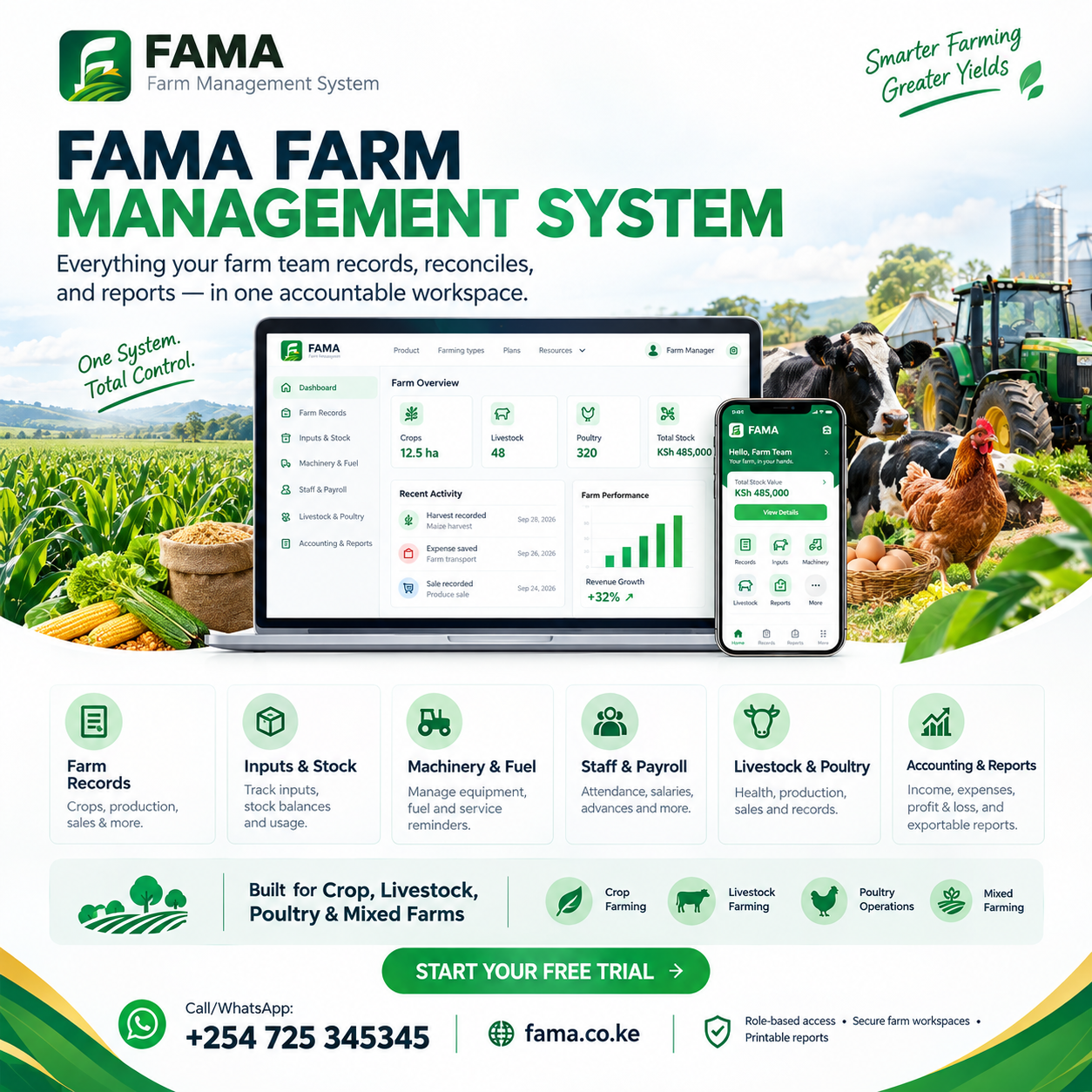
How to track livestock sales and profit is the single most important financial skill for any livestock farmer, because without accurate sales and profit data, every decision about breeding, feeding, and selling is based on guesswork rather than facts. Fama.co.ke provides an innovative platform that makes how to track livestock sales and profit simple and practical, helping farmers move from scattered receipts and memory to organised, verifiable financial records. With Kenya’s livestock sector contributing approximately 12 per cent of the country’s Gross Domestic Product and the government targeting Sh1 trillion in sector value, the adoption of how to track livestock sales and profit has become essential for anyone serious about profitable livestock production.
The consequences of not knowing how to track livestock sales and profit are devastating and documented across thousands of Kenyan farms. Elijah Rote from Oyani Farm in Uriri, Migori County, lost Sh8,000 on a single cow sale because he could not prove vaccination status to a buyer. “The trader asked if I had any proof of vaccination. I didn’t. He lowered the price by almost Sh8,000,” he recalled. This is precisely the kind of avoidable loss that how to track livestock sales and profit prevents. When every sale, cost, and profit margin is recorded digitally, farmers can negotiate from a position of strength and identify which animals are truly profitable.
Fama.co.ke‘s platform helps farmers master how to track livestock sales and profit by providing tools to record sales transactions, track production costs, calculate profitability per animal, and generate financial reports. Research shows that the Kenya Meat Commission pays Sh180 per kilogram live weight for bulls and steers weighing 350 kilograms and above, and Sh170 per kilogram for cows. But without how to track livestock sales and profit, farmers cannot determine whether these prices deliver a profit after accounting for feed, veterinary, labour, and transport costs.
The financial case for adopting how to track livestock sales and profit is compelling. A Kakamega farmer who abandoned sugarcane and maize for pig rearing now makes a net profit of Sh16,000 from each pig after seven months, delivering 25 pigs per cycle for a net profit of Sh400,000. He achieves this because he strictly tracks his costs and sales. A how to track livestock sales and profit system that captures every transaction enables farmers to replicate such success by identifying which enterprises are profitable and which are losing money.
Tracking livestock sales requires capturing every transaction with date, buyer, animal identification, weight, price, and payment status. For cattle, a single animal may represent hundreds of thousands of shillings, making accurate record-keeping critical. For poultry, pigs, goats, and sheep, farmers may sell multiple animals in a single transaction, making individual tracking more complex. A how to track livestock sales and profit platform from Fama.co.ke handles all species and transaction types, whether selling one bull or 100 broilers.
Profit calculation requires knowing not just revenue but the true cost of production for each animal. Feed, veterinary care, labour, housing, and transport all contribute to the cost of bringing an animal to market weight. A how to track livestock sales and profit system allocates these costs across the herd and calculates profit per animal, per kilogram of live weight, or per enterprise. Without this data, farmers may believe they are profitable when they are actually losing money on every animal sold.
The Kenya Meat Commission’s direct purchase programme, with buying prices of Sh180 per kilogram live weight for bulls and steers weighing 350 kilograms and above, provides a transparent benchmark that supports how to track livestock sales and profit. Farmers who track their production costs can determine whether selling to KMC at these prices is profitable or whether they should seek better markets or improve efficiency.
For farmers managing multiple species and production systems, how to track livestock sales and profit provides the structure that manual systems cannot. The platform tracks cattle, goats, sheep, pigs, poultry, and rabbits in one integrated system. With how to track livestock sales and profit, farmers can see at any moment which animals are ready for sale, what price they should achieve, and what profit margin is expected. The platform works offline and syncs automatically when connectivity returns, making it practical for remote farms.
Tax compliance is another critical reason to master how to track livestock sales and profit. From 2026, KRA requires all farm-related expenses to be supported by eTIMS-compliant invoices, or the deduction can be disallowed even when the cost is genuine. A livestock farmer who cannot document production costs may pay more tax than necessary because legitimate expenses are not claimed. For those seeking comprehensive digital tools to track every sale and maximise profitability, how to track livestock sales and profit from Fama.co.ke provides the infrastructure needed to plan, track, and grow a profitable livestock enterprise.
Why Kenyan Livestock Farmers Need to Track Sales and Profit
The adoption of systematic livestock sales and profit tracking is becoming increasingly essential as farmers face rising input costs, tightening margins, and demands for documented production records from cooperatives, processors, and lenders. Without proper tracking, farmers cannot determine whether their operations are profitable, identify their best-performing animals, or demonstrate creditworthiness.
The challenges facing livestock farmers without sales and profit tracking are numerous. Sales are recorded in notebooks that get lost. Production costs are never fully calculated. Profit per animal is unknown. Buyers exploit the information gap, knowing that farmers without records cannot negotiate effectively. A how to track livestock sales and profit system addresses each of these gaps by providing structured records, automated calculations, and complete financial histories.
The scale of the livestock market makes systematic tracking essential. Kenya exported approximately 40,000 tons of barley in 2025, with strong regional demand for livestock products. The national livestock population includes millions of cattle, goats, sheep, pigs, and poultry. Every transaction represents an opportunity for profit or loss, and without tracking, farmers cannot know which outcome they are achieving.
Key Features of How to Track Livestock Sales and Profit
Sales Transaction Recording
How to track livestock sales and profit from Fama.co.ke records every sale with date, buyer, animal identification, quantity, weight, price, and payment status. The platform maintains complete sales histories for every animal. With how to track livestock sales and profit, farmers can analyse sales trends and identify their best markets.
Cost of Production Calculation
How to track livestock sales and profit includes tools for calculating the true cost of production per animal. The platform tracks feed, veterinary, labour, housing, and transport costs. With how to track livestock sales and profit, farmers can determine their break-even price and set minimum selling prices.
Profitability Per Animal Analysis
How to track livestock sales and profit provides individual animal profitability analysis. The platform calculates revenue per animal based on sale price and costs per animal based on allocated expenses. With how to track livestock sales and profit, farmers can identify their most profitable animals and make informed culling decisions.
Enterprise-Level Profit and Loss
How to track livestock sales and profit generates profit and loss statements by enterprise. The platform tracks revenue and expenses for cattle, goats, sheep, pigs, poultry, and rabbits separately. With how to track livestock sales and profit, farmers can compare profitability across enterprises and allocate resources to the most profitable.
Buyer and Market Analysis
How to track livestock sales and profit tracks sales by buyer, market, and channel. The platform records buyer information, payment terms, and prices received. With how to track livestock sales and profit, farmers can identify their best buyers and negotiate better terms.
Payment Tracking and Receivables
How to track livestock sales and profit includes accounts receivable features. The platform tracks outstanding payments and alerts farmers when receivables are overdue. With how to track livestock sales and profit, farmers can improve cash flow and reduce bad debts.
Mobile Accessibility and Offline Functionality
How to track livestock sales and profit from Fama.co.ke works on mobile devices and functions offline. The platform is designed for remote areas with limited connectivity, allowing field staff to record sales without internet access. Data syncs automatically when connectivity is restored.
Benefits of How to Track Livestock Sales and Profit
Higher Sale Prices
How to track livestock sales and profit helps farmers command premium prices. By providing verifiable weight, health, and breeding records, farmers reduce buyer risk and justify higher prices. Elijah Rote noted that “buyers now offer better prices because of the records.”
Improved Profitability
How to track livestock sales and profit helps farmers identify which animals and enterprises are profitable. By tracking all costs and revenues, the platform reveals the true financial performance of every part of the operation.
Better Decision Making
How to track livestock sales and profit provides the data needed for informed decisions. Farmers can analyse trends, forecast profitability, and plan for future seasons. The platform gives farmers confidence that decisions are based on accurate financial information.
Improved Access to Finance
How to track livestock sales and profit creates reliable financial records that build creditworthiness. Financial institutions require documented financial histories before lending. With verifiable records, farmers can access loans and insurance.
Time Savings
How to track livestock sales and profit saves farmers hours of manual record-keeping time. With digital tools, recording sales takes seconds, and generating reports is instantaneous.
Tax Compliance
How to track livestock sales and profit maintains records that support KRA eTIMS compliance. The platform generates reports that match KRA requirements, ensuring that legitimate expenses are properly documented.
How to Get Started with How to Track Livestock Sales and Profit
Starting with how to track livestock sales and profit from Fama.co.ke is straightforward. The platform is user-friendly and easy to set up.
Create Your Account
Visit fama.co.ke and sign up for the how to track livestock sales and profit platform. The registration process is simple and takes only a few minutes.
Register Your Animals
In your how to track livestock sales and profit account, enter details for each animal including identification number, species, breed, and birth date.
Record Production Costs
Begin recording all production costs including feed, veterinary, labour, and housing in the how to track livestock sales and profit platform.
Record Sales Transactions
When animals are sold, record the transaction in the how to track livestock sales and profit platform. Include buyer, weight, price, and payment status.
Generate Reports
Use the reporting features of your how to track livestock sales and profit to analyse profitability, identify trends, and generate financial statements.
Real-World Applications in the Kenyan Context
Beef Ranchers
Beef ranchers benefit from how to track livestock sales and profit for tracking weight gain, calculating cost per kilogram of live weight, and determining optimal selling times. The platform helps ranchers command premium prices for documented performance.
Dairy Farmers
Dairy farmers benefit from how to track livestock sales and profit for tracking milk revenue against feed costs. The platform helps farmers determine which cows are profitable and which should be culled.
Poultry Farmers
Poultry farmers benefit from how to track livestock sales and profit for tracking egg and meat sales against feed costs. The platform helps farmers manage the 60 to 70 per cent of production costs that feed represents.
Pig Farmers
Pig farmers benefit from how to track livestock sales and profit for tracking sales against feed costs. The platform helps farmers achieve the Sh16,000 net profit per pig that top performers achieve.
Smallholder Mixed Farmers
Smallholder mixed farmers benefit from how to track livestock sales and profit for managing multiple species in one platform. The system tracks cattle, goats, sheep, pigs, and poultry in one integrated system.
Tips for Maximising How to Track Livestock Sales and Profit
Record Every Transaction
To get the most from how to track livestock sales and profit, record every sale and purchase immediately. Complete records enable accurate profit calculation.
Track All Costs
Use how to track livestock sales and profit to record all production costs. Many farmers underestimate costs because they ignore unpaid labour, depreciation, and overheads.
Review Reports Monthly
Make time to review the reports generated by your how to track livestock sales and profit. Regular analysis helps identify trends and improvement opportunities.
Compare Across Enterprises
Use how to track livestock sales and profit to compare profitability across species and enterprises. Allocate resources to the most profitable activities.
Overcoming Common Challenges
Internet Connectivity
How to track livestock sales and profit from Fama.co.ke works offline, allowing data recording without internet access. The platform syncs automatically when connectivity is restored.
Mobile Compatibility
How to track livestock sales and profit is fully mobile-compatible, working on smartphones and tablets. The platform is designed for use in field and market conditions.
Data Security
How to track livestock sales and profit uses encryption and secure servers to protect financial information, with backup options to ensure records are never lost.
Ease of Use
How to track livestock sales and profit is designed to be intuitive and user-friendly, minimising complexity and focusing on essential financial management features.
The Future of Livestock Sales Tracking in Kenya
As technology continues to advance, how to track livestock sales and profit will play an increasingly important role in livestock transformation. The government’s nationwide rollout of ANITRAC and the proposed Livestock Identification and Traceability Bill will make digital sales records mandatory for commercial livestock operations.
The adoption of how to track livestock sales and profit is expected to accelerate as more farmers recognise the benefits. With continued investment in digital infrastructure and training, how to track livestock sales and profit will become standard practice for livestock farmers across the country.
How to track livestock sales and profit from Fama.co.ke represents a powerful solution for farmers who want to maximise profitability and build sustainable livestock enterprises. The platform provides the tools needed to record sales, track costs, calculate profit, and generate reports efficiently.
Kenyan livestock farmers who adopt how to track livestock sales and profit position themselves for greater success in the evolving agricultural sector. The platform helps farmers make better decisions, reduce losses, and achieve higher returns.
Fama.co.ke has developed how to track livestock sales and profit that meets the unique needs of Kenyan farmers. The platform combines powerful features with intuitive design, making it accessible for farmers of all sizes. How to track livestock sales and profit supports the growth and sustainability of Kenya’s livestock industry.
Start your journey with how to track livestock sales and profit today. Visit fama.co.ke to learn more about how to track livestock sales and profit can transform your livestock operations.