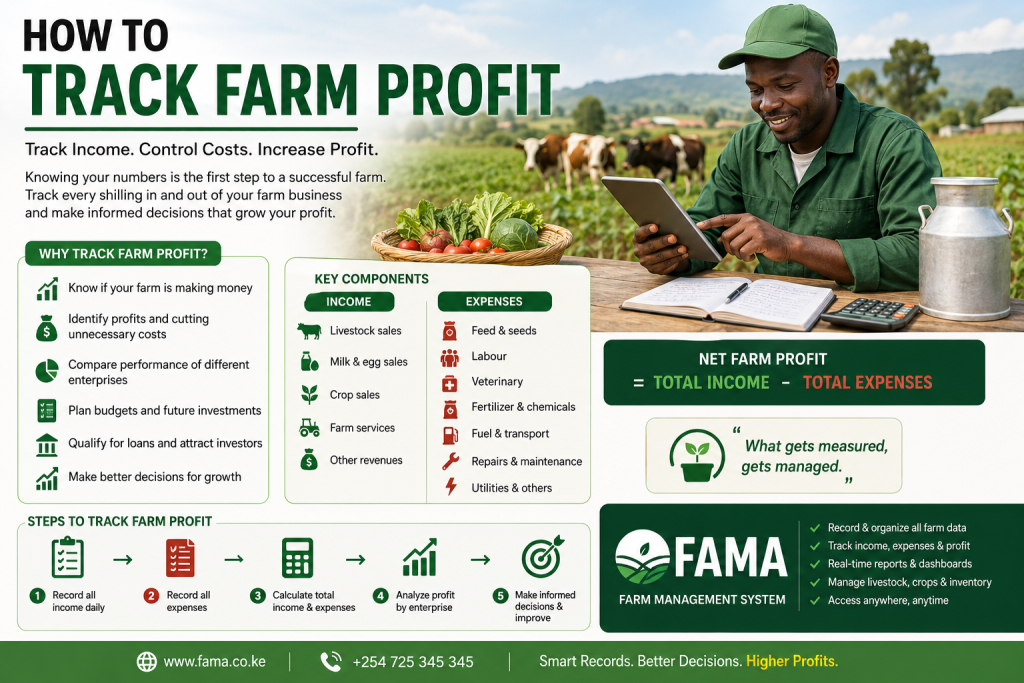
Tracking farm profit is one of the most important responsibilities for every farmer, regardless of the size of the farm. Whether you keep dairy cattle, grow maize, rear poultry, manage a mixed farm, or operate a commercial agricultural enterprise, understanding how to track farm profit helps you make informed decisions that increase productivity and long-term sustainability.
Many farmers focus on increasing production but fail to monitor whether their farming activities are actually making money. Producing more milk, harvesting more vegetables, or selling more chickens does not automatically translate into higher profits. Without proper records and financial tracking, it becomes difficult to know which enterprises generate income and which ones drain resources.
This comprehensive guide explains how to track farm profit, why it matters, the records you need, the calculations involved, and how modern farm management software like Fama Farm Management System simplifies the entire process.
What Does Farm Profit Mean?
Farm profit is the money left after subtracting all farm expenses from the total income generated by the farm.
In simple terms:
Farm Profit = Total Farm Income – Total Farm Expenses
If your farm earns KSh 2,000,000 annually but spends KSh 1,500,000 on operations, your profit is KSh 500,000.
Learning how to track farm profit ensures that every financial decision is based on accurate data rather than assumptions.
Why Every Farmer Should Learn How to Track Farm Profit
Many farmers only monitor sales while ignoring expenses. Unfortunately, income alone cannot tell whether a farm is successful.
Proper profit tracking helps you:
- Know whether your farm is making money
- Identify unnecessary expenses
- Compare enterprise performance
- Plan future investments
- Prepare farm budgets
- Apply for agricultural loans
- Improve operational efficiency
- Increase profitability
- Reduce financial losses
- Make informed management decisions
Knowing how to track farm profit transforms farming into a professional business instead of a guessing game.
Common Mistakes Farmers Make
Many farms fail financially because they make avoidable mistakes.
Examples include:
Not Recording Expenses
Small expenses accumulate over time.
Examples include:
- Fuel
- Animal medicine
- Fertilizer
- Seeds
- Transport
- Casual labour
- Water
- Electricity
Without records, farmers underestimate operating costs.
Mixing Personal and Farm Money
Many farmers withdraw money from farm income for household use without recording it.
This makes it impossible to determine actual farm profitability.
Ignoring Labour Costs
Family labour has value.
Even if family members work without receiving salaries, labour should still be included when calculating production costs.
Forgetting Equipment Depreciation
Farm machinery loses value over time.
Examples:
- Tractors
- Milking machines
- Water pumps
- Greenhouses
- Irrigation equipment
These costs should be included when learning how to track farm profit.
Not Tracking Individual Enterprises
A mixed farm may have:
- Dairy cows
- Poultry
- Fish farming
- Vegetables
- Fruit trees
Some enterprises may be profitable while others lose money.
Without enterprise-level records, identifying profitable activities becomes impossible.
The First Step in Tracking Farm Profit
The first requirement is keeping complete farm records.
Every financial transaction should be recorded.
These include:
- Purchases
- Sales
- Production
- Labour
- Assets
- Loans
- Repairs
- Livestock records
- Crop records
The better your records, the easier it becomes to understand how to track farm profit.
Farm Income You Should Record
Every source of farm income should be documented.
Examples include:
Livestock Sales
Record:
- Animal ID
- Buyer
- Selling price
- Date sold
- Weight
- Breed
Milk Sales
Keep daily records showing:
- Quantity produced
- Quantity sold
- Selling price
- Customer
- Payment status
Egg Sales
Record:
- Number of trays
- Selling price
- Customer
- Collection date
Crop Sales
Include:
- Crop type
- Quantity harvested
- Selling price
- Transport cost
- Buyer
Farm Services
Some farms earn money through:
- Tractor hire
- Hay baling
- Equipment rental
- Artificial insemination
- Farm training
These revenues should also be included when calculating profit.
Farm Expenses You Must Track
Expenses determine whether your farm remains profitable.
Record every expense, regardless of size.
Examples include:
Feed Costs
Feed often represents the largest livestock expense.
Track:
- Dairy meal
- Hay
- Silage
- Mineral supplements
- Poultry feed
- Pig feed
Seed Purchases
Record:
- Seed variety
- Quantity
- Supplier
- Cost
- Planting date
Fertilizer Costs
Include:
- Organic fertilizer
- DAP
- CAN
- Urea
- Foliar fertilizers
Veterinary Expenses
Track:
- Vaccinations
- Medicines
- Deworming
- Veterinary visits
- Laboratory tests
Labour Costs
Record:
- Permanent employees
- Casual workers
- Seasonal labour
- Overtime
- Harvest workers
Fuel Expenses
Include fuel used for:
- Tractors
- Water pumps
- Vehicles
- Generators
Repairs and Maintenance
Examples include:
- Machinery repair
- Fence maintenance
- Greenhouse repair
- Building maintenance
- Water system repairs
Fixed Costs vs Variable Costs
Understanding these costs is essential when learning how to track farm profit.
Fixed Costs
These remain relatively constant.
Examples:
- Land lease
- Insurance
- Equipment depreciation
- Salaries
- Farm buildings
Variable Costs
These change depending on production.
Examples:
- Feed
- Seeds
- Fertilizer
- Fuel
- Medicines
- Packaging
- Transport
Tracking both categories provides a clear picture of farm profitability.
Calculate Gross Farm Income
Gross income equals all money earned before expenses.
Example:
Milk Sales — KSh 850,000
Vegetable Sales — KSh 400,000
Chicken Sales — KSh 300,000
Egg Sales — KSh 250,000
Total Gross Income:
KSh 1,800,000
This is the starting point when learning how to track farm profit.
Calculate Total Farm Expenses
Suppose annual expenses include:
Feed — KSh 500,000
Labour — KSh 350,000
Veterinary Costs — KSh 100,000
Fuel — KSh 120,000
Seeds — KSh 90,000
Fertilizer — KSh 150,000
Repairs — KSh 80,000
Utilities — KSh 60,000
Transport — KSh 100,000
Other Expenses — KSh 50,000
Total Expenses:
KSh 1,600,000
Calculate Net Farm Profit
Net Profit:
Gross Income:
KSh 1,800,000
Minus Expenses:
KSh 1,600,000
Net Farm Profit:
KSh 200,000
This simple calculation forms the foundation of how to track farm profit.
Why Monthly Profit Tracking Is Better Than Annual Tracking
Waiting until the end of the year is risky.
Monthly profit reports help identify:
- Rising costs
- Falling production
- Seasonal trends
- Cash shortages
- Unprofitable enterprises
Monthly tracking allows farmers to correct problems before they become serious.
Enterprise Profitability Analysis
Every farm enterprise should be evaluated independently.
Examples:
| Enterprise | Income | Expenses | Profit |
|---|---|---|---|
| Dairy | 900,000 | 650,000 | 250,000 |
| Poultry | 400,000 | 300,000 | 100,000 |
| Vegetables | 300,000 | 150,000 | 150,000 |
| Fish Farming | 200,000 | 220,000 | -20,000 |
Without enterprise analysis, many farmers cannot identify which activities generate profit.
Track Production Costs
Knowing production costs improves pricing decisions.
Examples:
Cost per litre of milk
Cost per kilogram of tomatoes
Cost per tray of eggs
Cost per broiler
Cost per kilogram of maize
Understanding these figures is an essential part of how to track farm profit because they reveal whether your selling prices are sufficient to cover costs and generate a healthy margin.
Monitor Cash Flow Alongside Profit
Profit and cash flow are not the same thing. A farm may be profitable on paper but still struggle to pay bills if customers delay payments or if expenses occur before income is received.
Maintain records of:
- Cash received
- Cash paid out
- Outstanding customer balances
- Supplier debts
- Loan repayments
Healthy cash flow keeps daily farm operations running smoothly while profit tracking measures the long-term success of the business.
Use Farm Management Software for Accurate Profit Tracking
Manual record books and spreadsheets can work for small farms, but as your farm grows they become difficult to manage. Farm management software helps automate record keeping, generate reports, and calculate profitability with greater accuracy.
Fama Farm Management System enables farmers to:
- Record farm income and expenses in one place
- Track livestock and crop production
- Monitor inventory and input usage
- Generate financial reports
- Measure enterprise profitability
- Access records quickly for better decision-making
By digitizing records, farmers reduce errors and gain real-time visibility into their business performance.
Get Professional Farm Management Support
If you are looking for a reliable solution to simplify record keeping and improve profitability, Fama Farm Management System can help.
Website: https://fama.co.ke
Call/WhatsApp: +254 725 345 345
Whether you manage a small family farm or a large commercial operation, adopting proper systems for how to track farm profit will help you maximize returns, control costs, and build a more sustainable agricultural business.