How to start a poultry farm in Kenya is one of the most searched agricultural questions in the country today, and for good reason. Poultry farming offers one of the most accessible and profitable agricultural investments in Kenya, with growing demand for chicken meat and eggs across the country. Fama.co.ke provides an innovative farm management platform that makes how to start a poultry farm in Kenya manageable and data-driven, helping new farmers move from uncertainty to confident, profitable operations. Kenya consumes an estimated 30 million kilograms of chicken annually, yet local production falls short of meeting this demand. This supply-demand gap is precisely why understanding how to start a poultry farm in Kenya has become so important for aspiring agripreneurs.
The journey of learning how to start a poultry farm in Kenya begins with a clear understanding of the market opportunity. Kenya consumes over 100 million kilograms of chicken meat annually, yet domestic production meets only about 80% of demand, creating a significant market gap. The egg market is equally robust, with per capita consumption growing as incomes rise and urbanization accelerates. This is why mastering how to start a poultry farm in Kenya is not just about building houses and buying chicks—it’s about positioning yourself to capture a share of a growing, undersupplied market.
For many farmers, the question of how to start a poultry farm in Kenya is really a question about which poultry model to pursue. Broiler farming focuses on raising chickens for meat, with birds reaching market weight in 5-8 weeks. Layer farming produces eggs for sale, with hens productive for 18-24 months. Kienyeji chicken farming caters to the premium market, where traditional free-range chickens command prices 2-3 times higher than commercial broilers. Understanding how to start a poultry farm in Kenya means choosing the model that matches your capital, market access, and risk tolerance.
The financial realities of how to start a poultry farm in Kenya are encouraging when properly planned. A well-managed 100-bird broiler cycle can return KES 10,000–18,000 net in eight weeks, while a 500-broiler operation can generate KES 150,000 profit per cycle with an annual ROI of 332%. These figures explain why learning how to start a poultry farm in Kenya attracts so much interest from both local and diaspora investors. With the right knowledge and disciplined execution, how to start a poultry farm in Kenya can transform from a daunting question into a rewarding business reality.
Feed is the single largest cost in poultry production, accounting for 60-70% of total production costs. This is a critical factor in how to start a poultry farm in Kenya that many beginners underestimate. Disease is the second major risk—Newcastle, coccidiosis, and Gumboro can wipe out an entire flock if vaccination schedules are skipped. Understanding how to start a poultry farm in Kenya means understanding that profitability is determined more by disciplined management than by luck or location.
For farmers who master how to start a poultry farm in Kenya, the rewards extend beyond the farm gate. Poultry farming offers quick financial returns, as chickens reach market weight within about three months, allowing farmers to generate income in a short period. This rapid cycle means that how to start a poultry farm in Kenya is not just a long-term investment—it’s a business that can generate meaningful cash flow within a single season.
The success stories emerging across Kenya demonstrate the potential of how to start a poultry farm in Kenya when done properly. From a trader who built a thriving venture earning between Ksh.500 and Ksh.1,000 profit per chicken, to a farmer in Kasphat making Sh30,000 profit in three weeks from 700 birds, the evidence is clear. For those seeking comprehensive guidance on how to start a poultry farm in Kenya, Fama.co.ke provides the digital infrastructure to plan, track, and grow a successful poultry enterprise.
Why Poultry Farming Is a Lucrative Business in Kenya
Poultry farming is one of the most profitable agricultural ventures in Kenya, driven by the high demand for chicken meat and eggs across the country. The beauty of poultry farming is its scalability—you can start with as few as 100 birds and gradually expand to thousands as you gain experience and capital. The investment required is relatively modest compared to other farming enterprises, and the returns can be realized quickly.
The poultry sector in Kenya contributes significantly to the agricultural GDP. The agriculture sector contributes 25 per cent to the country’s GDP with poultry playing a significant role representing 30 per cent of the agricultural contribution to GDP and growing at a rate of five per cent per annum. Kenya has an estimated poultry population of 31 million birds, of which 75 per cent consist of indigenous chicken, 22 per cent of broilers and layers, and one per cent of breeding stock.
The market opportunity is further strengthened by the protein deficit that exists in Kenya. Kenya consumes an estimated 30 million kilograms of chicken annually, yet local production falls short of meeting this demand, with the deficit partly filled by imports that the government has periodically restricted to protect local producers. This supply-demand imbalance, combined with growing urbanization and rising protein consumption, makes poultry farming an attractive proposition for investors and small-scale farmers alike.
Choosing Between Broilers, Layers, and Kienyeji Chickens
The three main categories of poultry farming in Kenya are broiler production (meat birds), layer production (egg birds), and kienyeji (indigenous/free-range) chicken farming. Each has distinct characteristics, requirements, and profit potential. Your choice should depend on your target market, available capital, land, and personal interest.
Broiler Farming
Broiler farming involves raising fast-growing breeds like Cobb 500 or Ross 308 for meat production. Broilers reach market weight of 1.5-2.5 kg in 6-8 weeks and can be sold to hotels, restaurants, supermarkets, and individual consumers. The cycle is short, allowing up to 5-6 batches per year.
The cost to raise 100 broilers in Kenya is approximately KSh 55,000 to 60,000 per batch, covering day-old chicks at around KSh 105 each, roughly eight 50kg bags of feed at about KSh 36,800, plus housing, equipment, vaccines and fuel. Broilers give fast cash on a 5 to 6 week cycle, selling at 35 to 42 days.
For a 500-broiler operation, setup costs are approximately KES 180,000, with revenue of KES 330,000 per cycle and net profit of KES 150,000 per cycle, representing an 83% ROI per cycle and 332% annually.
Layer Farming
Layer farming involves raising breeds like Hy-Line Brown or Lohmann for egg production. Layers produce 280-320 eggs per bird per year over a productive period of about 18 months. Layers only start laying at about 18 to 20 weeks, meaning roughly 5 months of feeding before income, which is the key cashflow challenge.
Once in lay, estimated net income is approximately KSh 24,750 per month for 100 hens before housing costs. Layer operations with 500 birds can generate steady monthly income once production begins.
Kienyeji (Indigenous) Chicken Farming
Kienyeji chickens are increasingly popular due to consumer preference for their taste and perceived health benefits. Improved kienyeji breeds like KARI Improved and Rainbow Rooster combine the flavor of traditional chickens with better growth rates and egg production. Kienyeji eggs and meat command premium prices, with kienyeji eggs selling for KES 20-30 each compared to KES 12-15 for commercial eggs.
Improved Kienyeji birds produce over 200 eggs a year, with some maturing in as few as three months. They require proper housing, vaccination and controlled feeding to thrive, but are easier to raise than other commercial chicken. The common improved Kienyeji breeds include Kenbro, KARI Kienyeji, Rainbow Roosters, and Sasso.
Typical costs of rearing Kienyeji chicken include: 1-day-old chick at Ksh115, feeding per month at Ksh87, vaccines at Ksh5, supplements at Ksh5, disinfectants at Ksh5, and heating at Ksh20. The total to one month is approximately Ksh237. At 1 month, a chick is valued at about Sh300. Egg production yields 240 eggs/year at Sh20/egg, generating Sh4,800 per bird per year. Meat production at 3-4 months yields birds weighing 2-3.5 kgs selling for Sh1,200-Sh1,800 each.
Step-by-Step Guide on How to Start a Poultry Farm in Kenya
Step 1: Define Your Poultry Farming Goals
The first step in how to start a poultry farm in Kenya is to clearly define your goals. Are you looking for quick returns through broiler production, steady income through layers, or premium pricing through kienyeji? Your goals will determine your breed choice, housing requirements, and marketing strategy.
Your target market should also inform your decision. Broilers must move at 5-6 weeks or feed cost eats profit, meaning you need reliable buyers before you start. Layers require patience but offer consistent daily income once production begins. Kienyeji offers higher margins per bird but slower turnover.
Step 2: Prepare a Poultry Farming Business Plan
A comprehensive business plan is essential for how to start a poultry farm in Kenya successfully. Your plan should cover startup costs, operational expenses, projected revenue, and break-even analysis. The cost for a poultry project ranges between KES 500,000 and KES 1,000,000, covering construction, chicks, feed, and labor for a mixed operation of 500 broilers and 300 layers.
For a 500-broiler operation, initial setup costs include housing and equipment at KES 85,000 (broiler house construction at KES 45,000, feeders and drinkers at KES 15,000, heating system at KES 12,000, lighting at KES 8,000, and ventilation fans at KES 5,000). Operational costs per cycle include chicks and feed at KES 125,000, health and management at KES 35,000, and labor at KES 20,000, totaling KES 180,000 per cycle.
A detailed business plan should include a financial model with sensible defaults for the Kenyan market. The model should pair with a full layers or broilers business plan document, giving both the narrative and the numbers.
Step 3: Choose the Right Location
Location is a critical factor in how to start a poultry farm in Kenya. Starting a poultry farm requires land (even a quarter-acre can support a meaningful operation), poultry housing structures with proper ventilation, feeding and watering systems, storage for feed, and reliable water supply.
Location considerations include proximity to markets (urban centers or aggregation points), access to feed suppliers, availability of veterinary services, and suitable climate conditions. Many successful poultry operations are located on the outskirts of major towns, balancing land costs with market access.
Step 4: Construct Appropriate Housing
The first step is securing suitable land and constructing appropriate housing. A standard poultry house provides 1 square foot per broiler bird and 2 square feet per layer bird. For 500 broilers, you need a house measuring approximately 50 square meters. Construction costs range from KES 1,500 to KES 3,000 per square meter depending on materials and location.
The house should have proper ventilation, natural lighting, and protection from predators and weather. Essential equipment includes feeders, waterers (nipple drinkers are recommended for hygiene), heat lamps or brooders for chicks, egg trays and collection equipment for layers, and a reliable water supply.
For broiler operations, a simple structure housing 500-1,000 birds can be constructed for KES 200,000-500,000. Layer operations require more permanent structures with nesting boxes, costing KES 300,000-800,000 for a similar scale.
Step 5: Register Your Farm and Obtain Licenses
To operate legally, you’ll need to register your business on eCitizen, obtain a county trade license, and pass a public health inspection. A poultry operator may be registered by the County Government where located, and a poultry operator keeping birds for commercial purposes must keep a poultry register in a prescribed form.
Under the proposed Livestock (Poultry Industry) Regulations 2023, a poultry operator keeping birds for commercial purposes shall keep a register of poultry in Form PR1 set out in the First Schedule. Poultry breeders and hatcheries must also be registered and hold a valid license to operate.
For those starting a poultry farm in Kenya, missing permits can lead to fines and operational disruptions. Essential permits include the county Single Business Permit, KRA PIN, and public-health/veterinary compliance for selling meat and eggs.
Step 6: Source Quality Day-Old Chicks
Quality chicks are the foundation of a successful poultry farm. Day-old chicks for broilers cost approximately KSh 105 each, while layer chicks range from KSh 100-150. Kienyeji chicks cost between KSh 100-200.
Homerange, a traditional chicken company specializing in KALRO improved kienyeji chicken, sells vaccinated three-week-old chicks at Sh200. They also buy back meat and eggs when the chicken mature at five months, providing a ready market for farmers.
When sourcing chicks, ensure they come from reputable hatcheries with vaccination records. Poor quality chicks or unvaccinated stock can lead to high mortality rates and financial losses. For those learning how to start a poultry farm in Kenya, sourcing from established suppliers is a critical success factor.
Step 7: Implement a Feeding Program
Feed accounts for 60-70% of production costs, making feed management crucial for profitability. Commercial feeds from companies like Unga Farm Care, Sigma Feeds, and others provide balanced nutrition. Some larger operations mix their own feed to reduce costs.
A 50kg bag of Kienyeji chicken mash costs Sh2,279, growers’ mash 50kg goes for Sh2,090, and layers mash for Sh2,125. Layers mash averages between Sh3,500 and Sh3,900, chick mash between Sh2,750 and Sh4,150, and broiler starter between Sh3,500 and Sh4,000.
Proper feeding programs ensure optimal growth rates for broilers and consistent egg production for layers. Feed price volatility is a common mistake—feed is 60-70% of cost, so a spike can wipe out your margin. For those serious about how to start a poultry farm in Kenya, understanding feed economics is non-negotiable.
Step 8: Implement a Vaccination and Health Program
Health management includes vaccination schedules (Newcastle disease, Gumboro, and others), biosecurity measures to prevent disease introduction, regular veterinary check-ups, and proper sanitation of housing between batches.
Newcastle disease and infectious bronchitis boosters are commonly given several times during the growing period and later every three months while the birds are laying. Gumboro vaccination is usually repeated during the first few weeks of life, while fowl typhoid vaccination is often given at about six to eight weeks of age by injection.
A sample vaccination schedule for kienyeji chicken includes Marek’s vaccine on Day 1 (subcutaneous), 1st Infectious Bursal Disease Vaccine (IBDV) on Day 10 (drinking water), and Fowl Typhoid at 3 weeks in hot areas. For Newcastle disease control, vaccinate every three months and at point of lay for layers.
Skipping vaccination is fatal—disease like Newcastle or coccidiosis can wipe out an entire flock. Working with a qualified poultry veterinarian is essential for maintaining flock health and minimizing losses.
Step 9: Establish Market Channels
Poultry products can be sold through multiple channels. Direct sales to consumers through farm-gate sales or local markets capture the highest margins. Hotels, restaurants, and institutions purchase in bulk at slightly lower prices but provide consistent demand. Supermarkets and retail outlets require consistent supply and may require food safety certifications.
The main actors at the marketing level of the chicken value chain include aggregators, distributors, retailers, wholesalers, supermarkets, hotels/eateries and government regulatory bodies. Hotels and eateries often purchase chicken in bulk quantities to meet the demand for their menus.
For farmers learning how to start a poultry farm in Kenya, establishing reliable off-take agreements with hotels, restaurants, or institutional buyers provides predictable demand and simplifies sales management.
Step 10: Implement Record-Keeping and Management Systems
Record-keeping is often overlooked when learning how to start a poultry farm in Kenya, yet it is essential for profitability. Without proper records, farmers cannot track feed conversion ratios, monitor mortality, or calculate true production costs.
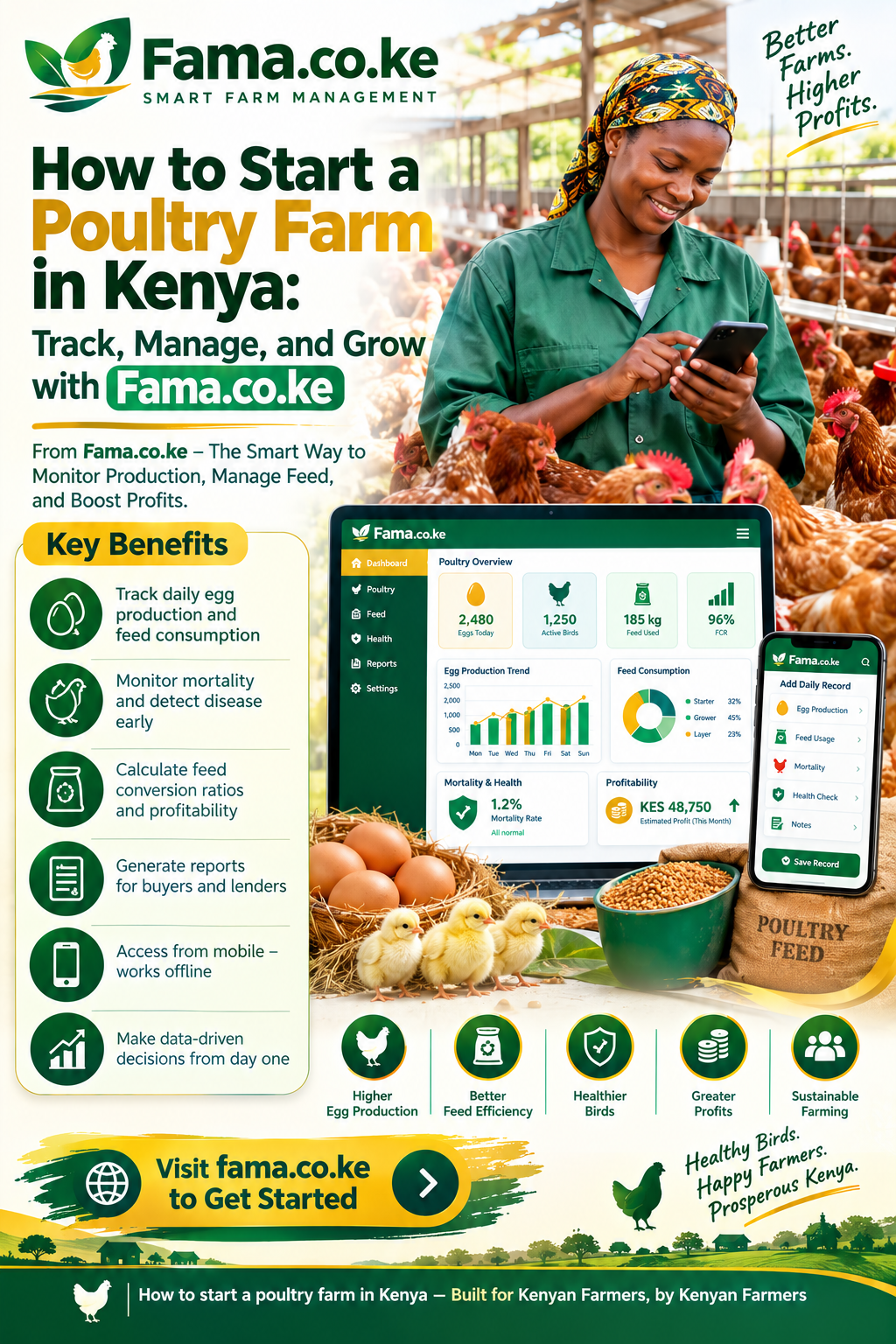
Daily farm records software helps poultry farmers capture daily egg collection, feed consumption, mortality, and health events. Digital tools enable farmers to identify production drops early, calculate feed-to-egg ratios, and generate reports for buyers and lenders.
KALRO offers training in poultry record keeping, poultry health management, and supervisory skills in poultry management. These skills are essential for anyone serious about how to start a poultry farm in Kenya sustainably.
Costs of Starting a Poultry Farm in Kenya
Understanding the full costs is essential for how to start a poultry farm in Kenya. Here is a breakdown of typical costs:
Broiler Farming (500 Birds)
Initial Setup Costs (One-time):
-
Broiler house construction: KES 45,000
-
Feeders and drinkers: KES 15,000
-
Heating system (brooder): KES 12,000
-
Lighting system: KES 8,000
-
Ventilation fans: KES 5,000
-
Total setup: KES 85,000
Operational Costs Per Cycle (3 months):
-
Day-old chicks (500): KES 25,000
-
Starter feed (1,000kg): KES 35,000
-
Grower feed (1,500kg): KES 45,000
-
Finisher feed (1,000kg): KES 20,000
-
Vaccines and medications: KES 15,000
-
Veterinary services: KES 8,000
-
Electricity: KES 7,000
-
Water and miscellaneous: KES 5,000
-
Labor: KES 20,000
-
Total costs per cycle: KES 180,000
Revenue: KES 330,000 per cycle (500 birds × KES 660 selling price)
Net Profit: KES 150,000 per cycle
ROI: 83% per cycle, 332% annually
Layer Farming (500 Birds)
Layer operations require more permanent structures with nesting boxes, costing KES 300,000-800,000 for 500 birds. Layers start producing eggs at 18-20 weeks, with approximately 5 months of feeding before income begins. Once in lay, farmers can expect steady monthly income from egg sales.
Kienyeji Farming
For 200 improved kienyeji chicken, production cost is Sh90,000 with sales income of Sh170,000, yielding Sh80,000 in profits. Improved kienyeji produce over 200 eggs a year, with some maturing in as few as three months.
Common Mistakes to Avoid When Starting a Poultry Farm in Kenya
Mistake 1: Underestimating Feed Costs
Feed price volatility is a common mistake—feed is 60-70% of cost, so a spike can wipe out your margin. New farmers often budget based on current feed prices without accounting for potential increases. Building a feed buffer into your budget is essential for how to start a poultry farm in Kenya sustainably.
Mistake 2: Skipping Vaccination
Disease (Newcastle, coccidiosis, Gumboro) can be fatal if vaccination is skipped. Many first-time farmers lose entire flocks because they underestimate the importance of vaccination schedules. Following a strict vaccination program from day-old to depletion is non-negotiable.
Mistake 3: Poor Brooding and Heating
Poor brooding/heating causes high chick mortality. Chicks require precise temperature management during their first weeks of life. Investing in proper brooders and monitoring temperature is critical for anyone learning how to start a poultry farm in Kenya.
Mistake 4: No Ready Market
Broilers must move at 5-6 weeks or feed cost eats profit. Many farmers start production without securing buyers, then scramble to sell when birds reach market weight. Establishing market channels before your first batch is essential.
Mistake 5: Missing Permits
Missing permits (county Single Business Permit, KRA PIN, public-health/veterinary compliance for selling meat/eggs) can lead to fines and operational disruptions. Completing all registration requirements should be done before operations begin.
Training and Capacity Building
KALRO offers training for first-hand poultry farmers, with costs of approximately Sh20,000 which caters for meals, facilitation fees and local transportation. KALRO also provides training in hatching management, poultry record keeping, poultry health management and supervisory skills in poultry management.
Makueni Agricultural Training Centre offers Level 3 AT-VET training in Poultry Production with a training fee of Ksh 25,000 and an application fee of Ksh 500. Zetech University also offers a Professional Poultry Farming Short Course.
NGOs and county governments also provide training. Over 150 farmers from various groups have been taken through technical training on poultry management, with skills intended to ensure sustainable poultry farming.
Market Outlook and Profitability
Kenya’s demand for chicken and eggs consistently outpaces supply in urban centres. A well-managed 100-bird broiler cycle can return KES 10,000–18,000 net in eight weeks.
A broiler operation with 1,000 birds per cycle can generate gross revenue of KES 400,000-500,000 per cycle (6-8 weeks). After feed, day-old chick costs, medication, and other inputs, net profit per cycle ranges from KES 80,000-150,000. With 5-6 cycles per year, annual net income can reach KES 400,000-900,000 from a relatively modest investment.
A poultry stock of 200 chicken has a production cost of Sh90,000 but comes with a sales income of Sh170,000, yielding Sh80,000 in profits. Farmers can earn between Ksh.500 and Ksh.1,000 in profit per chicken sold, with good days generating Ksh.2,000 to Ksh.3,000.
For kienyeji farming, while a 20-bird Kienyeji flock might bring in about Sh32,000 a year from eggs and meat, even a modest Brahma flock can earn Sh240,000 a year.
How Fama.co.ke Supports Your Poultry Farming Journey
Fama.co.ke provides the digital tools needed to succeed in how to start a poultry farm in Kenya. The platform offers daily farm records software that helps poultry farmers track egg production, feed consumption, mortality rates, and profitability in real time.
With Fama.co.ke, farmers can monitor feed conversion ratios, identify production drops early, and generate reports for lenders and buyers. The platform works offline, making it accessible even in areas with limited connectivity. As you learn how to start a poultry farm in Kenya, having the right record-keeping system from day one positions you for long-term success.
Start Your Poultry Farm with Confidence
Learning how to start a poultry farm in Kenya is a journey that begins with knowledge and is sustained by disciplined management. From choosing the right breed to implementing vaccination schedules and establishing market channels, every step matters. The demand for chicken meat and eggs in Kenya continues to outpace supply, creating a genuine opportunity for farmers who approach poultry farming as a business.
Fama.co.ke provides the digital infrastructure to track, manage, and grow your poultry operation. Start your journey with the right tools and the right knowledge. Visit fama.co.ke to learn more about how farm management software can support your poultry farming venture.