How to price farm produce in Kenya is the single most important commercial decision a farmer makes every season, because farming in Kenya has quietly become an act of charity where farmers absorb all the risks while other players in the value chain take the profits. Fama.co.ke provides an innovative platform that makes how to price farm produce in Kenya simple and practical, helping farmers move from accepting whatever a broker offers to setting prices grounded in cost, market intelligence, and negotiation strength. Many Kenyan farmers sell with one goal in mind: to avoid losses. Very few sell to make a real profit. Many will say, “At least I recovered my costs,” or worse, “I sold because the produce would spoil.” But farming is not charity—it is a business, and every business must price for profit. This guide on how to price farm produce in Kenya provides the framework to do exactly that.
The consequences of pricing badly are severe and quietly expensive. A tomato farmer in Kirinyaga sells a crate at KSh 1,000 and feels satisfied—until he calculates production costs and realises the real cost per crate is KSh 900. After market levies and losses, he is working almost for free. This is precisely the trap that mastering how to price farm produce in Kenya prevents. When a farmer knows his cost per unit, the market no longer decides his price; he does.
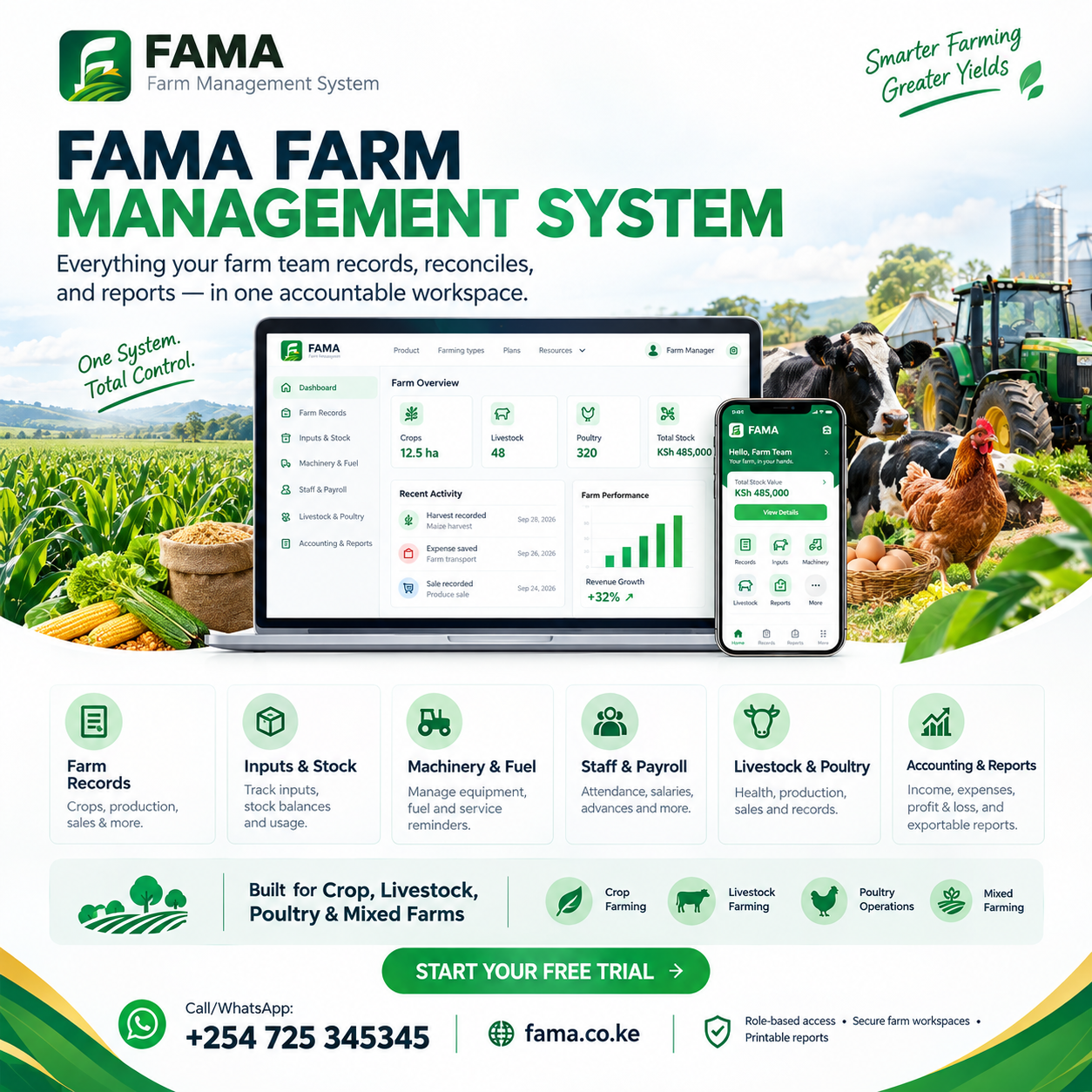
Fama.co.ke‘s platform helps farmers master how to price farm produce in Kenya by recording every input, labour payment, transport cost, and post-harvest loss against the crop that incurred it, then calculating cost per kilogram, per crate, or per bag automatically. Research from Farm to Market Alliance found that maize farmers linked to structured markets through cost-based pricing and contract farming models saw a 30 per cent increase in net incomes. With how to price farm produce in Kenya built on real cost data, that kind of improvement becomes achievable rather than accidental.
The first principle of how to price farm produce in Kenya is that if you do not know your costs, you cannot price. Many farmers price based on what their neighbour is selling at or what a broker offers. If you do not know your costs, the market will decide your price, and it will not favour you. Most farmers count only visible costs like seeds and fertiliser, ignoring hidden costs that give a false picture of profitability. Production costs include seeds or breeding stock, fertiliser and manure, chemicals and veterinary drugs, feed and supplements, labour including family labour, water, fuel and electricity, transport to market, packaging and storage, and losses due to spoilage, pests, or disease. A farmer serious about how to price farm produce in Kenya captures every one of these.
The second principle is the simple formula that transforms pricing from guesswork into arithmetic. Cost per unit equals total production cost divided by total produce. Selling price equals cost per unit plus profit margin. A Nyeri farmer who practices zero tillage and strategic input management keeps his cabbage production cost at just Sh2 per head, ensuring he makes a profit regardless of prevailing market prices. That is what disciplined how to price farm produce in Kenya looks like in practice—a cost floor so low that almost any market price delivers a margin.
The third principle is that pricing below cost is a silent killer. Some farmers knowingly sell below cost, hoping to recover something rather than lose everything. While this feels logical, it is dangerous. You train buyers to expect low prices, you cannot reinvest in your farm, you become dependent on loans and debt, and farming becomes unsustainable. Selling below cost may solve today’s problem, but it creates tomorrow’s crisis. Understanding how to price farm produce in Kenya means refusing to accept a price that does not cover the true cost of production plus a margin.
Market research is where how to price farm produce in Kenya meets reality. The market does not pay you more because you worked hard. It pays based on demand, timing, and quality. The best farmers produce what the market wants, not just what grows well. Common mistakes include planting without checking market demand, harvesting when everyone else is harvesting, and selling at the nearest market without checking alternatives. Kale prices crash when rains are plenty and everyone plants. Milk prices differ significantly between selling raw and supplying a processor. Avocados fetch different prices depending on size, quality, and market destination. A farmer who has mastered how to price farm produce in Kenya checks prices in local markets, town markets, aggregator channels, and processor channels before planting, talks to traders before committing land, joins farmer groups to access better markets, and diversifies crops to spread risk.
Understanding the price chain is essential to how to price farm produce in Kenya. A tomato can gain KES 47.06 per kilogram between a wholesale stall and a retail counter, yet that visible difference still cannot reveal who made a profit. Consumers see a higher till price; farmers remember a lower offer at harvest. Traders point to fuel, spoilage, labour, rent, credit, and produce that never sells. Food inflation was running at 9.0 per cent in July 2026 against general inflation of 6.5 per cent, while transport costs rose 15.6 per cent. A producer’s price can fall while a consumer’s price rises if losses, distance, energy, handling, or market scarcity increase between them. Knowing how to price farm produce in Kenya means understanding where your produce sits in that chain and what margin is genuinely available at each point.
Grading and sorting are among the most underused tools for how to price farm produce in Kenya. Small differences in size and appearance significantly shift price categories. Grading is a structured classification process where sorted produce is grouped into standardised categories such as Grade A, Grade B, and Grade C based on predefined quality parameters. Strawberry exporters in Kenya grade punnets one through three, with Grade 1 containing 12 to 14 fruits and commanding Sh400 per kilogram, Grade 2 sold at Sh280, and Grade 3 used for value addition. A farmer who sorts produce and presents uniform grades can price each grade separately rather than accepting a single blended price. That discipline is central to how to price farm produce in Kenya at a premium rather than a discount.
Why Most Kenyan Farmers Underprice Their Produce
The reasons Kenyan farmers underprice their produce are structural, cultural, and psychological. Understanding them is the first step toward correcting them.
Selling from a Position of Desperation
Most farmers lose money at the point of sale, not in the field. If you cannot walk away from a deal, you have already lost the negotiation. A broker arrives at the farm gate and says, “The market is bad. Take it or leave it.” The farmer, fearing spoilage, accepts a low price. Confidence in pricing comes from preparation, and preparation means knowing your costs and knowing the market.
Planting Without Market Intelligence
Farmers plant what they have always planted, or what everyone else is planting, without checking demand. When harvest arrives alongside everyone else’s harvest, prices collapse. The farmer who has researched demand and timed planting to avoid gluts prices from a position of scarcity rather than abundance.
Ignoring Hidden Costs
Visible costs like seed and fertiliser are counted. Hidden costs like family labour, depreciation, transport, packaging, and post-harvest losses are not. The result is a cost estimate that is significantly below reality, and a price that appears profitable but is not.
No Records
Without records, a farmer cannot calculate cost per unit at all. Pricing becomes imitation—copying the neighbour or accepting the broker’s offer. The farmer who keeps records prices from evidence.
Lack of Collective Bargaining
Individual farmers negotiating alone have little power against organised buyers. Farmers who sell collectively negotiate from strength, as demonstrated repeatedly across Kenyan value chains.
Step One: Know Your True Cost of Production
Every pricing decision begins with a complete and honest cost calculation.
List Every Direct Cost
Direct costs include seed and planting material, fertiliser and manure, crop protection chemicals, casual labour, machinery hire, fuel, transport, packaging, and storage. These are the costs attributable to producing and delivering the crop.
Include Labour Fully
Labour includes casual wages, permanent salaries, statutory contributions, and family labour valued at prevailing rates. Family labour is frequently excluded because no cash changes hands, but it has an opportunity cost and must be included.
Include Depreciation
Machinery, equipment, and buildings lose value over time. Depreciation is a real cost of production and must be included if the cost calculation is to be honest. Excluding it overstates profit and leaves the farm unable to fund replacement.
Include Post-Harvest Losses
Losses due to spoilage, pests, and rejection are real costs. A tomato farmer who loses 15 per cent of crates to spoilage before sale has a higher effective cost per sold crate than per harvested crate.
Include Transport and Market Costs
Transport to market, market levies, loading fees, and packaging all add to the cost of getting produce to the buyer. A farm-gate price comparison that ignores these costs overstates the net price received.
Calculate Total Cost and Cost Per Unit
Sum all costs to get total production cost. Divide by total produce to get cost per unit—per kilogram, per crate, per bag, or per litre. This figure is the foundation of every price decision.
Step Two: Set a Price Floor and a Target Price
With cost per unit established, pricing becomes a structured decision rather than a negotiation.
The Price Floor
The price floor is the minimum price at which the farm covers all costs. Selling below this floor means losing money. The floor should be calculated before planting, not after harvest when the farmer is under pressure.
The Target Price
The target price is the floor plus the desired profit margin. A farmer who wants a 30 per cent margin on a cost per unit of Sh100 sets a target price of Sh130.
The Walk-Away Price
The walk-away price is the lowest price the farmer will accept before walking away from a deal. It should be above the floor and set in advance, so that the decision is made rationally rather than in the heat of a negotiation.
Reviewing the Floor
The floor changes as input costs change. A farmer who knows that fertiliser prices have risen must recalculate the floor before setting a price. Pricing from an outdated floor is a common cause of quiet losses.
Step Three: Research Market Prices Before You Plant
Market intelligence is as important as agronomy when determining how to price farm produce in Kenya.
Use KAMIS Data
The Kenya Agricultural Market Information System publishes wholesale and retail prices by commodity, market, and county. A 90kg bag of dry maize has been wholesaling at between Sh2,200 and Sh4,500 depending on market and location. Beans have been selling at Sh5,000 to Sh5,600 per bag. Irish potatoes, particularly the Shangi variety, average Sh4,600 per bag. These figures provide a reference point for what the market is paying.
Use Published Weekly Prices
FarmBizAfrica has launched a weekly price service from Nairobi’s Marikiti and Wakulima markets, publishing prices every Monday for fourteen commodities including tomatoes, sukuma wiki, potatoes, onions, garlic, chillies, cabbage, capsicum, avocados, mangoes, oranges, watermelon, pineapple, and omena. Published prices have been found to see farmers earning 6 to 8 per cent more and consumer prices falling by as much as 4 per cent. A farmer who checks these prices before negotiating knows whether an offer is fair.
Compare Across Markets
Prices vary dramatically by market. Dry maize wholesale has ranged from Sh38 in Kajiado to Sh106 in Nairobi’s Nyamakima. A potato farmer in Nyeri hearing that Wakulima market is selling at Sh7,000 per 90kg bag can question why a broker is offering only Sh3,000 for the same bag. Comparing markets is the simplest way to strengthen a negotiating position.
Talk to Buyers Before Planting
Talking to traders, processors, and aggregators before planting reveals what they need and when. A farmer who plants to a known demand prices from confidence rather than hope.
Step Four: Grade and Sort to Capture Premium Prices
Grading converts a single commodity price into multiple price points and is one of the most practical answers to how to price farm produce in Kenya.
Why Grading Pays
Small differences in size and appearance shift price categories substantially. A tray of uniformly sized tomatoes commands a higher price than a tray of mixed sizes because the retailer can display and sell it more easily. The farmer who grades captures that premium.
Establishing Grades
Grades should be defined by measurable criteria: size, weight, colour, uniformity, absence of defects, and freshness. Grade A, Grade B, and Grade C categories allow each lot to be priced appropriately rather than all produce being sold at a blended average.
Pricing Each Grade Separately
Once graded, each grade should be priced and sold separately. Grade A to premium buyers, Grade B to wholesale markets, and Grade C to processors or value addition. This separation typically raises total revenue compared with selling everything at one price.
Recording Grades
Recording grades at harvest and at sale enables the farmer to understand which grades generate the most revenue and whether production practices are improving grade distribution over time.
Step Five: Negotiate from a Position of Strength
Negotiation is where pricing is won or lost, and preparation is what makes negotiation effective.
Know Your Numbers Before You Talk
A farmer entering a negotiation knowing cost per unit, floor price, target price, and current market prices has nothing to fear from a broker’s opening offer. A farmer without those numbers is negotiating blind.
Do Not Reveal Desperation
Produce that must be sold today is produce that will be sold cheaply. Farmers should avoid situations where spoilage forces a sale by harvesting to a schedule that matches buyer demand and by having storage or alternative channels available.
Build Relationships with Multiple Buyers
A farmer with one buyer has no negotiating power. A farmer with three or four potential buyers can compare offers and choose. Building buyer relationships before harvest, not at harvest, is what creates that optionality.
Understand the Buyer’s Position
Brokers and processors have their own costs and margins. Understanding their position allows the farmer to identify what price is genuinely fair rather than accepting claims that “the market is bad.” Published market prices make those claims verifiable.
Negotiate Terms, Not Just Price
Payment timing, collection arrangements, quality specifications, and volumes are all negotiable. A slightly lower price paid promptly may be worth more than a higher price paid months later.
Step Six: Sell Collectively to Increase Bargaining Power
Collective marketing is one of the most proven routes to better prices in Kenya.
Evidence of Impact
Sorghum and bean farmers who formed collective marketing groups in 2015 were selling a kilo of sorghum for Sh25 before joining forces; after forming groups, they sell at between Sh32 and Sh38. Citrus farmers in Kwale tripled prices from between Sh80 and Sh150 for a 30kg bag to between Sh300 and Sh400 after forming common working interest groups to market their produce. Nyandarua vegetable growers reported gaining both discounted input prices and more bargaining power when selling produce.
Why Collectives Work
Collectives aggregate volume, which gives them leverage with buyers who prefer to purchase in bulk. They also share market information, reducing the information asymmetry that brokers exploit. And they can negotiate contracts that individual farmers could never secure.
Joining or Forming a Group
Farmers can join existing cooperatives or form marketing groups with neighbouring farmers. The key requirements are clear governance, transparent pricing, and reliable aggregation. A group that cannot deliver consistent volume loses its negotiating advantage.
Pricing Within a Collective
Within a collective, prices should be set based on grade and cost of production, not divided equally. A farmer who delivers Grade A produce should receive more than one delivering Grade C.
Step Seven: Add Value to Escape Commodity Pricing
Value addition is the most powerful long-term answer to how to price farm produce in Kenya because it changes what you are selling.
The Price Difference
A Kitui factory buys mangoes from farmers at a minimum of Sh15 per kilogram and processes them into flakes that fetch up to Sh500 per kilogram. A Kisumu farmer exports dried okra at Sh100 per kilogram compared to Sh80 for fresh produce locally, and has seen prices reach Sh300 per kilogram. A farmer selling home-made cassava crisps prices them between Sh100 and Sh300 depending on quantity and size.
Simple Value Addition Options
Drying, milling, packaging, grading, and processing are all forms of value addition accessible to smallholders. Dried fruit, flour, crisps, juices, and oils all command higher prices than raw produce and have longer shelf lives, reducing the risk of distress sales.
The Cost of Value Addition
Value addition requires investment in equipment, packaging, and sometimes certification. The investment must be assessed against the price premium and the reduced risk of loss. A farmer who calculates this properly prices value-added products from a position of knowledge.
Branding and Packaging
Branding and packaging allow a farmer to move from selling a commodity to selling a product. A branded, well-packaged product commands a higher price and is less directly comparable to competitors’ produce, giving the farmer pricing power.
Step Eight: Time Your Sales and Use Storage
Timing is one of the most controllable determinants of price, and storage is what makes timing possible.
The Storage Advantage
Farmers with cold storage or proper warehouse facilities can store potatoes for up to four months and sell when prices are high, receiving up to 30 KES/kg compared to about 18 KES/kg for farmers without storage. Storage converts a perishable commodity into a tradeable asset.
Understanding Seasonal Price Patterns
Prices follow predictable seasonal patterns. Onion prices fell 12 per cent when Tanzanian onions entered the market, prompting a mass sell-off of stored onions by local growers. Potato prices fell about 30 per cent owing to market oversupply, and green capsicum fell 25 per cent. A farmer who understands these patterns can plan to sell before or after gluts rather than during them.
The Cost of Storage
Storage has costs—facility charges, shrinkage, quality deterioration, and financing costs of delayed payment. A farmer deciding whether to store must compare the expected price gain against these costs. Storing without calculating is as risky as selling without calculating.
The Warehouse Receipt System
Kenya’s Electronic Warehouse Receipt System allows farmers to store produce in certified warehouses and receive electronic receipts as proof of ownership, which can be used as collateral to access financing without distress sales. This mechanism allows farmers to hold produce for better prices while accessing working capital.
Step Nine: Use Contract Farming and Structured Markets
Contract farming removes price uncertainty by agreeing terms before production begins.
How Contract Farming Works
In contract farming, a buyer agrees to purchase specified quantities at agreed prices or price formulas. Some contracts fix the price for the season; others set a price band or a formula linked to market prices. Veg Pro, for example, offers a fixed price for each crop through the year and purchases the entire amount of contracted produce.
The Advantage for Farmers
Contract farming stabilises income and allows planning. A farmer who knows the price before planting can calculate profitability and invest accordingly. Maize farmers linked to structured markets through Farm to Market Alliance saw a 30 per cent increase in net incomes.
The Risks
Contract farming carries risks. Prices fixed at planting may become unfavourable if market prices rise. Quality specifications may be strict, and rejection rates can erode returns. Contracts may not be honoured by either party. A farmer entering contract farming should read the terms carefully, understand rejection rules, and ensure the price covers cost of production plus a margin.
Structured Market Linkages
Beyond formal contracts, structured linkages with institutional buyers—schools, hospitals, processors, exporters—provide more predictable demand and prices than spot markets. Building these relationships takes time but reduces the volatility that destroys pricing power.
Step Ten: Keep Records That Make Pricing Repeatable
Pricing is not a one-off decision; it is a recurring one, and records are what make it improve over time.
Record Every Sale
Record the date, buyer, quantity, grade, unit price, total amount, payment method, and payment status for every sale. This record becomes the evidence base for future pricing decisions.
Record Every Cost
Record every input, labour payment, transport charge, and levy against the crop that incurred it. Without this, cost per unit cannot be calculated.
Compare Prices Achieved Against Market Prices
Regularly compare the prices you achieved against published market prices. If you are consistently selling below market, you know that your negotiation or channel selection needs attention.
Review After Every Season
At the end of each season, review which crops, grades, buyers, and channels delivered the best margins. Adjust planting, grading, and selling decisions accordingly.
Use Records to Support Contract Negotiations
A farmer with three seasons of documented costs and sale prices can negotiate contracts with evidence rather than assertions. Buyers and lenders take documented figures seriously.
Common Pricing Mistakes Kenyan Farmers Make
Understanding the pitfalls helps avoid them.
Pricing from the Neighbour’s Price
Copying a neighbour’s price ignores differences in cost, quality, and timing. Two farms with different cost structures cannot profitably charge the same price.
Accepting the First Offer
The first offer is rarely the best offer. A farmer who has researched the market knows what is reasonable and can negotiate.
Selling Everything at One Price
Selling graded and ungraded produce at a single blended price gives away the premium that grading would capture.
Ignoring Transport and Levies
A farm-gate price that ignores transport, market levies, and packaging overstates the net price received.
Selling Under Pressure
Harvesting without a buyer lined up forces a distress sale. Planning harvest to match demand prevents this.
Not Accounting for Losses
A price calculated on harvested volume rather than sold volume overstates revenue. Losses must be priced in.
Failing to Review Prices After the Season
A farmer who does not review prices achieved versus prices available cannot improve next season.
How Fama.co.ke Helps You Price Farm Produce in Kenya
Fama.co.ke provides the digital infrastructure to make pricing decisions evidence-based and repeatable.
Cost Per Unit Calculation
The platform records every input, labour payment, transport charge, and post-harvest loss against the crop that incurred it, then calculates cost per unit automatically. That figure is the foundation of every price decision.
Market Price Tracking
The platform allows farmers to record published market prices and compare them against the prices they achieve, revealing whether they are selling at, above, or below market.
Grade Recording
Harvest and sales records capture grades, enabling the farmer to see which grades generate the most revenue and whether grading practices are improving.
Buyer and Channel Analysis
Sales records show which buyers and channels deliver the best net prices after accounting for transport, levies, and payment timing.
Contract and Payment Tracking
The platform tracks contract terms, deliveries, and payments, ensuring that agreed prices are actually received and that rejections and deductions are documented.
Reports for Negotiation
Reports showing cost of production, yields, grades, and prices achieved give the farmer evidence to support negotiations with buyers, lenders, and partners.
Works Offline
The platform works offline and syncs automatically when connectivity returns, making it practical for farms in remote areas.
Frequently Asked Questions About How to Price Farm Produce in Kenya
What is the formula for pricing farm produce?
Cost per unit equals total production cost divided by total produce. Selling price equals cost per unit plus profit margin. Every pricing decision should start from this calculation.
Why do Kenyan farmers sell below cost?
Many farmers fear spoilage and accept whatever a broker offers, particularly when they have no storage, no alternative buyers, and no knowledge of their true costs. Pricing below cost trains buyers to expect low prices and makes farming unsustainable.
What costs should be included in pricing?
Seeds or breeding stock, fertiliser and manure, chemicals and veterinary drugs, feed and supplements, labour including family labour, water, fuel and electricity, transport to market, packaging and storage, and losses due to spoilage, pests, or disease.
How do I find current market prices for my produce?
Use the Kenya Agricultural Market Information System, which publishes wholesale and retail prices by commodity, market, and county. FarmBizAfrica publishes weekly prices from Nairobi’s Marikiti and Wakulima markets every Monday. Compare prices across markets before negotiating.
Does grading really increase prices?
Yes. Small differences in size and appearance shift price categories substantially. Grading allows each grade to be priced separately rather than all produce being sold at a blended average, which typically raises total revenue.
How does collective marketing improve prices?
Collectives aggregate volume, share market information, and negotiate from a stronger position. Sorghum farmers moved from Sh25 to Sh32-38 per kilo after forming groups, and Kwale citrus farmers tripled prices from Sh80-150 to Sh300-400 per 30kg bag.
How does value addition affect pricing?
Value addition changes what you are selling from a commodity to a product. Mangoes bought at Sh15 per kilogram become flakes fetching up to Sh500 per kilogram. Dried okra exported at Sh100 per kilogram has reached Sh300 per kilogram.
Does storage help me get better prices?
Yes, when storage costs are lower than the expected price gain. Farmers with storage have received up to 30 KES/kg for potatoes compared to about 18 KES/kg for those without. Storage must be costed against the expected price improvement.
What is contract farming and how does it help pricing?
Contract farming agrees quantities and prices before production begins, removing price uncertainty. Maize farmers linked to structured markets saw a 30 per cent increase in net incomes, though contracts must be read carefully for rejection rules and quality specifications.
How does Fama.co.ke help with pricing farm produce in Kenya?
Fama.co.ke records every cost against the crop that incurred it, calculates cost per unit automatically, tracks market prices and grades, analyses buyers and channels, and generates reports that support negotiation—all offline-capable.