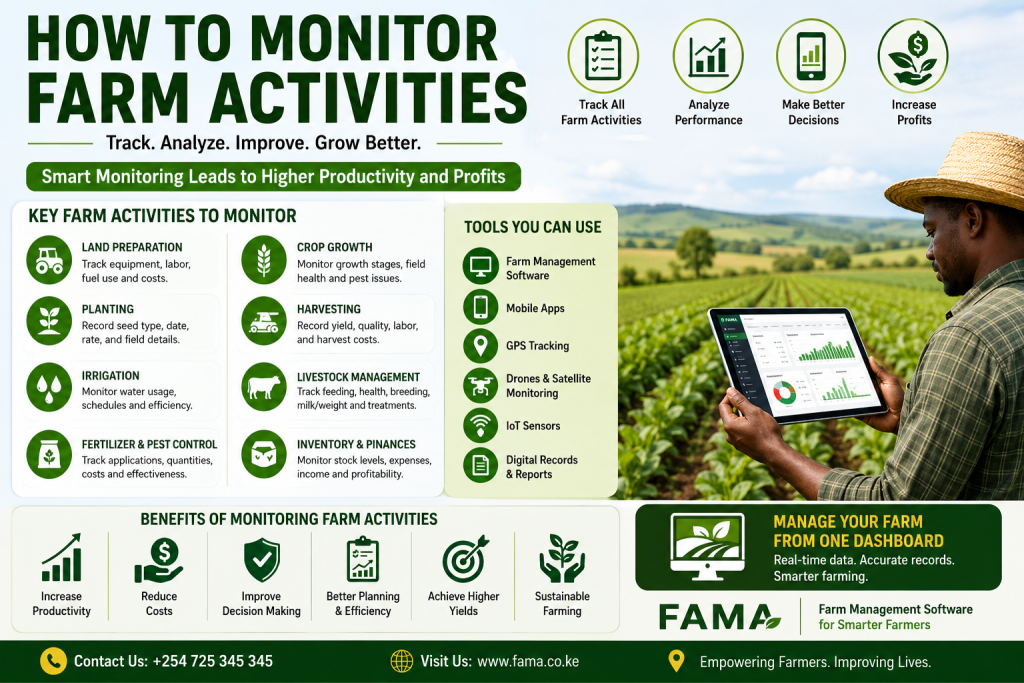
Agriculture has become increasingly data-driven. Farmers who understand how to monitor farm activities are able to make better decisions, reduce costs, increase productivity, and improve profits. Whether you own a small family farm or manage hundreds of acres, monitoring every farm operation is one of the most important practices for successful farming.
Learning how to monitor farm activities helps ensure that every task performed on the farm contributes toward maximum productivity. From planting and irrigation to harvesting and livestock management, every activity can be tracked, analyzed, and improved.
Today, technology has transformed how farmers monitor daily operations. Farm management software, GPS tracking, sensors, drones, mobile applications, and digital record-keeping make monitoring easier than ever before. Instead of relying on memory or paper records, farmers now have access to real-time information that supports better decision-making.
If you’re wondering how to monitor farm activities efficiently, this comprehensive guide explains everything you need to know.
What Does Monitoring Farm Activities Mean?
Monitoring farm activities refers to observing, recording, evaluating, and analyzing every operation taking place on a farm.
These activities include:
- Land preparation
- Planting
- Fertilizer application
- Irrigation
- Weed control
- Pest management
- Harvesting
- Equipment usage
- Employee attendance
- Livestock management
- Financial records
- Farm inventory
- Weather conditions
Proper monitoring ensures that nothing important is overlooked.
Without proper monitoring, farmers may experience:
- Reduced yields
- Increased production costs
- Poor employee accountability
- Wasted farm inputs
- Crop diseases spreading unnoticed
- Equipment breakdowns
- Poor financial management
Understanding how to monitor farm activities eliminates many of these challenges.
Why Monitoring Farm Activities is Important
Many farmers focus only on production but ignore monitoring. Monitoring is what transforms ordinary farming into profitable farming.
Benefits include:
Better Decision Making
When you have accurate records, you make informed decisions instead of guessing.
For example:
- Which fertilizer works best?
- Which crop variety performs better?
- Which employee is most productive?
- Which field requires more irrigation?
Monitoring provides the answers.
Increased Productivity
Every farm operation affects production.
When activities are monitored consistently, problems are identified early before they become expensive.
This leads to:
- Higher yields
- Healthier crops
- Better livestock performance
- Reduced losses
Reduced Costs
Monitoring helps identify unnecessary expenses.
Examples include:
- Excess fertilizer usage
- Fuel wastage
- Labor inefficiencies
- Water overuse
- Machinery misuse
Reducing these costs significantly improves profits.
Improved Farm Planning
Historical farm data makes future planning much easier.
Farmers can determine:
- Best planting dates
- Expected yields
- Budget requirements
- Labor needs
- Irrigation schedules
This improves long-term farm performance.
Key Farm Activities That Should Be Monitored
Knowing how to monitor farm activities begins with identifying what should actually be monitored.
1. Land Preparation
Record:
- Date of land preparation
- Equipment used
- Fuel consumed
- Labor involved
- Cost incurred
- Area prepared
Tracking these details helps estimate future preparation costs.
2. Planting Activities
Monitor:
- Planting dates
- Seed varieties
- Seed quantities
- Germination rates
- Plant spacing
- Number of workers
These records become valuable during harvest analysis.
3. Fertilizer Application
Track:
- Fertilizer type
- Quantity applied
- Application date
- Field location
- Cost
- Person responsible
Monitoring fertilizer applications prevents overuse and nutrient deficiencies.
4. Irrigation
Water management is one of the most critical farm activities.
Monitor:
- Irrigation schedules
- Water source
- Water usage
- Irrigation duration
- Pump performance
- Fuel or electricity consumption
Efficient irrigation monitoring reduces water wastage.
5. Pest and Disease Control
Monitor:
- Pest outbreaks
- Disease symptoms
- Chemicals used
- Application dates
- Weather conditions
- Treatment effectiveness
Early detection prevents severe crop losses.
6. Harvesting
Harvest records should include:
- Harvest dates
- Quantity harvested
- Crop quality
- Labor costs
- Storage location
- Selling price
These records determine profitability.
7. Livestock Activities
Livestock farmers should monitor:
- Feeding schedules
- Vaccinations
- Milk production
- Weight gain
- Disease treatment
- Breeding records
- Mortality rates
Continuous monitoring improves animal health and production.
Traditional Methods of Monitoring Farm Activities
Before digital technology, farmers relied on manual methods.
These include:
Farm Diaries
Many farmers maintain notebooks recording daily activities.
Information typically includes:
- Weather
- Planting dates
- Fertilizer use
- Expenses
- Harvest records
Although helpful, paper records are difficult to organize and analyze.
Whiteboards
Large farms often use whiteboards to assign daily tasks.
Workers can easily view:
- Today’s activities
- Assigned fields
- Equipment allocation
However, whiteboards do not store historical data.
Printed Farm Record Books
Printed record books help organize farm operations.
Sections may include:
- Crop records
- Livestock records
- Expenses
- Income
- Inventory
These remain popular among smallholder farmers.
Modern Ways to Monitor Farm Activities
Technology has completely transformed how to monitor farm activities.
Digital systems provide real-time information that improves decision-making.
Modern solutions include:
- Farm management software
- Mobile applications
- GPS tracking
- Satellite monitoring
- Drones
- IoT sensors
- Cloud databases
- Automated reports
These technologies reduce paperwork while improving accuracy.
Using Farm Management Software
One of the best answers to how to monitor farm activities is implementing farm management software.
A farm management system centralizes all farm operations into one platform.
Features typically include:
- Activity scheduling
- Employee management
- Crop monitoring
- Livestock records
- Expense tracking
- Inventory management
- Financial reporting
- Harvest management
Everything is stored digitally and can be accessed from anywhere.
Benefits of Digital Farm Monitoring
Digital monitoring offers several advantages.
Real-Time Updates
Managers immediately know:
- What work is ongoing
- Completed activities
- Delayed tasks
- Employee attendance
Real-time information improves supervision.
Automatic Reports
Instead of calculating everything manually, software generates reports instantly.
Examples include:
- Daily farm reports
- Weekly activity reports
- Monthly production reports
- Financial summaries
- Harvest analysis
These reports simplify management.
Improved Accountability
Employees record completed tasks.
Managers know:
- Who performed each task
- Time spent
- Resources used
- Task completion status
This improves productivity.
Monitoring Employees on the Farm
Farm labor represents a significant expense.
Monitoring employees helps improve efficiency.
Track:
- Attendance
- Working hours
- Assigned tasks
- Performance
- Output
- Overtime
Farm software allows managers to assign work digitally and receive progress updates.
Monitoring Farm Equipment
Farm machinery requires constant supervision.
Monitor:
- Fuel consumption
- Service schedules
- Repair history
- Operating hours
- Machine availability
Preventive maintenance reduces breakdowns.
Inventory Monitoring
Farm inventory includes:
- Seeds
- Fertilizers
- Chemicals
- Animal feed
- Equipment
- Spare parts
Inventory monitoring prevents shortages during critical farming periods.
Good inventory records also reduce theft and wastage.
Financial Monitoring
Farm success depends on good financial management.
Track:
Income:
- Produce sales
- Livestock sales
- Dairy income
Expenses:
- Seeds
- Fertilizer
- Labor
- Fuel
- Equipment repairs
- Utilities
Financial monitoring helps determine actual farm profitability.
Monitoring Crop Growth
Crop monitoring should happen throughout the growing season.
Observe:
- Germination percentage
- Plant height
- Leaf color
- Flowering stage
- Fruit development
- Disease symptoms
- Weed infestation
Regular monitoring allows corrective measures before problems become severe.
Weather Monitoring
Weather directly affects farming activities.
Monitor:
- Rainfall
- Temperature
- Humidity
- Wind speed
- Frost risk
- Heat stress
Weather monitoring improves planning for irrigation, spraying, planting, and harvesting.
Soil Monitoring
Healthy soil leads to healthy crops.
Monitor:
- Soil moisture
- Soil pH
- Organic matter
- Nutrient levels
- Drainage
- Soil compaction
Routine soil testing helps maintain soil fertility.
Why Fama Farm Management Software Makes Monitoring Easier
If you’re looking for the easiest way to learn how to monitor farm activities, Fama Farm Management Software provides a complete digital solution for modern farmers.
With Fama, you can:
- Monitor daily farm activities from one dashboard
- Track crop and livestock operations
- Record employee attendance and assigned tasks
- Manage inventory and farm inputs
- Monitor farm expenses and income
- Generate detailed reports for better decision-making
- Keep accurate digital farm records accessible anytime
Instead of relying on paper records or spreadsheets, Fama helps you organize your entire farming operation efficiently, saving time while improving productivity and profitability.
Contact Fama today: +254 725345345
Advanced Strategies on How to Monitor Farm Activities for Higher Productivity and Better Farm Management
Understanding how to monitor farm activities goes beyond simply recording what happens on the farm. Successful farmers continuously collect, analyze, and use farm data to improve operations. The more accurately you monitor your farm, the easier it becomes to identify inefficiencies, reduce waste, improve crop yields, and maximize profits.
Whether you are managing a crop farm, livestock farm, greenhouse, dairy farm, poultry farm, or mixed farm, mastering how to monitor farm activities allows you to make data-driven decisions that contribute to long-term success.
Using GPS Technology to Monitor Farm Activities
One of the biggest innovations in modern agriculture is GPS technology. GPS has revolutionized how to monitor farm activities by providing accurate location data for equipment, workers, and field operations.
Farmers can use GPS to:
- Track tractors during land preparation
- Monitor planting accuracy
- Measure field sizes
- Track fertilizer application
- Monitor harvesting routes
- Record spraying locations
- Prevent overlapping field operations
GPS monitoring reduces fuel consumption, saves time, and ensures that every section of the farm receives the correct treatment.
Using Drones to Monitor Farm Activities
Drone technology has become increasingly affordable, making it easier for farmers to understand how to monitor farm activities without spending countless hours walking through fields.
Drones can capture high-resolution aerial images that reveal valuable information about crop health.
Farmers can monitor:
- Crop growth
- Water stress
- Pest infestations
- Weed distribution
- Nutrient deficiencies
- Flooded areas
- Dry sections
- Harvest readiness
With drone images, farmers can identify problems days or even weeks before they become visible from the ground.
Monitoring Farm Activities Using Mobile Applications
Mobile technology has simplified how to monitor farm activities even for small-scale farmers.
Farm management mobile applications allow farmers to:
- Record daily farm activities
- Capture field observations
- Upload photos
- Track employee attendance
- Record expenses
- Monitor crop progress
- Schedule farm operations
- Generate activity reports
Since smartphones are widely available, mobile applications provide an affordable way to digitize farm management.
Internet of Things (IoT) in Farm Monitoring
The Internet of Things (IoT) is transforming how to monitor farm activities by connecting farm equipment and sensors to the internet.
IoT devices automatically collect and transmit farm data.
Examples include:
- Soil moisture sensors
- Weather stations
- Livestock tracking collars
- Greenhouse temperature sensors
- Water level sensors
- Irrigation controllers
- Feed monitoring systems
Instead of checking everything manually, farmers receive automatic updates whenever conditions change.
Monitoring Irrigation Systems
Water is one of the most valuable farm resources.
Understanding how to monitor farm activities includes ensuring that irrigation systems operate efficiently.
Monitor:
- Water pressure
- Water flow
- Pump performance
- Irrigation duration
- Moisture levels
- Water consumption
- Leakage
Efficient irrigation monitoring prevents both overwatering and underwatering.
Monitoring Fertilizer Applications
Fertilizer represents a major production cost.
Monitoring fertilizer applications helps farmers determine:
- Which fertilizer was applied
- Quantity used
- Application dates
- Crop response
- Cost
- Remaining inventory
Keeping accurate fertilizer records also supports compliance with agricultural regulations and sustainability goals.
Monitoring Pesticide Applications
Proper pesticide monitoring is essential for food safety and environmental protection.
Track:
- Product name
- Active ingredients
- Quantity applied
- Application date
- Weather conditions
- Field location
- Operator
- Spray equipment used
Good records help evaluate the effectiveness of pest control strategies.
Monitoring Crop Health
Crop health changes throughout the growing season.
Farmers should inspect crops regularly for:
- Leaf discoloration
- Wilting
- Insect damage
- Disease symptoms
- Nutrient deficiencies
- Growth uniformity
- Flowering
- Fruit development
Learning how to monitor farm activities includes identifying crop problems before they reduce yields.
Monitoring Soil Health
Healthy soil is the foundation of profitable farming.
Monitor:
- Organic matter
- Soil pH
- Nitrogen levels
- Phosphorus levels
- Potassium levels
- Soil moisture
- Drainage
- Soil compaction
Routine soil analysis helps maintain long-term productivity.
Monitoring Farm Workers
Labor productivity significantly affects profitability.
Monitor:
- Arrival time
- Departure time
- Assigned tasks
- Completed activities
- Daily output
- Equipment usage
- Safety compliance
Digital attendance systems improve accountability while reducing payroll errors.
Monitoring Livestock Performance
Livestock farmers should monitor every stage of animal production.
Important records include:
Dairy Farms
- Daily milk production
- Feed intake
- Vaccination schedules
- Artificial insemination
- Pregnancy records
- Calving dates
Poultry Farms
- Egg production
- Feed consumption
- Mortality rates
- Vaccinations
- Temperature
- Water intake
Beef Farms
- Weight gain
- Feed conversion
- Health treatments
- Breeding performance
- Grazing rotation
The more complete your livestock records, the easier it becomes to improve productivity.
Monitoring Farm Inventory
Inventory shortages can delay important farm operations.
Monitor inventory for:
- Seeds
- Fertilizers
- Chemicals
- Animal feed
- Fuel
- Machinery parts
- Packaging materials
A digital inventory system alerts farmers before stock runs out.
Monitoring Farm Expenses
One of the most important aspects of how to monitor farm activities is financial tracking.
Record expenses under categories such as:
- Seeds
- Fertilizers
- Chemicals
- Fuel
- Labor
- Repairs
- Transport
- Utilities
- Equipment purchases
Monitoring expenses helps determine production costs per acre or per animal.
Monitoring Farm Income
Income monitoring helps evaluate farm profitability.
Track:
- Sales date
- Buyer
- Product sold
- Quantity
- Selling price
- Payment status
- Transport costs
Financial reports generated from these records support better business decisions.
Monitoring Harvest Activities
Harvest monitoring ensures accurate production records.
Record:
- Harvest date
- Field harvested
- Quantity harvested
- Moisture content
- Crop quality
- Storage location
- Market destination
These records simplify yield comparisons between seasons.
Monitoring Storage Conditions
Post-harvest losses can significantly reduce profits.
Monitor storage facilities for:
- Temperature
- Humidity
- Pest infestation
- Ventilation
- Stock levels
- Product movement
Proper monitoring preserves product quality.
Monitoring Farm Machinery
Farm machinery should be inspected regularly.
Track:
- Service dates
- Oil changes
- Fuel usage
- Repairs
- Spare parts
- Machine hours
- Operator records
Preventive maintenance minimizes downtime during busy farming seasons.
Monitoring Greenhouse Operations
Greenhouse farming requires continuous monitoring.
Observe:
- Temperature
- Humidity
- Ventilation
- Irrigation
- Lighting
- Carbon dioxide
- Pest activity
Automated greenhouse monitoring systems improve consistency.
Monitoring Weather Conditions
Weather influences nearly every farming activity.
Monitor:
- Rainfall
- Wind speed
- Temperature
- Humidity
- Storm forecasts
- Frost warnings
Weather data helps farmers schedule planting, spraying, irrigation, and harvesting.
Key Performance Indicators (KPIs) for Farm Monitoring
Farmers should monitor measurable performance indicators.
Examples include:
Crop KPIs
- Yield per acre
- Germination percentage
- Fertilizer efficiency
- Irrigation efficiency
- Pest damage percentage
Livestock KPIs
- Daily milk production
- Average weight gain
- Mortality rate
- Feed conversion ratio
Financial KPIs
- Production cost
- Gross profit
- Net profit
- Revenue per acre
- Return on investment
Tracking KPIs is one of the most effective ways to improve how to monitor farm activities.
Daily Farm Monitoring Checklist
A daily checklist helps ensure nothing is overlooked.
Include:
- Employee attendance
- Weather observations
- Irrigation status
- Crop inspection
- Livestock health
- Equipment inspection
- Inventory levels
- Pest monitoring
- Security checks
- Financial transactions
Daily monitoring prevents small issues from becoming major problems.
Weekly Farm Monitoring Checklist
Weekly reviews should include:
- Crop growth comparison
- Livestock performance
- Inventory reconciliation
- Machinery servicing
- Financial review
- Employee performance
- Farm cleanliness
- Safety inspection
Monthly Farm Monitoring Checklist
Every month evaluate:
- Production targets
- Financial performance
- Crop development
- Livestock productivity
- Equipment condition
- Budget utilization
- Input consumption
Monthly reports reveal long-term trends.
Common Challenges When Monitoring Farm Activities
Farmers often encounter several obstacles when implementing monitoring systems.
These include:
- Poor record keeping
- Missing data
- Lack of technology
- Limited internet connectivity
- Human errors
- Employee resistance
- Delayed reporting
- Poor communication
Fortunately, modern farm management software minimizes these challenges.
Best Practices for Monitoring Farm Activities
If you want to master how to monitor farm activities, follow these best practices:
- Record every activity immediately.
- Standardize data collection across all fields.
- Conduct routine inspections.
- Use digital farm management software.
- Train employees on proper record keeping.
- Back up farm records securely.
- Analyze reports regularly.
- Compare seasonal performance.
- Monitor costs alongside production.
- Use dashboards for quick decision-making.
Consistency is more important than complexity. Small daily records often provide the greatest long-term value.
Why Farm Management Software Is the Best Solution
Manual record keeping can become difficult as a farm grows. Farm management software simplifies how to monitor farm activities by bringing every aspect of the farm into one centralized platform.
With software such as Fama Farm Management Software, farmers can:
- Monitor all daily farm activities from a single dashboard.
- Track crop production from planting to harvest.
- Manage livestock records with ease.
- Assign and monitor employee tasks.
- Track expenses and income automatically.
- Generate professional reports instantly.
- Manage farm inventory efficiently.
- Monitor equipment maintenance schedules.
- Access farm records from anywhere using a computer or smartphone.
- Improve accountability across the entire farming operation.
Digital monitoring not only saves time but also improves accuracy, helping farmers make faster and better-informed decisions.
Frequently Asked Questions
What is the best way to monitor farm activities?
The best approach combines regular field inspections, accurate record keeping, and farm management software that tracks crops, livestock, finances, inventory, and employees in one place.
Why is monitoring farm activities important?
Monitoring helps farmers identify problems early, improve efficiency, reduce production costs, increase yields, and make informed management decisions.
Can small-scale farmers monitor farm activities effectively?
Yes. Even small farms benefit from maintaining accurate records. Mobile applications and affordable farm management systems make digital monitoring accessible to farms of all sizes.
How often should farm activities be monitored?
Some activities, such as irrigation, livestock health, and employee attendance, should be monitored daily. Financial performance, inventory, and machinery maintenance should be reviewed weekly or monthly depending on farm operations.
Does monitoring farm activities increase profits?
Yes. By tracking inputs, labor, production, and finances, farmers reduce waste, improve efficiency, and make better decisions that contribute to higher profitability.
Why Every Farmer Should Learn How to Monitor Farm Activities
If you want to improve productivity, reduce costs, and increase profits, understanding how to monitor farm activities is essential. Knowing how to monitor farm activities allows farmers to track every stage of production, identify problems early, and make informed decisions based on accurate data. Whether you operate a small farm or a large commercial enterprise, learning how to monitor farm activities helps ensure that planting, irrigation, fertilization, pest control, harvesting, and livestock management are carried out efficiently.
Modern technology has made how to monitor farm activities easier than ever before. With farm management software, mobile applications, GPS tracking, drones, and smart sensors, farmers can monitor operations in real time and maintain accurate digital records. By understanding how to monitor farm activities, farmers can improve labor management, monitor equipment usage, track farm expenses, manage inventory, and evaluate crop performance throughout the growing season.
Another advantage of learning how to monitor farm activities is the ability to compare farm performance from one season to another. Historical records provide valuable insights into crop yields, production costs, weather patterns, and resource utilization. This information enables farmers to make better decisions, reduce waste, and improve overall farm efficiency. Consistently applying the principles of how to monitor farm activities also helps improve sustainability by ensuring that water, fertilizer, pesticides, and labor are used effectively.
Farmers who invest time in learning how to monitor farm activities are better prepared to respond to unexpected challenges such as pest outbreaks, equipment failures, changing weather conditions, or fluctuating market prices. Effective monitoring supports timely interventions that protect crops and livestock while maximizing profitability.
With Fama Farm Management Software, learning how to monitor farm activities becomes simple and practical. Fama provides powerful tools for tracking farm operations, managing employees, monitoring inventory, recording financial transactions, and generating detailed reports from a single dashboard. If you are serious about improving your farm’s productivity, profitability, and long-term success, now is the perfect time to adopt modern solutions for how to monitor farm activities.
For more information, visit Fama.co.ke or contact us at +254 725345345.
Conclusion
Learning how to monitor farm activities is one of the most valuable investments a farmer can make. Consistent monitoring transforms farming from a reactive process into a proactive business where decisions are based on reliable data rather than assumptions. Every activity—from land preparation and planting to irrigation, harvesting, livestock management, inventory control, and financial tracking—contributes to the overall success of the farm.
Modern technologies such as GPS, drones, IoT sensors, mobile applications, and cloud-based farm management systems have made how to monitor farm activities easier, faster, and more accurate than ever before. Farmers who embrace these tools gain greater visibility into their operations, improve resource utilization, reduce unnecessary expenses, and consistently achieve better yields.
If you’re looking for a reliable solution to simplify how to monitor farm activities, Fama Farm Management Software is designed to help you manage your entire farm from one easy-to-use platform. Whether you operate a small family farm or a large commercial enterprise, Fama gives you the tools to monitor daily operations, maintain accurate records, generate insightful reports, and make smarter farming decisions.
Visit Fama.co.ke today to discover how modern farm management software can transform your farming operations.
Contact us: +254 725345345