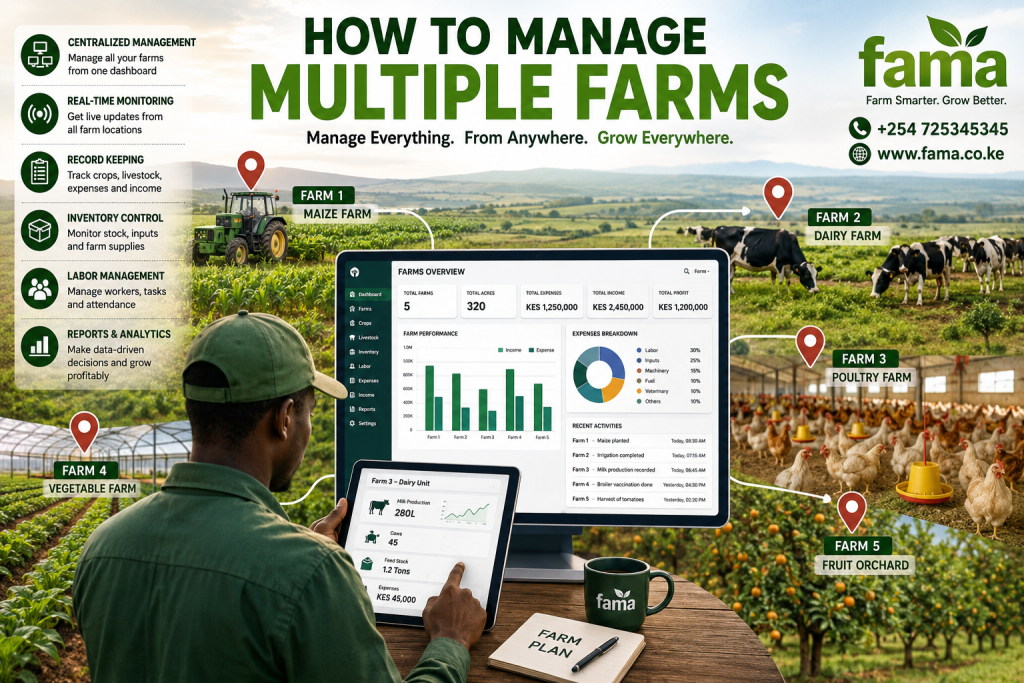
How to Manage Multiple Farms Successfully
Managing one farm is challenging enough. Managing multiple farms requires even greater organization, planning, and decision-making. Whether you own farms in different counties or several neighboring pieces of land dedicated to different agricultural activities, success depends on having the right management systems.
Many farmers begin with one farm and gradually expand as profits grow. However, expansion often creates new challenges such as keeping accurate records, supervising workers, monitoring crops and livestock, controlling expenses, scheduling activities, and ensuring every farm performs efficiently.
If these activities are handled manually, mistakes become common. Important information gets lost, workers may fail to complete assigned tasks, expenses increase unnoticed, and profitability declines.
Fortunately, modern technology has made how to manage multiple farms much easier than ever before. By combining proper planning, standard operating procedures, and modern farm management software, farmers can successfully oversee several farms from a single dashboard.
At Fama.co.ke, we help farmers simplify operations through smart digital farm management solutions designed specifically for modern agriculture.
For professional assistance, call +254 725345345 to learn how Fama can help you manage multiple farms efficiently.
Why Farmers Expand to Multiple Farms
Many successful farmers eventually diversify their operations.
Some purchase additional land in different regions to reduce climate risks while others establish specialized farms for different enterprises.
Examples include:
- Dairy farm in one county
- Poultry farm in another location
- Maize farm in Rift Valley
- Greenhouse vegetables near urban markets
- Fruit orchards in high rainfall areas
This diversification improves income opportunities while spreading production risks.
However, expansion also increases management complexity.
Without proper systems, farmers quickly become overwhelmed.
Common Challenges When Managing Multiple Farms
Understanding these challenges is the first step toward solving them.
1. Poor Communication
Workers on different farms may not receive instructions on time.
Managers may misunderstand priorities.
Important updates may never reach the farm owner.
This results in delays and reduced productivity.
2. Inconsistent Record Keeping
One farm may keep notebooks.
Another uses spreadsheets.
Others rely entirely on memory.
Eventually no one knows:
- Actual production costs
- Fertilizer usage
- Veterinary expenses
- Crop yields
- Employee attendance
Good farm management depends on reliable records.
3. Increased Travel Costs
Owners often spend many hours driving between farms.
Besides consuming time, travel increases fuel costs and delays decision-making.
Digital monitoring reduces unnecessary trips.
4. Labor Supervision
Managing workers across several farms can be difficult.
Questions include:
- Did workers report today?
- Was spraying completed?
- Were cows milked correctly?
- Were irrigation schedules followed?
- Was harvesting completed?
Without accountability, productivity drops.
5. Inventory Losses
Inputs such as:
- Fertilizer
- Animal feed
- Chemicals
- Fuel
- Seeds
- Veterinary drugs
may disappear due to poor inventory management.
Good inventory systems protect profits.
Why Proper Farm Management Matters
Efficient farm management improves every aspect of the business.
Benefits include:
- Higher productivity
- Better financial control
- Reduced wastage
- Improved worker accountability
- Better planning
- Faster decision-making
- Increased profits
- Easier reporting
- Better compliance
- Sustainable growth
These benefits become even more important when managing multiple farms.
Create One Central Management System
One of the biggest mistakes farmers make is treating every farm independently.
Instead, create one management structure covering all farms.
This includes:
- Standard operating procedures
- Shared financial reporting
- Unified inventory system
- Employee management
- Equipment tracking
- Production monitoring
A centralized system ensures consistency.
Standardize Operations Across Every Farm
Every farm should follow similar procedures wherever possible.
Examples include:
Feeding Procedures
Workers should know:
- Feeding times
- Feed quantities
- Storage procedures
- Cleaning routines
Consistency improves livestock performance.
Crop Management Procedures
Develop standard guidelines for:
- Land preparation
- Planting
- Fertilizer application
- Pest control
- Irrigation
- Harvesting
This maintains quality regardless of location.
Record Keeping Standards
Every farm should record:
- Daily activities
- Expenses
- Sales
- Production
- Labor
- Equipment usage
Standardization simplifies reporting.
Assign Responsible Farm Managers
As farms grow, owners cannot supervise everything personally.
Each farm should have a responsible manager.
Their duties include:
- Supervising workers
- Reporting daily activities
- Managing inventory
- Coordinating maintenance
- Recording production
- Communicating challenges
Good managers become the eyes and ears of the farm owner.
Use Farm Management Software
One of the smartest investments today is farm management software.
Instead of relying on paperwork, software centralizes operations.
A good farm management system allows farmers to:
- Monitor multiple farms
- Record expenses
- Track income
- Monitor crop progress
- Manage livestock
- Track inventory
- Assign workers
- Generate reports
- Monitor profits
- Access information anywhere
This is why many successful commercial farmers now rely on digital systems.
Benefits of Digital Farm Management
Modern software transforms farm operations.
Advantages include:
Real-Time Information
View updates from all farms instantly.
No waiting for weekly reports.
Better Decision Making
Current information supports faster, more accurate decisions.
Reduced Errors
Digital records reduce human mistakes.
Improved Financial Tracking
Know exactly:
- Income
- Expenses
- Outstanding payments
- Profit margins
for every farm.
Easier Reporting
Generate reports in minutes instead of days.
Separate Financial Records for Every Farm
Even when farms belong to one owner, financial records should remain separate.
Track:
- Farm A income
- Farm A expenses
- Farm B income
- Farm B expenses
This identifies:
- Most profitable farm
- Highest costs
- Best-performing enterprises
- Areas requiring improvement
Without separate financial records, decision-making becomes difficult.
Budget for Every Farm
Every farm should have its own annual budget.
Budgets should include:
Production Costs
Estimate:
- Seeds
- Fertilizer
- Chemicals
- Animal feed
- Veterinary costs
Labor Costs
Include:
- Permanent workers
- Casual labor
- Seasonal workers
Equipment Costs
Budget for:
- Fuel
- Repairs
- Maintenance
- Replacement
Marketing Costs
Include:
- Packaging
- Transport
- Storage
- Sales commissions
Regular budget reviews help control spending.
Schedule Farm Activities in Advance
Planning avoids confusion.
Prepare monthly schedules covering:
- Planting dates
- Irrigation
- Fertilizer application
- Vaccination
- Harvesting
- Equipment servicing
When everyone follows one calendar, productivity improves.
Monitor Farm Performance Regularly
Every farm should have measurable performance indicators.
Examples include:
Crop Farms
- Yield per acre
- Input costs
- Harvest quality
- Market prices
Dairy Farms
- Milk production
- Feed conversion
- Veterinary expenses
- Breeding success
Poultry Farms
- Egg production
- Mortality rates
- Feed consumption
- Sales
Comparing performance helps identify successful management practices.
Improve Communication
Communication is critical when farms operate in different locations.
Use digital tools to:
- Share daily reports
- Send photos
- Approve purchases
- Monitor activities
- Solve problems quickly
Better communication reduces delays.
Keep Accurate Inventory Records
Every farm should maintain inventory records covering:
- Fertilizers
- Seeds
- Animal feed
- Chemicals
- Fuel
- Tools
- Spare parts
Knowing available stock prevents shortages and unnecessary purchases.
Train Employees Continuously
Multiple farms require skilled employees.
Training should focus on:
- Farm safety
- Equipment operation
- Record keeping
- Animal welfare
- Crop management
- Customer service
- Technology adoption
Well-trained workers improve productivity while reducing costly mistakes.
How to Manage Multiple Farms Successfully
Monitor Multiple Farms Remotely
One of the biggest advantages of modern agriculture is the ability to manage multiple farms remotely. Farmers no longer need to travel every day between farms to know what is happening. Instead, they can rely on farm management software to monitor operations, receive updates, and make informed decisions from anywhere.
If you are wondering how to manage multiple farms without spending countless hours on the road, remote monitoring is the answer.
Using a reliable farm management system, you can:
- Track daily farm activities
- Monitor crop growth
- Supervise livestock production
- Review worker attendance
- Monitor expenses and revenues
- Check inventory levels
- Generate farm reports
- View production trends
The ability to manage multiple farms remotely saves time, reduces operational costs, and improves productivity.
Use Mobile Technology to Manage Multiple Farms
Every farm manager should have access to a smartphone or tablet connected to your farm management software.
With mobile technology, managing multiple farms becomes much easier because workers can instantly submit:
- Harvest reports
- Daily activities
- Livestock records
- Irrigation updates
- Disease reports
- Pest infestations
- Machinery breakdowns
- Purchase requests
This real-time communication makes managing multiple farms significantly more efficient.
GPS Technology Makes Managing Multiple Farms Easier
Modern GPS technology has transformed how to manage multiple farms.
GPS allows farmers to:
- Map farm boundaries
- Track machinery
- Monitor field activities
- Improve land utilization
- Plan irrigation systems
- Reduce fuel consumption
GPS also helps prevent overlapping activities and ensures each farm is operating efficiently.
When combined with farm management software, GPS improves decision-making and increases profitability.
Standardize Reporting Across Every Farm
Every farm should submit reports using the same format.
Daily reports may include:
- Weather conditions
- Crop status
- Livestock health
- Input usage
- Labor attendance
- Equipment condition
- Sales completed
- Expenses incurred
Standard reporting makes it easier to compare performance across different farms.
It also simplifies managing multiple farms because information is organized consistently.
Manage Farm Machinery Efficiently
Farm machinery represents a significant investment.
When managing multiple farms, machinery should be shared strategically.
Examples include:
- Tractors
- Ploughs
- Sprayers
- Harvesters
- Water pumps
- Feed mixers
- Milk cooling equipment
Using farm management software, machinery schedules can be organized to avoid conflicts.
This reduces idle time while increasing equipment utilization.
Schedule Preventive Maintenance
Equipment breakdowns are expensive.
Every farm should maintain maintenance schedules covering:
- Oil changes
- Tire inspections
- Engine servicing
- Hydraulic repairs
- Lubrication
- Safety inspections
Preventive maintenance reduces downtime while extending equipment life.
This is an important part of how to manage multiple farms successfully.
Manage Farm Workers Effectively
Labor management becomes increasingly difficult as farms grow.
Good labor management includes:
- Attendance tracking
- Performance monitoring
- Payroll management
- Task assignments
- Overtime recording
- Training records
Modern farm management software simplifies workforce management by storing all employee information in one place.
Managing multiple farms becomes easier when every worker has clearly assigned responsibilities.
Track Crop Performance Across Multiple Farms
One major benefit of farm management software is comparing crop performance.
Track information such as:
- Germination rates
- Fertilizer application
- Irrigation schedules
- Pest outbreaks
- Harvest quantities
- Market prices
- Production costs
Comparing results helps identify best-performing farms and best farming practices.
Monitor Livestock Across Different Farms
Livestock farmers managing multiple farms need accurate records.
Track:
- Milk production
- Weight gain
- Vaccinations
- Breeding records
- Feed consumption
- Mortality rates
- Veterinary treatments
Reliable livestock records improve productivity while reducing disease risks.
Improve Inventory Control
Inventory management is essential when learning how to manage multiple farms.
Track:
- Seeds
- Fertilizers
- Animal feeds
- Veterinary drugs
- Chemicals
- Fuel
- Packaging materials
- Irrigation equipment
A centralized farm management system reduces theft and prevents shortages.
Financial Management for Multiple Farms
Financial management determines whether farm expansion remains profitable.
Good financial records should include:
Income
Track revenue from:
- Crop sales
- Milk sales
- Livestock sales
- Poultry products
- Fruit sales
- Vegetable sales
Expenses
Monitor:
- Labor
- Fuel
- Repairs
- Veterinary costs
- Fertilizers
- Seeds
- Chemicals
- Transport
Profitability
Compare profitability for every farm individually.
This helps determine:
- Which farm generates the highest returns.
- Which enterprise needs improvement.
- Which expenses should be reduced.
Proper financial reporting is one of the foundations of how to manage multiple farms efficiently.
Reduce Operational Risks
Managing multiple farms comes with several risks.
Examples include:
- Drought
- Floods
- Disease outbreaks
- Market fluctuations
- Equipment failure
- Labor shortages
Reduce risks by:
- Diversifying crops
- Insuring livestock
- Maintaining emergency funds
- Using irrigation systems
- Keeping digital records
- Monitoring weather forecasts
Risk management protects long-term profitability.
Data-Driven Farm Management
Modern agriculture depends on data.
Successful farmers no longer rely on guesswork.
Instead they analyze:
- Production costs
- Yield trends
- Market prices
- Rainfall patterns
- Fertilizer usage
- Labor productivity
- Crop performance
Data enables smarter decisions and better planning.
This is one reason why farm management software is becoming essential for every commercial farmer.
Why Choose Fama Farm Management Software?
If you’re searching for the easiest way to manage multiple farms, Fama Farm Management Software offers an all-in-one solution designed for farmers in Kenya.
With Fama, you can:
- Manage multiple farms from one dashboard
- Track crops and livestock
- Record farm expenses and income
- Monitor inventory
- Manage workers
- Generate detailed reports
- Monitor profitability
- Access records from anywhere
- Improve decision-making
- Increase farm productivity
Whether you own two farms or twenty farms, Fama Farm Management Software helps simplify operations and improve efficiency.
Best Practices for Managing Multiple Farms
To successfully manage multiple farms, follow these proven best practices:
- Create one centralized management system.
- Use reliable farm management software.
- Standardize farm procedures.
- Keep accurate digital records.
- Assign responsible farm managers.
- Monitor farm performance regularly.
- Track inventory daily.
- Review financial reports monthly.
- Train employees continuously.
- Analyze farm data before making decisions.
- Schedule machinery efficiently.
- Monitor crop and livestock health consistently.
- Prepare annual farm budgets.
- Conduct regular farm inspections.
- Continuously improve farm processes.
These strategies help farmers successfully manage multiple farms while maximizing profits.
Frequently Asked Questions
How do you manage multiple farms efficiently?
The best way to manage multiple farms is by using farm management software, standardizing operations, assigning qualified managers, keeping accurate records, monitoring finances, and reviewing farm performance regularly.
Why is farm management software important?
Farm management software helps farmers organize operations, manage multiple farms, track expenses, monitor production, improve communication, and generate reports for better decision-making.
Can small farmers benefit from farm management software?
Yes. Even farmers with two or three farms benefit from using farm management software because it improves organization, saves time, and increases profitability.
How does farm management software improve productivity?
Farm management software reduces paperwork, improves communication, automates record keeping, tracks farm performance, manages inventory, and provides valuable reports that support better decisions.
Is managing multiple farms profitable?
Yes. Managing multiple farms can be highly profitable when supported by proper planning, digital record keeping, efficient labor management, financial control, and a reliable farm management system.
Why Learning How to Manage Multiple Farms Is Essential for Modern Farmers
If you are searching for how to manage multiple farms, you are already taking the first step toward building a more productive and profitable agricultural business. Understanding how to manage multiple farms is no longer optional for farmers who are expanding their operations across different locations. Whether you own crop farms, dairy farms, poultry farms, or mixed farming enterprises, knowing how to manage multiple farms helps you improve productivity, reduce costs, and increase profits.
The best approach to how to manage multiple farms is to establish clear management systems, maintain accurate records, and invest in reliable farm management software. Farmers who understand how to manage multiple farms are better equipped to monitor workers, track production, manage finances, and make informed decisions based on accurate data rather than guesswork.
As your farming business grows, the importance of learning how to manage multiple farms becomes even greater. Every successful agricultural business relies on planning, communication, accountability, and technology. When farmers fail to understand how to manage multiple farms, they often experience poor coordination, increased operational costs, inventory losses, and reduced profitability. On the other hand, farmers who master how to manage multiple farms can easily coordinate daily activities, supervise multiple farm managers, monitor livestock and crop performance, and compare productivity across different farm locations. This makes expansion much easier and more sustainable.
Modern agriculture has transformed how to manage multiple farms through digital solutions. Instead of relying on notebooks or spreadsheets, farmers can use farm management software to simplify how to manage multiple farms by keeping all records in one centralized system. Whether you are planning seasonal activities, tracking expenses, monitoring inventory, or generating financial reports, the right technology makes how to manage multiple farms easier and more efficient.
At Fama, we understand the challenges of how to manage multiple farms, which is why our farm management software is designed to help Kenyan farmers manage every aspect of their agricultural operations from a single platform. If you want to improve efficiency and profitability, learning how to manage multiple farms with the right tools is one of the smartest investments you can make for the future of your farming business.
Conclusion
Learning how to manage multiple farms is one of the most valuable skills for modern farmers. As agricultural businesses expand, manual management methods become inefficient, increasing the risk of poor communication, financial losses, inaccurate records, and reduced productivity. By adopting a structured approach and investing in reliable farm management software, farmers can confidently manage multiple farms, monitor operations in real time, improve labor supervision, control inventory, analyze financial performance, and make faster, data-driven decisions.
Whether you operate crop farms, dairy farms, poultry farms, horticultural farms, or mixed agricultural enterprises, implementing a modern farm management system will help you manage multiple farms more effectively while improving efficiency and profitability. The right technology enables you to reduce operational costs, maximize yields, and grow your farming business sustainably.
If you are looking for a trusted solution to manage multiple farms in Kenya, Fama Farm Management Software is designed to simplify every aspect of your farm operations.
Contact Fama today
📞 Phone: +254 725345345
Visit Fama.co.ke to discover how our advanced farm management software can help you manage multiple farms, increase productivity, improve farm records, and grow a successful agricultural business across Kenya.