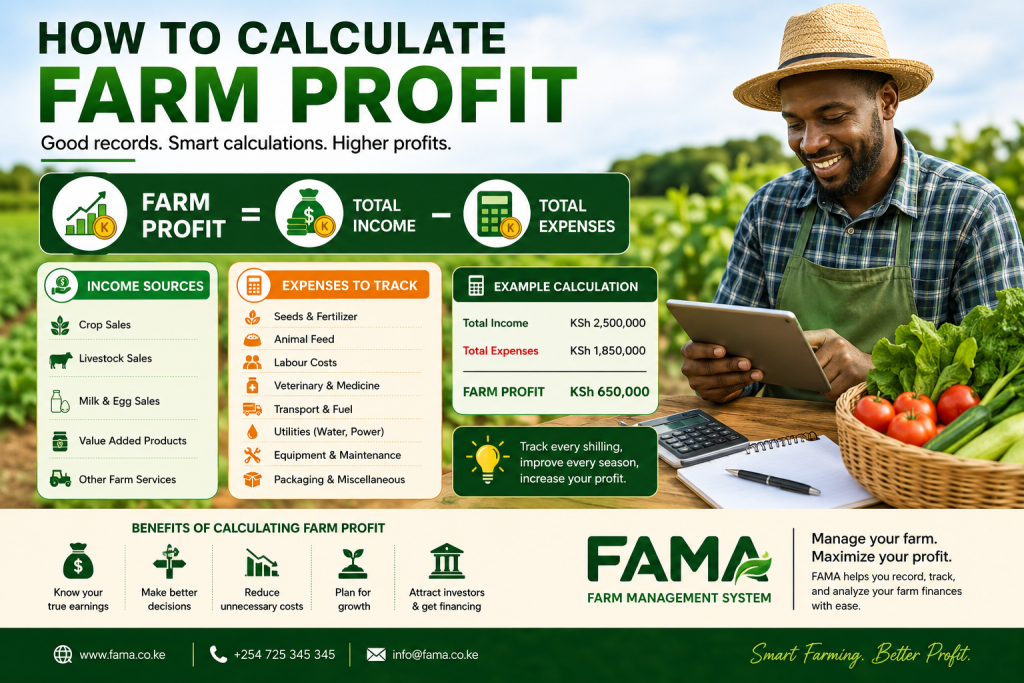
One of the biggest questions every farmer should ask is how to calculate farm profit. Whether you operate a small vegetable farm, a dairy enterprise, a poultry business, or a large commercial farm, understanding how to calculate farm profit helps you determine whether your farming activities are truly making money or simply generating revenue without real returns.
Many farmers believe that selling produce means they are profitable. Unfortunately, this is not always true. You may sell maize worth KSh 800,000, but if your total production costs amount to KSh 750,000, your actual profit is only KSh 50,000. Without proper records, it becomes almost impossible to know your real financial position.
Learning how to calculate farm profit allows you to:
- Understand your actual earnings
- Identify unnecessary expenses
- Improve decision-making
- Plan future investments
- Secure agricultural financing
- Increase long-term sustainability
This comprehensive guide explains everything you need to know about how to calculate farm profit, including practical examples, formulas, common mistakes, and how a Farm Management System like FAMA simplifies the entire process.
Why Knowing How to Calculate Farm Profit Is Important
Every successful business measures profitability regularly, and farming should be no different.
Many farmers focus only on production while ignoring financial management. They know how many bags of maize they harvested but cannot tell whether the season was profitable.
Understanding how to calculate farm profit enables you to answer critical questions such as:
- Did this farming season make money?
- Which crop generated the highest returns?
- Which livestock enterprise performs best?
- Are production costs increasing?
- Is fertilizer investment paying off?
- Should I expand or reduce production?
Without knowing how to calculate farm profit, decisions become guesswork rather than informed business choices.
What Is Farm Profit?
Farm profit refers to the money remaining after subtracting all production costs from total farm income.
In simple terms:
Farm Profit = Total Farm Income − Total Farm Expenses
If your income exceeds expenses, your farm is profitable.
If expenses exceed income, your farm operates at a loss.
Although the formula looks simple, accurate calculation requires complete financial records and proper expense tracking.
Difference Between Revenue and Profit
Many farmers confuse revenue with profit.
Revenue
Revenue is the total amount of money earned from selling farm products.
Examples include:
- Milk sales
- Egg sales
- Livestock sales
- Vegetable sales
- Fruit sales
- Honey sales
Revenue does not account for expenses.
Profit
Profit is what remains after deducting every production cost.
Example:
Revenue:
- Milk sales = KSh 600,000
Expenses:
- Feed = KSh 180,000
- Veterinary services = KSh 40,000
- Labour = KSh 120,000
- Electricity = KSh 30,000
- Fuel = KSh 20,000
- Equipment maintenance = KSh 15,000
Total expenses = KSh 405,000
Farm Profit:
KSh 600,000 − KSh 405,000 = KSh 195,000
This simple calculation demonstrates how to calculate farm profit accurately.
Types of Farm Income
Before learning how to calculate farm profit, identify every income source.
Farm income may come from:
Crop Sales
Examples include:
- Maize
- Beans
- Tomatoes
- Potatoes
- Onions
- Avocados
- Coffee
- Tea
- Bananas
Every sale should be recorded.
Livestock Sales
Income may come from:
- Dairy cattle
- Beef cattle
- Goats
- Sheep
- Pigs
- Poultry
- Rabbits
Include every sale.
Milk Sales
Dairy farms should record:
- Daily milk production
- Quantity sold
- Selling price
- Total revenue
Daily records improve the accuracy of how to calculate farm profit.
Egg Sales
Poultry farmers should track:
- Number of trays sold
- Selling price
- Daily production
- Weekly income
Value-Added Products
Some farms earn income from:
- Yogurt
- Cheese
- Processed milk
- Packaged vegetables
- Fruit juice
- Honey processing
These additional revenue streams must be included when calculating farm profit.
Farm Services
Income may also come from:
- Tractor hire
- Seedling sales
- Training services
- Farm tours
- Equipment rental
Every income source contributes to total farm revenue.
Types of Farm Expenses
Understanding expenses is the foundation of learning how to calculate farm profit.
Many farmers underestimate their expenses because they forget small daily costs.
Variable Costs
Variable costs change depending on production levels.
Examples include:
- Seeds
- Fertilizer
- Chemicals
- Animal feed
- Veterinary medicine
- Water
- Fuel
- Packaging materials
These costs increase as production expands.
Fixed Costs
Fixed costs remain relatively constant.
Examples include:
- Land lease
- Insurance
- Salaries
- Machinery depreciation
- Equipment maintenance
- Office expenses
- Farm security
Fixed costs must always be included when calculating farm profit.
Labour Costs
Many family farms ignore labour costs.
However, family labour has economic value.
Include:
- Permanent workers
- Casual workers
- Family labour
- Seasonal employees
Ignoring labour gives inaccurate profit figures.
Machinery Costs
Machinery expenses include:
- Fuel
- Repairs
- Servicing
- Spare parts
- Depreciation
- Insurance
These costs significantly affect profitability.
Utility Costs
Don’t forget:
- Electricity
- Water bills
- Internet
- Mobile communication
- Generator fuel
These operational expenses influence net farm profit.
Transport Costs
Transport expenses include:
- Deliveries
- Market trips
- Fuel
- Vehicle repairs
- Driver wages
Many farmers overlook these costs.
Packaging Costs
If products are packaged, include:
- Bags
- Boxes
- Labels
- Crates
- Wrapping materials
These directly reduce profit margins.
The Basic Formula for Calculating Farm Profit
The simplest way to understand how to calculate farm profit is by using this formula:
Farm Profit = Total Income − Total Expenses
For example:
Income:
- Milk = KSh 420,000
- Eggs = KSh 90,000
- Vegetables = KSh 180,000
Total Income = KSh 690,000
Expenses:
- Feed = KSh 180,000
- Fertilizer = KSh 60,000
- Labour = KSh 130,000
- Transport = KSh 40,000
- Veterinary = KSh 35,000
- Utilities = KSh 20,000
Total Expenses = KSh 465,000
Farm Profit:
KSh 690,000 − KSh 465,000 = KSh 225,000
This straightforward approach forms the basis of how to calculate farm profit for farms of any size.
Gross Profit vs Net Profit
Understanding the difference between gross profit and net profit provides deeper financial insight.
Gross Profit
Gross Profit = Sales Revenue − Direct Production Costs
Direct costs include:
- Seeds
- Feed
- Fertilizer
- Chemicals
- Veterinary medicine
Gross profit measures production efficiency before accounting for overhead costs.
Net Profit
Net Profit = Gross Profit − Operating Expenses
Operating expenses include:
- Salaries
- Rent
- Utilities
- Transport
- Administration
- Equipment maintenance
- Loan interest
Net profit shows the actual amount your farm earns after all costs have been deducted.
Why Farm Records Matter
You cannot accurately determine how to calculate farm profit without reliable records.
Essential records include:
- Sales records
- Expense records
- Labour records
- Input purchases
- Inventory records
- Livestock records
- Harvest records
- Production records
Accurate records help eliminate guesswork and make farm profitability measurable.
Common Mistakes Farmers Make When Calculating Farm Profit
Many farmers unknowingly overestimate their profits by making avoidable errors.
Some of the most common mistakes include:
- Ignoring small daily expenses.
- Failing to record family labour.
- Forgetting equipment maintenance costs.
- Excluding transport expenses.
- Mixing personal and farm finances.
- Not accounting for depreciation of machinery and equipment.
- Recording sales but not tracking production costs.
- Estimating figures instead of keeping actual records.
Avoiding these mistakes makes how to calculate farm profit much more accurate and reliable.
Advanced Guide on How to Calculate Farm Profit
Understanding how to calculate farm profit goes beyond subtracting expenses from income. Modern farming is a business, and successful farmers continuously monitor profitability, compare production seasons, calculate returns on investment, and identify which enterprises generate the highest income. If you truly want to master how to calculate farm profit, you must adopt a systematic approach that combines accurate record keeping with the right technology.
This is where a farm management solution like FAMA Farm Management System becomes invaluable. Instead of relying on handwritten notebooks or scattered spreadsheets, FAMA automatically records your farm activities, tracks expenses, monitors income, and simplifies how to calculate farm profit with real-time financial reports.
How to Calculate Farm Profit for Different Farming Enterprises
Every farming enterprise has unique expenses and income streams. While the basic formula remains the same, how to calculate farm profit varies slightly depending on the type of farming.
How to Calculate Farm Profit for Dairy Farming
A dairy farmer earns income from:
- Milk sales
- Sale of calves
- Sale of mature cows
- Manure sales
Expenses include:
- Dairy meal
- Hay
- Silage
- Veterinary services
- Artificial insemination
- Water
- Electricity
- Labour
- Milking equipment maintenance
Example:
Monthly milk sales = KSh 420,000
Other income = KSh 35,000
Total income = KSh 455,000
Expenses:
Feed = KSh 180,000
Labour = KSh 90,000
Veterinary = KSh 25,000
Utilities = KSh 20,000
Transport = KSh 15,000
Maintenance = KSh 10,000
Total expenses = KSh 340,000
Farm Profit = KSh 115,000
Knowing how to calculate farm profit every month helps dairy farmers identify periods of high and low profitability and adjust feed, breeding, and production strategies accordingly.
How to Calculate Farm Profit for Poultry Farming
Poultry farmers should include:
Income:
- Egg sales
- Chicken sales
- Manure sales
- Chick sales
Expenses:
- Feeds
- Vaccination
- Medication
- Electricity
- Water
- Labour
- Transport
- Equipment
- Bedding materials
If total poultry income is KSh 300,000 and expenses amount to KSh 190,000, then:
Farm Profit = KSh 110,000
Regularly understanding how to calculate farm profit helps poultry farmers determine whether increasing flock size will improve earnings.
How to Calculate Farm Profit for Crop Farming
Crop farmers should include every expense from land preparation to harvesting.
Typical costs include:
- Land preparation
- Seeds
- Fertilizer
- Chemicals
- Irrigation
- Labour
- Harvesting
- Storage
- Transport
- Packaging
Example:
Harvest Sales = KSh 950,000
Total production costs = KSh 620,000
Farm Profit = KSh 330,000
Without knowing how to calculate farm profit, many crop farmers mistakenly believe high yields automatically translate into high profits.
Enterprise Analysis Improves Profitability
One of the best ways to understand how to calculate farm profit is by analyzing each enterprise separately.
Suppose your farm has:
- Dairy cows
- Poultry
- Tomatoes
- Bananas
Rather than calculating one overall profit figure, calculate the profit for each enterprise.
Example:
Dairy Profit = KSh 320,000
Poultry Profit = KSh 180,000
Tomatoes Profit = KSh 75,000
Bananas Profit = KSh 290,000
This reveals where your highest returns come from and where improvements are needed.
FAMA Farm Management System allows you to separate enterprises and automatically calculate profitability for each section of your farm.
Seasonal Profit Analysis
Farm profitability changes throughout the year.
Rainfall
Market prices
Disease outbreaks
Input costs
Harvest timing
all influence profitability.
Instead of calculating farm profit once per year, successful farmers calculate it:
- Daily
- Weekly
- Monthly
- Quarterly
- Annually
Frequent analysis gives better financial control.
Understanding how to calculate farm profit throughout the year allows farmers to respond quickly to changing market conditions.
Gross Margin Analysis
Gross Margin helps determine whether an enterprise is worth continuing.
Formula:
Gross Margin = Gross Income − Variable Costs
Example:
Income = KSh 700,000
Variable costs = KSh 420,000
Gross Margin = KSh 280,000
This calculation is another important aspect of how to calculate farm profit, especially when comparing multiple farming activities.
Return on Investment (ROI)
Farmers should also calculate their Return on Investment.
ROI Formula:
ROI = (Net Profit ÷ Total Investment) × 100
Example:
Investment = KSh 1,000,000
Net Profit = KSh 250,000
ROI = 25%
ROI helps determine whether your farming investment is producing acceptable returns.
When learning how to calculate farm profit, ROI provides an additional performance indicator.
Break-Even Analysis
Another useful financial tool is the break-even point.
Break-even means the point where:
Income = Expenses
No profit.
No loss.
For example:
Annual expenses = KSh 850,000
You must sell enough produce to generate at least KSh 850,000 before making a profit.
Knowing how to calculate farm profit includes understanding your break-even point so you know the minimum sales required.
The Importance of Accurate Farm Records
Good records make how to calculate farm profit simple and reliable.
Essential records include:
- Input purchases
- Daily expenses
- Labour payments
- Livestock production
- Crop yields
- Equipment maintenance
- Sales
- Customer invoices
- Inventory
- Fertilizer usage
- Feed consumption
Without accurate records, it becomes impossible to calculate real farm profit.
How FAMA Makes It Easy to Calculate Farm Profit
Manual calculations are time-consuming and often inaccurate.
FAMA Farm Management System automates the entire process.
With FAMA, you can:
- Record every farm expense.
- Track all income sources.
- Monitor crop production.
- Manage livestock records.
- Record worker activities.
- Generate financial reports.
- Monitor inventory.
- Calculate enterprise profitability.
- Compare seasons.
- Monitor cash flow.
Instead of spending hours working out how to calculate farm profit, FAMA performs the calculations automatically using your farm records.
Benefits of Using FAMA Farm Management System
Farmers using FAMA enjoy numerous advantages, including:
- Better financial planning.
- Improved decision-making.
- Reduced record-keeping errors.
- Faster reporting.
- Higher productivity.
- Better inventory control.
- Easier tax preparation.
- Better budgeting.
- Increased profitability.
- Improved farm sustainability.
Most importantly, FAMA removes the complexity from how to calculate farm profit, allowing farmers to focus on production while the system manages the numbers.
Practical Example of How to Calculate Farm Profit
Imagine a mixed farm with dairy cows, poultry, vegetables, and fruit trees.
Annual Income:
Milk = KSh 1,200,000
Eggs = KSh 400,000
Vegetables = KSh 600,000
Fruit = KSh 300,000
Total Income = KSh 2,500,000
Annual Expenses:
Feed = KSh 700,000
Seeds = KSh 90,000
Fertilizer = KSh 180,000
Labour = KSh 420,000
Transport = KSh 120,000
Utilities = KSh 80,000
Veterinary = KSh 90,000
Equipment Maintenance = KSh 70,000
Packaging = KSh 50,000
Miscellaneous = KSh 50,000
Total Expenses = KSh 1,850,000
Net Farm Profit = KSh 650,000
This complete example demonstrates how to calculate farm profit accurately using all income sources and expenses.
Tips for Increasing Farm Profit
Once you understand how to calculate farm profit, the next goal is improving it.
Some practical ways include:
- Reduce unnecessary production costs.
- Buy farm inputs in bulk.
- Adopt precision farming techniques.
- Improve crop yields through good agronomic practices.
- Invest in quality livestock breeds.
- Monitor feed conversion efficiency.
- Minimize post-harvest losses.
- Use proper irrigation systems.
- Negotiate better market prices.
- Diversify farm enterprises.
- Keep detailed financial records.
- Regularly review profit reports.
- Invest in farm technology like FAMA.
Small improvements in efficiency can significantly increase overall profitability.
Why Every Farmer Should Learn How to Calculate Farm Profit
Whether you own one acre or one thousand acres, learning how to calculate farm profit is one of the most valuable financial skills you can develop. It enables you to make informed decisions, identify profitable enterprises, reduce wasteful spending, and build a sustainable farming business.
Farmers who consistently monitor how to calculate farm profit are better equipped to secure financing, plan expansion, respond to market changes, and increase long-term returns. Instead of relying on assumptions, they use accurate financial data to guide every investment and operational decision.
By combining proper record keeping with a reliable farm management solution like FAMA, calculating profitability becomes faster, more accurate, and far less stressful.
How Regular Profit Analysis Supports Long-Term Farm Growth
Understanding how to calculate farm profit is not something farmers should do only at the end of the year. Instead, profit analysis should become a regular part of farm management. Monthly and seasonal reviews help identify financial trends early, allowing farmers to make timely decisions before small problems become major losses. When you consistently practice how to calculate farm profit, you gain valuable insights into which farming activities contribute the most to your overall income and which ones require improvement.
Regular profit analysis also helps farmers prepare accurate budgets for future seasons. By reviewing previous records, you can estimate the cost of seeds, fertilizer, animal feed, labour, fuel, and other farm inputs more accurately. This reduces the chances of overspending and improves cash flow management. Farmers who understand how to calculate farm profit are better prepared to plan for expansion, purchase new equipment, or invest in improved technologies because they have reliable financial data to support their decisions.
Another important benefit of learning how to calculate farm profit is improved risk management. Agriculture is affected by unpredictable weather, fluctuating market prices, pests, and diseases. When you monitor profits regularly, you can quickly identify declining performance and take corrective action, such as changing production methods, reducing unnecessary expenses, or diversifying into more profitable enterprises. Rather than reacting after significant losses occur, regular financial monitoring helps you stay proactive.
Digital farm management tools such as FAMA Farm Management System make this process even easier. Instead of manually compiling records from notebooks or spreadsheets, FAMA stores all your financial and production information in one secure platform. With just a few clicks, farmers can generate profit reports, compare different production seasons, monitor enterprise performance, and understand how to calculate farm profit with greater accuracy. These reports also make it easier to share financial information with investors, financial institutions, or agricultural partners when seeking funding or expanding farm operations.
Ultimately, mastering how to calculate farm profit gives farmers confidence in every business decision they make. It transforms farming from a traditional practice into a data-driven enterprise where every shilling invested is monitored, every expense is accounted for, and every opportunity to improve profitability is identified. By combining proper record keeping with the powerful features of FAMA Farm Management System, farmers can build resilient, profitable, and sustainable agricultural businesses for many years to come.
Conclusion
Understanding how to calculate farm profit is essential for every modern farmer. Profit is not determined by how much you harvest or how much revenue you receive—it is determined by what remains after all costs have been accounted for. Accurate profit calculations reveal the true financial health of your farm and help you make smarter business decisions.
The easiest way to simplify how to calculate farm profit is by using a digital farm management solution. FAMA Farm Management System helps you record expenses, track income, monitor production, manage inventory, generate financial reports, and automatically calculate profits across all your farming enterprises.
Whether you operate a dairy farm, poultry business, crop farm, greenhouse, or a mixed agricultural enterprise, FAMA provides the tools you need to improve efficiency and maximize profitability.
Start managing your farm like a business today.
Visit: fama.co.ke
Call: +254 725345345
Take control of your farm finances with FAMA Farm Management System and discover how easy how to calculate farm profit can be when you have the right technology supporting your farming journey.