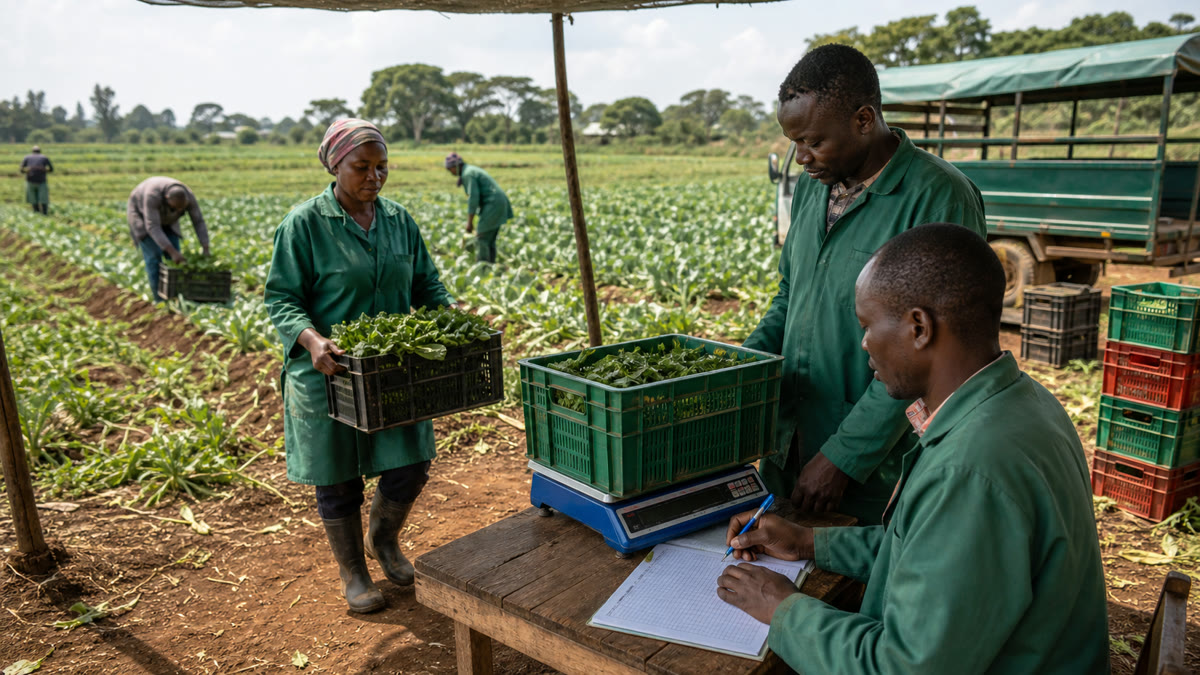
A horticulture farm management software exists to solve the problem that defines intensive farming: too many decisions, too many crops, and too little time between them.
Where a maize farmer makes a handful of decisions per season, the horticulture farmer makes dozens per week — what to plant next in which bed, when to spray before the rain, which block gets the fertiliser, which picking crew goes where, and whether the tomatoes due Thursday will actually be ready. Horticulture is the most management-dense form of agriculture, and managing its density on memory and notebooks is where profitable farms quietly bleed.
Walk through any commercial vegetable operation — the greenhouse blocks in Limuru, the open-field beans in Nanyuki, the onion acres in Kieni — and you will find the same scene: an owner who knows the crop intimately but runs the operation on a phone full of messages, a wall calendar of spray dates, and a notebook of sales.
The knowledge is real, but it is not systematised, and knowledge that is not systematised cannot be delegated, audited, financed, or defended. A horticulture farm management software converts that private expertise into a system the whole farm runs on.
What has changed is that horticulture has become a documented trade. Export buyers demand spray records and residue compliance; contract buyers specify grades, counts, and delivery schedules; retailers require traceability to the block; and certification schemes — GlobalG.A.P. above all — are built entirely on records. A farm that grows beautifully but documents poorly is locked out of the premium end of the market. A horticulture farm management software deployment is what turns documentation from a burden into a by-product.
The cost of running horticulture blind is specific and severe. The spray applied without a recorded pre-harvest interval that fails the residue test at the packhouse; the block that consumed a third of the fertiliser budget while contributing almost nothing at sale; the picking crew recorded generously while the actual crates tell another story; the glut week that arrived with nobody having planned an alternative buyer. Each of these failures was decided weeks before it appeared — and a working horticulture farm management software system surfaces each one while correction is still possible.
This guide examines horticulture farm management software in full: why the timing is no accident, why horticulture’s management density decides everything, what the software actually is, the core features that separate genuine systems from generic farm apps, the benefits growers report, who needs it most, what each horticulture model demands, the single number that changes everything, and how to choose, implement, and afford a system without disrupting the growing. By the end, managing intensive crops becomes architecture rather than improvisation.
The proven horticulture farm management software principle is simple: horticulture rewards decisions made early and punishes decisions made late, and records are the only mechanism that moves decisions earlier. Everything in this guide serves that one discipline.
Why the Timing Is No Accident
The urgency behind adopting horticulture farm management software is no accident. Input costs have climbed relentlessly — seed, fertiliser, chemicals, and packaging now cost dramatically more than five years ago — which means the thin margins horticulture always carried have become thinner still. A management error that a farm once absorbed now erases the season.
Markets professionalised at the same time. Export programmes, supermarket contracts, and institutional buyers increasingly demand traceability, residue documentation, and delivery records as entry conditions — not preferences. Growers who run horticulture farm management software meet those conditions as a by-product of daily work, while undocumented competitors discover the requirements at exactly the wrong moment.
The tools completed the shift. Smartphones reached every production zone, offline-capable apps handle the field where networks fail, and software priced for Kenyan growers puts systems once reserved for estates within reach of a five-acre operation. A horticulture farm management software platform now costs less than one season’s chemical programme — against losses it routinely prevents that dwarf the price.
Why Horticulture’s Management Density Decides Everything
Horticulture operates on the shortest cycles and the tightest margins in agriculture. A bean crop matures in fifty days, a tomato cycle turns in months, and leafy greens repeat weekly — which means every inefficiency compounds many times per year. A farm losing five percent per cycle loses twenty percent or more annually, and this compounding is what makes horticulture farm management software records more valuable here than in almost any other farming system.
The second reason is labour intensity. Picking, grading, packing, and spraying run daily or weekly across many workers, and labour is typically the largest controllable cost on the farm. Without task records and output tracking, the wage bill pays for attendance rather than productivity — and growers who manage crews through horticulture farm management software attribution consistently find output rising without new hires.
The third reason is the spray discipline. Horticulture lives or dies on chemical timing: the wrong product, the wrong dose, or the wrong interval fails the residue test, loses the contract, and closes the market lane for a season. The record-keeping at the heart of horticulture farm management software systems is precisely the discipline that prevents this — turning compliance from a shipping-week scramble into a running habit.
The fourth reason is block economics. Horticulture farms typically run many crops across many blocks simultaneously, each with its own cycle, costs, and buyer — and no owner can hold that matrix in memory. A horticulture farm management software system computes profit per block, per crop, per cycle automatically — and that single report routinely reorganises what gets planted next season.
What the Software Actually Is
At its core, horticulture farm management software is a digital system — mobile-first, increasingly paired with a web dashboard — that manages the full life of every crop: the plan, the planting, the inputs, the tasks, the harvest, the grading, the packing, and the sale, all connected in one record. Think of it as the farm’s agronomist and its accountant combined, available at the bed edge and never too tired to log what actually happened.
The architecture follows one principle: every block, crop cycle, input, task, and sale is an identified record that events attach to. A spray attaches to a block and a cycle; a harvest attaches to the same cycle; a sale attaches to the harvest lot; and the buyer attaches to the sale. A serious horticulture farm management software platform is engineered so nothing is recorded twice and nothing is ever forgotten once — the connected chain that makes traceability, costing, and planning all fall out of the same entries.
The daily workflow shows the design. Morning: the day’s tasks are assigned — picking crew to Block C, spraying team to Block B — and each worker sees their assignment. Midday: harvest is weighed per block and per grade as crates come in. Evening: inputs used are logged, sales are recorded with buyer and payment, and the spray calendar confirms tomorrow’s window.
By nightfall, the owner opens the horticulture farm management software and sees the whole operation: crop stages by block, harvest against plan, labour cost against output, orders confirmed, and the input stock running low — one picture, no notebooks, nothing depending on memory.
The intelligence layer is what separates management systems from digital diaries. Quality horticulture farm management software computes continuously: cost per kilogram per crop, yield per block per cycle, spray intervals as live countdowns, harvest forecasts against confirmed orders, and margins per buyer and per channel. The grower stops asking “how is the crop doing?” and starts seeing the answer while the season can still be steered.
Alerts finish the system. Spray windows due, pre-harvest intervals closing, orders due for delivery, irrigation schedules, stock falling below reorder — a capable horticulture farm management software watches everything at once and reports each morning what needs attention, ranked and ready. The farm’s deadlines stop depending on whoever remembers.
Core Features That Matter
Not every app deserves space on the grower’s phone. When evaluating horticulture farm management software, these are the capabilities that genuinely separate the useful from the decorative — each tested against the realities of intensive growing.
Block and Crop Cycle Planning
The foundation is the planting plan: every block mapped with its size, and every cycle scheduled — variety, planting date, expected harvest window, and the crop that follows. A horticulture farm management software system with real planning depth lets the grower stagger plantings deliberately, spreading harvest across weeks instead of dumping it into one glut week. Staggering alone, done from records rather than instinct, is one of the highest-return practices in horticulture.
The rotation record belongs here too: what grew in each block, in which sequence, across seasons. Tomatoes after brassicas, beans into rested ground — rotation is horticulture’s cheapest agronomy, and a horticulture farm management software that remembers every block’s history makes rotation decisions evidence-based instead of habitual.
Input and Fertigation Management
Seed, fertiliser, chemicals, and packaging are the farm’s largest cash outflows, and the system should track every one from purchase to application: what was bought, what was applied, to which block, at what rate, and what remains in the store. A horticulture farm management software with strong input tracking makes the agrovet bill negotiable — because the grower who knows consumption per block per crop stops buying on the seller’s advice.
Fertigation deserves specific depth where greenhouses dominate: nutrient mixes per crop stage, dosing logged per block, and consumption reconciled against crop growth. Growers who manage fertigation through horticulture farm management software records routinely find nutrient spending falling while yield holds — the waste was invisible until someone counted.
Spray Records and Pre-Harvest Intervals
This is the feature that earns the software its place. Every application logged with product, rate, block, operator, weather, and — critically — the pre-harvest interval computed as a live countdown per block. A horticulture farm management software that turns PHIs into automated countdowns prevents the single most expensive mistake in horticulture: the harvest that happens inside the interval and fails the residue test at destination.
The residue file builds itself from here: approved-inputs list, application history per block, and the test results attached to the lots they certified. Growers supplying export programmes through horticulture farm management software documentation describe audits that once took weeks becoming afternoon file exports.
Irrigation and Water Management
Water is horticulture’s most scheduled input, and the system should record it as one: irrigation events per block, durations or quantities, and the observations that connect them to crop response. A horticulture farm management software with irrigation history lets the grower see which schedules produced which yields — and irrigation, once measured, becomes optimisable instead of habitual.
Where water is metered or pumped, the records tie directly to cost: litres or kilowatt-hours per block per cycle feeding the per-crop economics. Growers who track water through horticulture farm management software systems frequently discover irrigation costs they had never attributed to any crop — and adjust both the schedule and the enterprise plan accordingly.
Harvest Records by Grade
Every harvest weighed per block, per picker, and per grade — Grade One, Grade Two, and the discards — because the grade split is where horticulture’s true economics live. A horticulture farm management software system that captures grade-out percentages reveals what the farm actually sells versus what it grows: the gap that quality problems, pest damage, and grading discipline all hide inside.
The picker attribution matters as much as the tonnage. Crews recorded per block per day with their actual crates turn labour into measurable productivity — and growers who run picking through horticulture farm management software attribution report the same pattern as every other farm that counted: output rises simply because effort became visible.
Packing Shed and Order Management
Between the field and the buyer sits the pack shed, and the system should follow the produce through it: intake from the field, grading and packing into orders, and dispatch per delivery. A horticulture farm management software with pack-shed depth reconciles what arrived against what shipped — exposing the shrinkage, the downgrades, and the losses that happen between the harvest weight and the invoice.
Order tracking closes the loop: confirmed orders, quantities committed, harvests allocated against them, and delivery status per buyer. Growers who manage orders through horticulture farm management software systems stop the classic failure of committing more than the crop will deliver — the over-commitment that quietly destroys buyer relationships.
Buyer, Contract and Price Records
Every sale recorded with buyer, grade, quantity, price, and payment builds the farm’s commercial memory: who pays on time, who takes which grade, which channel earns the margin, and what each crop actually fetched across the season. A horticulture farm management software with buyer histories converts negotiation from mood to evidence — and the price improvements alone often justify the system.
Contract farming fits this module naturally: contracted volumes, delivery schedules, and performance against the agreement tracked per buyer. Growers supplying contracts through horticulture farm management software records hold the documented history that renewals, expansions, and premium negotiations are built on.
Labour and Task Management
Horticulture’s daily workforce — pickers, sprayers, weeders, packers — needs assignment and attribution: tasks issued each morning, completions recorded, and hours or piece-rates computed per crew. A horticulture farm management software with task depth turns supervision across many workers into a dashboard, and gives every worker a documented record of the work they actually did — which protects them as much as it informs the owner.
The wage connection matters: piece rates computed from recorded crates, hours summed from recorded tasks, and the payroll assembled from the field’s own entries. Growers who pay through horticulture farm management software computation report disputes collapsing — the tally was made in the field, not argued at month end.
Traceability from Block to Buyer
When a buyer, auditor, or inspector asks where a specific consignment came from, the answer must arrive in minutes: which blocks, which inputs, which harvest dates, which pack shift. Traceability is now an entry ticket, and a horticulture farm management software system generates it from the same entries the farm makes anyway — no separate compliance exercise, no retrospective reconstruction.
Reports That Steer the Season
The reporting layer must answer the grower’s actual questions: profit per crop per cycle, yield per block, cost per kilogram, grade-out trends, buyer margins, and spray compliance status. A capable horticulture farm management software generates these on demand from entries already made — and the weekly review of that report is where management actually happens.
The Benefits Growers Report
The first benefit is residue compliance without fear. Growers running spray records and PHI countdowns through horticulture farm management software describe the change plainly: the residue test stopped being a gamble. The interval was counted, the inputs were approved, and the file exists — which is what keeps contracts and market lanes open season after season.
The second is block economics at last. Profit-per-block reports routinely shock growers: the block everyone assumes carries the farm barely breaks even, and the modest corner block quietly earns the margin. Growers who replant according to their horticulture farm management software numbers describe that first reallocation as the most profitable management decision of their careers.
The third is waste falling across the board. Inputs measured per block stop being over-applied; harvests graded against records expose where quality dies; and pack-shed reconciliation shows what shrinks between field and invoice. Operations running horticulture farm management software discipline routinely recover a visible share of their costs within the first season — money that returns without one extra acre.
The fourth is labour that pays for work. Attribution, tallies, and task records convert the workforce from attendance into productivity — and the wage bill stops growing faster than the harvest. Growers who manage crews through horticulture farm management software systems consistently report output per worker climbing within weeks of counting it.
The fifth is planning power. Harvest forecasts against confirmed orders, staggered plantings against market windows, and input budgets against cash — the farm stops reacting and starts scheduling. Growers using horticulture farm management software planning describe the glut-week panic simply leaving, because the calendar did the anticipating.
The sixth is market access. Traceability, spray files, and delivery records are what export programmes, retailers, and contract buyers verify before committing volume — and growers whose horticulture farm management software documentation is systematic qualify for programmes their undocumented neighbours cannot enter, at prices the open market never offers.
The seventh compounds longest: the learning farm. Every recorded cycle teaches — which variety earned its seed, which spray programme paid, which buyer deserved the best grade. Farms that sustain horticulture farm management software records across three seasons operate with agronomic and commercial knowledge no newcomer can purchase retroactively.
Who Needs It Most
Smallholder and medium growers supplying contracts benefit immediately, because contract buyers demand the documentation and penalise its absence. A five-acre operation holding a supermarket or exporter contract cannot maintain the compliance file manually at the required standard — and horticulture farm management software makes the file a by-product of ordinary work.
Greenhouse growers need the software most of all, because protected cropping is the most input-dense, decision-dense form of horticulture: fertigation, climate, scouting, and daily picking across a costly structure. The economics of a greenhouse forgive nothing, and horticulture farm management software records are how the structure earns its capital back.
Export-oriented farms need the system as their licence to operate: residue regimes, traceability, and certification audits are not optional at that tier. Growers serving horticulture farm management software documented supply chains discover the audit season becomes routine because the records never stopped.
Mixed horticulture farms — many crops, many blocks, many buyers — face the matrix problem no memory can solve. The farm running ten crops across fifteen blocks needs horticulture farm management software consolidation precisely because no individual, however experienced, can hold that many cycles’ state in their head.
Family farms preparing for succession or financing complete the list. A farm whose cycles, costs, and buyers live in the founder’s memory is unfinanceable and uninheritable in any practical sense — and horticulture farm management software records are what convert that private knowledge into a transferable, bankable asset.
Model by Model: What Each Horticulture Operation Demands
Open-field vegetable growers live on rotation, staggering, and spray discipline across weather they cannot control. Their decisive horticulture farm management software features are the planting planner, the block rotation history, and the PHI countdowns — the three tools that turn open-field volatility into managed variation.
Greenhouse and protected-cropping growers live on fertigation, climate, and intensity: nutrient dosing per stage, scouting logs, and daily harvests against a costly structure’s depreciation. Their horticulture farm management software priority is per-crop cost tracking deep enough to show what the structure actually earns per square metre.
Herb and specialty growers live on niche margins: small volumes, premium buyers, and specifications that reward precision. Their horticulture farm management software emphasis is grade records and buyer histories — because in specialty lines, the documented grower earns multiples of the undocumented one.
Fruit growers — avocado, mango, passion fruit — live on longer cycles and treatment calendars: orchard blocks rather than beds, maturity indices rather than picking weeks. Their horticulture farm management software needs run toward block-level history across years, with the same spray and traceability disciplines the vegetable trade demands.
Contract and export suppliers live on the file: the residue record, the traceability chain, the delivery performance against the agreement. For this tier, horticulture farm management software documentation is not an efficiency tool — it is the qualification the contract is written around.
The Number That Changes Everything: Cost per Kilogram by Crop
The single most clarifying exercise in horticulture is computing the true cost per kilogram for every crop, per cycle — seed, inputs, labour, water, packaging, and the block’s share of overhead, divided by what actually sold in Grade One. Growers who compute this through their horticulture farm management software records are consistently surprised: the crops everyone assumes are profitable often are not, once the grade-out and the real labour are counted.
The second number is profit per block per cycle — the enterprise view that decides what gets planted next. A farm that steers its planting plan by horticulture farm management software profitability stops planting tradition and starts planting evidence, and the margin difference compounds within two seasons.
The third is the trend: cost per kilogram rising against flat prices is the early warning that the variety, the block, or the market is exhausted. Growers who watch trends through horticulture farm management software reports change course while changing course is still cheap.
Paper Notebooks vs Digital Systems
Paper is familiar, cheap, and better than nothing — but horticulture breaks it structurally. The spray calendar, the harvest book, the buyer ledger, and the task list live in four different notebooks that never reconcile, and the questions that matter — cost per kilogram, PHI status, profit per block — require all four at once. The horticulture farm management software alternative answers those questions in seconds because the entries were connected the moment they were made.
Paper also cannot compute or survive. Totals, averages, and margins must be worked by hand with errors compounding quietly — and one rain-soaked book erases a season’s history. A horticulture farm management software system calculates continuously, backs up beyond the farm, and never loses a spray record to the weather.
Records and Financing
Ask any lender why horticulture credit remains expensive, and the answer is always the same: applicants cannot demonstrate their cycle economics. A horticulture farm management software record base changes that conversation — yields per block, costs per crop, sales per buyer, reconciled to the shilling — presented from data that matches the field by construction.
Buyers follow the same logic. Exporters, retailers, and processors now audit the farms behind their programmes, and the grower whose horticulture farm management software documentation answers every question in an afternoon clears the audit that quietly ends a records-poor competitor’s contract.
How to Choose the Right System
Start with the farm’s actual needs rather than the feature list’s ambitions. List the three problems that hurt most — perhaps spray compliance, labour attribution, or block profitability — and test whether the horticulture farm management software candidate handles those three brilliantly, because a tool that does everything poorly is worse than one that does your priorities well.
Then insist on a trial during real operations. Hand the phone to the actual supervisors, run one genuine week of tasks, harvests, and sprays, and verify that offline capture works where the farm actually is — a horticulture farm management software system that only functions in good signal and good moods will die within a month.
Finally, read the commercial terms with grower caution. Model the total annual cost at your scale, confirm the vendor understands horticulture specifically rather than farming generally, and confirm in writing that the farm’s entire history remains yours, exportable in full — a horticulture farm management software vendor unclear on that point is telling you something, and the disciplined buyers listen, then keep shopping.
Implementing Without Disrupting the Growing
Begin with the baseline: every block mapped and sized, current crop cycles entered with planting dates, input stock counted once, and active buyers and orders recorded. A few days on this foundation saves a season of corrections, because horticulture farm management software records are only as trustworthy as the numbers beneath them.
Then launch at a natural boundary — a new planting is ideal — and record forward rather than reconstructing history. Anchor entries to routines that already exist: tasks assigned at the morning meeting, harvests weighed at the shed, sprays logged at the tank. A horticulture farm management software deployment that rides existing habits sustains itself; one that demands new habits dies with the first busy week.
Bring the whole team in openly: explain the records as the farm’s shared memory and the workers’ proof of work, and review the first month’s entries daily with the supervisors. Growers who deploy horticulture farm management software transparently report adoption without friction — and adoption is what makes the numbers real.
Costs and Return on Investment
Pricing follows recognisable models: free tiers for smallholdings, modest monthly subscriptions scaled to acreage and users for commercial growers, and custom licensing for estates and packhouses — with setup, mapping, and training sometimes quoted separately. Model the total annual cost of each horticulture farm management software candidate at your actual scale, and weigh it against what it will recover rather than against zero.
The return arrives through channels the farm already knows: residues that never fail, inputs no longer over-applied, labour that pays for output, grade-outs that shrink as quality discipline takes hold, and contracts retained on clean documentation. Across those channels, growers consistently report that a well-run horticulture farm management software deployment pays for itself within the first crop cycle — frequently within weeks, once the first block-profitability report redirects the planting plan.
The Future of Horticulture Management
The technology is still accelerating. Systems increasingly read satellite and drone imagery against block records, predict harvest windows from accumulated data, and flag disease risk from weather and scouting history. Growers feeding clean records into today’s horticulture farm management software platforms are building the histories that will make tomorrow’s advisory tools accurate for their specific blocks — and that history cannot be bought retroactively at any price.
Frequently Asked Questions
Is this useful for a small grower, or only for large estates? Especially for small growers supplying contracts — the documentation buyers demand does not scale down manually, and the software makes it a by-product of ordinary entries. A five-acre horticulture farm management software deployment typically costs less per season than one failed residue test.
Do I need to map my farm before starting? A simple block list with sizes is enough to begin — formal mapping can come later. What matters is that every entry from day one attaches to a named block, because horticulture farm management software analysis all flows from that connection.
How does it handle spray records for certification? Every application is logged with product, rate, block, and date, and the system computes pre-harvest intervals as live countdowns — which is the core of what GlobalG.A.P. and buyer audits examine. Growers describe their horticulture farm management software audit files as assembling themselves.
Can it manage both open field and greenhouse crops together? Yes — and it should. Genuine platforms run beds, blocks, and greenhouse structures side by side in one system, so the whole farm’s cycles, costs, and sales consolidate without forcing a choice between the two worlds.
How long before I see results? The first benefits arrive within weeks — spray intervals under control, harvests reconciled, tasks tracked. The deeper returns — block profitability, input savings, contract retention, cheaper credit — build across two to three seasons of consistent horticulture farm management software records, and compound from there.