Hay bale prices in Kenya have become one of the most critical cost variables for dairy farmers, directly determining whether milk production remains profitable or collapses under rising input costs. Fama.co.ke provides an innovative farm management platform that helps dairy farmers track hay bale prices in Kenya, monitor fodder consumption, and make data-driven decisions that protect margins. A bale of hay that sold for Sh150 in a normal season can now fetch Sh350 during peak scarcity, while prices have been reported as high as Sh500 to Sh700 in drought-affected regions. Understanding hay bale prices in Kenya has never been more important for farmers seeking to keep their herds fed and their enterprises viable.
The current landscape of hay bale prices in Kenya reflects a market shaped by prolonged drought, seasonal supply swings, and uneven distribution across the country. The failure of the October–December 2025 short rains triggered a critical shortage of livestock feed and fodder, with a reported 60 percent deficit affecting pastoral and agricultural livelihoods. This supply shock pushed hay bale prices in Kenya sharply higher in early 2026, with overgrown Rhodes grass hay trading at KES 200 per bale at the farm gate—a 42.9 percent increase compared to the same period last year.
Understanding hay bale prices in Kenya requires awareness of the sharp seasonal variations that drive the market. During periods of surplus, farmers often sell fodder immediately due to limited storage capacity, with hay prices falling to between KSh 100 and 150 per bale. In contrast, prices can rise to between KSh 300 and 500 during dry seasons, increasing production costs and affecting profitability. This volatility in hay bale prices in Kenya means farmers must plan fodder procurement strategically rather than buying at the peak of scarcity.
The regional variations in hay bale prices in Kenya are equally significant. In Nakuru County, a farmer sells high-quality hay to dairy farmers at KSh150 for an 18kg bale, with customers reporting an average yield increase of 2 litres per cow. In Kiambu County, a cooperative partnership has enabled farmers to access quality hay at only Sh150, down from the Sh180 to Sh250 they previously paid for hay from Delamere. In Mandera County, the government is supplying hay at Ksh 250 per bale under a feed subsidy programme. These variations in hay bale prices in Kenya mean farmers must compare sources carefully before purchasing.
For farmers producing their own hay, hay bale prices in Kenya determine the return on investment. Geoffrey Rono from Narok County abandoned maize for Boma Rhodes hay farming and now sells a bale of hay at between Sh200 and Sh250, harvesting in phases with each phase earning him Sh60,000. Selling a bale at Sh200 and a kilo of seeds at Sh950, a farmer can earn total gross returns of Sh137,000 per acre—more than double the Sh48,000 a maize farmer earns from the same land. These figures demonstrate why hay bale prices in Kenya matter to producers and consumers alike.
The cost of hay bale prices in Kenya has direct implications for milk production economics. Feed accounts for 43 to 58 percent of the total cost of milk production, and hay is a major component of dairy rations. When hay bale prices in Kenya rise from Sh150 to Sh350, the cost of producing a litre of milk increases accordingly. Farmers who track hay bale prices in Kenya against their milk revenue can determine whether current market conditions allow profitable production or require adjustments to feeding strategies.
The government has intervened to cushion farmers from soaring hay bale prices in Kenya through the Food Systems Resilience Programme, which supplies subsidized fodder at Ksh 250 per bale with the government covering the remaining cost. The Ministry of Agriculture has restructured the subsidy into a revolving fund model, shifting from one-off emergency grants to a sustainable, market-oriented approach. For farmers who track hay bale prices in Kenya systematically, these interventions provide relief during periods of peak scarcity while supporting long-term resilience.
Current Hay Bale Prices in Kenya by Region
Understanding hay bale prices in Kenya requires examining the significant regional variations across the country. These differences reflect local supply conditions, transport costs, and the presence of cooperative or government interventions.
In Nakuru County, a major hay-producing region, a farmer sells high-quality hay to dairy farmers at KSh150 for an 18kg bale. This has been described as an affordable rate that has helped dairy farmers in the Rift Valley, Central, and Western regions maintain milk production.
In Kiambu County, a partnership between Ndumberi and Nyala dairy cooperatives, supported by Kenya Markets Trust and Technoserve, has enabled farmers to access hay at only Sh150 per bale. This is significantly cheaper than the Sh180 to Sh250 per bale they previously paid for hay from Delamere, about 100 km away.
In Mandera County, the government’s feed subsidy programme has capped hay prices at Ksh 250 per bale, with the government covering the remaining cost. This intervention aims to mitigate livestock losses where forage is depleted.
In dry season conditions, hay prices can rise to between KSh 300 and 500 per bale depending on quality and source. During periods of extreme drought, bales of hay have been reported selling for Ksh 700 in Isiolo and neighbouring counties.
In Baringo County, hay prices have been reported at between Ksh 300 and 500 per bale to cover gaps during prolonged droughts. A lactating cow would probably need one bale per day, supplemented by green fodder.
Farmers can use market intelligence tools to track these regional hay bale prices in Kenya and identify the most cost-effective sources for their fodder requirements. The differences between producing and consuming regions create opportunities for farmers who can access transport infrastructure and storage capacity.
Factors Driving Hay Bale Prices in Kenya
Drought and Climate Impact
The most significant factor affecting hay bale prices in Kenya is the prolonged drought that has cut pasture availability and reduced fodder production. The failure of the October–December 2025 short rains triggered a critical shortage of livestock feed and fodder, with a 60 percent deficit affecting pastoral and agricultural livelihoods. Findings from the 2026 Drought Impact and Needs Assessment highlight worsening conditions, including deteriorating livestock health, rising disease outbreaks, and a 70 to 90 percent decline in rain-fed crop yields.
The drought conditions directly influence hay bale prices in Kenya by reducing the volume of locally produced fodder reaching the market. Farmers in affected areas are forced to buy feed at elevated prices or sell animals at throwaway prices, creating a dual crisis that affects both production and profitability.
Seasonal Supply Patterns
Hay bale prices in Kenya follow seasonal patterns based on rainfall and harvest calendars. During periods of surplus, when rains are adequate and fodder is abundant, prices fall to between KSh 100 and 150 per bale. During dry seasons, when pasture is scarce and demand remains high, prices can rise to between KSh 300 and 500 per bale.
This seasonal volatility in hay bale prices in Kenya creates opportunities for farmers who have storage capacity. Those who can buy during surplus periods and store fodder for dry seasons avoid paying premium prices at the peak of scarcity. Limited storage capacity among smallholders, however, forces many farmers to sell immediately after harvest and then buy back at much higher prices.
Feed Deficit and Structural Challenges
Kenya faces a structural feed deficit estimated at 55 million tonnes, with post-harvest losses of up to 46 percent that continue to constrain milk productivity. The dairy sector supports more than 1.8 million smallholder households, yet average milk yields remain at approximately 7.5 litres per cow per day, largely due to persistent feed and fodder constraints.
This structural deficit means that hay bale prices in Kenya will remain structurally elevated until feed production and conservation systems improve. The root cause, as noted by sector stakeholders, is the lack of adequate and quality feed.
Transport and Logistics Costs
Transport costs significantly influence hay bale prices in Kenya, particularly in regions far from production zones. Farmers in Kiambu previously paid Sh180 to Sh250 per bale for hay transported from Delamere, about 100 km away, before local production reduced costs to Sh150. The higher price reflected transport and logistics costs that were built into the delivered price.
In regions like Isiolo, locally produced hay is priced between Ksh 250 and 300, while hay from external counties is available for Ksh 180 to 200. The difference reflects transport costs, with external hay sometimes cheaper than local production due to economies of scale in major producing regions.
Government Policy and Interventions
Government policy interventions affect hay bale prices in Kenya through subsidy programmes, feed reserves, and regulatory oversight. The Food Systems Resilience Programme has rolled out livestock feed subsidies aimed at shielding farmers from soaring costs and the effects of prolonged drought. The programme is increasingly viewed as a long-term investment rather than short-term relief, designed to mitigate livestock losses where forage is depleted.
The Ministry of Agriculture has restructured the subsidy into a revolving fund model, shifting from one-off emergency grants to a sustainable, market-oriented approach. These interventions provide a floor for hay bale prices in Kenya during drought periods and give farmers a reliable alternative to buying at peak market rates.
How Fama.co.ke Helps Farmers Navigate Hay Bale Prices in Kenya
Track Fodder Costs Against Milk Revenue
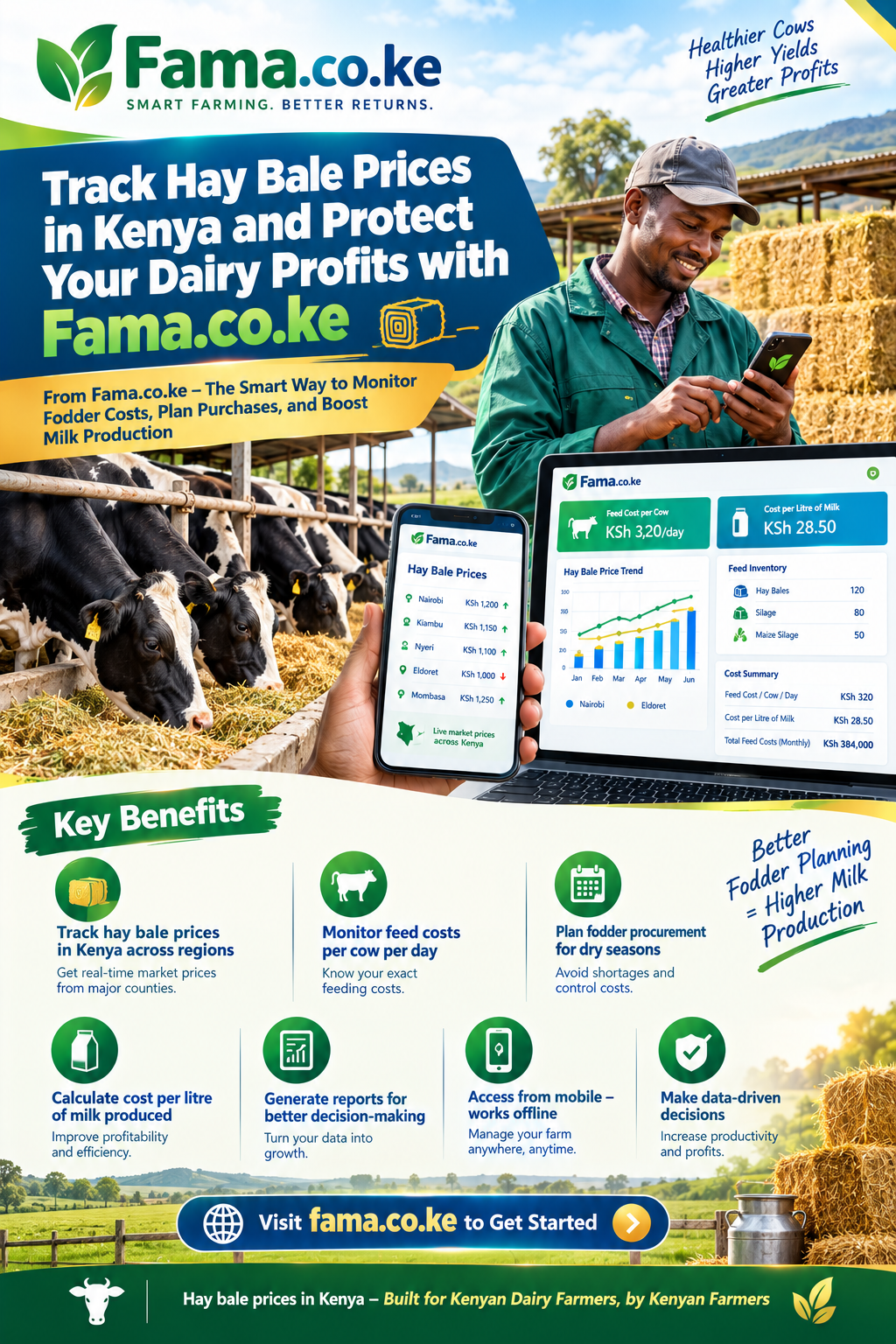
Fama.co.ke helps farmers calculate the true cost of feeding their herd, enabling them to determine whether current hay bale prices in Kenya allow profitable milk production. By tracking feed costs per cow per day against milk revenue, farmers can make informed decisions about feeding strategies and herd management.
Monitor Market Trends
The platform provides tools to track hay bale prices in Kenya across different regions and suppliers, helping farmers identify the most cost-effective sources for their fodder requirements. Farmers can compare prices across counties such as Nakuru, Kiambu, and Mandera, and plan purchases accordingly.
Optimise Storage and Procurement
Fama.co.ke helps farmers plan fodder procurement strategically, buying during surplus periods when hay bale prices in Kenya are low and storing for dry seasons. The platform tracks fodder inventory, consumption rates, and storage losses, enabling better planning and cost control.
Generate Financial Reports
The platform generates reports that show feed costs per litre of milk produced, helping farmers understand which feeding strategies deliver the best returns relative to hay bale prices in Kenya. With proper record-keeping, farmers can identify cost-saving opportunities and improve margins even when fodder prices are volatile.
The Outlook for Hay Bale Prices in Kenya
The outlook for hay bale prices in Kenya remains uncertain but leans toward continued volatility. The structural feed deficit of 55 million tonnes means that Kenya will continue to face supply constraints regardless of seasonal improvements. The government’s revolving fund model for feed subsidies may provide some stabilisation during drought periods, but market forces will continue to drive seasonal price swings.
Heifer International Kenya has launched a four-year dairy feed initiative targeting more than 50,000 smallholder farmers across key dairy-producing counties including Uasin Gishu, Nandi, Elgeyo Marakwet, Trans Nzoia, Laikipia, Nakuru, Kiambu, and Narok. This programme aims to improve fodder production, conservation, and market access while building more efficient, year-round feed supply systems. If successful, it could moderate hay bale prices in Kenya by increasing domestic production and reducing post-harvest losses.
Farmers using Fama.co.ke to track hay bale prices in Kenya and manage their fodder costs will be best positioned to navigate this uncertainty. By understanding their break-even point and monitoring market trends, they can make informed decisions that protect profitability regardless of market conditions.
Hay bale prices in Kenya are influenced by drought, seasonal supply patterns, transport costs, and government interventions. For farmers seeking to maximise profitability, proper record-keeping and market intelligence are essential. Fama.co.ke provides the tools needed to track fodder costs, monitor market trends, and make data-driven decisions that protect profitability.
Kenyan farmers who use Fama.co.ke to track hay bale prices in Kenya position themselves for greater success in the evolving dairy sector. The platform helps farmers make better decisions, reduce losses, and achieve higher returns.
Fama.co.ke has developed farm management software that meets the unique needs of Kenyan dairy farmers. The platform combines powerful features with intuitive design, making it accessible for farmers of all sizes.
Start your journey with Fama.co.ke today. Visit fama.co.ke to learn more about how farm management software can help you track hay bale prices in Kenya and optimise your dairy operations.