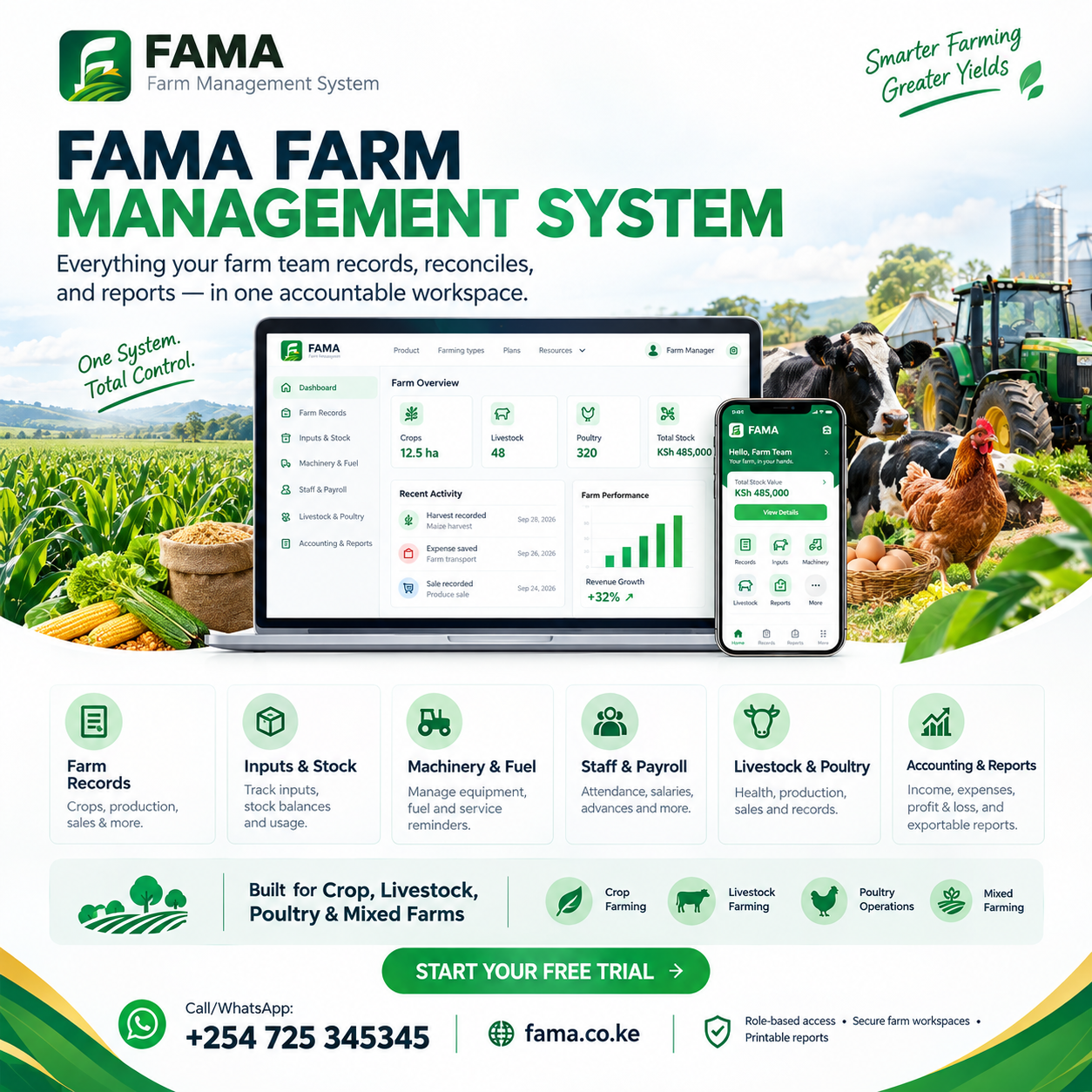
Harvest tracking and sales records in Kenya have become the difference between a farm that knows what it produced and earned and one that merely hopes the season went well, because Kenya loses an estimated nine million tonnes of food worth about Sh72 billion every year along its supply chains. Fama.co.ke provides an innovative platform that makes harvest tracking and sales records in Kenya simple and practical, helping farmers record every kilogram harvested, every bag sold, and every shilling received in one organised system. With post-harvest losses alone adding an estimated 30 per cent reduction on top of climate-related crop losses in some regions, disciplined harvest tracking and sales records in Kenya has become essential for protecting both income and market access.
The consequences of weak harvest tracking and sales records in Kenya are severe and quietly expensive. Produce is harvested without quantities being recorded, so losses between field and market go undetected. Sales are made without documentation, so buyers dispute volumes and prices. Credit applications fail because there is no verifiable record of production or revenue. Traceability audits are failed because harvest dates and lot numbers cannot be produced. This is precisely the blindness that structured harvest tracking and sales records in Kenya eliminates, turning every harvest and sale into evidence rather than recollection.
Fama.co.ke‘s platform helps farmers master harvest tracking and sales records in Kenya by capturing harvest quantities by field, crop, and date, linking each lot to its sales, and reconciling payments against deliveries. Research shows that digital tracking of sales and inventory, supported by sales records that help farmers qualify for future credit, is already transforming how Kenyan smallholders access finance and markets. With harvest tracking and sales records in Kenya, that capability becomes available on any basic smartphone, offline where necessary.
The financial case for adopting harvest tracking and sales records in Kenya is compelling. Kenya loses between 30 and 40 per cent of food produced along the supply chain, amounting to approximately nine million tonnes valued at KES 72 billion annually. A farm that reduces its own losses by even a fraction of that through better harvest recording and faster sales captures income that would otherwise rot, spoil, or disappear. A harvest tracking and sales records in Kenya system that records quantities at harvest and reconciles them against sales makes loss visible and therefore manageable.
The regulatory context has made harvest tracking and sales records in Kenya a legal requirement for anyone selling into formal or export markets. Amendments to the Crops (Horticultural Crops) Regulations in 2025 tightened farm-level traceability, requiring growers to register with the National Horticulture Traceability System and maintain detailed, auditable records for each crop. Farmers must now log planting and harvesting dates, track pest and disease scouting reports, record every pesticide application including product, dosage, method, operator and weather conditions, and document irrigation and equipment calibration. This is why harvest tracking and sales records in Kenya is no longer optional for export-oriented producers.
GLOBALG.A.P. certification adds another layer of documentation demands that harvest tracking and sales records in Kenya must satisfy. Seven record categories are required, including harvest and lot numbers, and missing any category is a Major Must non-conformance. Auditors are trained to detect retrospective records and treat them as deliberate misrepresentation, and the 15-minute mock recall test requires tracing any produce lot from buyer invoice back to the specific field, spray records, and water tests. A harvest tracking and sales records in Kenya system that captures data at the point of harvest makes this traceability achievable.
The eTIMS regime has made sales records central to tax compliance. From 1 January 2026, KRA validates income and expenses declared in tax returns against eTIMS invoices, and every commercial transaction must be supported by an electronic tax invoice, even when buying from smallholder farmers who are not VAT-registered. Many unprocessed agricultural products are zero-rated for VAT, so the invoice carries no VAT but is still a compliant invoice. A harvest tracking and sales records in Kenya platform that stores eTIMS invoices alongside each sale ensures that revenue is documented and input VAT on packaging, fuel, and equipment can still be reclaimed.
The warehouse receipt system offers another route to monetising harvest records. Kenya has launched the Electronic Warehouse Receipt System Central Registry to cut post-harvest losses, boost farmer incomes, and unlock access to financing. Farmers can store produce in certified warehouses and receive electronic receipts as proof of ownership, which can be used as collateral to access financing without resorting to distress sales. A harvest tracking and sales records in Kenya system that documents harvest volumes and quality provides the data needed to participate in this system.
For cooperatives and aggregators, harvest tracking and sales records in Kenya becomes a question of centralising data across many farmers. Platforms like VunaPay help cooperatives maintain accurate and up-to-date records on farmers, delivered volumes, and available inventories, while also speeding up payments after delivery. A harvest tracking and sales records in Kenya platform that records each farmer’s deliveries and links them to payment provides the transparency that cooperatives need to function efficiently.
Why Kenyan Farmers Struggle with Harvest Tracking and Sales Records in Kenya
The reasons farmers fail at harvest tracking and sales records in Kenya are well understood. Harvest is the busiest period of the farming calendar, and recording quantities feels like a distraction from getting produce out of the field. Sales happen quickly, often to brokers who arrive with cash and leave without paperwork. By the time records are attempted, the details have already blurred.
The structure of Kenyan produce markets makes documentation harder. Produce is sold through cooperatives, brokers, processors, exporters, supermarkets, and direct consumers, each with different documentation requirements. A farm selling to several channels simultaneously cannot maintain consistent records without a system.
The consequences extend beyond individual sales. Without harvest tracking and sales records in Kenya, farmers cannot calculate yield per acre, identify their best-performing fields, or demonstrate production history to lenders. They cannot prove traceability to export buyers or satisfy KRA that declared revenue is accurate. A structured system addresses all these gaps simultaneously.
What Harvest Tracking and Sales Records in Kenya Must Capture
A capable system must record more than just a total harvest figure. It must capture the details that make the record useful for management, compliance, and finance.
Harvest Quantities by Field and Crop
Each harvest should be recorded with the field, crop, variety, date, and quantity harvested. This enables yield per acre calculation and reveals which fields perform best. Recording harvest by field is the foundation of any credible harvest tracking and sales records in Kenya system.
Lot and Batch Numbers
Each harvest should be assigned a lot or batch number. Lot numbers allow produce to be traced from buyer invoice back to the specific field and production cycle, which is exactly what GLOBALG.A.P auditors and export buyers require. A system that assigns lot numbers automatically makes traceability straightforward.
Quality Grades and Rejections
Recording quality grades and rejected quantities reveals the true saleable yield. A harvest of 10 tonnes may include 2 tonnes of rejects that never reach the market, and without recording this, yield and revenue calculations are overstated.
Sales Transactions and Buyers
Every sale should record the date, buyer, quantity, unit price, total amount, payment method, and payment status. Recording the buyer allows analysis of which channels pay best and most reliably.
Payment Reconciliation
Sales records must be reconciled against payments received. An invoice that is recorded but never matched to a payment becomes a receivable that may never be collected. A harvest tracking and sales records in Kenya system that tracks payment status prevents silent revenue loss.
eTIMS Invoice References
Each commercial sale should be linked to its eTIMS invoice, and each input purchase should be supported by one. Where a supplier’s turnover is at or below Sh5 million, buyer-initiated invoicing allows the buying farm to generate the invoice on the supplier’s behalf, keeping informal supply inside the system and the purchase deductible.
Storage and Inventory Records
Produce held in store after harvest should be recorded as inventory until sold. Movements in and out of store should be documented. Without this, revenue may be recognised before it is earned, and losses in storage go undetected.
Harvest Tracking and Sales Records in Kenya: The Losses They Prevent
The scale of post-harvest loss in Kenya makes accurate harvest tracking a financial imperative, not an administrative nicety.
Post-Harvest Losses
Post-harvest losses for some commodities reach 30 to 40 per cent, eroding farmer incomes and undermining food security. In the North Rift, workshop estimates indicated crop losses of up to 70 per cent during the 2026 season, with post-harvest losses adding a further estimated 30 per cent reduction.
Horticultural Losses
Up to 40 per cent of fruits and vegetables, including tomatoes, mangoes, and dark leafy greens, are lost or wasted along Nairobi’s supply chains, with the largest losses occurring during overnight storage at wholesale markets rather than transportation. Harvest records that show when produce was harvested and how long it has been in storage help farmers avoid holding perishable crops too long.
Potato Losses
Pre-harvest and on-farm post-harvest losses account for a substantial proportion of total losses in the Irish potato value chain, and nationally producer-level potato losses could amount to KSh 14.5 billion annually. A farmer tracking harvest and storage losses can identify where the value is disappearing.
The Economic Scale
About nine million tonnes of food produced along Kenya’s supply chains are estimated to be lost or wasted annually, representing an economic loss of about Sh72 billion. This volume is equivalent to roughly 1.8 million five-tonne trucks. Every farm that tracks harvest and sales carefully removes a small part of this national loss.
How to Set Up Harvest Tracking and Sales Records in Kenya
Setting up a system is straightforward when approached step by step.
Step 1: Define Your Harvest Units
Decide the units in which you will record harvest—bags, crates, kilograms, or tonnes—and use them consistently. Inconsistent units make later analysis impossible.
Step 2: Assign Field and Lot Codes
Give each field a code and each harvest a lot number. Record these on the harvest record at the point of harvest. Lot numbers are essential for traceability and for the mock recall tests auditors perform.
Step 3: Record Harvest at the Point of Harvest
Record quantities as produce leaves the field, not days later. A harvest record completed in the evening from memory is unreliable. Mobile capture makes point-of-harvest recording practical.
Step 4: Record Quality and Rejections
Note the quality grade and any rejected produce at harvest. This reveals true saleable yield and explains discrepancies between harvested and sold quantities.
Step 5: Record Every Sale Against a Lot
When produce is sold, record the sale against the specific lot, with buyer, quantity, price, and payment terms. This links field to market and enables traceability.
Step 6: Record Payment and Reconcile
Record payments as they are received and reconcile them against sales invoices. Follow up on overdue payments systematically.
Step 7: Reconcile Harvest Against Sales and Storage
At the end of each season, reconcile total harvest against total sales plus closing storage. Any unexplained gap represents loss, theft, or recording error and must be investigated.
Step 8: Generate Reports
Produce reports showing yield per acre, sales by buyer and product, and loss rates. These reports guide decisions about which fields and channels to prioritise.
Harvest Records and Traceability Compliance in Kenya
Traceability has moved from a voluntary good practice to a legal requirement for horticultural producers, and harvest records are at its centre.
The National Horticulture Traceability System
Growers must register with the National Horticulture Traceability System and maintain detailed, auditable records for each crop. Exporters must ensure every shipment comes from registered suppliers and is accompanied by verifiable documentation, and if a batch fails inspection abroad, authorities should be able to trace it back to the precise farm, production cycle, and operator responsible.
What Must Be Logged
Farmers must log planting and harvesting dates, pest and disease scouting reports, every pesticide application including product, dosage, method, operator, and weather conditions, and irrigation and equipment calibration. A harvest tracking system must integrate with these records so that a lot number links to every relevant field activity.
The 15-Minute Mock Recall
GLOBALG.A.P auditors require tracing any produce lot from buyer invoice back to the specific field, spray records, and water tests within 15 minutes, and a broken traceability chain is a Critical non-conformance. Digital records that link lot numbers to sales invoices make this achievable; paper records rarely do.
Retention Periods
The minimum retention period is two years, but pesticide and traceability records should be kept for five years. A digital archive satisfies this requirement without filling a filing cabinet.
Sales Records, eTIMS, and Market Access in Kenya
Sales records serve three masters: management, tax, and market access. A good system satisfies all three.
When eTIMS Applies
eTIMS becomes relevant the moment produce is sold to a business buyer, processor, or exporter who needs a compliant invoice. Selling to a neighbour at the gate may not require one, but selling to a processor, exporter, supermarket, or any business buyer is a clear commercial sale that does.
Zero-Rated Produce
Many unprocessed agricultural products are zero-rated for VAT, meaning the invoice carries no VAT but is still a compliant invoice. Because produce is zero-rated rather than exempt, a VAT-registered agribusiness can still reclaim input VAT on standard-rated farm inputs like packaging, fuel, and some equipment. Treating the sale as exempt by mistake throws that legitimate refund away.
Buyer-Initiated Invoicing
Where a supplier’s annual turnover is at or below Sh5 million, buyer-initiated invoicing lets the buying business generate the eTIMS invoice on the grower’s behalf. This provision keeps informal supply inside the system and keeps the purchase deductible for the buyer.
Reverse Invoicing in Value Chains
In the avocado sector, when a buying agent logs a delivery from a registered farmer, the system generates a reverse invoice, transmits it to KRA via eTIMS, and links it to the eventual payment. This model shows how harvest delivery records can become tax records automatically.
Matching Sales to Payments
Sales records must be matched to payments to identify receivables. Platforms that record sales and link them to M-PESA or bank payments make this reconciliation routine rather than a monthly ordeal.
Digital Tools for Harvest Tracking and Sales Records in Kenya
Paper records remain common, but digital tools solve the problems paper cannot.
Mobile Capture
Digital platforms allow harvest and sales records to be captured on smartphones at the point of activity. Offline functionality means records can be made in the field where connectivity is poor, and data syncs when the signal returns.
Lot-Level Traceability
Digital systems assign lot numbers automatically and link each lot to its harvest record, sales invoices, and payment. This is the capability that makes mock recalls possible within minutes.
Integration with M-PESA
Linking sales records to M-PESA transactions eliminates manual reconciliation and ensures that every payment is matched to an invoice.
Reporting
Digital platforms generate yield per acre, sales by buyer, and loss rate reports automatically. These reports turn records into management intelligence rather than archived paperwork.
What to Look For
Look for offline capability, mobile data capture, lot tracking, eTIMS integration, inventory management, and automated reports. The system must be usable by farm staff with limited digital experience, or it will be abandoned.
Benefits of Strong Harvest Tracking and Sales Records in Kenya
The benefits of a disciplined system extend across the whole farm business.
Reduced Losses
Recording harvest, storage, and sales reveals where produce is disappearing and enables targeted action. Even a modest reduction in a 30 to 40 per cent loss rate translates into significant recovered income.
Access to Credit
Sales records that demonstrate consistent revenue and production history support credit applications. Digital tracking of sales and inventory is explicitly linked to helping farmers qualify for future credit.
Market Access and Compliance
Traceability records are mandatory for export horticulture and are increasingly demanded by supermarkets and processors. Complete records open doors that incomplete records keep closed.
Better Pricing Decisions
Sales records showing buyer, quantity, price, and payment reliability reveal which channels deliver the best returns and which pay late.
Accurate Yield and Profitability
Harvest records by field enable yield per acre and cost per kilogram calculations, revealing which fields and crops are profitable.
Warehouse Receipt Participation
Documented harvest volumes and quality support participation in the warehouse receipt system, allowing farmers to use stored produce as collateral.
Tax Compliance
Complete sales and purchase records supported by eTIMS invoices ensure that declared income and expenses survive KRA validation.
Common Mistakes in Harvest Tracking and Sales Records in Kenya
Even committed farmers make mistakes that undermine the value of their records.
Recording Harvest After the Fact
A harvest recorded in the evening from memory is an estimate. Recording must happen at the point of harvest.
No Lot Numbers
Without lot numbers, produce cannot be traced from buyer back to field, and mock recalls fail.
Recording Sales Without Buyers
A sales figure without a buyer cannot be reconciled, analysed, or defended in a dispute.
Ignoring Rejections and Losses
Recording only saleable produce overstates yield and hides the losses that need addressing.
No Payment Reconciliation
Invoices that are not matched to payments become uncollected receivables.
Mixing Units
Recording some harvests in bags and others in kilograms makes aggregation impossible.
Failing to Link Harvest to Sales
A harvest figure and a sales figure that are never reconciled leave an unexplained gap that could be theft, spoilage, or error.
Not Storing eTIMS Invoices
Sales to business buyers without eTIMS invoices cannot be properly recorded by the buyer and create compliance risk.
How Fama.co.ke Supports Harvest Tracking and Sales Records in Kenya
Fama.co.ke provides the digital infrastructure to make harvest tracking and sales records in Kenya simple, compliant, and useful.
Harvest Recording by Field and Lot
The platform records harvest quantities by field, crop, and date, and assigns lot numbers automatically. It works offline and syncs when connectivity returns.
Sales Recording and Buyer Management
Every sale is recorded with buyer, quantity, price, payment method, and status. The platform links each sale to its harvest lot, preserving traceability.
eTIMS Invoice Storage
The platform stores eTIMS invoices alongside sales and purchase records, ensuring that every declared transaction is supported.
Payment Reconciliation
M-PESA and bank payments are matched to sales invoices, and outstanding receivables are flagged automatically.
Storage and Inventory Tracking
Produce held in store is recorded as inventory, and movements in and out are documented, making loss visible.
Yield and Loss Reports
The platform calculates yield per acre, loss rates, and sales by channel, turning records into management decisions.
Compliance-Ready Documentation
Records are structured to support traceability audits, GLOBALG.A.P requirements, and KRA validation without last-minute reconstruction.
Works Offline
The platform works offline and syncs automatically when connectivity returns, making it practical for farms in remote areas.
Frequently Asked Questions About Harvest Tracking and Sales Records in Kenya
What are harvest tracking and sales records in Kenya?
Harvest tracking and sales records in Kenya are documented records of quantities harvested by field and lot, and of every sale with buyer, price, and payment. Fama.co.ke‘s platform digitises both.
Why is harvest tracking important in Kenya?
Kenya loses about nine million tonnes of food worth Sh72 billion annually along its supply chains, and post-harvest losses reach 30 to 40 per cent for some commodities. Harvest tracking makes loss visible and manageable.
What must be recorded at harvest?
Field, crop, variety, harvest date, quantity, lot number, quality grade, and rejected quantities. Lot numbers are essential for traceability.
How do sales records support eTIMS compliance?
From January 2026, KRA validates declared income against eTIMS invoices. Sales to business buyers require compliant invoices, and many unprocessed agricultural products are zero-rated but still require a compliant invoice.
What is the National Horticulture Traceability System?
A digital platform that tracks horticultural produce from farm to market. Growers must register and maintain auditable records including planting and harvesting dates, pesticide applications, and irrigation.
How long should harvest and sales records be kept?
Keep records for at least two years, and keep pesticide and traceability records for five years to satisfy GLOBALG.A.P and audit requirements.
Can harvest records help access credit?
Yes. Digital sales and production records demonstrate revenue and management competence, and are explicitly linked to helping farmers qualify for future credit.
What is the warehouse receipt system?
A system allowing farmers to store produce in certified warehouses and receive electronic receipts as proof of ownership, which can be used as collateral for financing.
How does Fama.co.ke help with harvest tracking and sales records?
Fama.co.ke records harvest by field and lot, records every sale with buyer and payment, stores eTIMS invoices, reconciles payments, tracks storage inventory, and generates yield and loss reports—all offline-capable.
Connect produce dispatch to the buyer’s payment
Give each dispatch a reference and retain the weighed quantity, agreed unit price and accepted delivery quantity. If the buyer pays an advance, tie it to the invoice and keep the remaining amount visible. A supervisor should approve any shortfall attributed to rejected or damaged produce. At the end of the week, trace one buyer payment through the dispatch, invoice and bank or M-Pesa record to check that the report separates sales from cash actually received.
For help connecting the systems behind this workflow, see Muki’s business systems integration services in Kenya.