Why “Spend 10 Minutes a Day on Records” Is Not a Business Strategy
The top result when you search “harvest record keeping system Kenya” is a newspaper article from 2022 advising farmers to spend ten minutes each day updating a notebook or a free mobile application. The second result lists types of farm records — spray logs, harvest quantities, sales receipts — without a single KES figure showing what poor harvest records actually cost, or what disciplined harvest tracking actually returns.
This is the state of content on harvest record keeping system Kenya: general, vague, and completely disconnected from the financial reality of running a commercial Kenyan farm. Nobody tells you that a maize farm in Uasin Gishu harvesting 2,000 bags per season with no structured harvest record keeping system Kenya cannot prove which field yielded what, cannot identify theft between the field and the store, cannot link each sale to the correct buyer at the correct weight and price, and cannot produce a season-end P&L that a bank or co-operative will accept. These failures are not minor inconveniences. They translate directly into KES lost, credit denied, and decisions made on guesswork.
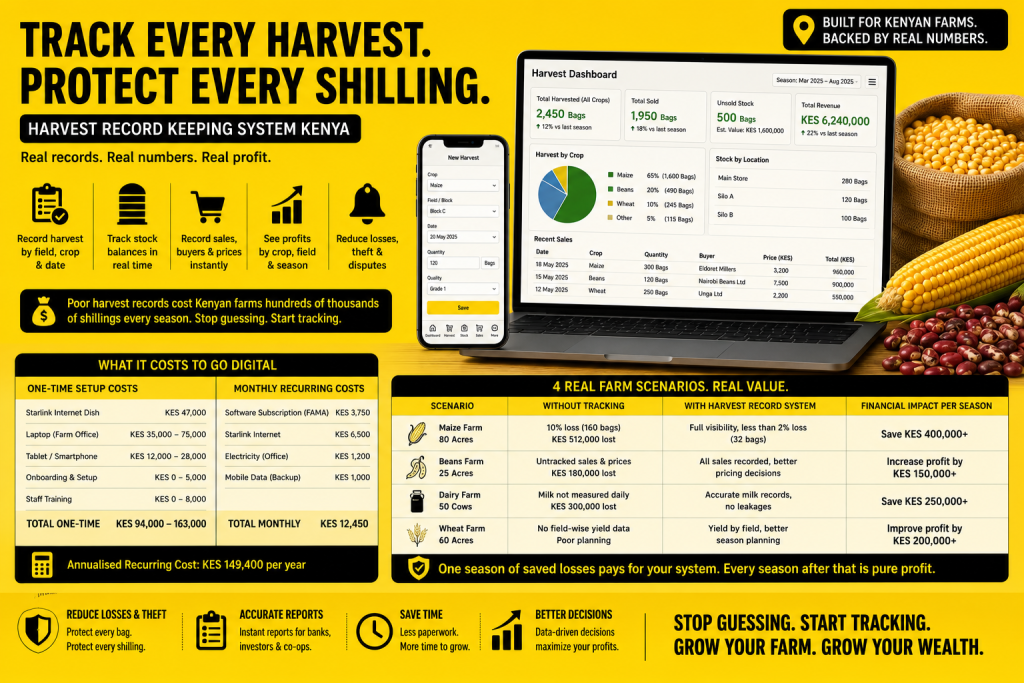
This article is different. Every claim in it is backed by real Kenyan farm numbers — actual harvest volumes, current commodity prices, real cost structures, and a precise break-even calculation showing when a digital harvest record keeping system Kenya pays for itself. If you are a farm owner, farm manager, or agricultural investor in Kenya and you want the real picture, read on.
What Is a Harvest Record Keeping System Kenya — and Why It Is Not a Notebook
A harvest record keeping system Kenya is a structured digital platform that captures, stores, and reports on every event from the point of harvest through storage and sale. It is not a notebook. It is not a WhatsApp group where the store keeper photographs bags before loading. It is not a free mobile app that records quantities without linking them to specific fields, farming periods, buyers, or financial outcomes.
A proper harvest record keeping system Kenya records the harvest quantity by crop and by block or field, the date and responsible team, the unit of measure (bags, crates, kilogrammes, litres), the quality grade where applicable, the storage location and stock balance at any point in time, the sale quantity and price per unit for each buyer transaction, and the remaining unsold stock value. When all of these are recorded in one system, the farm owner can answer in thirty seconds: how many bags of maize were harvested from Block C this season, how many have been sold, at what average price, and what the current stock is worth.
A harvest record keeping system Kenya that is purpose-built for Kenyan farms also handles livestock production — daily milk output, livestock sales, animal groups — and links all harvest and production records to the farm’s accounting module so that income from each sale flows automatically into the P&L. This integration is what separates a harvest record keeping system Kenya from a simple tally sheet. The data entered once produces financial reports, stock balance reports, and farming period summaries without any additional work from the farm team.
The existing content on this topic does not make this distinction. It treats harvest records as a documentation habit — something to do for compliance or general awareness. A properly implemented harvest record keeping system Kenya is a financial control mechanism. It is the difference between knowing your profit and guessing it.
Real Startup Costs: What You Pay to Go Digital on a Kenyan Farm
Every article on harvest record keeping system Kenya either ignores the cost of going digital or says something like “affordable solutions are available.” Here are the actual numbers for a mid-scale commercial farm in Kenya — 30 to 200 acres, multiple crops or a livestock unit, 5 to 30 staff — adopting a cloud-based harvest record keeping system for the first time.
One-Time Setup Costs
| Item | Low Estimate (KES) | High Estimate (KES) | Notes |
|---|---|---|---|
| Starlink internet dish (rural farm) | 47,000 | 47,000 | One-time hardware, includes mounting |
| Laptop for farm office or store | 35,000 | 75,000 | Budget to mid-range |
| Tablet or smartphone for store keeper | 12,000 | 28,000 | For field-level harvest entry |
| Software onboarding and initial setup | 0 | 5,000 | FAMA is self-onboarding; some providers charge |
| Staff training (store keeper, manager, accountant) | 0 | 8,000 | Internal or paid session |
| Total One-Time Setup | 94,000 | 163,000 |
Monthly Recurring Costs
| Item | Monthly Cost (KES) | Notes |
|---|---|---|
| Farm management software subscription | 3,750 | FAMA Standard Plan (KES 11,250 billed quarterly) |
| Starlink internet | 6,500 | Rural residential plan |
| Electricity (farm office) | 1,200 | Approx. 60 kWh/month |
| Mobile data backup | 1,000 | Safaricom or Airtel SIM |
| Total Monthly Recurring | 12,450 |
Annualised recurring cost: KES 149,400.
Now consider what the absence of a harvest record keeping system Kenya costs. Kenya loses an estimated KES 720 million per year in post-harvest losses, largely driven by poor storage and tracking. At the individual farm level, a maize farm storing 800 bags without a proper harvest record keeping system Kenya typically loses 8–12% to untracked consumption, theft, and unrecorded informal sales — that is 64–96 bags at KES 3,200 per bag, or KES 204,800–307,200 in unaccounted stock per season. One season’s untracked losses alone covers the entire first-year cost of a digital harvest record keeping system Kenya, including hardware.
Monthly Profit Model: 4 Real Harvest Scenarios with KES Figures
The right question is not “what does a harvest record keeping system Kenya cost?” but “what does it protect and enable?” Here are four specific Kenyan farm scenarios with current commodity prices, real cost structures, and the precise financial value that structured harvest tracking creates.
Scenario 1: Maize Farm, Uasin Gishu — 80 Acres, 2 Harvests Per Year
A commercial maize operation harvesting an average of 1,600 bags per season across two seasons annually. Current NCPB and trader buying price: KES 3,000–3,400 per 90 kg bag.
| Harvest Item | Season KES | Annual KES |
|---|---|---|
| Gross harvest value (1,600 bags × KES 3,200) | 5,120,000 | 10,240,000 |
| Inputs, land, labour, transport | 2,360,000 | 4,720,000 |
| Gross seasonal profit | 2,760,000 | 5,520,000 |
| Untracked stock loss (10% without harvest system) | 512,000 per season | 1,024,000 |
| Profit with harvest record keeping system Kenya | 2,760,000 | 5,520,000 |
| Profit without (after untracked losses) | 2,248,000 | 4,496,000 |
| Annual value of harvest tracking | 1,024,000 |
The harvest record keeping system Kenya does not increase revenue. It protects it. On this farm, a 10% untracked loss represents KES 1,024,000 per year disappearing into informal sales, driver theft, weighbridge discrepancies, and store consumption that nobody recorded. The software costs KES 149,400 per year to run. The protection value is KES 1,024,000. The return on investment is 585% before counting any other benefit.
Scenario 2: French Bean Export Farm, Kiambu — 15 Acres, Weekly Harvests
A contract horticultural farm supplying a Nairobi exporter with grade-A French beans. Weekly harvests of 2.2 tonnes, with rejections tracked per batch.
| Harvest Item | Weekly KES | Monthly KES |
|---|---|---|
| Gross produce (2,200 kg × KES 58/kg accepted grade) | 127,600 | 510,400 |
| Rejections at 12% (264 kg not paid for) | –15,312 | –61,248 |
| Labour, inputs, packaging, transport | –88,000 | –352,000 |
| Monthly net profit | 97,152 |
Without a harvest record keeping system Kenya, this farm cannot distinguish which field block is generating the highest rejection rate, which harvesting team is handling produce in a way that increases grade failures, or what the weekly yield trend looks like across 15 weeks of continuous harvest. With a harvest record keeping system Kenya tracking batch quantities, rejection counts, and team assignments for each harvest, the farm identifies within three weeks that one of two harvest teams has a 19% rejection rate versus 7% for the other — a finding worth KES 36,000 per month in reduced rejections if corrected.
Scenario 3: Dairy Farm, Nyandarua — 40 Cows, Daily Production Records
A medium dairy farm tracking milk production daily across a herd of 40 Friesian-cross cows, selling to a co-operative and directly to a hotel.
| Production Item | Daily KES | Monthly KES |
|---|---|---|
| Co-operative sales (280 litres × KES 45) | 12,600 | 378,000 |
| Direct hotel sales (40 litres × KES 65) | 2,600 | 78,000 |
| Feed, vet, labour, utilities | –178,000 | |
| Monthly net profit | 278,000 |
A harvest record keeping system Kenya — in this context, a daily livestock production module — tracks which animals are producing below target, flags drops in herd output that precede health events, and compares co-operative versus direct sales yield per litre over time. On this farm, the system identifies four animals producing less than 8 litres per day at a feed cost exceeding their milk revenue contribution — a finding that saves KES 22,000 per month in wasted feed expenditure once those animals are culled or moved to a dry period. Over twelve months, that single insight is worth KES 264,000 — nearly two full years of software subscription.
Scenario 4: Mixed Crop and Livestock Farm, Meru — 120 Acres, Multiple Enterprises
A diversified farm growing coffee and maize while maintaining a livestock unit of 60 beef animals. Three distinct harvest types to track: coffee cherries, maize grain, and livestock sales.
| Harvest / Production Item | Annual KES |
|---|---|
| Coffee cherry sales (12 tonnes × KES 35/kg) | 420,000 |
| Maize harvest (3,200 bags × avg KES 3,100) | 9,920,000 |
| Livestock sales (18 animals × avg KES 42,000) | 756,000 |
| Total annual gross income | 11,096,000 |
| All farm operating costs | –6,870,000 |
| Annual net profit | 4,226,000 |
| Monthly equivalent | 352,167 |
Without a harvest record keeping system Kenya, this farm’s accountant attempts to reconcile three completely different types of produce records at season end, using WhatsApp records, handwritten notebooks, and verbal reports from different managers. The reconciliation takes two weeks and still produces figures the owner does not fully trust. With a harvest record keeping system Kenya, every coffee delivery slip, every maize bag recorded at weighing, and every livestock sale is entered on the day it happens. The annual P&L takes one click to generate and is trusted by the owner, the accountant, and the bank.
Break-Even Calculator: Exact Months to Payback
Here is a precise payback calculation for a Kenyan farm adopting a harvest record keeping system Kenya on a modest setup budget.
Assumptions:
- One-time setup cost: KES 94,000 (low scenario)
- Monthly recurring cost: KES 12,450 (software + internet + power + backup)
- Conservative monthly value created: Preventing stock loss (KES 15,000), identifying grade or quality issues faster (KES 8,000), faster buyer reconciliation reducing credit period by 5 days on KES 500,000 monthly revenue at 12% annual interest = KES 822 interest saving ≈ KES 1,000 rounded. Total: KES 24,000 per month
| Month | Cumulative Investment (KES) | Cumulative Value Created (KES) | Net Position (KES) |
|---|---|---|---|
| 0 (setup) | 94,000 | 0 | –94,000 |
| 1 | 106,450 | 24,000 | –82,450 |
| 2 | 118,900 | 48,000 | –70,900 |
| 3 | 131,350 | 72,000 | –59,350 |
| 4 | 143,800 | 96,000 | –47,800 |
| 5 | 156,250 | 120,000 | –36,250 |
| 6 | 168,700 | 144,000 | –24,700 |
| 7 | 181,150 | 168,000 | –13,150 |
| 8 | 193,600 | 192,000 | –1,600 |
| 9 | 206,050 | 216,000 | +9,950 |
Break-even point: Month 8–9. Using only conservative, verifiable savings — no optimistic projections — a Kenyan farm reaches payback from a harvest record keeping system Kenya in under two average farming seasons. Farms with higher turnover, multiple crop types, or large storage operations recover their investment significantly faster.
Ongoing Costs That Quietly Reduce Your Harvest Margins
A harvest record keeping system Kenya has a predictable cost structure once set up. These are the ongoing items every farm owner should understand and budget for honestly.
Internet connectivity remains the largest monthly cost. Starlink at KES 6,500/month is the appropriate solution for rural farms where 4G coverage is unreliable. Do not use a harvest record keeping system Kenya on a connection that drops out during harvest season — the period when data entry is most critical. Budget the full KES 6,500 and treat it as a non-negotiable farm operating cost, not a technology experiment.
Software subscription at KES 3,750/month on FAMA’s quarterly billing plan is the most predictable line in the budget. The habit that protects this is simple: pay the quarterly invoice immediately from harvest sale proceeds. A suspended account during active harvest recording means a team reverting to notebooks — and the data gap created in that period may never be fully recovered.
Hardware maintenance is a real but infrequent cost. A farm laptop used in a dusty store environment needs a protective case (KES 2,000–4,000) and a screen clean at minimum. Budget KES 5,000–8,000 per year for hardware maintenance and consumables. A UPS or surge protector for the farm office power outlet adds another KES 3,500–6,000 but protects a KES 50,000+ laptop from power surge damage — a worthwhile insurance cost in rural Kenya where power quality is variable.
Staff time for data entry is the invisible cost. A dedicated store keeper entering harvest records daily spends approximately 20–35 minutes at the end of each harvest day on the system. This is not wasted time — it replaces the time previously spent doing manual tally sheets, reconciling WhatsApp photos, and arguing with drivers about bag counts. But it is real time that the store keeper must be allocated, and the farm manager must ensure this time is protected, especially during peak harvest periods.
Risks and How to Mitigate Them
A harvest record keeping system Kenya does not eliminate operational risk. These are the specific failure modes to anticipate and plan for.
Risk 1: Data entry lag during peak harvest. The most common breakdown in harvest record keeping system Kenya implementation is that the store keeper falls behind during a heavy harvest week — 200 bags come in on a Tuesday, there is no connectivity, and by Thursday the entries are being reconstructed from memory and tally marks. The reconstructed data is unreliable and defeats the purpose of the system. Mitigation: maintain a pre-printed daily harvest tally sheet as a bridge document during high-volume or offline days. Entries are written on the sheet at harvest time and transferred to the system same evening or next morning. The tally sheet is kept as a physical backup.
Risk 2: Weighbridge or bag count disputes with buyers. A buyer’s truck driver records 120 bags at loading. The farm’s harvest record keeping system Kenya shows 123 bags leaving the store. The KES 9,600 discrepancy (3 bags × KES 3,200) becomes a dispute with no digital evidence. Mitigation: record deliveries at the point of loading, not from memory. The store keeper enters the quantity at the time the buyer’s vehicle is loaded, signed off by both the driver and the store keeper. The system record and the driver’s delivery note must match before the vehicle leaves.
Risk 3: Multiple crops entered under wrong categories. On a diversified farm, a store keeper unfamiliar with the system may record coffee cherries in the same inventory category as maize, or enter a livestock sale as a crop sale. The resulting report mixes data that cannot be reliably separated later. Mitigation: spend one hour at system setup establishing clear product categories for every crop and livestock type the farm produces. Review the first two weeks of entries with the store keeper to catch categorisation errors before they compound.
Risk 4: Harvest data not linked to financial records. Some farms adopt a harvest record keeping system Kenya for the store operations but continue using a separate notebook for sales. The result is two sets of records that never reconcile — the store shows 800 bags harvested and 620 bags sold, but the cash book shows income from only 590 bags. The 30-bag discrepancy (worth KES 96,000) cannot be explained. Mitigation: use a farm management system like FAMA where the harvest module and the accounting module are the same integrated system. Every sale recorded in the harvest module automatically creates an income entry in the farm accounts.
Risk 5: Seasonal cash flow pressure on the subscription. A farm that earns most of its income in two seasonal harvests may struggle to pay a monthly software subscription in the dry months between harvests. A missed payment suspends the account precisely when the store keeper needs to start entering the new season’s planting and input records. Mitigation: use a system that bills quarterly (like FAMA at KES 11,250/quarter) and set aside the quarterly amount immediately from each harvest payment. Keep one quarter’s subscription in reserve at all times.
Is a Harvest Record Keeping System Kenya Worth It? An Honest Verdict
For any Kenyan farm harvesting crops or producing livestock for commercial sale — anything generating more than KES 500,000 per season — a digital harvest record keeping system Kenya is unambiguously worth adopting. The recurring cost of KES 149,400 per year is typically 1–3% of seasonal revenue at that scale. The value protected — in stock loss prevention, buyer dispute resolution, quality tracking, and financial reporting — is a multiple of that cost in almost every scenario modelled above.
The honest caveat is that the system requires operational discipline that not every farm team is immediately ready for. A harvest record keeping system Kenya cannot be implemented in the middle of harvest season as an emergency measure. It needs to be set up before the season begins, with categories configured, staff trained, and daily entry habits established during a quieter period. The technology is ready on day one. The team readiness takes two to four weeks of consistent use to become natural.
The larger benefit that no existing article on harvest record keeping system Kenya mentions is what clean harvest data enables downstream. A farm with two years of season-by-season harvest records — quantities by block, sales by buyer, prices by date — has a verifiable production history that a bank, co-operative, or contract buyer can assess. That history is the difference between accessing a KES 1,000,000 seasonal credit facility at 12% from a bank and borrowing KES 500,000 at 36% from an informal lender. The interest saving on that credit difference alone — KES 120,000 per year — covers the entire recurring cost of the harvest record keeping system Kenya with KES 29,400 to spare.
Meet FAMA: The Harvest Record Keeping System Built for Kenya
FAMA is the only purpose-built farm management system in Kenya with a fully integrated harvest and inventory module designed for how Kenyan farms actually operate. FAMA’s harvest module records every crop harvest by farming period, quantity, unit, and field block. It tracks stock movements from store to buyer, maintains a live stock balance at any point in the season, and links every sale to a specific buyer, quantity, and price. Livestock production — daily milk records, livestock health events, animal sales — is tracked in the same system alongside crop records.
Crucially, FAMA’s harvest record keeping is not a standalone module. Every harvest quantity recorded flows into the farm’s inventory balance. Every sale recorded flows into the farm’s income accounts. Every farming period closes with a P&L showing exactly what the season cost and what it earned — across crop, livestock, lease, labour, input, and machinery records all in one place. This is what a harvest record keeping system Kenya should be: not a tally board digitised, but a connected financial and operational record that tells the farm owner the true state of the business at any moment.
FAMA is priced at KES 3,750 per month, billed quarterly at KES 11,250 — structured around Kenyan farm cash flow, not international SaaS pricing. There are no per-user fees and no separate module charges. All 16+ farm modules, including harvest record keeping, lease management, input stock, machinery, staff payroll, livestock, and full accounting, are included in the standard plan.
FAMA is built and maintained by Awasam, a Nairobi-based SaaS company with 16 digital products serving Kenyan businesses and organisations across industries from farming to property management to church administration.
Start your free FAMA trial at fama.co.ke →
Our SaaS Products at a Glance
Kenya Website Experts partners with Awasam across a portfolio of 16 purpose-built SaaS platforms for East African businesses. If your organisation needs a digital solution beyond a harvest record keeping system Kenya, one of the platforms below almost certainly covers it. Here are 15 of the 16 products currently available:
| No. | Product / Group | Websites / Platforms | Purpose |
|---|---|---|---|
| 1 | RentalDesk Product Family | rentaldesk.co.ke, pms.co.ke, estateadmin.co.ke | Property, rental, PMS, and estate management systems |
| 2 | Prim | prim.co.ke | Salon management software |
| 3 | Vega POS | vega.co.ke | POS system for shops and businesses |
| 4 | Pawa | pawa.co.ke | WiFi hotspot billing system |
| 5 | Dereva | dereva.co.ke | Driver marketplace and hire-a-driver platform |
| 6 | Vota | vota.co.ke | Campaign and leadership management platform |
| 7 | Zivo / ZChat | zivo.co.ke, zchat.zamacore.com | WhatsApp shared inbox and customer communication platform |
| 8 | Dexa / Sibed | dexa.co.ke, Sibed | HR, HSSE, accounts, attendance, and business workflow system |
| 9 | Wito | Wito | RSVP, attendance, and check-in system |
| 10 | Ratibu | ratibu.co.ke | School management system |
| 11 | ChurchesAdmin | churchesadmin.com | Church management system |
| 12 | FAMA | fama.co.ke | Farm management and harvest record keeping system Kenya |
| 13 | Jaat | jaat.co.ke | Core SaaS product |
| 14 | KayaPro360 | kayapro360.com | Commercial property management platform |
| 15 | Musa Music AI | — | Music AI SaaS product |
Every product in this portfolio is priced in KES, designed for Kenyan operational realities, and supported by teams based in Kenya.
FAQ: 5 Questions Farm Owners and Investors Ask
1. How is a harvest record keeping system Kenya different from a simple stock management app?
A general stock management app records quantities in and out of a store. A harvest record keeping system Kenya does that and connects those quantities to specific farming periods, field blocks, crop types, buyers, sale prices, and financial accounts. The difference is that a stock app tells you how many bags are in the store. A harvest record keeping system Kenya tells you what those bags cost to produce, what they have sold for, what is still in stock, and what the net profit for the season is — all from one integrated record.
2. Can I implement a harvest record keeping system Kenya for multiple crop types on the same farm?
Yes. FAMA handles unlimited crop types and livestock categories under a single farm account. A farm growing maize, beans, and coffee while maintaining a dairy unit can track all four production streams separately, with individual harvest records, stock balances, and sales records for each — and a consolidated P&L that brings all four together at season end.
3. What if my harvest team is not comfortable with technology?
The field or store-level entry in FAMA is simple: a quantity, a date, a crop type, and a location. It does not require accounting knowledge or advanced technical skills. A store keeper who can send a WhatsApp message can learn to record a harvest entry in FAMA in one training session. The complexity — report generation, P&L analysis, farming period summaries — sits at the manager and owner level, where it belongs.
4. How does a harvest record keeping system Kenya help with bank loans or co-operative credit?
Kenyan banks and agricultural co-operatives increasingly require documented production history as part of loan assessments. A farm with two seasons of harvest records showing consistent yields, buyer relationships, and sale prices presents a credible repayment capacity case that a farm operating on verbal estimates cannot. FAMA’s printable farming period report is exactly the kind of document that supports a loan application for KES 500,000–2,000,000 in seasonal working capital.
5. What happens to my harvest records if I stop paying the FAMA subscription?
FAMA accounts that become overdue are suspended — not deleted. Your records are preserved and accessible again as soon as the subscription is renewed. Before choosing any harvest record keeping system Kenya, confirm that you can export all records to PDF or Excel at any time. FAMA provides printable and exportable reports across all modules, meaning your harvest history is never locked in a format you cannot retrieve.
Start Recording Your Harvests the Right Way
Every season that your farm harvests without a structured harvest record keeping system Kenya, you are operating on estimates. You do not know the exact yield from each field. You are not certain how many bags left the store versus how many were sold and paid for. You cannot produce a clean season-end P&L. And when you approach a bank, co-operative, or contract buyer, you have no verifiable production history to present.
FAMA solves all of this, for KES 3,750 per month, in a system that your store keeper, farm manager, and accountant can each use from their role on day one.
Start your free FAMA trial today at fama.co.ke/register — all modules included, no credit card required, full harvest and inventory tracking from the first day.
For help building your farm’s complete digital infrastructure — website, farm management system, or any of the 16 Awasam platforms that serve Kenyan businesses — reach out to the team at Kenya Website Experts. We design, build, and manage digital systems for Kenyan businesses at every stage of growth.