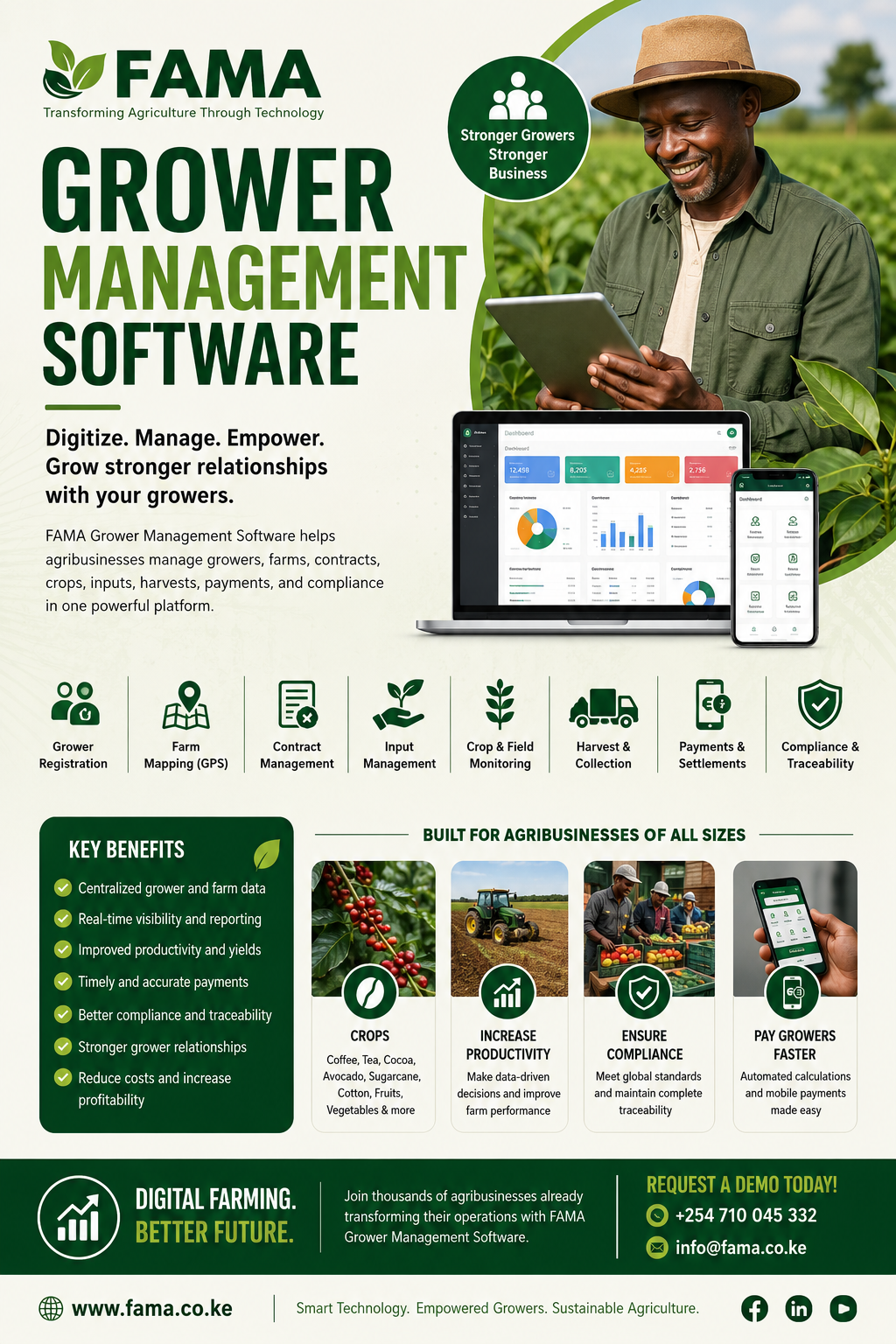
Agriculture is rapidly becoming a technology-driven industry. Across the world, growers, cooperatives, exporters, food processors, and contract farming organizations are embracing digital solutions to improve efficiency, increase yields, reduce operational costs, and strengthen relationships with farmers. One of the most impactful technologies leading this transformation is Grower Management Software.
Whether you manage hundreds of contract growers, operate a commercial farm, run an agricultural cooperative, or oversee an export company sourcing produce from thousands of farmers, managing grower information manually is no longer sustainable. Spreadsheets, paper records, disconnected communication channels, and manual reporting often result in inefficiencies, data inaccuracies, delayed payments, and poor decision-making.
A comprehensive Grower Management Software platform brings all grower-related information into one centralized system. From farmer registration and contract management to field monitoring, harvest tracking, payment processing, compliance reporting, and performance analytics, every aspect of grower management becomes streamlined and transparent.
At FAMA, we have developed a modern Grower Management Software solution that helps agribusinesses digitize operations, improve productivity, and build stronger relationships with growers across the entire agricultural value chain.
In this guide, you’ll discover how Grower Management Software works, its benefits, key features, implementation strategies, and why it has become essential for modern agriculture.
What is Grower Management Software?
Grower Management Software is a digital platform designed to help agricultural businesses manage growers, farms, production activities, contracts, inputs, harvests, financial transactions, and compliance requirements from a single system.
Instead of managing growers through multiple spreadsheets or paper files, organizations use one centralized platform where every grower has a complete digital profile.
This includes:
- Personal information
- Farm location
- Farm size
- Crops grown
- Contracts
- Input allocations
- Extension officer visits
- Production history
- Harvest deliveries
- Payment records
- Certifications
- Compliance reports
- Performance analytics
The software provides complete visibility across the farming lifecycle, allowing agribusinesses to make faster, more informed decisions.
Why Traditional Grower Management No Longer Works
Many organizations still rely on manual systems to manage growers. While this may work for a small number of farmers, it quickly becomes inefficient as operations expand.
Common challenges include:
Poor Data Organization
Farmer records are often scattered across:
- Excel spreadsheets
- Paper files
- WhatsApp conversations
- Email attachments
- Accounting software
- Field notebooks
Finding accurate information becomes time-consuming and error-prone.
Limited Visibility
Managers struggle to answer questions like:
- Which growers have active contracts?
- Who has received farm inputs?
- Which farms require inspection?
- Which growers are due for payment?
- Which regions are performing best?
Without centralized data, decision-making becomes reactive instead of proactive.
Communication Challenges
Extension officers often communicate individually with growers through phone calls and messaging apps.
This creates inconsistent communication and makes it difficult to track conversations or distribute important farming updates.
Harvest Tracking Issues
Many organizations lose revenue because they cannot accurately track:
- Expected yields
- Actual deliveries
- Harvest quality
- Collection schedules
- Warehouse receipts
Digital harvest management significantly reduces these risks.
Compliance Risks
International buyers increasingly demand traceability.
Without digital records, proving compliance with food safety standards becomes extremely difficult.
How Grower Management Software Works
Modern Grower Management Software follows the entire agricultural production cycle.
The process generally includes:
Step 1: Grower Registration
Every grower is registered with detailed information including:
- Name
- National ID
- Phone number
- GPS location
- Farm size
- Crop type
- Photos
- Certifications
- Bank details
- Mobile money information
Each grower receives a unique profile within the system.
Step 2: Farm Mapping
Fields are mapped using GPS coordinates.
This allows organizations to:
- Measure farm acreage accurately
- Prevent duplicate registrations
- Monitor crop distribution
- Improve planning
GPS mapping also supports satellite monitoring and precision agriculture.
Step 3: Contract Management
Growers can sign digital contracts specifying:
- Crop variety
- Production targets
- Delivery schedules
- Pricing models
- Input support
- Payment terms
The software stores every contract securely for future reference.
Step 4: Input Distribution
Agricultural organizations often provide growers with:
- Seeds
- Fertilizers
- Chemicals
- Equipment
- Irrigation supplies
Grower Management Software records:
- Quantity issued
- Distribution date
- Batch numbers
- Outstanding balances
- Repayment schedules
This creates full accountability throughout the season.
Step 5: Field Monitoring
Extension officers record field visits using mobile devices.
They can capture:
- Crop health
- Pest outbreaks
- Disease observations
- Growth stages
- Photos
- Recommendations
Managers receive real-time updates without waiting for paper reports.
Key Features of Grower Management Software
A powerful Grower Management Software solution should include the following features.
1. Grower Registration
Maintain complete digital profiles for every grower.
Features include:
- Digital forms
- Identity verification
- Document uploads
- GPS coordinates
- Family information
- Farm ownership records
2. Farm Management
Track every farm under each grower.
Information includes:
- Acreage
- Soil type
- Irrigation status
- Crop history
- Production capacity
3. Contract Farming Management
Contract farming becomes easier through:
- Digital agreements
- Contract renewals
- Pricing management
- Quantity commitments
- Delivery obligations
4. Input Management
Monitor agricultural inputs throughout the season.
Track:
- Inventory
- Distribution
- Usage
- Returns
- Costs
5. Crop Monitoring
Field officers can monitor:
- Germination
- Flowering
- Fruiting
- Harvest readiness
- Pest infestations
- Fertilizer application
- Weather impact
Real-time updates improve response times.
6. Harvest Management
Harvest tracking includes:
- Expected yield
- Harvest dates
- Collection centers
- Quality grading
- Weight records
- Warehouse transfers
Organizations can forecast production more accurately.
7. Payment Management
Growers deserve timely, transparent payments.
The software manages:
- Produce delivered
- Price calculations
- Deductions
- Bonuses
- Mobile money payments
- Bank transfers
Payment history remains permanently accessible.
8. Compliance Management
Meet global agricultural standards including:
- GlobalG.A.P.
- Organic Certification
- Fairtrade
- Rainforest Alliance
- Food Safety Standards
Digital compliance reduces audit preparation time.
9. Mobile Field Applications
Field officers can use smartphones to:
- Register growers
- Capture photos
- Record inspections
- Upload reports
- Work offline
- Synchronize later
This improves productivity even in remote farming regions.
10. Reporting and Analytics
Executives gain instant insights through dashboards showing:
- Active growers
- Farm acreage
- Crop performance
- Harvest forecasts
- Payment summaries
- Regional comparisons
- Extension officer performance
Instead of waiting days for reports, information becomes available instantly.
Industries That Benefit from Grower Management Software
Grower Management Software is suitable for a wide range of agricultural organizations, including:
- Contract farming companies
- Coffee cooperatives
- Tea estates
- Sugar companies
- Dairy cooperatives
- Horticulture exporters
- Fresh produce exporters
- Fruit processors
- Vegetable producers
- Seed companies
- Cotton organizations
- Tobacco companies
- Avocado exporters
- Macadamia processors
- Cocoa companies
- Grain aggregators
- Government agriculture programs
- NGOs supporting farmers
Regardless of the crop, having a centralized digital platform improves operational efficiency and strengthens grower relationships.
Grower Management Software: The Ultimate Guide to Digitizing Modern Agriculture and Improving Farm Productivity (Part 2)
Benefits of Grower Management Software
Agricultural businesses today face increasing pressure to produce more food, meet strict compliance requirements, improve sustainability, and maintain profitable relationships with growers. A modern Grower Management Software solution addresses these challenges by digitizing every aspect of grower operations.
Whether your organization manages 100 growers or 100,000 growers, implementing a centralized grower management platform delivers measurable benefits across the entire agricultural value chain.
1. Centralized Grower Database
One of the biggest advantages of Grower Management Software is having a single source of truth.
Instead of maintaining grower information across multiple spreadsheets, notebooks, emails, and messaging applications, all data is stored securely in one centralized platform.
This includes:
- Personal details
- Farm information
- GPS coordinates
- Contracts
- Input allocations
- Inspection reports
- Harvest records
- Payment history
- Certifications
- Compliance documentation
- Communication history
Having one complete digital profile for every grower reduces duplication, minimizes errors, and makes information accessible in seconds.
2. Better Decision Making Through Real-Time Data
Modern agriculture depends on timely and accurate information.
Grower Management Software provides real-time dashboards that allow managers to monitor operations without waiting for weekly or monthly reports.
For example, managers can instantly see:
- Number of active growers
- Total acreage under production
- Crops currently planted
- Farms requiring inspection
- Harvest forecasts
- Produce collected
- Outstanding grower payments
- Input stock levels
- Extension officer performance
Instead of reacting to problems after they occur, organizations can identify risks early and take corrective action.
3. Improved Grower Relationships
Growers are the foundation of every successful agricultural business.
When communication is poor, payments are delayed, or records are inaccurate, trust begins to decline.
Grower Management Software strengthens grower relationships by providing:
- Faster registration
- Transparent contracts
- Accurate production records
- Timely payment calculations
- Easy access to historical transactions
- Better communication with extension officers
Satisfied growers are more likely to remain loyal and deliver higher-quality produce season after season.
4. Increased Operational Efficiency
Many agricultural organizations still spend hundreds of hours each month performing manual administrative tasks.
Examples include:
- Entering grower information
- Updating spreadsheets
- Calculating payments
- Tracking contracts
- Preparing compliance reports
- Scheduling field visits
Automation significantly reduces repetitive work.
Instead of spending hours searching for information, employees can focus on supporting growers and improving production.
5. Better Contract Farming Management
Contract farming involves numerous moving parts.
Organizations must monitor:
- Contract terms
- Delivery obligations
- Pricing agreements
- Input advances
- Harvest quantities
- Payment schedules
Without proper software, managing thousands of contracts becomes extremely difficult.
Grower Management Software digitizes every contract and automatically tracks progress throughout the production cycle.
Managers can quickly identify growers who are meeting expectations and those who require additional support.
6. Accurate Farm Mapping
Knowing exactly where growers are located is becoming increasingly important.
Modern Grower Management Software supports GPS-based farm mapping.
Benefits include:
- Accurate acreage measurement
- Improved logistics planning
- Reduced duplicate registrations
- Satellite monitoring
- Easier extension officer routing
- Better production forecasting
Interactive maps allow managers to visualize grower distribution across regions.
7. Efficient Input Distribution
Many agribusinesses provide growers with agricultural inputs before planting.
These may include:
- Seeds
- Fertilizers
- Agrochemicals
- Irrigation equipment
- Farm tools
Tracking input distribution manually often leads to:
- Missing records
- Over-allocation
- Fraud
- Inventory losses
Grower Management Software records every transaction.
Managers know:
- Who received inputs
- Quantities issued
- Remaining inventory
- Outstanding balances
- Repayment status
This improves accountability throughout the season.
8. Improved Harvest Planning
Harvest season is often the busiest period for agricultural organizations.
Without accurate forecasts, businesses struggle with:
- Transport planning
- Warehouse allocation
- Processing schedules
- Buyer commitments
Grower Management Software enables organizations to forecast harvests using:
- Crop age
- Farm size
- Historical yields
- Weather patterns
- Field inspection reports
This allows logistics teams to prepare well in advance.
9. Faster Grower Payments
Nothing builds grower confidence like receiving accurate payments on time.
Manual payment calculations frequently result in:
- Delays
- Errors
- Disputes
- Administrative costs
Grower Management Software automatically calculates:
- Produce delivered
- Quality grades
- Pricing
- Bonuses
- Input deductions
- Taxes
- Final payment amounts
Organizations can integrate with banks or mobile money platforms to process payments quickly and securely.
10. Enhanced Traceability
Consumers increasingly want to know where their food comes from.
Export markets require complete traceability from farm to market.
Grower Management Software provides digital traceability by recording:
- Farm location
- Planting dates
- Seed varieties
- Fertilizer applications
- Chemical usage
- Harvest dates
- Transportation records
- Warehouse information
If quality issues arise, organizations can trace produce back to the specific grower and farm.
How FAMA Grower Management Software Supports Modern Agriculture
At FAMA, we understand the unique challenges faced by agricultural organizations.
Our platform has been designed specifically for agribusinesses seeking to digitize grower operations while improving efficiency and profitability.
FAMA supports organizations of all sizes—from local cooperatives managing a few hundred growers to multinational agribusinesses working with tens of thousands of farmers.
Key capabilities include:
- Digital grower registration
- Farm mapping using GPS
- Crop planning
- Contract farming management
- Extension officer management
- Input inventory tracking
- Harvest collection
- Produce grading
- Warehouse management
- Grower payment management
- Financial reporting
- Mobile field data collection
- Real-time dashboards
- Multi-user access with role-based permissions
- Cloud-based access from anywhere
By bringing these capabilities together in one integrated platform, FAMA helps agricultural organizations make better decisions while reducing operational costs.
Digital Agriculture Is Transforming the Industry
Agriculture is entering a new era.
Technology is helping farmers produce more while using fewer resources.
Grower Management Software forms the foundation of digital agriculture by integrating information from multiple technologies.
These include:
Internet of Things (IoT)
Connected farm sensors monitor:
- Soil moisture
- Temperature
- Humidity
- Irrigation systems
- Water usage
Data collected automatically updates management systems.
Satellite Monitoring
Satellite imagery helps organizations monitor:
- Crop growth
- Vegetation health
- Drought conditions
- Flood damage
- Land use
Managers can identify problems before they become visible during field inspections.
Drone Technology
Drones provide detailed aerial views of farms.
They assist with:
- Crop scouting
- Disease detection
- Plant counting
- Irrigation assessment
- Fertilizer application monitoring
Drone imagery can be linked directly to Grower Management Software for better decision-making.
Artificial Intelligence (AI)
Artificial intelligence helps agricultural businesses:
- Predict yields
- Identify disease outbreaks
- Recommend fertilizer application
- Forecast harvest dates
- Analyze weather risks
- Improve production planning
As AI continues to evolve, Grower Management Software will become even more intelligent and predictive.
Sustainability and Environmental Responsibility
Sustainability has become a major focus for agricultural businesses worldwide.
Grower Management Software supports sustainable farming practices by helping organizations monitor:
- Fertilizer application
- Water usage
- Chemical usage
- Carbon footprint
- Land conservation
- Soil health
- Tree planting programs
This information supports environmental reporting and certification programs while helping businesses meet sustainability goals.
Why Cloud-Based Grower Management Software Is Better
Cloud-based systems offer significant advantages over traditional desktop software.
Organizations benefit from:
- Automatic backups
- Enhanced security
- Remote access
- Lower infrastructure costs
- Automatic updates
- Multi-location collaboration
- Faster deployment
- Better scalability
Managers can access reports from the office, home, or while traveling, using any internet-connected device.