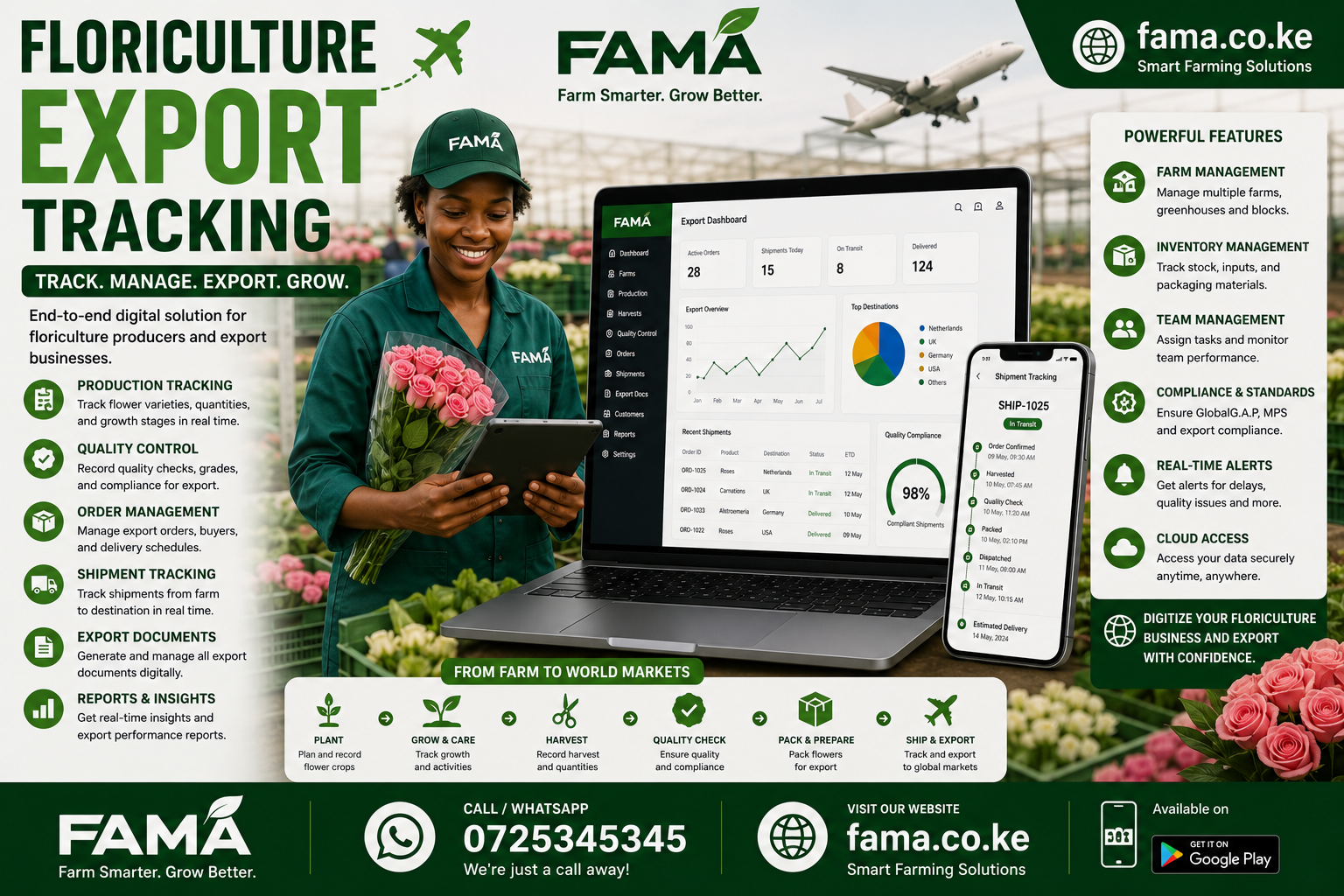
Kenya’s floriculture industry depends on precision. Flowers are cultivated, harvested, graded, packed, transported, documented, and exported within tightly controlled timelines. A small delay or inaccurate record can affect product quality, customer satisfaction, shipment coordination, and revenue. For growers, packhouses, aggregators, exporters, and agricultural managers, having reliable information throughout the export process is therefore increasingly important.
Floriculture Export Tracking can help businesses create a structured information trail from production to shipment. Instead of depending on disconnected spreadsheets, paper records, phone calls, and messaging applications, an agricultural business can organize important information in one digital environment.
FAMA is designed as a farm operations platform for agricultural teams, bringing together fields, crops, inputs, stock, labour, harvests, production, sales, accounting, and reporting. Its published capabilities make it relevant to businesses looking to strengthen the records behind horticultural production and export preparation.
Floriculture Export Tracking: Why Digital Records Matter in Flower Exports
Flower exports involve numerous activities that must remain connected. Production begins with land and crop management, while later stages may involve harvesting, sorting, grading, packing, storage, dispatch, transportation, documentation, and customer coordination.
Floriculture Export Tracking creates an opportunity to connect these stages through structured records. Managers can maintain clearer information about what was produced, when it was harvested, how it was handled, and what quantities moved toward buyers or export channels.
Digital records also make historical information easier to retrieve. If an exporter needs to investigate a previous shipment, review production information, or compare seasonal performance, organized records provide a more dependable starting point than scattered paperwork.
The objective is not simply to replace paper. It is to create a consistent information system that supports operational visibility.
Floriculture Export Tracking: Connecting Flower Production With Export Preparation
Export performance begins long before flowers reach an airport or international buyer. Growers need to know what is planted, where it is planted, which inputs have been applied, how labour is allocated, and when production is expected.
Floriculture Export Tracking connects the production side of agriculture with the information needed later in the supply chain. A manager can use organized farm records to establish a clearer history of production and harvesting.
FAMA supports fields, farming periods, crops, inputs, harvests, stock, labour, machinery, sales, and accounting within one farm workspace. This structure can help floriculture businesses create better records before flowers enter export preparation.
A reliable production record becomes especially useful when managers need to investigate differences between expected and actual harvest quantities.
Floriculture Export Tracking: Tracking Flower Harvest Quantities
Harvest quantities are among the most important records in a flower business. Managers need to know how much product was harvested, which production area supplied it, and how much eventually moved through packing and sales.
Floriculture Export Tracking helps establish a more structured relationship between harvest information and subsequent activities.
For example, a farm may record flowers harvested during a particular farming period before those flowers are prepared for buyers. Once harvest information is captured consistently, management has a reference point for comparing available production against sales or dispatch records.
FAMA includes harvest and production records as part of its farm management capabilities. Businesses can also explore the FAMA harvest tracking resources for additional guidance on organizing harvest information.
Floriculture Export Tracking: Managing Flower Grades and Quality Information
Quality is central to floriculture because buyers often have specific expectations concerning flower variety, stem length, freshness, appearance, packaging, and quantity. Quality information should therefore be captured as close to the production and packing processes as possible.
Floriculture Export Tracking can support a broader information-management approach in which production records provide context for later commercial activities.
Although software alone does not determine flower quality, structured records can make operational exceptions easier to investigate. If one production area repeatedly generates lower-value output, managers can review the related farming activities and inputs.
A digital record also helps management avoid treating every harvest as an isolated event. Instead, flower production becomes part of a historical dataset that can support planning and operational improvement.
Floriculture Export Tracking: Managing Flower Inventory Before Shipment
After harvesting, flowers become inventory that needs careful handling. Quantities can change because of sorting, grading, rejected products, packing, sales, internal losses, or dispatch.
Floriculture Export Tracking makes inventory visibility an important part of the overall export workflow.
Managers should be able to distinguish between harvested quantities, available stock, packed quantities, sold quantities, and quantities awaiting dispatch. When these records are disconnected, reconciliation becomes difficult.
FAMA provides inventory and harvest functionality, including stock valuation and remaining produce records. This can help agricultural businesses build a more organized view of produce movement.
For perishable products such as flowers, timely information can be particularly valuable because delays may reduce commercial value.
Floriculture Export Tracking: Improving Export Documentation
Export transactions involve documentation and information exchanges between multiple parties. Depending on the operation, these may include buyer details, product information, shipment quantities, invoices, delivery information, and internal production records.
Floriculture Export Tracking provides a framework for organizing the operational information that supports these processes.
A digital system should not be viewed as a replacement for regulatory requirements or specialized export documentation platforms where such systems are required. Instead, it can provide the internal records needed to prepare, verify, and reconcile information.
Accurate internal records can reduce confusion when teams need to confirm quantities, buyers, sales, harvests, or production periods.
This creates a more accountable environment for export preparation.
Floriculture Export Tracking: Connecting Farms With Export Buyers
Flower exporters depend on reliable relationships with buyers. Buyer information should be maintained alongside sales records so that the business can understand transaction history and outstanding commercial activity.
Floriculture Export Tracking can connect production information with the commercial side of the agricultural operation.
When a farm knows what has been produced and sold, management can better understand available inventory and customer demand. Buyer records can also make follow-up easier because transactions are maintained in a structured format.
FAMA includes buyers and sales among its farm management functions. Businesses can explore the FAMA farm management system to see how operational records are organized within one workspace.
Floriculture Export Tracking: Reducing Spreadsheet Dependence
Spreadsheets can be useful for small operations, but they may become difficult to maintain as the number of farms, fields, varieties, workers, buyers, harvests, and transactions increases.
Floriculture Export Tracking gives agricultural businesses an opportunity to move toward a centralized record environment.
The problem with disconnected spreadsheets is not necessarily the spreadsheet itself. The bigger issue is that several files may contain different versions of the same information. One team may update harvest quantities while another maintains a separate sales record.
A centralized system can reduce duplication by giving teams a common workspace.
FAMA describes its platform as a secure workspace for farm operations, including crop records, inputs, stock, labour, harvests, production, sales, accounting, and reporting.
Floriculture Export Tracking: Monitoring Flower Production Costs
Export performance should be evaluated against production costs. Flowers may require land, seedlings, fertilizers, chemicals, irrigation, labour, machinery, packaging, transport, and other resources.
Floriculture Export Tracking can connect production records with financial information, helping management understand the cost side of the operation.
FAMA provides accounting capabilities covering income, expenses, cashbook entries, salaries, advances, profit and loss, and financial reporting.
When production and financial information are available together, management can evaluate more than sales volume. It becomes possible to investigate whether particular production periods or activities are financially sustainable.
This is particularly important for commercial floriculture businesses where margins depend on controlling numerous operational costs.
Floriculture Export Tracking: Tracking Flower Inputs
Inputs influence agricultural production, and accurate input records are essential for understanding farm costs and operational activities.
Floriculture Export Tracking can incorporate information about fertilizers, seeds, chemicals, suppliers, purchases, stock balances, and usage.
FAMA’s feature set includes input purchases, supplier details, stock balances, and input usage records. These records can help managers understand how agricultural resources move from purchase to field application.
For a flower-growing operation, such information can support better purchasing decisions and make it easier to investigate unusual consumption.
Farm managers can also use the FAMA farm inputs guide to explore practical approaches to recording agricultural inputs.
Floriculture Export Tracking: Coordinating Labour in Floriculture
Labour plays a significant role in flower production. Employees may participate in planting, pruning, crop care, harvesting, sorting, packing, maintenance, and other activities.
Floriculture Export Tracking can help place labour information within the broader farm-management structure.
FAMA supports staff profiles, attendance, salaries, advances, allowances, casual labour, and payroll-related records.
A structured workforce record can help managers understand who is responsible for particular activities and how labour resources are being used.
This can also make payroll administration more organized. Instead of keeping attendance and salary information in disconnected files, the business can maintain a consistent employee record.
Floriculture Export Tracking: Managing Multiple Flower Fields
Commercial flower businesses may operate multiple fields, production blocks, rented areas, or farming sites. Each area can have different production characteristics and operational requirements.
Floriculture Export Tracking becomes more useful when field information is connected to production and harvest records.
FAMA supports owned fields, rented leases, crops, farming periods, inputs, harvests, machinery, and reporting.
This structure can help managers distinguish activities between production areas.
For example, if one block produces significantly different quantities from another, management can review the records associated with each area. Such comparisons can support planning without relying solely on memory.
Floriculture Export Tracking: Monitoring Flower Sales
Sales records transform production data into commercial information. An exporter needs to know which products were sold, to whom, at what quantities, and for what financial value.
Floriculture Export Tracking connects sales visibility with the broader agricultural record.
FAMA includes buyers, sales, accounting, harvests, and inventory functionality. This allows businesses to maintain a relationship between physical production and commercial transactions.
Sales data can help management identify active buyers, recurring transactions, and revenue patterns.
When sales information is properly organized, it can also support future production planning. Management can use previous transaction history to understand commercial demand rather than planning only from production assumptions.
Floriculture Export Tracking: Improving Stock Reconciliation
Stock reconciliation is necessary whenever produce moves through several stages. A business may start with a recorded harvest quantity and later have a smaller quantity available after grading, rejection, packing, or sales.
Floriculture Export Tracking helps create a structured basis for reviewing these differences.
The important principle is that every significant stock adjustment should have an explanation. A reduction could result from a legitimate sale, wastage, rejected product, internal use, or a correction.
FAMA’s inventory and harvest functionality can provide a central record for produce and stock information.
Regular reconciliation can therefore become part of routine farm management instead of an activity performed only when discrepancies become obvious.
Floriculture Export Tracking: Supporting Flower Export Traceability
Traceability means being able to follow the history of a product through relevant stages of its journey. In horticulture, this can involve connecting farms, fields, production activities, harvest lots, grading, packing, and shipment information.
Floriculture Export Tracking strengthens the importance of maintaining connected operational records.
FAMA recently published guidance on horticulture export traceability describing the value of connecting grower, farm, plot, harvest-lot, input, packhouse, packing, dispatch, and trace-back information.
For exporters, this approach can make investigations more structured. When information can be followed through defined stages, teams have a better basis for answering questions about where produce came from and where it went.
Floriculture Export Tracking: Managing Flower Packhouse Information
The packhouse is an important point between production and export. Produce arriving from farms may be received, sorted, graded, prepared, packed, labeled, and dispatched.
Floriculture Export Tracking can help businesses think about the information that must remain connected across these stages.
Even when a dedicated packhouse system is used, farm management records can provide useful upstream information about production and harvest quantities.
A consistent digital record can help identify what quantity entered the packing process and compare it with what was eventually packed or sold.
This makes the relationship between field production and commercial dispatch more visible.
Floriculture Export Tracking: Managing Seasonal Flower Production
Flower production changes according to farming schedules, varieties, weather conditions, market demand, and operational decisions. Seasonal records therefore provide useful historical information.
Floriculture Export Tracking allows managers to structure information around different farming periods.
FAMA supports farming periods as part of its farm operations framework. A business can therefore maintain production information in a way that makes historical comparison more practical.
Managers can review previous periods when planning future activities. They can examine harvest quantities, input usage, labour activity, expenses, and sales.
This creates a stronger connection between historical performance and future production decisions.
Floriculture Export Tracking: Connecting Agricultural Accounting With Exports
Financial reporting becomes more useful when accounting information can be related to real agricultural activity.
Floriculture Export Tracking helps establish this connection by bringing production, sales, income, and expenses into the same management perspective.
FAMA combines farm operations with accounting records, including expenses, income, cashbook entries, payroll, profit-and-loss reporting, and exports.
This can help management investigate the financial outcome of particular production activities.
Instead of asking only how many flowers were exported, decision-makers can consider the costs associated with producing, handling, and selling those products.
That provides a more complete basis for evaluating business performance.
Floriculture Export Tracking: Creating Better Management Reports
Management reports convert operational records into information that can support decision-making.
Floriculture Export Tracking can support reporting by organizing the records behind farm production, stock, harvests, sales, labour, inputs, and financial activity.
FAMA provides printable and exportable reports across multiple operational areas, including harvests, farming periods, stock, inputs, machinery, staff, income, expenses, and profit and loss.
For floriculture businesses, reports can help managers monitor production trends, stock balances, operational expenses, and sales.
The quality of a report depends on the quality of the information entered into the system. Consistent daily records are therefore essential.
Floriculture Export Tracking: Monitoring Flower Export Readiness
Export readiness requires more than having flowers available. The business needs confidence that the right quantities, records, packing activities, sales information, and logistical arrangements are in place.
Floriculture Export Tracking helps create a broader operational view of the information that supports readiness.
A digital system can make missing information easier to identify. If harvest quantities have not been recorded or stock information has not been updated, management can address the gap before relying on the figures.
This reduces the risk of preparing commercial decisions around outdated information.
FAMA’s daily workflow is based on recording activities, updating balances and totals, and producing management reports.
Floriculture Export Tracking: Managing Buyer Relationships
International flower buyers expect exporters to maintain consistent commercial records. Buyer information should be organized so that previous transactions can be reviewed when needed.
Floriculture Export Tracking makes buyer and sales records part of a wider agricultural management process.
A structured customer history can help management understand purchasing patterns, outstanding transactions, and previous sales.
FAMA includes buyers and sales functionality within its farm management platform.
For exporters, this information can complement specialized customer relationship or logistics systems.
The central benefit is visibility. Managers should be able to understand the relationship between available produce and commercial commitments.
Floriculture Export Tracking: Reducing Information Gaps Between Teams
Agricultural export businesses often involve multiple departments. Farm managers, store keepers, accountants, supervisors, sales personnel, and owners may all need different information.
Floriculture Export Tracking can reduce information gaps by giving teams a structured record environment.
FAMA provides role-based access for farm owners, farm managers, accountants, store keepers, supervisors, and other users.
This allows responsibilities to be distributed while keeping the operation within one farm account.
A coordinated record system can reduce the need for every department to maintain separate versions of the same operational information.
Floriculture Export Tracking: Supporting Remote Farm Management
Some agricultural business owners do not spend every day at the production site. They may manage multiple farms, travel for business, or rely on farm managers for daily operations.
Floriculture Export Tracking can support remote oversight by ensuring important records are maintained in a centralized workspace.
Remote visibility should not replace physical inspections. Instead, digital records provide an additional layer of management information.
An owner can review reports, stock information, production records, sales activity, expenses, and other information without depending entirely on verbal updates.
FAMA is designed as a SaaS farm-management platform where farm teams work within their respective farm accounts.
Floriculture Export Tracking: Improving Flower Transport Coordination
Transportation is a crucial stage in moving flowers from farms and packhouses toward buyers and export points. Timing matters because harvested flowers are perishable.
Floriculture Export Tracking provides a framework for maintaining the records needed to coordinate produce movement.
While transport operations may require dedicated logistics tools, agricultural management software can still provide the upstream information needed to establish what quantities are ready for dispatch.
Knowing available stock, packed quantities, buyers, and sales information can make dispatch planning more structured.
The more accurate the upstream records, the easier it becomes for logistics teams to work from dependable information.
Floriculture Export Tracking: Monitoring Export-Related Inventory
Inventory management is especially important when flower quantities change quickly.
Floriculture Export Tracking can help businesses maintain a clearer picture of available agricultural stock.
FAMA’s inventory functionality includes harvest stock, tools, spare parts, input stock, low-stock alerts, and valuation.
For floriculture operations, inventory information can help management understand how much product remains available after harvesting and sales activities.
This information can also support internal planning. Managers can compare physical stock with recorded balances and investigate discrepancies before they affect customer commitments.
Floriculture Export Tracking: Supporting Export Business Growth
Growth introduces complexity. A small flower farm may initially manage a few production areas and buyers. As volumes increase, the operation may add fields, workers, suppliers, machinery, buyers, and more sophisticated sales processes.
Floriculture Export Tracking becomes increasingly valuable as the number of records increases.
A scalable management system can help businesses establish consistent processes before administrative complexity becomes overwhelming.
FAMA provides modules covering leases, inputs, machinery, staff, inventory, harvests, livestock, accounting, sales, and reporting.
The objective is to create an operational foundation that can support growth without requiring every new process to be managed through disconnected files.
Floriculture Export Tracking: Using FAMA for Agricultural Export Records
FAMA brings together the records that form the operational foundation of a farm business. Its published platform includes fields, leases, crops, inputs, machinery, staff, harvests, inventory, livestock, sales, accounting, and reports.
Floriculture Export Tracking can therefore be approached as part of a wider agricultural information strategy rather than as an isolated reporting activity.
For floriculture businesses, the first step is to map the current workflow. Identify how production is recorded, how harvests are measured, where inventory is stored, how sales are documented, and which reports management needs.
The business can then determine which records should be digitized first.
Floriculture Export Tracking: Establishing Daily Digital Farm Records
Successful digitization depends on consistent daily usage. A system cannot provide reliable management information when employees enter information irregularly.
Floriculture Export Tracking works best when farm teams establish clear procedures for recording purchases, input usage, labour, harvests, inventory, sales, and expenses.
FAMA recommends a workflow in which teams record activities, balances and totals are updated, and management reviews reports.
Training is therefore an important part of implementation.
Employees should understand not only which buttons to use, but why accurate records matter. When workers understand how their information affects stock, reports, accounting, and management decisions, adoption can become more meaningful.
Floriculture Export Tracking: Improving Agricultural Data Accuracy
Digital systems are only as useful as the information entered into them. Incorrect quantities, duplicated records, missing transactions, and inconsistent units can undermine reporting.
Floriculture Export Tracking should therefore be supported by clear data-entry procedures.
Managers can establish rules for measurement, naming, dates, product categories, buyers, suppliers, and stock adjustments.
Regular review is also important. Supervisors should identify unusual records and correct errors before they become part of routine reporting.
FAMA uses validated forms and tenant-isolated farm accounts as part of its platform controls. These technical controls complement good internal processes and staff discipline.
Floriculture Export Tracking: Supporting Export Performance Analysis
Historical information can help flower businesses understand performance over time. Managers may compare production periods, harvest quantities, costs, sales, inventory movements, and other operational indicators.
Floriculture Export Tracking makes this historical record valuable for strategic planning.
For example, management may discover that certain production periods generated stronger harvest volumes or that specific activities were associated with higher costs.
FAMA provides reports covering harvests, farming periods, stock, inputs, machinery, staff, income, expenses, and profit and loss.
The goal is to turn historical records into useful business information.
Instead of storing data simply because it is required, farms can use it to understand what happened and plan what should happen next.
Floriculture Export Tracking: Building a Traceable Flower Supply Chain
A traceable supply chain gives management greater visibility into the movement of agricultural products.
Floriculture Export Tracking can connect information from fields and production through harvests, stock, sales, and other relevant activities.
FAMA’s broader agricultural record structure can support the farm-level information needed for traceability. Its horticulture export guidance also highlights grower, farm, plot, harvest-lot, input, packhouse, packing, dispatch, and trace-back records as important areas to consider.
For exporters, this means building a consistent information chain rather than collecting information only when a problem occurs.
The result can be a more accountable approach to managing agricultural products.
Floriculture Export Tracking: Managing Flower Export Exceptions
No agricultural operation runs perfectly. Quantities can differ, products can be rejected, shipments can be delayed, and records can occasionally contain errors.
Floriculture Export Tracking can help managers establish records that make exceptions easier to investigate.
An effective process should identify what happened, when it happened, who was responsible, and how the record was corrected.
FAMA’s structured modules provide separate areas for stock, harvests, inputs, sales, accounting, staff, and reporting.
When information is organized in this way, unusual outcomes can be investigated using connected records instead of relying exclusively on informal explanations.
This is especially useful when several teams participate in the export workflow.
Floriculture Export Tracking: Integrating Farm Management and Export Operations
Export businesses often use several systems because different departments have different requirements. A farm management system may handle production and accounting, while specialized platforms may handle logistics, compliance, customer management, or shipment processing.
Floriculture Export Tracking can therefore form one part of a broader technology environment.
The important consideration is ensuring that information can be reconciled between systems.
FAMA’s published guidance on horticulture export traceability recommends confirming integrations, data mapping, reconciliation, security, and error handling before promising automation.
This practical approach helps businesses avoid assuming that every process must be automated immediately.
Instead, organizations can begin with a valuable workflow and expand after adoption has been demonstrated.
Floriculture Export Tracking: Preparing for Digital Floriculture Management
Digital transformation should begin with the business process rather than the software screen. Managers should identify current records, users, hand-offs, bottlenecks, repeated errors, and reporting requirements.
Floriculture Export Tracking can then be incorporated into a practical implementation plan.
FAMA’s horticulture traceability guidance recommends mapping the current workflow, defining the first release, preparing data, confirming integrations, piloting realistic scenarios, and training users.
This approach allows an exporter to begin with a manageable objective.
For example, the first phase could focus on fields, inputs, harvests, inventory, buyers, and sales. Later phases can address more complex integrations or specialized export processes.
Floriculture Export Tracking: Choosing a Digital Platform for Flower Export Businesses
Choosing agricultural software requires more than comparing feature lists. Businesses should consider whether the platform fits their actual workflows, team structure, data requirements, and reporting needs.
Floriculture Export Tracking becomes more effective when the selected platform supports the operational questions management asks every day.
FAMA provides a farm management environment for owners, managers, accountants, store keepers, and supervisors, with role-based access and tenant-isolated farm records.
A floriculture business should evaluate the system using real examples from its operation.
Test actual harvest records, stock movements, input usage, sales, expenses, and reporting requirements.
This provides a more realistic evaluation than choosing software based solely on a marketing checklist.
Floriculture Export Tracking: Turning Flower Data Into Business Decisions
The ultimate value of agricultural data is not the data itself. It is the ability to use reliable information to make better decisions.
Floriculture Export Tracking can support this transition by connecting production, inventory, sales, accounting, and reporting records.
Management can use these records to ask important questions. Which production areas perform best? What quantities are being harvested? How much stock remains? Which buyers purchase the most? What costs are increasing? Which periods generate stronger financial results?
FAMA provides management reports designed to show operational balances, stock, production, harvests, labour, income, expenses, and profit information.
This transforms farm records from passive paperwork into a practical management resource.
Floriculture Export Tracking: Creating a More Accountable Export Operation
Accountability becomes increasingly important as floriculture businesses grow. More employees, fields, suppliers, buyers, and transactions mean more opportunities for information gaps.
Floriculture Export Tracking helps businesses establish clearer responsibility for operational records.
FAMA’s role structure separates responsibilities among farm owners, farm managers, accountants, store keepers, supervisors, and other users.
This can help organizations establish who records purchases, who controls stock, who manages workers, who records harvests, and who reviews financial information.
When responsibilities are clearly assigned, management can build a stronger internal control process.
Floriculture Export Tracking: Building the Future of Digital Flower Exports
Kenya’s floriculture businesses operate in an environment where production efficiency, product quality, timely handling, accurate records, and strong buyer relationships all matter.
Floriculture Export Tracking provides a practical direction for connecting these information requirements through structured digital records.
The journey can begin with simple steps: organize farm and field information, record inputs consistently, capture harvest quantities, maintain inventory records, document buyers and sales, track expenses, and generate regular reports.
FAMA provides these core farm-management functions within one platform.
Businesses interested in strengthening their agricultural records can explore the FAMA Farm Management System and review the FAMA features to understand how the platform connects farm operations, accounting, management, application controls, inventory, harvests, staff, and reporting.
A structured digital foundation can help floriculture businesses move toward better visibility, stronger accountability, and more informed export-management decisions.