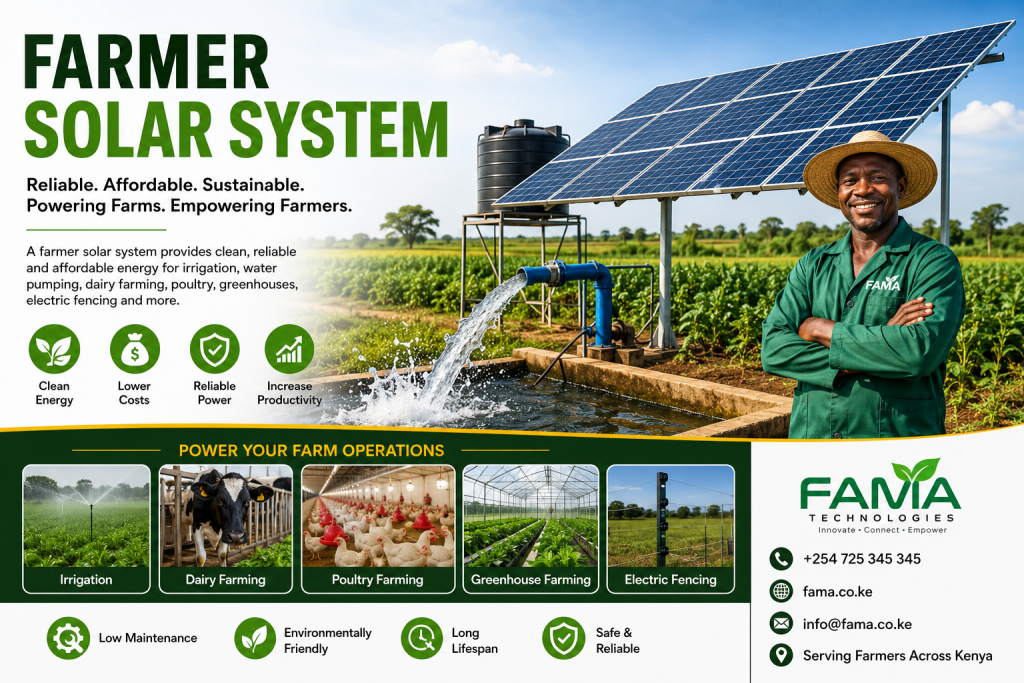
Farmer Solar System: Transforming Agriculture with Renewable Energy
Agriculture remains the backbone of Kenya’s economy, employing millions of people and contributing significantly to food security and economic growth. However, many farmers continue to face one major challenge—reliable and affordable electricity. A farmer solar system provides the perfect solution by offering clean, renewable, and cost-effective energy for everyday farming activities.
Whether you own a small vegetable farm, a dairy enterprise, a poultry project, or a large commercial farm, investing in a farmer solar system can dramatically improve productivity while reducing operational costs. Solar-powered farming is becoming increasingly popular because it enables farmers to irrigate crops, pump water, power electric fences, light farm buildings, run milk cooling equipment, and operate essential agricultural machinery without relying on expensive grid electricity or diesel generators.
At FAMA Kenya, we believe technology should empower every farmer. A properly installed farmer solar system helps farmers reduce energy bills, improve efficiency, and maximize profits throughout the year.
What Is a Farmer Solar System?
A farmer solar system is a solar energy solution specifically designed to meet agricultural energy requirements. Unlike ordinary home solar systems, farm solar installations are engineered to power equipment used in farming operations.
A complete farmer solar system generally consists of:
- Solar panels
- Solar inverter
- Deep cycle batteries
- Charge controller
- Mounting structures
- Electrical protection devices
- Wiring accessories
- Monitoring systems
These components work together to convert sunlight into electricity, store excess power, and provide reliable energy whenever required.
Farmers can choose between:
- Off-grid solar systems
- Hybrid solar systems
- Grid-tied solar systems
Each option serves different farming needs depending on farm size, electricity demand, and available infrastructure.
Why Every Farmer Needs a Farmer Solar System
Energy costs continue to rise every year. Diesel prices fluctuate regularly, while electricity tariffs increase over time. These expenses significantly affect farming profitability.
Installing a farmer solar system offers numerous long-term benefits.
Lower Operating Costs
Solar energy is free after installation. Instead of purchasing fuel every week or paying high electricity bills, farmers generate their own electricity directly from sunlight.
Reliable Power Supply
Power outages can interrupt irrigation schedules, affect milk cooling, damage hatcheries, or stop greenhouse operations.
A farmer solar system ensures continuous farm operations even during blackouts.
Increased Farm Productivity
With dependable electricity, farmers can automate many daily tasks including:
- Water pumping
- Drip irrigation
- Electric fencing
- Poultry lighting
- Dairy cooling
- Farm security
Automation saves time while increasing productivity.
Environmentally Friendly Farming
Solar energy produces zero emissions.
A farmer solar system helps reduce environmental pollution while supporting sustainable agriculture.
How a Farmer Solar System Works
Understanding how a farmer solar system operates helps farmers appreciate its value.
The process follows several simple steps:
Step 1: Solar Panels Collect Sunlight
Solar panels absorb sunlight during the day.
They convert solar radiation into direct current (DC) electricity.
Step 2: Charge Controller Regulates Power
The controller manages battery charging.
It prevents:
- Overcharging
- Deep discharge
- Voltage fluctuations
Step 3: Batteries Store Energy
Any unused electricity is stored inside batteries.
This stored power becomes available:
- At night
- During cloudy weather
- During power outages
Step 4: Inverter Converts Electricity
Most farm equipment requires alternating current (AC).
The inverter converts DC electricity into AC electricity.
Step 5: Farm Equipment Uses Electricity
The electricity powers various farming operations efficiently throughout the day.
Applications of a Farmer Solar System
One reason the farmer solar system has become popular is its versatility.
Solar Water Pumping
Water is essential for successful farming.
Solar-powered pumps eliminate fuel costs while supplying water for:
- Irrigation
- Livestock
- Domestic farm use
- Fish ponds
Farmers enjoy uninterrupted water supply during sunny days.
Solar Irrigation Systems
Climate change has increased drought frequency across Kenya.
A farmer solar system makes irrigation affordable by powering:
- Drip irrigation
- Sprinkler irrigation
- Pivot irrigation
- Greenhouse irrigation
Reliable irrigation increases crop yields significantly.
Dairy Farming
Modern dairy farms require electricity for:
- Milk cooling
- Water pumping
- Lighting
- Electric fencing
- Milking equipment
A properly sized farmer solar system provides dependable energy while lowering operating expenses.
Poultry Farming
Poultry production depends on reliable electricity.
Solar systems power:
- Brooders
- Incubators
- Ventilation fans
- Security lighting
- Automatic feeders
- Drinking systems
Consistent power improves bird health and productivity.
Greenhouse Farming
Greenhouses often require:
- Irrigation pumps
- Ventilation fans
- Temperature control
- Humidity monitoring
- Lighting systems
A farmer solar system ensures uninterrupted greenhouse operations throughout the growing season.
Fish Farming
Fish ponds require continuous water circulation.
Solar energy powers:
- Aerators
- Pumps
- Water filtration systems
Healthy oxygen levels improve fish growth.
Types of Farmer Solar Systems
Choosing the right farmer solar system depends on farm operations.
Off-Grid Farmer Solar System
This system operates independently without utility electricity.
Suitable for:
- Remote farms
- Ranches
- Rural agricultural projects
- Livestock farms
Advantages include complete energy independence.
Hybrid Farmer Solar System
Hybrid systems combine:
- Solar panels
- Batteries
- Utility power
- Backup generators
Farmers enjoy maximum reliability.
Grid-Tied Farmer Solar System
Where electricity is available, grid-tied systems reduce electricity bills while maintaining connection to the national grid.
Ideal for commercial farms.
Benefits of Installing a Farmer Solar System
Significant Savings
After installation, solar energy dramatically reduces monthly expenses.
Many farmers recover their investment within a few years.
Increased Farm Efficiency
Farm activities continue without delays caused by power interruptions.
Operations become predictable and more productive.
Reduced Maintenance
Modern solar equipment requires minimal maintenance.
Cleaning solar panels periodically and inspecting electrical connections usually keeps the system operating efficiently for many years.
Improved Farm Security
A farmer solar system powers:
- Security lights
- CCTV cameras
- Motion sensors
- Electric fences
This improves protection against theft and wildlife intrusion.
Supports Climate-Smart Agriculture
Consumers increasingly value sustainable food production.
Solar-powered farms reduce carbon emissions while supporting environmentally responsible farming practices.
Factors to Consider Before Buying a Farmer Solar System
Every farm has unique energy requirements.
Before purchasing a farmer solar system, consider the following:
Farm Size
Larger farms usually require more electricity than smaller farms.
Daily Energy Consumption
List every electrical appliance including:
- Pumps
- Freezers
- Lighting
- Motors
- Incubators
- Computers
- CCTV
Knowing total power consumption helps determine the correct solar system size.
Future Expansion
Choose a system that can accommodate future farm growth.
Adding more solar panels later becomes easier if expansion is planned from the beginning.
Battery Backup Requirements
Some farms operate mainly during the day.
Others require overnight electricity.
Battery capacity should match operational needs.
Budget
A farmer solar system is an investment.
Higher-quality components often provide better long-term value through improved durability and efficiency.
Why Farmer Solar Systems Are Becoming Popular in Kenya
Kenyan farmers are increasingly embracing renewable energy because it offers practical solutions to common farming challenges.
Several factors are driving adoption:
- Rising fuel costs
- Frequent electricity outages
- Government support for renewable energy
- Increased awareness of climate-smart agriculture
- Declining prices of solar equipment
- Higher demand for efficient farming technologies
As a result, more farms are transitioning to solar-powered operations every year.
Why Choose FAMA Kenya for Your Farmer Solar System?
At FAMA Kenya, we specialize in delivering innovative agricultural technology solutions tailored to the needs of modern farmers. We understand that every farm has unique energy requirements, and our team helps you select the right farmer solar system based on your farm size, equipment, and future expansion plans.
Our solutions are designed to improve productivity, lower operating costs, and provide reliable renewable energy for irrigation, dairy farming, poultry farming, greenhouse production, livestock management, and other agricultural activities.
Whether you are starting a small farm or managing a large commercial agricultural enterprise, FAMA Kenya is committed to helping you achieve sustainable farming through dependable solar energy solutions.
Contact Us
FAMA Kenya
📞 Phone: +254 725345345
🌐 Website: https://fama.co.ke
End of Part 1
The next episode will cover:
- How to size a farmer solar system
- Solar system costs in Kenya
- Maintenance tips
- ROI calculations
- Common mistakes farmers make
- Frequently Asked Questions (FAQs)
- Conclusion and strong SEO call-to-action
Farmer Solar System: The Complete Guide to Solar Power for Modern Farming in Kenya (Part 2)
How to Choose the Right Farmer Solar System
Selecting the right farmer solar system is one of the most important decisions a farmer can make. Every farm has unique energy requirements depending on the size of the operation, the type of farming activities, and the electrical equipment in use. A system that is too small may fail to provide sufficient power, while an oversized system may lead to unnecessary expenses. Proper planning ensures maximum return on investment and long-term reliability.
The first step is conducting a detailed energy assessment. List every electrical appliance on the farm and note its power rating in watts. Include irrigation pumps, borehole pumps, dairy equipment, milk coolers, incubators, greenhouse fans, lighting systems, electric fences, CCTV cameras, office equipment, refrigerators, freezers, and any other electrical devices.
After identifying all equipment, calculate the total daily energy consumption. This helps determine the number of solar panels, inverter capacity, battery storage, and charge controller specifications required. Professional energy audits also consider seasonal changes, future expansion plans, and backup requirements.
A well-designed farmer solar system ensures every component works efficiently together, minimizing power losses while maximizing solar energy production.
Understanding Solar Panel Capacity
Solar panels are available in different wattage ratings. Common panels range between 300W and 700W depending on the manufacturer and technology used.
Higher wattage panels produce more electricity using less installation space. Modern monocrystalline solar panels are popular because they offer excellent efficiency and durability.
Several factors influence solar panel performance:
- Sunlight intensity
- Panel orientation
- Installation angle
- Temperature
- Dust accumulation
- Shading from trees or buildings
Proper installation ensures maximum energy production throughout the year.
Choosing the Right Solar Inverter
The inverter is the heart of every farmer solar system because it converts DC electricity generated by solar panels into AC electricity used by farm equipment.
There are several inverter options available.
Pure Sine Wave Inverters
These are ideal for farms because they produce stable electricity suitable for sensitive equipment including:
- Computers
- Milk cooling systems
- Incubators
- Water pumps
- Refrigeration units
- Farm management systems
Hybrid Inverters
Hybrid inverters combine solar power, battery storage, and utility electricity into one intelligent system.
They automatically switch between power sources depending on energy availability.
This provides uninterrupted farm operations.
Importance of Battery Storage
Battery storage enables farmers to continue working even after sunset.
Modern batteries store excess electricity produced during the day for use later.
Battery storage becomes especially important for:
- Poultry lighting
- Security lighting
- CCTV surveillance
- Night irrigation
- Dairy cooling
- Electric fencing
- Farm offices
Lithium batteries are becoming increasingly popular because they offer:
- Longer lifespan
- Faster charging
- Higher efficiency
- Lower maintenance
- Better depth of discharge
- Smaller installation space
Although they cost more initially, they often provide better long-term value than traditional lead-acid batteries.
Solar Water Pumps for Farmers
One of the most common applications of a farmer solar system is water pumping.
Solar pumps eliminate diesel expenses while providing reliable access to water for agricultural production.
Water pumps can be used for:
- Boreholes
- Rivers
- Wells
- Dams
- Water tanks
- Livestock watering
- Fish ponds
Solar-powered pumps operate automatically whenever sufficient sunlight is available.
Some systems include battery storage to allow pumping during cloudy weather or at night.
Farmer Solar System for Irrigation Projects
Irrigation is critical for consistent crop production, especially during dry seasons.
A farmer solar system provides affordable electricity for irrigation systems without recurring fuel costs.
Solar-powered irrigation supports crops such as:
- Tomatoes
- Onions
- Kale
- Spinach
- Cabbages
- Watermelons
- Maize
- Beans
- Fruits
- Flowers
Reliable irrigation helps farmers maintain healthy crops regardless of rainfall patterns.
Greenhouse Farming with Solar Energy
Greenhouse farming requires continuous environmental control.
A farmer solar system supplies electricity for:
- Ventilation fans
- Irrigation pumps
- Humidity control
- Cooling systems
- Monitoring equipment
- Automatic fertigation
- Lighting
Solar-powered greenhouses experience fewer production interruptions while reducing operational costs.
Dairy Farming Benefits
Electricity is essential in modern dairy farming.
A farmer solar system powers:
- Milking machines
- Milk cooling tanks
- Water pumps
- Cleaning equipment
- Farm lighting
- Security systems
Continuous electricity protects milk quality and reduces spoilage.
Farmers also benefit from lower electricity bills throughout the year.
Poultry Farming Benefits
Poultry farms require dependable electricity throughout the production cycle.
Solar energy powers:
- Incubators
- Brooders
- Heating systems
- Ventilation
- Feeding equipment
- Lighting schedules
- Egg storage rooms
Reliable electricity contributes to higher hatchability rates and healthier birds.
Livestock Farming Applications
Livestock farms also benefit greatly from installing a farmer solar system.
Solar power supports:
- Water pumping
- Electric fencing
- Security lighting
- Veterinary refrigeration
- CCTV monitoring
- Communication systems
Reliable electricity improves overall livestock management.
How Weather Affects Farmer Solar Systems
Solar panels perform best under direct sunlight, but they continue generating electricity even on cloudy days.
Rain provides an added benefit by naturally washing away dust and dirt from panel surfaces, improving efficiency.
Seasonal weather changes should always be considered during system design to ensure year-round performance.
Professional installers calculate average solar radiation levels before recommending system sizes.
Maintenance Tips for a Farmer Solar System
Proper maintenance helps maximize system performance and extend equipment lifespan.
Recommended maintenance includes:
Clean Solar Panels Regularly
Dust, bird droppings, pollen, and leaves reduce solar efficiency.
Cleaning panels every few weeks keeps energy production high.
Inspect Electrical Connections
Loose wiring can reduce performance or create safety hazards.
Regular inspections help identify issues early.
Monitor Battery Performance
Check battery voltage, charging cycles, and storage capacity regularly.
Healthy batteries improve system reliability.
Remove Nearby Shade
Growing trees may gradually shade solar panels.
Trim vegetation whenever necessary.
Schedule Professional Servicing
Annual inspections by qualified technicians help maintain peak performance.
Common Mistakes Farmers Make When Buying Solar Systems
Many farmers purchase solar systems without proper planning.
Common mistakes include:
Buying Cheap Equipment
Low-quality solar equipment may fail after only a few years.
Investing in quality products saves money over time.
Ignoring Future Expansion
Many farms grow over time.
Installing expandable systems allows additional solar panels and batteries to be added easily.
Underestimating Energy Needs
Failing to calculate actual electricity demand often results in overloaded systems.
Professional sizing eliminates this problem.
Poor Installation
Improper installation reduces efficiency and increases maintenance costs.
Always use experienced installers.
Neglecting Maintenance
Even the best farmer solar system requires routine maintenance.
Ignoring maintenance reduces performance.
Cost of Installing a Farmer Solar System in Kenya
The cost depends on several factors including:
- Farm size
- Daily electricity consumption
- Battery capacity
- Solar panel quantity
- Inverter size
- Water pumping requirements
- Installation complexity
Small farms generally require lower-capacity systems, while commercial agricultural enterprises require larger installations.
Although the initial investment may appear significant, the long-term savings on electricity and fuel often outweigh the installation costs.
Many farmers recover their investment through reduced operating expenses and increased productivity.
Return on Investment (ROI)
One of the greatest advantages of a farmer solar system is its excellent return on investment.
Savings come from:
- Reduced electricity bills
- Eliminated diesel expenses
- Lower maintenance costs
- Increased farm productivity
- Reduced equipment downtime
- Improved product quality
- Better irrigation efficiency
Over the lifetime of the system, these savings can greatly exceed the original installation cost.
Environmental Benefits
Solar-powered farming contributes to environmental conservation.
Benefits include:
- Reduced greenhouse gas emissions
- Lower fossil fuel consumption
- Cleaner agricultural production
- Sustainable resource management
- Improved air quality
- Reduced noise pollution
Consumers increasingly prefer products produced using environmentally responsible farming methods.
The Future of Farmer Solar Systems
Renewable energy continues transforming agriculture around the world.
Future developments include:
- Smart solar monitoring
- AI-powered energy management
- Remote system diagnostics
- Internet-connected irrigation
- Automated farm control
- Battery technology improvements
- Higher-efficiency solar panels
- Lower installation costs
These innovations will make farmer solar systems even more valuable for both small-scale and commercial farmers.
Why Choose FAMA Kenya?
FAMA Kenya is committed to helping farmers adopt reliable, efficient, and sustainable agricultural technologies. Our experienced team provides tailored solar solutions that match your farm’s specific energy needs, ensuring optimal performance and long-term value.
Our services include:
- Farm energy assessments
- Professional solar system design
- Solar water pumping solutions
- Irrigation system integration
- Installation services
- Maintenance and technical support
- System upgrades and expansion
- Expert consultation
Whether you operate a dairy farm, poultry project, greenhouse, horticultural enterprise, fish farm, or mixed agricultural business, FAMA Kenya has the expertise to help you transition to renewable energy successfully.
Frequently Asked Questions (FAQs)
How long does a farmer solar system last?
High-quality solar panels typically last 25 years or more. Inverters generally last 10–15 years, while lithium batteries can provide 10–15 years of dependable service with proper care.
Can a farmer solar system run a borehole pump?
Yes. Properly sized solar systems can efficiently power borehole pumps for irrigation, livestock watering, and domestic farm water supply.
Will the system work during cloudy weather?
Yes. Solar panels still generate electricity under cloudy conditions, although production is lower than on bright sunny days. Battery storage also helps maintain power availability.
Is maintenance expensive?
No. Routine cleaning, periodic inspections, and occasional servicing are generally sufficient to keep the system operating efficiently.
Can I expand my system later?
Absolutely. Most professionally designed systems can be expanded by adding more solar panels, batteries, or inverter capacity as your farm grows.
Is a farmer solar system suitable for small farms?
Yes. Solar solutions are available for farms of all sizes, from small family farms to large commercial agricultural operations.
Can solar reduce my farming costs?
Yes. By replacing or reducing dependence on diesel generators and grid electricity, farmers can significantly lower operating expenses over the life of the system.
Conclusion
A farmer solar system is more than an alternative power source—it is a strategic investment in the future of agriculture. By harnessing abundant solar energy, farmers can reduce production costs, improve operational efficiency, increase profitability, and build resilience against rising fuel prices and unreliable electricity supplies.
Whether your goal is to power irrigation systems, dairy equipment, poultry houses, greenhouse operations, livestock facilities, or complete farm infrastructure, solar technology offers a dependable and environmentally friendly solution. As renewable energy technologies continue to advance, adopting a farmer solar system today positions your farm for long-term success.
If you are ready to modernize your agricultural operations with reliable solar energy, FAMA Kenya is here to help. Our experienced team will assess your energy needs, recommend the ideal system, and provide professional installation and ongoing support.
Contact FAMA Kenya Today
Website: fama.co.ke
Phone: +254 725345345
Start your journey toward sustainable, efficient, and profitable farming with a professionally designed farmer solar system from FAMA Kenya.