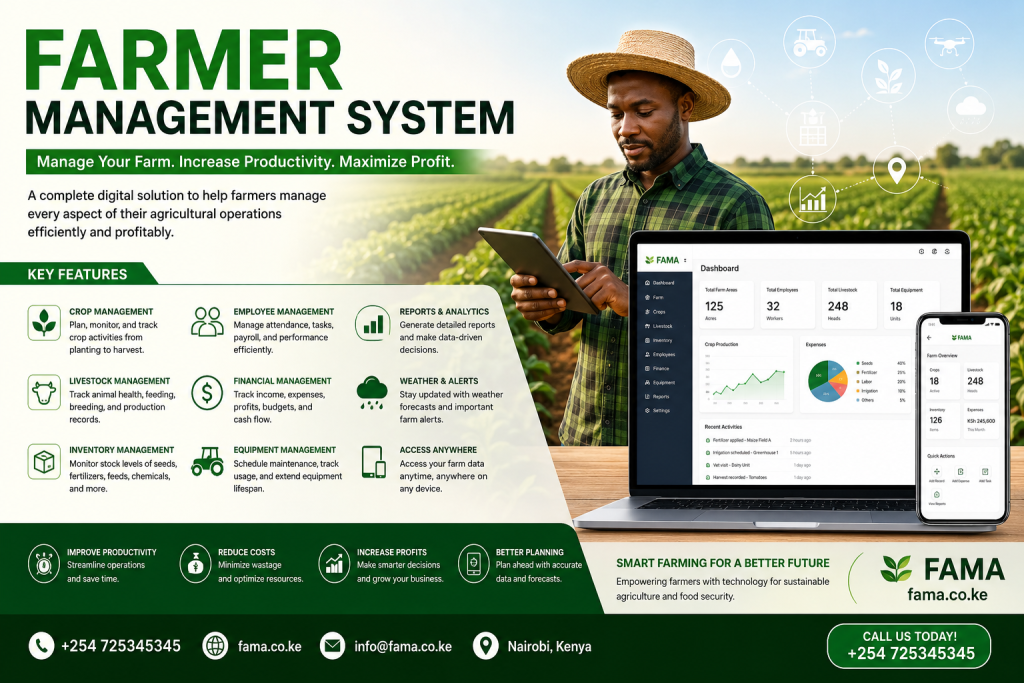
Running a successful farm today requires more than hard work. Farmers must keep accurate records, monitor production, manage workers, track expenses, forecast profits, and make informed decisions. This is where a farmer management system becomes essential. Whether you operate a small family farm or a large commercial agricultural enterprise, a farmer management system helps streamline operations, increase productivity, and maximize profitability.
At FAMA, we provide innovative agricultural management solutions that simplify farming operations and empower farmers through digital technology. If you are looking for a reliable farmer management system in Kenya, our solutions are designed to help you manage every aspect of your farming business efficiently.
Need professional assistance? Contact FAMA today at +254 725345345 for customized farmer management system solutions.
What is a Farmer Management System?
A farmer management system is a software platform designed to help farmers organize, monitor, and manage every activity taking place on a farm. Instead of relying on notebooks, spreadsheets, or memory, farmers use a centralized system that stores all farm information in one place.
A modern farmer management system can manage:
- Crop production
- Livestock management
- Farm employees
- Farm inventory
- Equipment maintenance
- Financial records
- Farm budgeting
- Harvest planning
- Sales tracking
- Customer management
- Supplier management
- Farm reports
- Weather monitoring
- Irrigation scheduling
Using a farmer management system allows farmers to improve efficiency while reducing operational costs and increasing productivity.
Why Every Modern Farm Needs a Farmer Management System
Agriculture has become increasingly competitive. Farmers who embrace technology often outperform those who continue using manual systems.
A farmer management system helps farmers make better decisions using accurate data instead of assumptions.
Some of the biggest reasons farmers are adopting a farmer management system include:
- Better farm organization
- Improved record keeping
- Higher crop yields
- Reduced wastage
- Better employee accountability
- Easier financial management
- Improved planning
- Accurate production tracking
- Increased profitability
- Compliance with agricultural standards
As farming becomes more data-driven, investing in a farmer management system is becoming less of a luxury and more of a necessity.
How a Farmer Management System Works
A farmer management system collects information from every farm activity and organizes it into useful reports.
For example, when a farmer plants maize, the system records:
- Planting date
- Seed variety
- Farm section
- Fertilizer applied
- Labor used
- Irrigation schedule
- Expected harvest date
- Estimated yield
- Production cost
As the season progresses, the farmer management system continuously updates records.
By harvest time, the farmer already knows:
- Total production
- Cost of production
- Profit margin
- Stock available
- Market value
- Sales performance
This makes planning for future seasons much easier.
Key Features of a Farmer Management System
Farm Record Management
One of the most important features of a farmer management system is centralized record keeping.
Instead of storing information in multiple notebooks, farmers can access everything from one dashboard.
Records may include:
- Farm activities
- Daily operations
- Worker attendance
- Fertilizer application
- Pesticide usage
- Harvest records
- Livestock records
- Sales history
This improves transparency and simplifies reporting.
Crop Management
Crop production requires continuous monitoring throughout the growing season.
A farmer management system helps farmers monitor:
- Planting schedules
- Seed varieties
- Field mapping
- Soil preparation
- Fertilizer application
- Irrigation schedules
- Pest control
- Disease management
- Crop growth
- Harvest planning
With proper monitoring, crop productivity significantly improves.
Livestock Management
Livestock farmers also benefit greatly from a farmer management system.
The software can track:
- Animal identification
- Breed information
- Vaccination records
- Feeding schedules
- Milk production
- Breeding history
- Health records
- Weight monitoring
- Veterinary visits
- Animal sales
This information helps improve livestock productivity while reducing disease risks.
Employee Management
Managing farm workers can become difficult as the farm grows.
A farmer management system simplifies workforce management by recording:
- Employee profiles
- Attendance
- Daily tasks
- Payroll
- Performance
- Overtime
- Leave records
- Work schedules
Managers can easily monitor productivity and improve accountability.
Farm Inventory Management
Every farm uses numerous supplies.
A farmer management system keeps track of:
- Seeds
- Fertilizers
- Chemicals
- Animal feeds
- Veterinary drugs
- Fuel
- Farm tools
- Machinery spare parts
The system automatically updates stock levels whenever supplies are issued or purchased.
This prevents stock shortages and reduces wastage.
Equipment Management
Farm machinery represents a significant investment.
A farmer management system monitors equipment including:
- Tractors
- Harvesters
- Irrigation pumps
- Generators
- Sprayers
- Water tanks
- Vehicles
Maintenance schedules can also be automated to reduce breakdowns.
Financial Management Using a Farmer Management System
Financial control is one of the greatest benefits of implementing a farmer management system.
The software records:
- Income
- Expenses
- Supplier payments
- Customer invoices
- Cash flow
- Farm budgets
- Profit analysis
- Cost analysis
- Loan repayments
- Investment tracking
Farm owners can clearly understand whether their farming enterprise is profitable.
Benefits of Using a Farmer Management System
Better Decision Making
Accurate information allows farmers to make better decisions regarding planting, harvesting, budgeting, and investments.
Instead of relying on guesswork, the farmer management system provides real-time insights.
Increased Productivity
By organizing farm activities efficiently, farmers complete tasks on time.
Proper planning leads to:
- Better planting schedules
- Timely fertilizer application
- Efficient harvesting
- Improved livestock care
This directly increases productivity.
Improved Profitability
A farmer management system identifies areas where costs can be reduced.
Examples include:
- Reducing fertilizer waste
- Minimizing labor inefficiencies
- Lowering machinery maintenance costs
- Reducing inventory losses
- Improving market timing
These savings significantly improve profits.
Easier Compliance
Many agricultural organizations require proper documentation.
A farmer management system makes compliance easier by generating reports instantly.
This is particularly useful for:
- Export farms
- Agricultural cooperatives
- Government reporting
- Food safety certification
- Organic farming certification
Enhanced Farm Planning
Planning becomes easier because the farmer management system stores historical farm data.
Farmers can compare:
- Previous harvests
- Rainfall patterns
- Fertilizer usage
- Production costs
- Market prices
This information supports better future planning.
Who Needs a Farmer Management System?
A farmer management system is suitable for nearly every agricultural operation, including:
- Small-scale farmers
- Medium-sized farms
- Commercial farms
- Dairy farms
- Poultry farms
- Pig farms
- Goat farms
- Sheep farms
- Fish farms
- Greenhouse farms
- Coffee farms
- Tea farms
- Horticulture farms
- Fruit farms
- Vegetable farms
- Mixed farming enterprises
- Agricultural cooperatives
- Farm consultants
- Agricultural NGOs
- Agricultural training institutions
Regardless of the size of the operation, implementing a farmer management system helps improve efficiency, transparency, and long-term sustainability.
Why Choose FAMA for Your Farmer Management System?
At FAMA, we understand the unique challenges faced by farmers in Kenya. Our farmer management system is designed to simplify daily farm operations, improve record keeping, enhance productivity, and support informed decision-making. Whether you manage crops, livestock, or a mixed farm, our solution can be tailored to meet your specific needs.
We also provide implementation support, user training, and ongoing technical assistance to ensure you get the maximum value from your investment.
Call us today on +254 725345345 to learn how our farmer management system can transform your farming business.
How to Successfully Implement a Farm Management Solution
Adopting digital tools is not simply about installing software. It requires proper planning, staff training, and continuous improvement to achieve long-term success. Every farm has unique operations, so implementation should be tailored to the specific needs of the business.
1. Assess Your Current Operations
Begin by evaluating how your farm currently operates. Identify areas where records are still kept manually, tasks are difficult to monitor, or information is frequently lost. This assessment helps determine which processes should be digitized first.
Questions to ask include:
- How are production records maintained?
- How are employee activities tracked?
- Is inventory updated regularly?
- How are farm expenses recorded?
- Can management quickly generate reports?
- Are harvest forecasts accurate?
Understanding existing gaps allows for a smoother transition.
2. Define Clear Objectives
Before implementation, establish measurable goals.
Examples include:
- Reduce paperwork by 90%
- Improve production monitoring
- Minimize inventory losses
- Enhance employee accountability
- Improve financial reporting
- Increase overall operational efficiency
Having defined objectives makes it easier to measure success.
3. Digitize Historical Records
Historical farm records are valuable because they provide insights into long-term performance.
Data worth migrating includes:
- Previous harvest quantities
- Livestock production records
- Financial statements
- Customer information
- Supplier records
- Equipment maintenance history
- Employee records
Maintaining historical information allows management to analyze trends over multiple farming seasons.
4. Train Every User
Technology is only effective when people know how to use it correctly.
Training should cover:
- Daily data entry
- Report generation
- Inventory updates
- Financial recording
- Production monitoring
- Equipment scheduling
- Employee management
Regular refresher training ensures consistent usage across the organization.
Common Challenges During Digital Transformation
Although digital solutions offer enormous advantages, farms may experience several challenges during implementation.
Resistance to Change
Employees who have worked with manual records for years may initially resist new technology.
The best solution is involving staff throughout the implementation process and demonstrating how technology simplifies their daily work.
Poor Data Quality
If incorrect information is entered into the system, reports become unreliable.
Managers should establish procedures for:
- Data verification
- Daily updates
- Regular audits
- User accountability
Accurate information produces accurate decisions.
Limited Internet Connectivity
Some rural farming areas experience unstable internet connections.
Modern agricultural software should support offline functionality where possible, allowing data to synchronize once connectivity returns.
Budget Constraints
Some farm owners postpone adopting technology because of perceived costs.
However, the long-term savings from improved productivity, lower wastage, better planning, and accurate financial management often outweigh the initial investment.
Best Practices for Farm Record Management
Effective farm management depends on consistent record keeping.
Recommended practices include:
Record Activities Daily
Waiting several days before entering information increases the likelihood of forgotten details and inaccurate reports.
Daily updates provide real-time visibility into farm operations.
Standardize Data Collection
All employees should follow the same recording procedures.
Examples include:
- Using identical units of measurement
- Recording dates consistently
- Following standard naming conventions
- Using approved inventory descriptions
Consistency improves reporting accuracy.
Perform Regular Backups
Digital records represent valuable business assets.
Regular backups protect information from:
- Hardware failures
- Power outages
- Accidental deletion
- Cybersecurity incidents
Cloud-based storage offers additional protection.
Review Reports Frequently
Generating reports is not enough.
Management should routinely analyze:
- Monthly expenses
- Revenue trends
- Production performance
- Employee productivity
- Inventory movement
- Equipment maintenance costs
Frequent review enables early identification of problems before they become expensive.
Improving Farm Profitability
Technology alone does not increase profits.
Profitability improves when managers use available information to make smarter operational decisions.
Some proven strategies include:
Reduce Input Waste
Carefully monitor usage of:
- Seeds
- Fertilizers
- Chemicals
- Animal feeds
- Fuel
Reducing unnecessary consumption lowers production costs.
Optimize Labor Allocation
Understanding employee workloads helps assign workers efficiently.
This minimizes overtime while ensuring critical farm activities are completed on schedule.
Improve Harvest Planning
Harvesting at the right time reduces crop losses and improves produce quality.
Better planning also allows sufficient labor, transport, and storage arrangements.
Monitor Production Costs
Every farming activity incurs costs.
Understanding production expenses per acre, greenhouse, field, or livestock unit enables managers to identify profitable and unprofitable operations.
Strengthen Customer Relationships
Maintaining accurate customer records allows farms to:
- Deliver orders on time
- Track outstanding payments
- Improve communication
- Encourage repeat business
Satisfied customers often become long-term buyers.
Environmental Sustainability
Modern agriculture increasingly focuses on sustainability.
Digital farm management supports environmentally responsible practices by improving resource utilization.
Examples include:
Water Conservation
Monitoring irrigation schedules helps avoid overwatering while maintaining healthy crop growth.
This reduces water consumption and lowers pumping costs.
Responsible Fertilizer Application
Applying fertilizers according to crop requirements prevents excessive usage that may contaminate soil and nearby water sources.
Efficient Chemical Usage
Proper scheduling reduces unnecessary pesticide application while supporting healthier crops and safer food production.
Reduced Fuel Consumption
Monitoring machinery utilization helps eliminate unnecessary equipment movements across the farm.
Lower fuel usage reduces operating costs and environmental impact.
Data-Driven Decision Making
One of the greatest advantages of digital agriculture is access to reliable information.
Instead of relying solely on experience or assumptions, managers can use measurable indicators when making decisions.
Examples include:
- Comparing production between seasons
- Evaluating employee performance
- Forecasting future demand
- Planning expansion projects
- Scheduling equipment replacement
- Identifying profitable crops
- Monitoring livestock productivity
Reliable information reduces uncertainty and improves long-term planning.
Emerging Technologies in Agriculture
Agriculture continues evolving rapidly as new technologies become more accessible.
Some innovations shaping the future include:
Artificial Intelligence
AI systems can analyze historical production data to recommend planting schedules, predict diseases, estimate yields, and optimize farm operations.
Drones
Agricultural drones assist with:
- Crop monitoring
- Field mapping
- Disease detection
- Fertilizer application
- Spraying operations
Drone imagery enables faster identification of problem areas.
Internet of Things (IoT)
Connected sensors continuously collect information such as:
- Soil moisture
- Temperature
- Humidity
- Water levels
- Livestock movement
Managers receive real-time alerts whenever conditions require attention.
Satellite Monitoring
Satellite imagery provides large-scale monitoring of crop development and vegetation health.
Farm managers can quickly identify stress areas requiring intervention.
Predictive Analytics
Advanced analytics estimate future outcomes based on historical patterns.
Predictions may include:
- Expected yields
- Market demand
- Rainfall trends
- Resource requirements
- Production costs
This improves strategic planning.
Frequently Asked Questions
Can small farms benefit from digital management?
Yes. Even family-owned farms gain significant benefits through improved organization, accurate financial records, better planning, and easier reporting.
Is internet access always required?
Many modern platforms support offline data entry and synchronize information once internet connectivity becomes available.
Can multiple users access the system?
Yes. Farm owners, managers, accountants, supervisors, and authorized employees can often access different parts of the platform based on assigned permissions.
How secure is farm data?
Reliable solutions use password protection, encrypted communication, regular backups, and user permissions to safeguard valuable business information.
Is training necessary?
Absolutely. Proper training ensures users understand how to enter information correctly, generate reports, and maximize the benefits of the system.
Can the platform grow with the farm?
Yes. As farms expand, additional users, production units, inventory categories, equipment, and reporting modules can typically be added without disrupting existing operations.
Final Thoughts
Agriculture is becoming increasingly knowledge-driven. Success no longer depends solely on favorable weather, fertile land, or hard work. Efficient planning, accurate information, sound financial management, and timely decision-making have become equally important.
Digital management solutions provide farmers with better visibility into every aspect of their operations. From production planning and inventory management to employee supervision and financial reporting, having centralized information enables managers to identify opportunities, solve problems quickly, and operate more efficiently.
Whether managing crops, livestock, horticulture, dairy production, poultry, aquaculture, or mixed farming enterprises, adopting modern technology creates a strong foundation for sustainable growth. Farms that embrace digital transformation are often better positioned to improve productivity, reduce operational costs, strengthen customer relationships, and remain competitive in an increasingly data-driven agricultural sector.
As the agricultural industry continues to evolve with artificial intelligence, automation, drones, satellite imagery, and smart sensors, digital management platforms will become even more valuable. Investing in technology today prepares farms for tomorrow’s challenges while supporting long-term profitability and resilience.
For professional farm management solutions tailored to your agricultural operations, FAMA is ready to help. Our experienced team provides implementation support, user training, customization, and ongoing technical assistance to help your farming business achieve greater efficiency and sustainable success.
Contact FAMA today
Phone: +254 725345345
Website: fama.co.ke