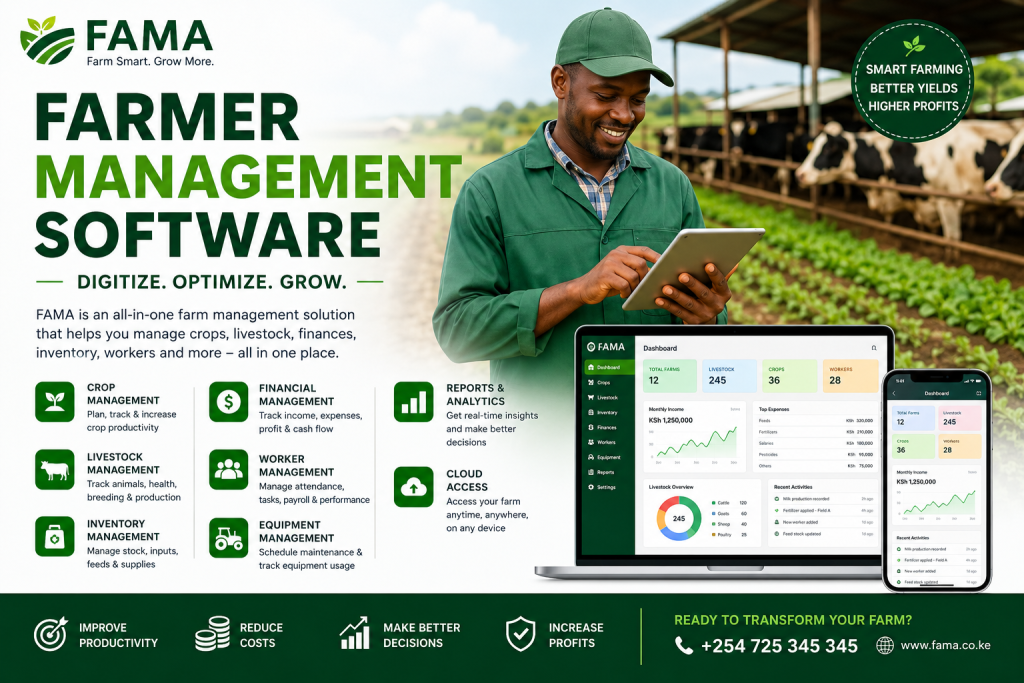
Farmer Management Software: Transforming Agriculture Through Smart Farm Management

Farmer Management Software

Agriculture is rapidly becoming more data-driven than ever before. Farmers no longer rely solely on notebooks, memory, or spreadsheets to manage their daily farm activities. Instead, many successful farms are embracing Farmer Management Software to simplify operations, increase productivity, improve decision-making, and maximize profitability.

Whether you manage a dairy farm, poultry farm, horticulture business, mixed farm, ranch, greenhouse, or large commercial agricultural enterprise, investing in Farmer Management Software is becoming a necessity rather than a luxury.

For Kenyan farmers especially, digital transformation is changing how farms operate. From tracking livestock records to monitoring crop performance, managing workers, recording expenses, scheduling irrigation, and generating financial reports, Farmer Management Software provides everything farmers need in one centralized platform.

If you’re looking for an all-in-one solution designed for modern farming, visit FAMA at fama.co.ke or contact us today at +254 725345345.


Table of Contents

What is Farmer Management Software?

Farmer Management Software is a digital platform designed to help farmers organize, monitor, automate, and optimize every aspect of farm operations.

Instead of maintaining multiple notebooks and manual records, farmers use one centralized system to manage:

  • Crop production
  • Livestock management
  • Farm inventory
  • Financial records
  • Employee management
  • Equipment maintenance
  • Irrigation scheduling
  • Fertilizer application
  • Harvest planning
  • Sales management
  • Customer management
  • Supplier records
  • Farm analytics
  • Production forecasting

The primary objective of Farmer Management Software is to make farming more organized, profitable, and sustainable.


Why Modern Farms Need Farmer Management Software

Agriculture has become increasingly competitive. Rising input costs, unpredictable weather patterns, labor shortages, and fluctuating market prices require farmers to make smarter decisions.

Without proper record keeping, many farms experience:

  • Poor financial management
  • Inventory losses
  • Low productivity
  • Employee inefficiencies
  • Difficulty tracking profits
  • Crop diseases spreading unnoticed
  • Livestock performance challenges
  • Missed planting schedules
  • Poor harvest planning

Using Farmer Management Software solves these problems by providing accurate, real-time information for every farm activity.

Instead of guessing, farmers make decisions based on actual farm data.


How Farmer Management Software Works

A typical Farmer Management Software platform integrates every farm department into one system.

For example:

A farmer records planting activities.

The software schedules irrigation.

Fertilizer applications are tracked.

Workers record daily activities.

Harvest estimates are generated.

Sales are recorded.

Profit reports are automatically calculated.

Everything remains connected, reducing paperwork while improving accuracy.


Key Features of Farmer Management Software

The best Farmer Management Software includes powerful tools that simplify everyday farm management.

Crop Management

Crop management features allow farmers to monitor every stage of production.

These include:

  • Planting dates
  • Seed varieties
  • Field mapping
  • Fertilizer schedules
  • Irrigation schedules
  • Pest management
  • Disease monitoring
  • Harvest forecasting
  • Crop rotation planning

Proper crop management significantly improves productivity while reducing losses.


Livestock Management

Livestock farmers benefit enormously from Farmer Management Software.

The software helps track:

  • Animal identification
  • Breed information
  • Birth records
  • Vaccinations
  • Medical history
  • Weight monitoring
  • Milk production
  • Feeding schedules
  • Breeding cycles
  • Pregnancy records
  • Mortality reports

Whether managing dairy cattle, beef cattle, goats, sheep, pigs, poultry, rabbits, or fish farming, accurate livestock records increase profitability.


Farm Financial Management

One of the strongest advantages of Farmer Management Software is financial tracking.

Farmers can record:

  • Expenses
  • Income
  • Sales
  • Purchases
  • Loans
  • Payroll
  • Operating costs
  • Equipment expenses
  • Fuel usage
  • Veterinary costs

Financial dashboards instantly reveal whether the farm is making profits or losses.


Inventory Management

Inventory often represents a significant investment.

Farmer Management Software tracks:

  • Fertilizers
  • Seeds
  • Chemicals
  • Animal feeds
  • Vaccines
  • Spare parts
  • Fuel
  • Packaging materials
  • Harvest storage

Farm managers receive alerts before stock runs out.


Worker Management

Large farms employ numerous workers.

Managing attendance manually can be difficult.

Farmer Management Software allows managers to track:

  • Employee attendance
  • Daily assignments
  • Performance
  • Payroll
  • Leave management
  • Productivity reports
  • Department allocation

This improves accountability throughout the farm.


Equipment Management

Farm machinery is expensive.

The software helps monitor:

  • Tractors
  • Irrigation pumps
  • Generators
  • Harvesters
  • Sprayers
  • Vehicles

Managers receive maintenance reminders before breakdowns occur.

Preventive maintenance reduces repair costs.


Benefits of Farmer Management Software

Implementing Farmer Management Software creates numerous long-term benefits.

Better Decision Making

Every decision becomes data-driven.

Managers know:

  • Which crops perform best
  • Which livestock generate more profit
  • Which fields need attention
  • Which employees perform better
  • Which inputs cost the most

Reliable information improves planning.


Increased Productivity

Automation reduces repetitive work.

Farm managers spend less time on paperwork and more time improving production.

Tasks become easier to schedule and monitor.


Higher Profits

Because expenses are monitored closely, farmers quickly identify unnecessary costs.

Better planning results in:

  • Increased yields
  • Reduced wastage
  • Better pricing
  • Lower operational costs

Profitability improves significantly.


Improved Record Keeping

One of the greatest strengths of Farmer Management Software is centralized record management.

Instead of searching through notebooks, every record is available instantly.

Historical records help compare performance over multiple seasons.


Enhanced Traceability

Consumers increasingly demand food traceability.

Farmer Management Software records:

  • Planting dates
  • Fertilizer usage
  • Chemical applications
  • Harvest dates
  • Storage history
  • Distribution records

This supports food safety standards.


Who Needs Farmer Management Software?

Many people assume digital farm systems are only for large commercial farms.

That is no longer true.

Today, Farmer Management Software benefits:

  • Small-scale farmers
  • Medium-sized farms
  • Large commercial farms
  • Dairy farms
  • Poultry farms
  • Pig farms
  • Goat farms
  • Fish farms
  • Coffee farms
  • Tea farms
  • Flower farms
  • Fruit farms
  • Vegetable farms
  • Greenhouses
  • Export farms
  • Agricultural cooperatives
  • Farm consultants
  • Agricultural training institutions

Every farming business can improve efficiency through digital management.


Farmer Management Software for Crop Farmers

Crop farmers face many challenges:

  • Rainfall uncertainty
  • Pest outbreaks
  • Input costs
  • Market fluctuations
  • Labor shortages

Using Farmer Management Software, crop farmers can:

  • Plan planting calendars
  • Schedule irrigation
  • Track fertilizer applications
  • Monitor diseases
  • Record pesticide usage
  • Forecast harvests
  • Compare seasonal performance
  • Analyze profitability per field

These insights improve farm performance every season.


Farmer Management Software for Dairy Farms

Dairy farming requires detailed daily records.

The software helps dairy farmers monitor:

  • Milk production
  • Artificial insemination
  • Calving records
  • Feeding schedules
  • Veterinary treatments
  • Mastitis management
  • Heat detection
  • Animal performance

Managers can easily identify high-producing animals while improving herd genetics.


Farmer Management Software for Poultry Farms

Poultry farmers manage thousands of birds.

Manual record keeping becomes impossible.

Farmer Management Software simplifies:

  • Feed consumption
  • Egg production
  • Mortality rates
  • Vaccination schedules
  • Broiler growth
  • Medication records
  • Sales
  • Inventory

This improves production planning and profitability.


Why Kenyan Farmers Are Adopting Farmer Management Software

Kenyan agriculture is becoming increasingly technology-driven.

Farmers want solutions that help them:

  • Reduce production costs
  • Increase yields
  • Improve accountability
  • Access accurate reports
  • Make informed business decisions
  • Reduce paperwork
  • Improve sustainability

With smartphones becoming more common, accessing Farmer Management Software has never been easier.

Cloud-based systems allow farm owners to monitor operations from anywhere.


Why Choose FAMA Farmer Management Software?

FAMA provides a comprehensive Farmer Management Software solution built to meet the needs of modern farms in Kenya.

With FAMA, farmers can:

  • Digitize farm records
  • Manage crops and livestock
  • Monitor expenses and income
  • Track inventory
  • Manage employees
  • Generate detailed reports
  • Improve operational efficiency
  • Increase profitability
  • Access farm information anytime

Whether you operate a small family farm or a large agricultural enterprise, FAMA provides the tools needed to streamline farm management.

For demonstrations, pricing, or consultations, contact FAMA today at +254 725345345.

Cloud-Based Farm Management: Access Your Farm Anytime, Anywhere

One of the biggest advantages of modern agricultural technology is cloud computing. Unlike traditional desktop applications that store data on a single computer, cloud-based systems securely store farm information online, allowing authorized users to access it from virtually anywhere with an internet connection.

This flexibility is especially valuable for farm owners who manage multiple properties or travel frequently. Instead of relying on phone calls or handwritten reports, they can monitor farm activities through a computer, tablet, or smartphone.

Cloud technology offers several important advantages, including:

  • Automatic data backup
  • Multi-user access
  • Improved data security
  • Real-time updates
  • Reduced paperwork
  • Easier collaboration between farm managers and owners
  • Faster reporting
  • Simplified software updates

Whether managing one farm or several across different counties, centralized access helps maintain consistency while improving oversight.


Mobile Accessibility for Farm Managers

Agriculture doesn’t happen behind a desk. Farm managers spend much of their time in fields, greenhouses, livestock sheds, warehouses, and production areas. Mobile access allows important information to be available exactly where it is needed.

With mobile functionality, users can:

  • Record daily field activities
  • Update livestock records immediately
  • Check inventory levels
  • Approve purchases
  • Assign tasks to workers
  • Monitor irrigation schedules
  • Capture field photos
  • Record pest outbreaks
  • Update harvest information
  • Review production reports

Instead of waiting until the end of the day to update records, information can be entered instantly, reducing errors and improving accuracy.


Real-Time Reporting and Farm Analytics

Good decisions are based on reliable information. One of the greatest strengths of modern farm management solutions is the ability to generate reports automatically without spending hours compiling spreadsheets.

Useful reports include:

Production Reports

Production reports provide detailed information on:

  • Crop performance
  • Livestock output
  • Milk production
  • Egg collection
  • Harvest volumes
  • Feed consumption

These reports help managers identify trends and opportunities for improvement.

Financial Reports

Financial reports make it easier to understand the overall health of the farming business by showing:

  • Revenue
  • Operating expenses
  • Profit margins
  • Cash flow
  • Outstanding payments
  • Budget performance

Having this information readily available supports better financial planning and investment decisions.

Labour Performance Reports

Employee productivity has a direct impact on farm profitability. Reporting tools can highlight:

  • Attendance records
  • Task completion
  • Daily productivity
  • Department performance
  • Payroll summaries
  • Labour costs

This improves accountability while helping managers allocate resources more efficiently.


Better Planning Through Historical Data

Successful farming requires learning from previous seasons. Historical records provide valuable insights that help improve future planning.

By reviewing past data, farmers can determine:

  • Which crop varieties produced the highest yields
  • Which fields consistently perform well
  • The best planting periods
  • Seasonal rainfall trends
  • Fertilizer application effectiveness
  • Pest and disease patterns
  • Harvest timing
  • Sales performance

Rather than making assumptions, future decisions are supported by accurate historical information.


Inventory Control Made Simple

Managing inventory is often overlooked, yet it has a significant impact on operational costs.

An organized inventory system allows managers to monitor:

  • Seed stock
  • Fertilizers
  • Animal feeds
  • Agrochemicals
  • Veterinary medicines
  • Packaging materials
  • Spare parts
  • Fuel supplies
  • Farm tools

Automated stock monitoring reduces wastage, prevents shortages, and minimizes unnecessary purchases.

Receiving alerts before inventory reaches critical levels also helps avoid disruptions during important farming activities.


Equipment Maintenance Scheduling

Farm machinery represents a major investment and requires regular servicing to remain productive.

Instead of waiting for equipment to fail, maintenance schedules can be planned in advance.

Maintenance records may include:

  • Service dates
  • Oil changes
  • Filter replacements
  • Engine inspections
  • Tyre replacements
  • Repair history
  • Fuel usage
  • Maintenance costs

Preventive maintenance extends equipment lifespan while reducing costly breakdowns during peak production periods.


Managing Multiple Farms Efficiently

Many agricultural businesses operate more than one farm. Without centralized management, coordinating operations becomes increasingly difficult.

A digital platform allows managers to monitor multiple locations through a single dashboard.

This includes:

  • Production across all farms
  • Inventory levels
  • Staff allocation
  • Machinery utilization
  • Financial performance
  • Harvest schedules
  • Livestock numbers
  • Input consumption

Centralized management creates better visibility while simplifying decision-making.


Improving Compliance and Record Keeping

Agricultural businesses increasingly need accurate records for certification programs, export markets, financial institutions, and regulatory authorities.

Well-maintained records support:

  • Farm audits
  • Quality assurance
  • Food safety programs
  • Organic certification
  • GAP compliance
  • Insurance claims
  • Loan applications
  • Investor reporting

Digital documentation reduces the risk of missing or incomplete records.


Improving Sustainability Through Better Farm Management

Sustainability has become an important priority for modern agriculture. Better management practices help farms reduce waste while protecting natural resources.

Examples include:

Water Conservation

Efficient irrigation scheduling helps reduce unnecessary water usage while maintaining healthy crops.

Responsible Fertilizer Use

Monitoring fertilizer applications prevents excessive use, reducing costs and environmental impact.

Better Chemical Management

Recording pesticide applications helps ensure recommended application intervals are followed, improving both safety and crop quality.

Reduced Waste

Improved planning minimizes spoilage, expired inventory, and production losses.


Data Security Matters

Farm information is one of the most valuable assets within an agricultural business.

Important records include:

  • Financial information
  • Production data
  • Customer records
  • Supplier contacts
  • Employee information
  • Livestock history
  • Crop records

Modern systems typically include security measures such as:

  • User authentication
  • Role-based permissions
  • Secure cloud storage
  • Automatic backups
  • Activity logs

These protections reduce the likelihood of accidental data loss or unauthorized access.


Common Challenges Solved Through Digital Farm Management

Many farms experience similar operational challenges regardless of their size.

Common issues include:

  • Missing records
  • Duplicate purchases
  • Stock shortages
  • Poor communication
  • Delayed reporting
  • Labour inefficiencies
  • Inaccurate financial tracking
  • Equipment downtime
  • Production inconsistencies

Organized digital workflows help reduce these challenges while creating smoother day-to-day operations.


Choosing the Right Farm Management Solution

Selecting the right software involves more than comparing prices. Farmers should evaluate several factors before making a decision.

Consider the following:

Ease of Use

The system should be simple enough for managers and employees to learn quickly.

Scalability

Choose a solution that can grow alongside your farming business.

Reporting Capabilities

Comprehensive reporting helps support better planning and informed decision-making.

Technical Support

Reliable customer support ensures any issues are resolved promptly.

Customization

Every farm operates differently. Flexible systems that can adapt to unique workflows provide greater long-term value.

Mobile Compatibility

Access from smartphones and tablets improves convenience for field operations.

Security

Strong security features help protect sensitive farm information.


Future Trends in Agricultural Technology

Technology continues to reshape farming around the world. In the coming years, farms are expected to benefit from even greater automation and smarter decision-making tools.

Emerging innovations include:

  • Artificial intelligence for production forecasting
  • Drone-assisted crop monitoring
  • Satellite imagery for field analysis
  • Smart irrigation systems
  • IoT sensors for soil monitoring
  • Automated livestock monitoring
  • Climate-based production planning
  • Predictive maintenance for machinery
  • Digital supply chain integration

Businesses that embrace these technologies early are often better positioned to improve efficiency and remain competitive.


Frequently Asked Questions

Is digital farm management suitable for small farms?

Yes. Small farms can benefit from organized record keeping, expense tracking, production planning, and improved financial management just as much as larger operations.


Can both crop and livestock activities be managed together?

Yes. Integrated solutions allow farmers to manage mixed farming enterprises from a single platform, simplifying administration and reporting.


Is training required?

Most users benefit from an initial onboarding session. After learning the basics, daily use becomes straightforward, especially when the software is designed with a user-friendly interface.


Can reports be exported?

Many systems allow reports to be exported for sharing with accountants, financial institutions, management teams, or business partners.


Is my farm information secure?

Reputable providers implement multiple security measures, including encrypted connections, regular backups, and controlled user permissions to help protect farm data.


Final Thoughts

Modern farming is no longer driven solely by experience and intuition. Data, organization, and timely information now play an equally important role in building productive and profitable agricultural enterprises.

Digitizing daily operations reduces paperwork, improves visibility across the business, strengthens financial control, and supports better long-term planning. Whether managing crops, livestock, employees, machinery, or inventory, having reliable information in one place allows farmers to respond more quickly to challenges and make informed decisions with confidence.

As agriculture continues to evolve, businesses that embrace digital management tools will be better equipped to improve productivity, reduce operational costs, and adapt to changing market conditions. Investing in the right technology today lays the foundation for a more efficient, sustainable, and profitable farming operation tomorrow.

Contact FAMA Today

If you are ready to modernize your agricultural operations with a reliable farm management solution, FAMA is here to help.

Our platform is designed to simplify farm administration, improve operational efficiency, and provide valuable insights that support better decision-making across every aspect of your farming business.

Visit fama.co.ke to learn more or speak with our team for a personalized demonstration.

Phone: +254 725345345

Take the next step toward smarter, more efficient farm management with FAMA and discover how technology can help your agricultural business achieve sustainable growth for years to come.