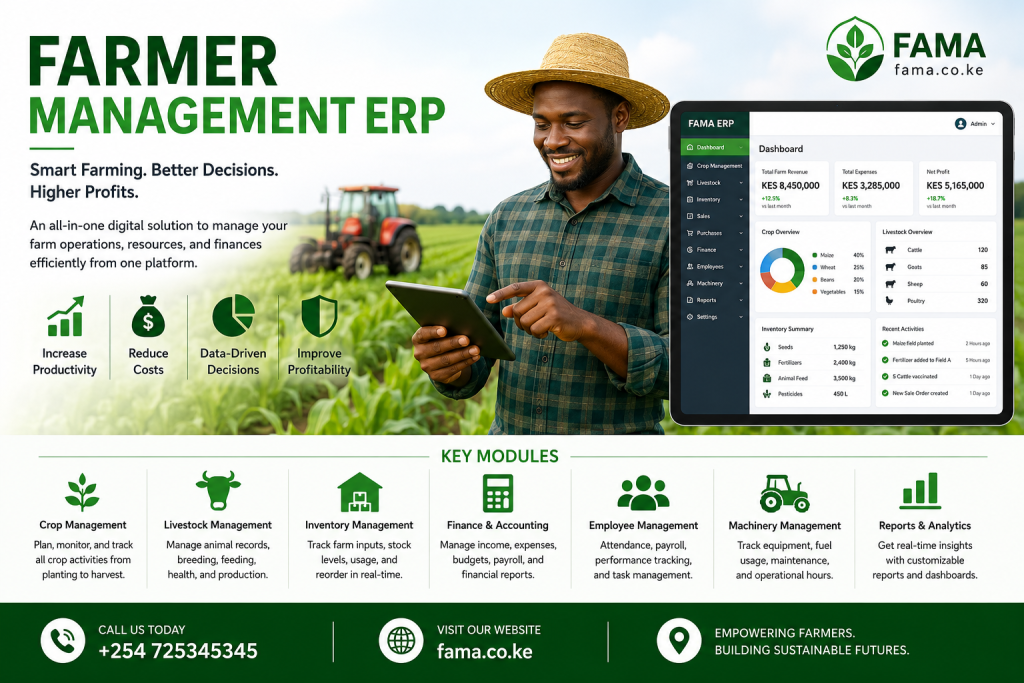
Farmer Management ERP: The Complete Guide to Modern Farm Management

Farmer Management ERP

Table of Contents

Introduction

Agriculture is rapidly becoming a technology-driven industry. Today’s farmers are expected to manage crops, livestock, employees, machinery, finances, inventory, customer relationships, and compliance—all while maintaining profitability. Traditional methods such as notebooks, spreadsheets, and disconnected software systems often create inefficiencies that limit growth.

This is where a Farmer Management ERP becomes an essential business solution.

A Farmer Management ERP is a centralized software platform that helps farmers automate operations, improve productivity, reduce costs, and make informed decisions using real-time data. Whether you own a small farm, a commercial plantation, or a large agricultural enterprise, implementing a Farmer Management ERP transforms how your farm operates.

At FAMA (fama.co.ke), we provide a comprehensive Farmer Management ERP specifically designed for farmers across Kenya and Africa. Our solution enables agricultural businesses to digitize every farming process from planting to harvesting, livestock management to financial reporting.

Call us today: +254 725345345


What is a Farmer Management ERP?

A Farmer Management ERP (Enterprise Resource Planning) is an integrated farm management software system that combines every major farming activity into one centralized platform.

Instead of managing different operations using separate applications, a Farmer Management ERP allows farmers to access everything from one dashboard.

The software integrates:

  • Crop management
  • Livestock management
  • Farm financial management
  • Inventory management
  • Employee management
  • Machinery tracking
  • Purchase management
  • Sales management
  • Customer management
  • Supplier management
  • Production planning
  • Reports and analytics

Every department works together, allowing information to flow seamlessly across the farm.


Why Every Modern Farm Needs a Farmer Management ERP

Agriculture has become increasingly competitive.

Farmers today face numerous challenges including:

  • Rising production costs
  • Labor shortages
  • Climate change
  • Pest outbreaks
  • Water scarcity
  • Market fluctuations
  • Compliance requirements
  • Supply chain disruptions

A Farmer Management ERP helps solve these problems by providing complete visibility into farm operations.

Instead of reacting to problems after they occur, farmers can identify risks early and make informed decisions.


Key Features of a Farmer Management ERP

1. Crop Management

Crop production involves hundreds of activities.

A Farmer Management ERP helps monitor every stage including:

  • Land preparation
  • Seed selection
  • Planting schedules
  • Irrigation
  • Fertilizer application
  • Pesticide spraying
  • Disease monitoring
  • Harvest planning

Managers can view the progress of every field in real time.


2. Livestock Management

For livestock farms, a Farmer Management ERP simplifies animal management.

The software tracks:

  • Animal identification
  • Breeding records
  • Vaccination schedules
  • Feeding programs
  • Milk production
  • Weight monitoring
  • Veterinary treatments
  • Mortality reports

Everything is stored digitally for easy retrieval.


3. Inventory Management

Inventory losses are among the biggest hidden costs in farming.

A Farmer Management ERP manages:

  • Seeds
  • Fertilizers
  • Chemicals
  • Animal feeds
  • Veterinary drugs
  • Spare parts
  • Packaging materials
  • Fuel

The system automatically updates stock levels after every transaction.


4. Farm Financial Management

Financial management determines whether a farm is profitable.

A Farmer Management ERP records:

  • Income
  • Expenses
  • Cash flow
  • Payroll
  • Profit margins
  • Budgeting
  • Cost centers
  • Financial reports

Managers gain a clear understanding of where money is earned and spent.


5. Employee Management

Managing farm workers manually can become overwhelming.

A Farmer Management ERP handles:

  • Staff records
  • Attendance
  • Payroll
  • Daily assignments
  • Performance tracking
  • Leave management

Managers know exactly who worked, where they worked, and what tasks were completed.


Benefits of Implementing a Farmer Management ERP

Improved Decision Making

Data drives successful farming.

A Farmer Management ERP provides dashboards showing:

  • Current production
  • Farm expenses
  • Inventory status
  • Employee productivity
  • Crop performance
  • Livestock performance

This information supports faster and better decisions.


Better Resource Utilization

A Farmer Management ERP minimizes waste by optimizing:

  • Water usage
  • Fertilizer application
  • Seed distribution
  • Chemical usage
  • Labor allocation
  • Equipment scheduling

This reduces production costs significantly.


Increased Productivity

Automation eliminates repetitive manual work.

Instead of preparing reports manually, the Farmer Management ERP generates reports instantly.

Employees spend more time on productive farming activities.


Enhanced Traceability

Consumers increasingly demand food traceability.

A Farmer Management ERP records every farming activity.

You can trace products back to:

  • Planting date
  • Field location
  • Fertilizer applied
  • Pesticides used
  • Harvest date
  • Storage location

This improves food safety and compliance.


Accurate Forecasting

Historical farm data allows better planning.

The Farmer Management ERP helps forecast:

  • Future harvests
  • Expected expenses
  • Inventory requirements
  • Labor needs
  • Equipment maintenance

Planning becomes more accurate.


Modules Found in a Farmer Management ERP

A complete Farmer Management ERP includes multiple integrated modules.

Crop Production Module

Tracks:

  • Farm blocks
  • Crop varieties
  • Planting dates
  • Field activities
  • Harvest yields

Livestock Module

Tracks:

  • Animal records
  • Health management
  • Feeding schedules
  • Production records
  • Breeding cycles

Finance Module

Handles:

  • Accounting
  • Invoicing
  • Budgeting
  • Payments
  • Financial statements

Procurement Module

Manages:

  • Purchase requests
  • Supplier quotations
  • Purchase orders
  • Goods received
  • Supplier payments

Sales Module

Handles:

  • Customer orders
  • Product sales
  • Delivery notes
  • Invoices
  • Receipts

Inventory Module

Monitors:

  • Warehouse stock
  • Farm inputs
  • Harvest storage
  • Reorder levels
  • Stock valuation

Human Resource Module

Manages:

  • Employees
  • Payroll
  • Attendance
  • Contracts
  • Leave

Equipment Management Module

Tracks:

  • Tractors
  • Harvesters
  • Irrigation systems
  • Fuel usage
  • Maintenance schedules

How Farmer Management ERP Improves Farm Profitability

Profitability depends on accurate information.

A Farmer Management ERP improves profits by:

  • Reducing waste
  • Lowering operational costs
  • Increasing production efficiency
  • Improving labor productivity
  • Eliminating duplicate work
  • Preventing stock losses
  • Improving financial management

Over time, these improvements increase overall farm profitability.


Industries That Benefit from Farmer Management ERP

A Farmer Management ERP is suitable for numerous agricultural sectors.

These include:

  • Grain farming
  • Dairy farming
  • Poultry farming
  • Fish farming
  • Horticulture
  • Floriculture
  • Coffee farming
  • Tea farming
  • Sugarcane farming
  • Fruit farming
  • Vegetable farming
  • Greenhouse farming
  • Mixed farming
  • Livestock ranches

Every agricultural business can benefit from digital farm management.


Common Problems Solved by Farmer Management ERP

Many farms struggle with similar operational challenges.

A Farmer Management ERP helps eliminate:

  • Poor record keeping
  • Lost inventory
  • Uncontrolled expenses
  • Payroll errors
  • Poor communication
  • Delayed reporting
  • Duplicate data entry
  • Low productivity
  • Equipment downtime
  • Financial inaccuracies

Replacing manual systems with automation significantly improves efficiency.


Why Choose FAMA Farmer Management ERP?

At FAMA, we understand the unique challenges faced by African farmers.

Our Farmer Management ERP has been developed specifically for agricultural businesses that require:

  • Complete farm visibility
  • Real-time reporting
  • Automated workflows
  • Cloud accessibility
  • Mobile access
  • Easy implementation
  • Secure data storage
  • Scalable architecture

Whether you manage one farm or multiple agricultural enterprises, FAMA provides a solution that grows with your business.

Why farmers choose FAMA:

  • User-friendly interface
  • Affordable pricing
  • Comprehensive farm management
  • Local support
  • Continuous updates
  • Customizable modules
  • Secure cloud technology
  • Powerful reporting tools

For inquiries or to schedule a demo, contact us:

Phone: +254 725345345

Website: fama.co.ke

How to Successfully Implement a Farmer Management ERP

Purchasing software is only the first step. The real value comes from implementing it correctly and ensuring it becomes part of the farm’s daily operations. A structured implementation process minimizes disruptions and allows the organization to realize benefits much sooner.

1. Evaluate Current Operations

Before introducing a digital solution, assess existing workflows. Document how crops are managed, how livestock records are maintained, how inventory is tracked, and how financial transactions are recorded. Identifying inefficiencies beforehand helps configure the system to address real operational needs rather than simply replacing paper records with digital forms.

2. Define Clear Objectives

Every agricultural business has different priorities. Some farms want to improve production planning, while others focus on reducing costs, managing labor, or strengthening financial control. Setting measurable goals makes it easier to evaluate the success of the implementation later.

Common objectives include:

  • Reducing manual paperwork
  • Improving inventory accuracy
  • Increasing crop yields
  • Enhancing employee productivity
  • Improving financial reporting
  • Tracking farm profitability more accurately

3. Migrate Existing Records

Historical information remains valuable. Existing records for crops, livestock, suppliers, customers, inventory, machinery, and finances should be carefully transferred into the new platform. Accurate migration ensures continuity and enables long-term performance analysis.

4. Train Employees

Technology delivers value only when people know how to use it. Farm managers, accountants, supervisors, machine operators, and storekeepers should receive practical training tailored to their responsibilities. Hands-on experience builds confidence and reduces resistance to change.

5. Start with Core Modules

Rather than activating every feature at once, many organizations begin with essential areas such as inventory, finance, production, and employee management. Additional modules can be introduced gradually as users become more comfortable with the platform.

6. Monitor Performance

After implementation, management should continuously review reports and key performance indicators. Regular monitoring helps identify opportunities for optimization and ensures the software continues to support changing business requirements.


The Digital Transformation of Agriculture

Agriculture is entering an era where data is becoming just as valuable as land, water, and machinery. Modern farming increasingly relies on connected technologies that provide real-time visibility into every aspect of production.

Digital transformation enables producers to:

  • Monitor crops remotely
  • Analyze weather patterns
  • Track equipment performance
  • Predict harvest volumes
  • Manage labor efficiently
  • Improve financial planning
  • Strengthen food traceability

Instead of making decisions based solely on experience, managers can combine practical knowledge with accurate operational data to improve outcomes.


Integrating Emerging Technologies

Modern farm management platforms are increasingly compatible with advanced technologies that enhance operational efficiency.

Internet of Things (IoT)

Sensors placed throughout fields, greenhouses, livestock facilities, and storage units continuously collect environmental data.

Examples include:

  • Soil moisture
  • Temperature
  • Humidity
  • Water levels
  • Livestock activity
  • Feed consumption
  • Equipment operating hours

This information enables timely interventions before minor issues become costly problems.


Drone Technology

Drones have transformed field monitoring by providing detailed aerial imagery within minutes.

They help identify:

  • Pest infestations
  • Disease outbreaks
  • Water stress
  • Nutrient deficiencies
  • Uneven crop growth
  • Storm damage

Instead of inspecting hundreds of acres manually, farm managers can prioritize areas requiring immediate attention.


GPS-Based Equipment Tracking

GPS technology improves fleet management by monitoring tractors, harvesters, irrigation systems, and transport vehicles.

Benefits include:

  • Reduced fuel consumption
  • Better route planning
  • Improved machine utilization
  • Lower maintenance costs
  • Enhanced security against theft

Managers gain full visibility into machinery operations regardless of farm size.


Artificial Intelligence

Artificial intelligence is increasingly supporting agricultural decision-making through predictive analytics and automation.

AI can assist in:

  • Forecasting yields
  • Predicting disease risks
  • Optimizing irrigation schedules
  • Estimating fertilizer requirements
  • Detecting production trends
  • Improving resource allocation

These insights help managers respond proactively rather than reactively.


Mobile Accessibility

Farm management no longer requires being in the office. Mobile applications allow managers and field supervisors to record activities directly from the field.

Common mobile functions include:

  • Recording completed tasks
  • Updating harvest quantities
  • Approving purchases
  • Monitoring inventory
  • Viewing financial summaries
  • Assigning work orders
  • Tracking employee attendance

This mobility improves communication and reduces reporting delays.


Best Practices for Sustainable Farm Management

Technology should support sustainable agricultural practices alongside operational efficiency.

Successful farms increasingly focus on:

Water Conservation

Monitoring irrigation schedules helps minimize unnecessary water use while maintaining healthy crop growth.

Soil Health

Maintaining detailed records of fertilizer applications, crop rotation, and soil testing supports long-term productivity.

Responsible Chemical Use

Accurate application records help prevent overuse of pesticides and fertilizers while supporting compliance with food safety standards.

Equipment Maintenance

Preventive maintenance extends machinery lifespan, reduces unexpected breakdowns, and lowers repair costs.

Employee Safety

Digital task management allows organizations to schedule training, monitor compliance, and document workplace safety procedures.


Measuring Success After Implementation

A successful digital transformation should produce measurable improvements across multiple areas of the business.

Important indicators include:

Production Metrics

  • Crop yield per acre
  • Livestock productivity
  • Harvest quality
  • Production consistency

Financial Metrics

  • Cost per acre
  • Gross profit
  • Net profit
  • Cash flow
  • Operating expenses

Operational Metrics

  • Inventory accuracy
  • Machinery utilization
  • Employee productivity
  • Task completion rates

Customer Metrics

  • Order fulfillment speed
  • Product traceability
  • Customer satisfaction
  • Delivery performance

Monitoring these indicators regularly supports continuous improvement.


Common Challenges During Adoption

While digital transformation offers significant benefits, organizations should prepare for a few common challenges.

Resistance to Change

Employees accustomed to manual processes may initially hesitate to adopt new technology. Clear communication, training, and ongoing support help ease the transition.

Data Accuracy

The quality of reports depends on accurate data entry. Establishing clear procedures for recording information ensures reliable analytics.

Connectivity

Some rural locations experience inconsistent internet access. Cloud-based systems with offline capabilities can help maintain productivity until connectivity is restored.

Continuous Learning

As software evolves, organizations should provide refresher training to ensure employees continue using new features effectively.


Choosing the Right Solution

Selecting software should involve more than comparing features. Consider long-term value, support quality, scalability, and the provider’s understanding of agricultural operations.

Important evaluation criteria include:

  • Ease of use
  • Local customer support
  • Industry experience
  • Data security
  • Mobile accessibility
  • Integration capabilities
  • Reporting flexibility
  • Scalability
  • Regular updates
  • Training services

Choosing a trusted partner reduces implementation risks and supports future growth.


Why Businesses Across Kenya Are Embracing Digital Agriculture

Kenya’s agricultural sector continues to modernize as producers seek greater efficiency and competitiveness. Digital solutions help organizations adapt to changing market conditions while improving operational control.

Benefits experienced by many businesses include:

  • Faster decision-making
  • Better financial visibility
  • Reduced operational costs
  • Improved productivity
  • Stronger compliance
  • Better planning
  • Higher customer confidence
  • Improved resource utilization

As agriculture becomes increasingly data-driven, digital platforms are becoming an important component of long-term business success.


Frequently Asked Questions

Is this solution suitable for small farms?

Yes. Smaller farms benefit from improved record keeping, better financial management, and more organized daily operations. The platform can grow alongside the business as production expands.


Can it support multiple farm locations?

Yes. Organizations managing several farms can monitor operations across different locations from a centralized dashboard, making supervision and reporting much easier.


Does it handle livestock and crops together?

Yes. Mixed farming operations can manage crop production, livestock activities, inventory, finances, and employee records within a unified system.


Is data stored securely?

Modern cloud infrastructure incorporates multiple layers of protection, including user authentication, encrypted communication, regular backups, and controlled access permissions.


Can reports be customized?

Yes. Organizations can generate operational, financial, inventory, production, and management reports tailored to their specific requirements.


Is technical support available?

Reliable implementation partners provide onboarding, user training, software updates, and ongoing technical assistance to ensure customers continue receiving value from the platform.


Why Choose FAMA?

Technology should simplify farming, not complicate it. At FAMA, our mission is to help agricultural businesses improve efficiency through practical, user-friendly software designed for real farming operations.

Our platform supports organizations of different sizes—from family-owned farms to large commercial enterprises—by providing centralized management tools that improve visibility and control across every department.

With local expertise, dedicated customer support, and continuous product improvements, FAMA helps farmers embrace digital transformation with confidence.

Whether your goal is improving production planning, strengthening financial oversight, optimizing inventory, or enhancing workforce management, our experienced team is ready to help.

Contact FAMA today

Website: fama.co.ke

Phone: +254 725345345


Building a Data-Driven Farming Culture

One of the greatest long-term benefits of adopting modern farm management software is the creation of a data-driven culture within the organization. Instead of relying solely on assumptions or memory, every important decision is backed by accurate records and real-time information. Managers can compare seasonal performance, evaluate production costs, identify the most profitable crops or livestock enterprises, and recognize areas that require improvement. Historical data also makes it easier to plan future planting seasons, estimate labor requirements, forecast inventory needs, and prepare realistic budgets.

As farms continue to grow, managing operations manually becomes increasingly difficult. Digital tools create standardized processes that ensure consistency across departments, even when multiple supervisors or farm locations are involved. Communication between field workers, managers, accountants, and business owners becomes more efficient because everyone accesses the same reliable information. This reduces misunderstandings, minimizes duplicate work, and improves accountability throughout the organization.

Ultimately, investing in a comprehensive farm management solution is not just about replacing paperwork with technology—it is about building a smarter, more resilient agricultural business. Organizations that embrace innovation today are better prepared to adapt to changing market conditions, climate challenges, customer expectations, and regulatory requirements in the future. With the right systems in place, farmers can focus less on administrative tasks and more on increasing productivity, delivering quality produce, and achieving sustainable long-term growth.

Conclusion

Agriculture is becoming increasingly data-driven, and organizations that invest in modern management systems are better positioned to improve productivity, profitability, and sustainability. A centralized platform brings together production, finance, inventory, employees, equipment, and reporting into a single source of truth, reducing manual work while enabling faster, better-informed decisions.

For farms looking to scale operations, strengthen accountability, and prepare for future growth, investing in the right management solution is more than a technology upgrade—it is a strategic business decision. By combining industry expertise with innovative software, FAMA empowers agricultural businesses to operate more efficiently today while building a stronger foundation for tomorrow. Contact +254 725345345 or visit fama.co.ke to learn more or request a personalized demonstration.