Table of Contents
ToggleFarm Workflow Management Software: Why Modern Farms Need Better Operational Control
Agriculture has become increasingly complex. Modern farms are no longer managed by simply planting crops, feeding livestock, and waiting for harvests. Today’s agricultural businesses must coordinate workers, equipment, inputs, field activities, livestock operations, procurement, inventory, compliance requirements, and financial reporting. Managing all these moving parts manually can quickly become overwhelming. This is why many agricultural businesses are adopting Farm Workflow Management Software to streamline operations and improve efficiency.
A growing farm may have dozens of daily activities happening simultaneously. Workers may be assigned to irrigation, spraying, planting, harvesting, feeding livestock, equipment maintenance, and inventory management. Without a structured system, tasks can be forgotten, duplicated, delayed, or completed incorrectly. Communication gaps often lead to wasted resources and reduced productivity.
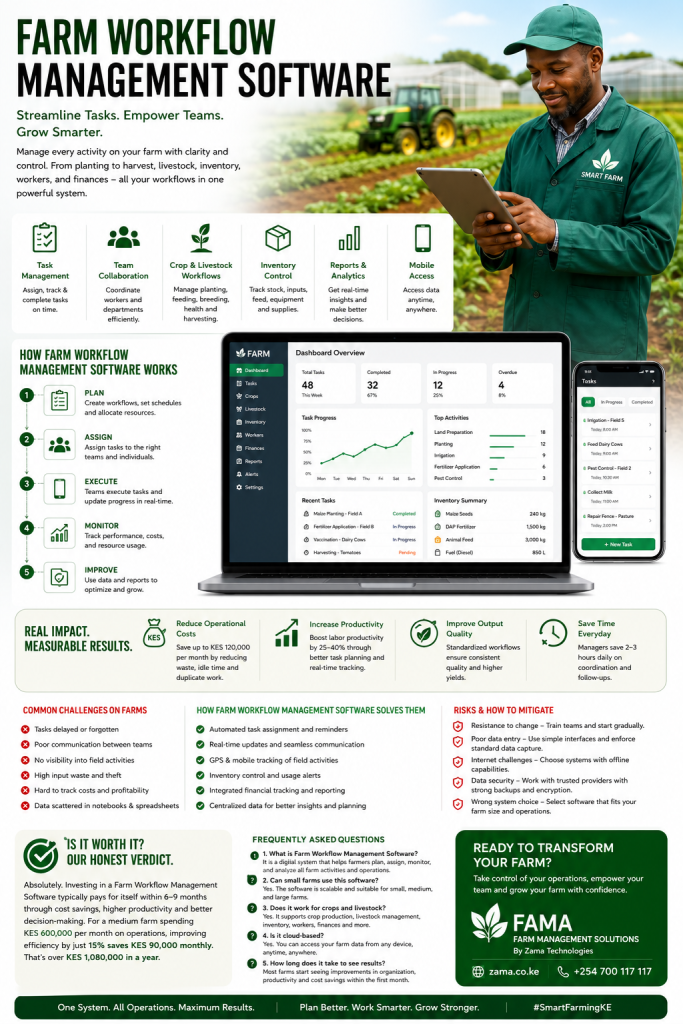
Farm Workflow Management Software helps solve these challenges by providing a centralized platform for planning, assigning, monitoring, and tracking agricultural activities. Instead of relying on notebooks, phone calls, and verbal instructions, farm managers can coordinate operations using a digital workflow system.
As farming becomes more commercialized and competitive, Farm Workflow Management Software is becoming a critical tool for farms that want greater visibility, accountability, and operational control.
What is Farm Workflow Management Software?
Farm Workflow Management Software is a digital system designed to help farms organize, manage, and monitor daily agricultural activities.
The software allows managers to assign tasks, track completion progress, monitor employee performance, manage equipment schedules, oversee inventory usage, and generate operational reports.
Unlike generic task management applications, Farm Workflow Management Software is built around agricultural processes. It understands farm operations such as planting schedules, irrigation programs, livestock feeding routines, pesticide application tracking, harvesting activities, and maintenance workflows.
The goal is to create a structured operating environment where every task is planned, tracked, and documented.
This visibility improves efficiency while reducing operational confusion.
Why Manual Farm Management Creates Problems
Many farms still rely on paper records, WhatsApp messages, notebooks, and verbal instructions to coordinate activities.
While these methods may work for small farms, they become increasingly difficult to manage as operations grow.
Employees may misunderstand instructions. Managers may forget scheduled activities. Equipment maintenance may be delayed. Inventory usage may not be documented properly. Important tasks may fall through the cracks.
The result is reduced productivity and increased operational risk.
Farm Workflow Management Software creates structure and accountability by ensuring tasks are assigned, monitored, and completed according to plan.
Managers gain visibility into what is happening across the farm without constantly following up manually.
Farm Workflow Management Software for Task Scheduling
Task scheduling is one of the most valuable features of Farm Workflow Management Software.
Agricultural operations depend heavily on timing. Planting, spraying, irrigation, fertilization, harvesting, and livestock care all require activities to be completed according to specific schedules.
Missing critical deadlines can affect yields and profitability.
The software allows managers to create schedules for recurring and one-time activities. Tasks can be assigned to employees, departments, or teams while deadlines and priorities are clearly communicated.
This reduces confusion and improves operational consistency.
Employees know what needs to be done, when it needs to be done, and who is responsible.
Farm Workflow Management Software for Employee Management
Labor management remains one of the biggest challenges in agriculture.
Many farms employ permanent workers, seasonal laborers, supervisors, drivers, security personnel, and technical specialists.
Tracking employee activities manually often leads to accountability issues.
Farm Workflow Management Software helps managers assign responsibilities, monitor progress, and track completed work.
Employee performance becomes more visible because task completion records are maintained digitally.
Managers can identify bottlenecks, improve workforce allocation, and ensure activities are completed according to operational requirements.
This visibility supports better labor utilization and stronger productivity.
Equipment and Machinery Workflow Management
Farm equipment represents a major investment.
Tractors, irrigation systems, harvesters, generators, pumps, sprayers, and transport vehicles all require regular maintenance and monitoring.
Without structured management, equipment breakdowns can disrupt operations significantly.
Farm Workflow Management Software allows businesses to schedule maintenance activities, monitor equipment usage, and track service histories.
Managers receive reminders for preventive maintenance and can monitor equipment availability.
This helps reduce downtime while extending asset lifespan.
Well-maintained equipment contributes directly to operational efficiency and reliability.
Farm Workflow Management Software for Crop Production
Crop production involves numerous interconnected activities.
Land preparation, planting, irrigation, fertilization, pest control, weeding, harvesting, and post-harvest handling all require careful coordination.
Farm Workflow Management Software helps managers create structured workflows for each production stage.
Activities can be planned in advance and monitored throughout the growing season.
This visibility ensures critical tasks are completed on schedule and according to farm standards.
Improved workflow coordination often leads to better resource utilization and more consistent production outcomes.
Livestock Workflow Automation
Livestock operations involve recurring daily activities.
Feeding schedules, vaccinations, breeding programs, health monitoring, cleaning routines, and medication administration must all be managed consistently.
Manual coordination becomes increasingly difficult as herd sizes grow.
Farm Workflow Management Software helps organize livestock-related activities and maintain operational consistency.
Managers can monitor completed tasks and verify that important procedures are not overlooked.
This improves animal welfare while supporting operational efficiency.
Inventory and Input Management
Agricultural inputs represent significant operating costs.
Seeds, fertilizers, chemicals, feeds, medicines, spare parts, fuel, and packaging materials must be managed carefully.
Poor inventory visibility often results in shortages, overstocking, or wastage.
Farm Workflow Management Software integrates inventory management into operational planning.
Managers can track inventory usage alongside scheduled activities.
This improves procurement planning and reduces operational disruptions caused by stock shortages.
Better inventory control also supports stronger financial management.
Farm Workflow Management Software for Compliance and Documentation
Agricultural businesses increasingly face compliance requirements related to food safety, environmental management, employee safety, and quality assurance.
Maintaining documentation manually can be time-consuming and unreliable.
Farm Workflow Management Software helps farms document completed activities, maintain records, and generate reports.
This improves operational transparency and simplifies compliance processes.
Accurate documentation also supports customer confidence and certification requirements.
As agricultural standards continue to evolve, record keeping becomes increasingly important.
Multi-Farm and Multi-Location Management
Many agricultural businesses operate multiple farms, production sites, or storage facilities.
Managing these locations manually often creates communication challenges and visibility gaps.
Farm Workflow Management Software provides centralized oversight across multiple locations.
Managers can monitor activities, employee performance, inventory usage, and operational progress from one platform.
This visibility improves coordination and supports scalable growth.
Multi-location functionality is particularly valuable for commercial agricultural enterprises.
Benefits of Farm Workflow Management Software
The advantages of Farm Workflow Management Software extend throughout farm operations.
Key benefits include:
- Improved task management
- Better employee accountability
- Enhanced operational visibility
- Reduced communication gaps
- Better inventory control
- Improved equipment management
- Stronger compliance documentation
- Better scheduling efficiency
- Reduced operational delays
- Improved resource utilization
- Easier multi-location management
- Better decision-making
These benefits contribute to improved productivity and operational consistency.
Farm Workflow Management Software and Decision Making
One of the greatest strengths of Farm Workflow Management Software is the quality of information it provides.
Managers no longer rely solely on verbal updates or assumptions.
Instead, they gain access to real-time operational data.
They can monitor task completion rates, employee productivity, equipment utilization, inventory consumption, and workflow performance.
This information supports faster and more informed decision-making.
Better decisions often lead to improved operational outcomes and stronger financial performance.
Common Challenges Without Farm Workflow Management Software
Farms operating without structured workflow systems frequently encounter recurring issues.
These include:
- Missed deadlines
- Poor communication
- Labor inefficiencies
- Equipment downtime
- Inventory shortages
- Inconsistent documentation
- Reduced accountability
- Operational confusion
As farm operations expand, these challenges become increasingly difficult to manage.
Farm Workflow Management Software provides the structure needed to reduce these risks and improve operational control.
Risks and How to Mitigate Them
Like any technology investment, implementing Farm Workflow Management Software involves certain risks.
Staff Resistance
Employees may resist new processes.
Mitigation: Provide training and involve employees during implementation.
Poor Data Entry
Inaccurate information can affect reporting quality.
Mitigation: Establish clear data management procedures.
Choosing the Wrong Software
Some systems lack agricultural functionality.
Mitigation: Select software designed specifically for farming operations.
Weak Management Involvement
Technology requires leadership support.
Mitigation: Ensure managers actively use reports and workflow tools.
Incomplete Adoption
Some farms only use a portion of available features.
Mitigation: Conduct ongoing training and process reviews.
Is Farm Workflow Management Software Worth It?
For most commercial farms, the answer is yes.
The larger and more complex the operation becomes, the greater the benefits.
Improved visibility, better accountability, stronger scheduling, and enhanced operational control contribute directly to productivity and profitability.
Small farms may initially manage with manual systems.
However, as operations grow, manual processes often become barriers to efficiency.
Farm Workflow Management Software provides the structure necessary to support sustainable growth.
The real value lies in reducing operational chaos and creating a more organized farming environment.
Farm Workflow Management Software and Agricultural Planning
One of the most important aspects of successful farming is planning. Every agricultural activity depends on timing, coordination, and proper resource allocation. Whether a farm focuses on crop production, livestock farming, greenhouse operations, horticulture, dairy farming, poultry production, or mixed farming, poor planning often leads to missed opportunities and reduced productivity.
Farm Workflow Management Software helps farm managers move from reactive management to proactive planning. Instead of waiting for problems to occur, managers can create detailed activity schedules weeks or even months in advance. Planting activities, irrigation schedules, fertilizer applications, harvesting operations, machinery servicing, employee assignments, and livestock care programs can all be planned within a centralized system.
This planning capability improves operational efficiency because everyone understands what needs to be done and when it should be completed. Managers spend less time coordinating daily activities manually and more time focusing on production quality, profitability, and business growth.
Many farms struggle because critical tasks are remembered only when problems arise. Fertilizer applications may be delayed, machinery servicing may be forgotten, or livestock vaccinations may occur later than planned. Farm Workflow Management Software reduces these risks by creating structured workflows and automated reminders that keep operations running smoothly.
Farm Workflow Management Software for Agricultural Teams
As farms expand, managing employees becomes increasingly challenging. Agricultural businesses often employ farm managers, supervisors, machine operators, field workers, drivers, irrigation technicians, livestock attendants, security personnel, and seasonal laborers.
Without proper coordination, communication gaps can create confusion. Employees may duplicate tasks, overlook responsibilities, or receive conflicting instructions. This not only affects productivity but can also increase operational costs.
Farm Workflow Management Software improves team coordination by providing a central location where tasks, responsibilities, and schedules are clearly defined. Supervisors can assign work digitally while employees receive instructions through mobile devices or centralized workstations.
Managers can monitor task completion, track employee productivity, and identify operational bottlenecks. This level of visibility improves workforce management and helps ensure resources are being utilized effectively.
For larger agricultural enterprises, labor costs often represent one of the biggest operating expenses. Better coordination through Farm Workflow Management Software helps maximize workforce productivity while reducing inefficiencies.
Farm Workflow Management Software and Equipment Utilization
Farm machinery is essential for modern agriculture. Tractors, harvesters, irrigation pumps, generators, sprayers, loaders, trucks, and processing equipment play critical roles in daily operations. However, equipment can only generate value when it is available and functioning properly.
Many farms lose productivity because machinery maintenance is managed informally. Service schedules may be forgotten, repairs may be delayed, and equipment breakdowns may occur during critical production periods.
Farm Workflow Management Software provides a structured approach to equipment management. Maintenance schedules can be created and monitored automatically. Service records are stored digitally, making it easier to track equipment history and identify recurring issues.
Managers gain visibility into equipment availability and can plan activities more effectively. Preventive maintenance becomes easier to manage, reducing the likelihood of costly breakdowns.
Well-maintained equipment supports operational continuity and contributes to higher productivity throughout the farming season.
Farm Workflow Management Software for Harvest Management
Harvesting is one of the most important periods in agricultural production. Months of planning, investment, and labor culminate during harvest. Poor coordination at this stage can significantly affect product quality, storage conditions, and profitability.
Farm Workflow Management Software helps organize harvesting activities by coordinating labor, machinery, transportation, storage, and post-harvest processing requirements. Managers can monitor harvesting progress and ensure resources are deployed efficiently.
This level of coordination becomes especially valuable for commercial farms producing fruits, vegetables, flowers, grains, and export crops. Harvest windows are often limited, and delays can negatively affect product quality.
With structured workflows, farms can respond more effectively to changing conditions and maintain operational efficiency throughout the harvest season.
Farm Workflow Management Software and Data-Driven Farming
Modern agriculture increasingly relies on data to improve decision-making. Successful farms do not simply track production outcomes; they analyze operational performance to identify opportunities for improvement.
Farm Workflow Management Software generates valuable operational data through daily activities. Managers can review task completion rates, labor utilization, equipment performance, inventory consumption, and workflow efficiency.
This information supports continuous improvement initiatives. Farms can identify inefficiencies, optimize processes, and allocate resources more effectively.
For example, if certain tasks consistently take longer than expected, managers can investigate the causes and implement improvements. Similarly, recurring operational issues can be identified and addressed before they become major problems.
Data-driven farming helps businesses remain competitive while improving productivity and profitability.
Farm Workflow Management Software for Compliance and Sustainability
Agricultural regulations and sustainability requirements continue to evolve. Many farms must maintain records related to pesticide applications, fertilizer usage, worker safety, environmental management, livestock treatments, and production activities.
Maintaining these records manually can be difficult and time-consuming. Missing documentation can create compliance risks and complicate certification processes.
Farm Workflow Management Software helps farms maintain accurate digital records of operational activities. Managers can document completed tasks, generate reports, and maintain audit trails for important processes.
This capability supports compliance while improving transparency. Farms pursuing certifications, export opportunities, or sustainability initiatives benefit significantly from structured record-keeping systems.
Digital documentation also reduces administrative workload and improves information accessibility.
The Future of Farm Workflow Management Software
Agriculture is undergoing rapid digital transformation. Farmers increasingly use precision agriculture technologies, remote monitoring systems, mobile applications, and cloud-based platforms to improve operational efficiency.
The future of Farm Workflow Management Software will likely involve deeper integration with agricultural technologies such as IoT sensors, weather monitoring systems, drone data, GPS tracking, and automated irrigation systems.
These integrations will provide even greater visibility into farm operations and support more informed decision-making. Managers will be able to monitor activities in real time while receiving automated recommendations based on operational data.
Artificial intelligence may also play a larger role in workflow optimization. Future systems could automatically prioritize tasks, predict resource requirements, and identify operational risks before they affect production.
Despite these technological advances, the primary purpose of Farm Workflow Management Software will remain the same: helping farms operate more efficiently, maintain accountability, improve coordination, and support long-term growth.
For agricultural businesses looking to remain competitive in the coming years, workflow management technology is becoming increasingly important. Farms that adopt digital systems today are positioning themselves to achieve greater productivity, stronger operational control, and sustainable growth in an increasingly data-driven agricultural industry.
Other Digital Solutions for Growing Businesses
Businesses looking to digitize operations can also explore:
- fama.co.ke – Farm and agricultural management software
- dexa.co.ke – HR, attendance, workflow and business management software
- vega.co.ke – Point of sale software
- prim.co.ke – Salon management software
- pawa.co.ke – WiFi hotspot billing software
- zivo.co.ke – Customer communication software
- rentaldesk.co.ke – Rental property management software
- pms.co.ke – Property management software
- estateadmin.co.ke – Estate management software
- dereva.co.ke – Driver marketplace platform
- vota.co.ke – Campaign management software
- ratibu.co.ke – School management software
- churchesadmin.com – Church management software
- jaat.co.ke – Business SaaS platform
- kayapro360.com – Enterprise software solution
- Musa Music AI – AI-powered music software
Frequently Asked Questions
1. What is Farm Workflow Management Software?
It is software designed to manage agricultural tasks, employees, equipment, inventory, and operational workflows from a centralized platform.
2. Can Farm Workflow Management Software support livestock farms?
Yes. It can manage feeding schedules, health programs, maintenance activities, and operational workflows.
3. Is Farm Workflow Management Software suitable for small farms?
Yes. Small farms benefit from improved organization and operational visibility.
4. Can the software support multiple farm locations?
Yes. Many platforms offer centralized management for multiple sites.
5. How does Farm Workflow Management Software improve productivity?
By improving task coordination, accountability, communication, scheduling, and resource utilization.
Start with Fama Today
If you want better task management, improved employee accountability, stronger operational visibility, and streamlined agricultural operations, start with Fama.
Visit https://fama.co.ke today and discover how Farm Workflow Management Software can help your agricultural business improve efficiency, reduce operational risks, enhance productivity, and support long-term growth.