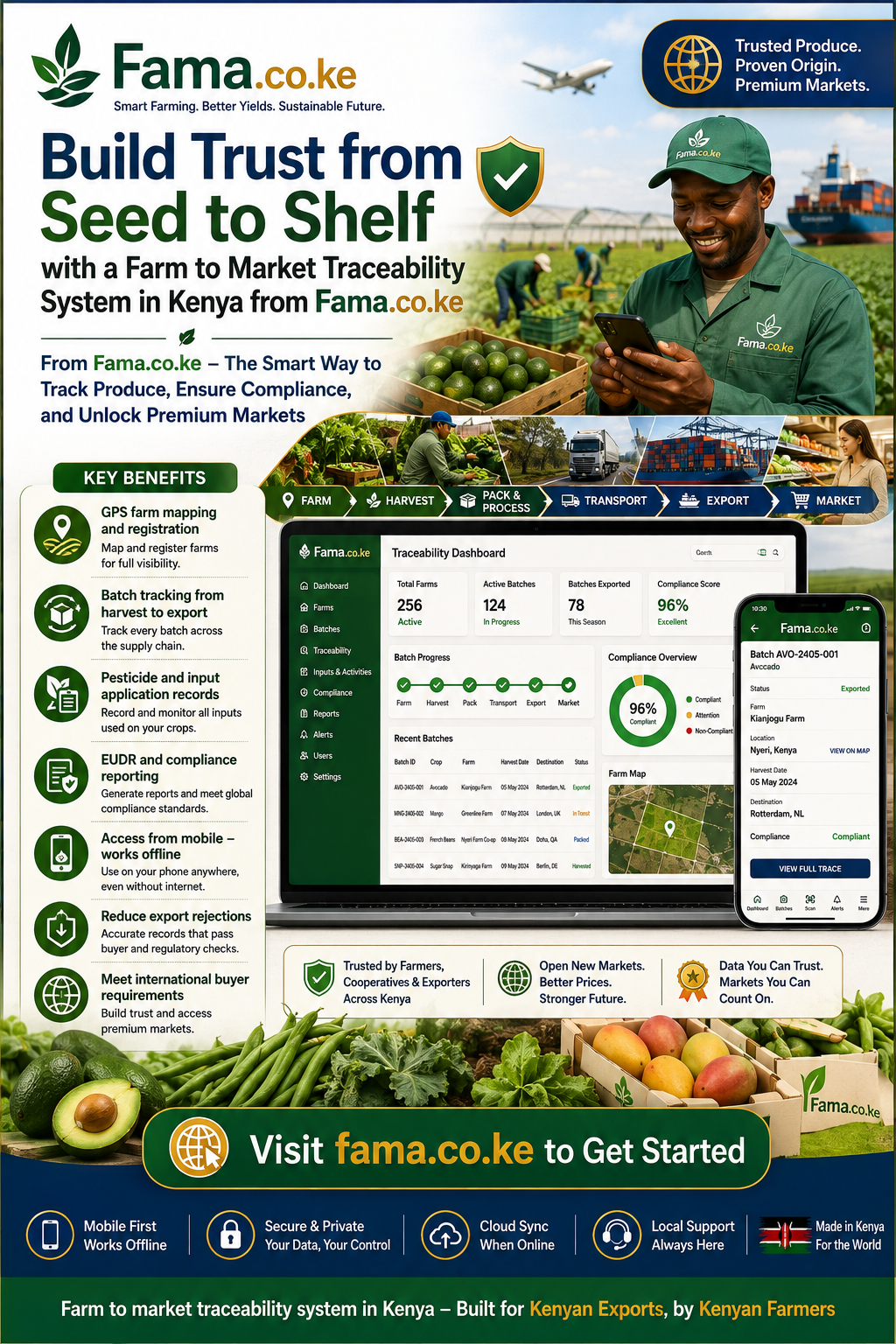
Farm to market traceability system in Kenya has become an indispensable tool for farmers, exporters, and agribusinesses seeking to access premium international markets and meet increasingly stringent regulatory requirements. Fama.co.ke provides an innovative platform that serves as a comprehensive farm to market traceability system in Kenya, helping stakeholders track produce from farm to fork and generate verifiable digital evidence for buyers and regulators. As global markets tighten traceability requirements, the adoption of a farm to market traceability system in Kenya has become essential for protecting the country’s lucrative export sector.
The stakes for Kenya’s agricultural exports are significant. Horticulture is one of Kenya’s leading foreign exchange earners, contributing about 34 per cent of the country’s agricultural gross domestic product. Horticultural exports generated Sh143.7 billion in revenue in 2025, with flowers accounting for 55 per cent, vegetables 15 per cent, and fruits 30 per cent by value . A farm to market traceability system in Kenya helps protect this billion-dollar sector by providing the transparency and accountability that international buyers demand.
The National Horticulture Traceability System (NHTS), developed by the Agriculture and Food Authority, represents a major step forward in Kenya’s traceability infrastructure. This digital platform is designed to track fresh produce from individual farms through the supply chain to export markets, integrating licensing, registration, and phytosanitary certification into a single paperless interface . Fama.co.ke‘s farm to market traceability system in Kenya complements these national efforts by providing the farm-level tools needed for effective traceability.
The farm to market traceability system in Kenya integrates advanced features including farm mapping, batch tracking, and compliance reporting. This innovative farm to market traceability system in Kenya platform monitors production practices, tracks produce from harvest to export, and generates audit-ready documentation. With a farm to market traceability system in Kenya, exporters can finally eliminate the documentation gaps that have led to costly export rejections and lost contracts.
The farm to market traceability system in Kenya platform is designed with Kenyan realities in mind. Fama.co.ke understands that farmers and exporters need tools that work in areas with limited connectivity, handle multiple crop types, and provide offline functionality. Farm to market traceability system in Kenya does all this and more, making it the ideal choice for stakeholders across all agricultural value chains. AFA officials have noted that previously, “whenever there was an interception, it was difficult for our country to know where the crop came from,” often affecting entire groups of farmers . A farm to market traceability system in Kenya solves this problem by enabling precise identification of produce sources.
The power of a farm to market traceability system in Kenya lies in its ability to transform fragmented agricultural records into verified digital evidence. As one traceability platform developer notes, “In modern agricultural supply chains, trust has become a form of infrastructure” . The platform enables farmer verification, GPS-based farm registration, digital identities, batch traceability, and compliance automation into one connected ecosystem . This is what a farm to market traceability system in Kenya delivers for the sector.
The farm to market traceability system in Kenya solution helps farmers meet the stringent requirements of the EU Deforestation Regulation (EUDR) and other international standards. By providing GPS mapping, forest cover verification, and legal documentation, a farm to market traceability system in Kenya enables exporters to demonstrate compliance. Through a farm to market traceability system in Kenya, stakeholders can access the digital tools needed to protect Kenya’s reputation as a reliable export supplier.
The National Horticulture Traceability System is being expanded to other agricultural value chains, including maize, coconut, and macadamia nuts . The farm to market traceability system in Kenya platform enables integration with these national initiatives. With a farm to market traceability system in Kenya, stakeholders can align with national digital infrastructure and access the benefits of unified traceability. Through a farm to market traceability system in Kenya, farmers can become bankable entities with credible digital farm profiles. For those seeking comprehensive solutions, a farm to market traceability system in Kenya provides the digital infrastructure needed to reduce export rejections, improve market access, and boost profitability.
The Growing Need for a Farm to Market Traceability System in Kenya
The adoption of a farm to market traceability system in Kenya is becoming increasingly essential as international markets tighten requirements for agricultural imports. In 2024, Kenya’s horticulture sector recorded 43 pest-related interceptions, 77 interceptions linked to documentation failures, and 80 notifications for pesticide residue levels above permitted limits . A farm to market traceability system in Kenya addresses these challenges by providing the documentation needed to prevent costly export rejections.
The challenges facing export agriculture are numerous. Some exporters have in the past exported volumes that exceeded the production capacity of their registered farms, raising concerns about the origin and compliance status of additional produce . A farm to market traceability system in Kenya prevents such practices by linking export volumes to verified farm production capacity.
The financial impact of poor traceability is significant. A single lost contract can cost hundreds of thousands of shillings. A farm to market traceability system in Kenya helps farmers maintain the detailed records needed to prevent such losses. The platform enables exporters to complete approval processes from their offices and receive approvals electronically, lowering operational costs .
The EU currently accounts for more than 50 per cent of Kenya’s agricultural exports, making compliance with new regulations essential for continued trade. A farm to market traceability system in Kenya enables farmers to meet these stringent requirements through GPS mapping, forest cover verification, and legal documentation .
The transparency provided by a farm to market traceability system in Kenya also benefits supply chain partners and buyers. When exporters can provide reliable production records and traceability data, a farm to market traceability system in Kenya builds trust and facilitates market access. This is particularly important for export markets that require detailed traceability from farm to shelf.
Key Features of a Farm to Market Traceability System in Kenya
Farm Mapping and GPS Registration
A farm to market traceability system in Kenya from Fama.co.ke provides comprehensive farm mapping capabilities. The platform uses geospatial mapping to register farms, track field locations, and verify production capacity. With a farm to market traceability system in Kenya, stakeholders can ensure that export volumes align with registered farm output.
The platform integrates geolocation mapping to verify farm size and expected yield, assisting in curbing fraud and over-declaration of export volumes . Fama.co.ke has designed the farm to market traceability system in Kenya to be accurate and reliable, using an offline-first architecture for rural areas .
Batch Tracking and Produce Tracing
A farm to market traceability system in Kenya provides tools for tracking produce from harvest to export. The platform creates batch records for every harvest, enabling tracking through the supply chain. With a farm to market traceability system in Kenya, farmers can maintain compliance with export requirements and buyer demands.
The system captures information throughout the production cycle, including planting dates, crop varieties, pesticide applications, harvesting activities, and movement of produce through the supply chain . This is what a farm to market traceability system in Kenya delivers for the sector.
Pesticide and Input Application Tracking
A farm to market traceability system in Kenya includes features for tracking all pesticide and input applications. The platform records crop protection practices, fertilisation, and irrigation activities. With a farm to market traceability system in Kenya, you can generate complete spray records that satisfy export market requirements.
AFA officials have noted that the platform will help importers know “which pesticides are being used, and even the chemicals that are used during planting” . A farm to market traceability system in Kenya ensures that all operations are properly documented for export certification.
EUDR and Compliance Reporting
A farm to market traceability system in Kenya provides automated compliance reporting capabilities. The platform generates EUDR-compliant reports including deforestation risk assessments, GPS data, and legal documentation. With a farm to market traceability system in Kenya, you can produce audit-ready export reports that satisfy the most stringent international requirements.
The platform also supports carbon accounting and ESG reporting features, expanding opportunities for access to premium buyers and sustainability-driven markets . A farm to market traceability system in Kenya helps farmers demonstrate their commitment to sustainable production practices.
Mobile Accessibility and Offline Capability
A farm to market traceability system in Kenya from Fama.co.ke is accessible on mobile devices and works offline. The platform is designed for rural areas with connectivity challenges, allowing field workers to capture data without internet. A farm to market traceability system in Kenya syncs automatically when connection is restored.
The platform supports training across the value chain to ensure everyone understands their responsibilities under the new system . A farm to market traceability system in Kenya is designed to be simple enough for all users, including farmers with limited digital experience.
Benefits of a Farm to Market Traceability System in Kenya
Reduced Export Rejections
A farm to market traceability system in Kenya helps reduce export interceptions through better documentation. By maintaining detailed records of pesticide applications and production practices, a farm to market traceability system in Kenya helps farmers avoid the pesticide residue and documentation failures that lead to costly rejections. The NHTS is expected to improve product monitoring and reduce the risk of export rejections .
Access to Premium Markets
A farm to market traceability system in Kenya opens doors to premium export markets. Buyers increasingly require traceability documentation, and a farm to market traceability system in Kenya provides the digital proof they demand. With a farm to market traceability system in Kenya, farmers can access sustainability-driven markets and secure better prices for their produce.
Improved Financial Management
A farm to market traceability system in Kenya helps exporters track payments and manage finances efficiently. With automated documentation and financial integration, a farm to market traceability system in Kenya ensures timely payments and accurate record-keeping. A farm to market traceability system in Kenya also creates reliable financial records that support loan applications and business planning.
Enhanced Compliance and Risk Management
A farm to market traceability system in Kenya helps agribusinesses maintain compliance with international regulations and export requirements. With a farm to market traceability system in Kenya, farmers can generate audit-ready reports that satisfy the most stringent standards. The system protects both yield and farm reputation effortlessly .
Time Savings
A farm to market traceability system in Kenya saves farmers and exporters hours of manual documentation time. With a farm to market traceability system in Kenya, recording data takes seconds, and generating export reports is instantaneous. Exporters using a farm to market traceability system in Kenya can focus on market development rather than administrative paperwork. The paperless system lowers operational costs and enables exporters to complete approval processes from their offices .
How to Get Started with a Farm to Market Traceability System in Kenya
Starting with a farm to market traceability system in Kenya from Fama.co.ke is straightforward. The farm to market traceability system in Kenya platform is scalable and easy to deploy. Here’s how to begin using a farm to market traceability system in Kenya:
Create Your Account
Visit fama.co.ke and sign up for the farm to market traceability system in Kenya platform. The registration process is simple and takes only a few minutes.
Register Your Farms
In your farm to market traceability system in Kenya account, map your farms using GPS and enter details about your crops and production practices. The platform allows you to define multiple farm locations and crop varieties.
Begin Recording Production Data
Start entering data into the farm to market traceability system in Kenya platform. Record planting activities, input applications, and harvest details. The system maintains a complete production history for each farm.
Track Deliveries and Sales
Use the farm to market traceability system in Kenya platform to record produce deliveries and sales transactions. The system links every delivery to specific farms and batches.
Generate Export Reports
Use the reporting features of your farm to market traceability system in Kenya to generate compliance-ready export documentation, including EUDR reports and phytosanitary certificates.
Overcoming Common Challenges
Internet Connectivity
A farm to market traceability system in Kenya from Fama.co.ke works offline, allowing data recording without internet access. The platform syncs automatically when connectivity is restored.
Mobile Compatibility
A farm to market traceability system in Kenya is fully mobile-compatible, working on smartphones and tablets. The platform supports both English and Swahili interfaces for accessibility .
Data Security
A farm to market traceability system in Kenya uses encryption and secure servers to protect your production and export information, with backup options to ensure records are never lost.
Ease of Use
A farm to market traceability system in Kenya is designed to be intuitive and user-friendly, minimizing complexity and focusing on essential export compliance features. Industry representatives have called for extensive training across the value chain to ensure smooth adoption .
A farm to market traceability system in Kenya from Fama.co.ke represents a powerful solution for farmers, cooperatives, and exporters who want to access global markets and maximise returns. The farm to market traceability system in Kenya platform provides the tools needed to track produce, manage compliance, and generate export documentation efficiently.
Kenyan farmers and exporters who adopt a farm to market traceability system in Kenya position themselves for greater success in the evolving global marketplace. The farm to market traceability system in Kenya platform helps users make better decisions, reduce errors, and achieve higher export revenues.
Fama.co.ke has developed a farm to market traceability system in Kenya that meets the unique needs of Kenya’s export agriculture sector. The farm to market traceability system in Kenya platform combines powerful features with intuitive design, making it accessible for users of all sizes. A farm to market traceability system in Kenya supports the growth and sustainability of Kenya’s agricultural exports.
Start your journey with a farm to market traceability system in Kenya today. Visit fama.co.ke to learn more about how a farm to market traceability system in Kenya can transform your export operations.