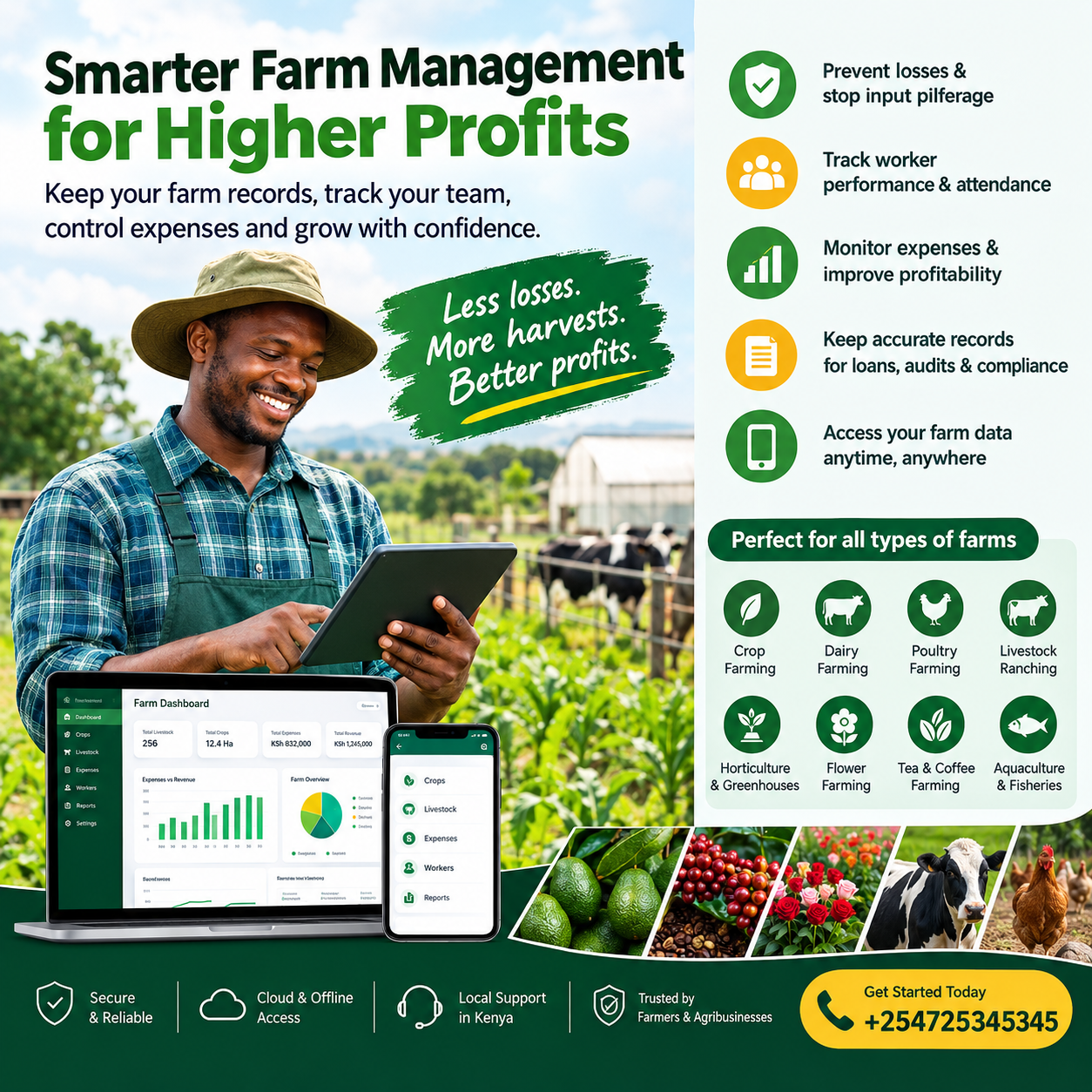
A farm software for agricultural colleges exists to resolve a contradiction at the heart of agricultural education: institutions teaching the most management-intensive industry in the country are, in many cases, running their own farms on the least managed methods. The lecture halls teach agribusiness, farm planning, and record keeping — while the college dairy unit down the hill runs its breeding calendar on a wall chart, its feed store on the herdsman’s memory, and its sales on a notebook kept in the farm manager’s office.
Every agricultural institution in Kenya operates a teaching farm or several: the dairy unit, the poultry houses, the horticulture blocks, the demonstration plots. These farms exist to show students what real farming looks like — and that is precisely the problem, because what students see daily is a farm run on paper and habit.
The graduate who watched records get skipped for three years learns the deepest lesson of all: that records are optional. A farm software for agricultural colleges flips that lesson, because it puts the college’s own farm on the same digital footing the industry now demands.
What has changed is that the destination has moved. The employers, buyers, lenders, and programmes graduates enter today all run on documentation: co-operatives pay against digital records, exporters audit traceability, banks finance against statements, and farm jobs increasingly begin with “can you use it?” Teaching graduates for that world without showing them a farm software for agricultural colleges in daily use is like training pilots in simulators that never leave the ground.
The cost of the gap is visible at every graduation. Employers report that agricultural graduates arrive fluent in theory and helpless at record keeping; graduates discover at their first job that the practical skill employers test is exactly the one their training farm never modelled; and the college itself loses money on enterprises it teaches others to profit from. A working farm software for agricultural colleges closes all three gaps with one deployment — because the system that manages the farm is the same system that teaches the students.
This guide examines farm software for agricultural colleges in full: why the timing is no accident, why the teaching farm decides everything, what the software actually is, the features that matter for both management and instruction, the benefits colleges report, who needs it most, what each teaching unit demands, the number that changes everything, and how to choose and implement a system without disrupting the academic calendar. By the end, running a college farm becomes teaching and business in one system.
The principle underneath is simple: in agricultural education, the farm is the curriculum’s most honest chapter — and farm software for agricultural colleges is what makes that chapter current.
Why the Timing Is No Accident
The urgency behind farm software for agricultural colleges is no accident. Kenya’s agricultural sector has professionalised around documentation: certified farms, traceable produce, audited payrolls, financed herds. Every one of those systems runs on records, and every employer of agricultural graduates now treats record keeping as a core competency rather than a courtesy.
Curriculum reform has moved the same direction. Competency-based training models emphasise practical ability over memorised theory, and assessors increasingly examine whether students can actually do what the syllabus claims — plan a rotation, cost an enterprise, keep a herd’s records, reconcile a milk statement. Institutions that run their teaching farms on farm software for agricultural colleges platforms demonstrate exactly those competencies every day, live, on their own gates.
The tools completed the shift. Record systems priced for smallholder farms fit a college’s budget the way a textbook does, and the phones students already own become the field terminals. A farm software for agricultural colleges deployment no longer requires special hardware or technical staff — it requires the decision to teach what the industry actually runs on.
Why the Teaching Farm Decides Everything
Students learn farming from the farm, not from the whiteboard. What the college’s own unit does daily becomes the student’s definition of normal — and if that normal is unrecorded, unmeasured, and unprofitable, the graduate carries it into every farm they will ever manage. This is why the choice of farm software for agricultural colleges is a curriculum decision, not an administration decision.
The second reason is the employability evidence. Agricultural employers consistently rank practical record keeping, cost awareness, and digital tool fluency among their top complaints about graduates — and all three are learned by practice, not by lecture. Colleges that teach through farm software for agricultural colleges daily use graduate students who have already done the thing employers will hire them to do.
The third reason is the farm as a business. College farms are real enterprises with real budgets: herds to feed, crops to sell, wages to meet, and usually an expectation of contributing to institutional income. A teaching farm managed without farm software for agricultural colleges records teaches agronomy while practising financial blindness — selling produce without knowing cost per unit, and keeping animals without knowing which earn their feed.
The fourth reason is accreditation and standing. Inspectors, quality auditors, and industry partners all form impressions from the operational state of the teaching farm — and a farm with systematic records reads as an institution that practises what it teaches. Farm software for agricultural colleges visibility has quietly become part of the institutional reputation.
What the Software Actually Is
At its core, farm software for agricultural colleges is a digital farm management system serving two audiences at once: the farm staff who run the teaching units as real enterprises, and the students who learn from those units as living classrooms. The same records do both jobs — which is what makes the model powerful.
The architecture follows one principle: one farm, one record, many readers. Every entry the farm makes — a treatment, a harvest, a sale, a feed issue — is simultaneously a management record for the farm manager, a teaching case for the lecturer, and a competency exercise for the student assigned to it. A serious farm software for agricultural colleges deployment never separates the operational record from the educational one, because the connection between them is the entire point.
The daily workflow shows the design. Morning: the student on practical duty logs the dairy unit’s yields per cow, under the supervisor’s review. Midday: the farm manager issues feed against the store, and the system updates stock, cost, and the herd’s consumption record. Afternoon: the horticulture class weighs and grades the morning’s harvest, entering each grade into the record.
By evening, three audiences have read the same data: the manager sees enterprise performance, the lecturer builds tomorrow’s lesson from today’s numbers, and the head of department reviews the whole farm from one screen. That triple duty is the defining character of farm software for agricultural colleges — one system serving the business, the classroom, and the administration simultaneously.
The intelligence layer turns the records into curriculum. Quality farm software for agricultural colleges platforms compute continuously: cost per litre on the dairy unit, feed conversion per batch of broilers, profit per crop block — and those computed results become the case studies students work through, drawn from their own farm rather than a textbook’s hypothetical. Few teaching tools connect theory to consequence as directly as a farm software for agricultural colleges deployment where the numbers being analysed belong to the herd the students milked that morning.
Core Features That Matter
Multi-Enterprise Management
College farms teach everything — dairy, poultry, horticulture, cereals, sometimes rabbits, bees, and fish — and the software must handle all of it in one system, the way the curriculum does. A farm software for agricultural colleges platform with genuine multi-enterprise depth lets each unit run its own records while the institution sees the whole farm’s economics together.
Student Roles and Supervised Access
The teaching use demands controlled participation: students assigned to units for practical terms, recording under supervision, with their entries attributable and reviewable. A farm software for agricultural colleges with role-based access turns every practical rotation into a documented, assessable exercise — the student’s work is their record, and the record is their portfolio.
Livestock Module for the Teaching Herd
The dairy and beef units need the full depth: individual animal profiles, breeding calendars, treatment logs with withdrawal periods, feed issues, and production curves. A farm software for agricultural colleges livestock module gives animal science students the real biological calendar to learn from — heats, calvings, and withdrawals happening on schedule, recorded by students, visible to everyone.
Crop Module for the Teaching Blocks
The horticulture and field-crop blocks need block-level records: planting plans, input applications, spray intervals, irrigation, and harvests by grade. A farm software for agricultural colleges crop module lets agronomy students follow real cycles from planting plan to sale — and compare what the block actually produced against what the plan promised.
Financial Records and Enterprise Costing
Every unit’s costs and incomes should sit in one ledger, tagged by enterprise — producing cost per litre, per crate, per kilogram automatically. Farm software for agricultural colleges with integrated finance turns the teaching farm into a live agribusiness case: students see, in their own unit’s numbers, exactly where enterprise profit is decided.
Sales and Buyer Records
The farm’s produce sells to real markets — staff, local buyers, institutions — and every sale should be recorded with buyer, quantity, price, and payment. A farm software for agricultural colleges with sales records teaches the commercial half of farming that graduates consistently report being least prepared for: invoicing, collection, and buyer management.
Experiment and Trial Records
Agricultural colleges run trials — variety comparisons, fertiliser rates, treatment differences — and the software should record them with the structure trials need: plots, treatments, replications, and measured results. A farm software for agricultural colleges with trial support lets research data and teaching data live in one place, connected to the same farm.
Practical Assessment and Reporting
Instructors need to see, per student and per unit, what was recorded and how well — for grading, for competency assessment, and for portfolio evidence. A farm software for agricultural colleges with assessment views converts daily entries into evidence that satisfies examiners without a single extra document being written.
Alerts as Teaching Moments
A vaccination due on the teaching herd, a spray interval closing on the block, feed stock falling low — the system’s alerts are simultaneously farm management and curriculum timing. Farm software for agricultural colleges alerts teach students what a managed farm’s morning looks like: a ranked list of what needs attention, before anything becomes urgent.
Administrative Dashboards
The farm manager, the head of department, and the principal need different views of the same farm: operational detail, academic integration, and institutional economics respectively. A farm software for agricultural colleges deployment serves all three from one database — the farm’s truth, read at whatever altitude each office requires.
The Benefits Colleges Report
The first benefit is graduates who can actually do it. Colleges that run their farms on farm software for agricultural colleges platforms graduate students who have personally recorded herds, costed enterprises, and reconciled sales — and employers notice within the first month of hiring. Several institutions report the reputation effect arriving before the curriculum paperwork does.
The second is the teaching farm becoming profitable. Units managed on real records stop losing money to the leaks every farm suffers — feed shrinkage, unrecorded sales, wasted inputs — and many college farms turn their first genuine profit under farm software for agricultural colleges discipline, funding the next teaching cycle instead of requesting it.
The third is assessment evidence without paperwork. Student practicals, unit performance, and competency demonstrations all document themselves through the entries the work already produces. Instructors using farm software for agricultural colleges records describe moderation and inspection seasons becoming routine rather than crisis.
The fourth is curriculum credibility. When the institution teaches record keeping on a farm that demonstrably keeps records — profitably, visibly, daily — the theory and the practice stop contradicting each other. Students trust farm software for agricultural colleges lessons more when the farm itself is the proof.
The fifth is research data quality. Trials recorded on the same platform as operations gain clean structure, consistent measurement, and permanent storage — and student projects contribute to a growing institutional dataset. Colleges running farm software for agricultural colleges research alongside teaching describe publications and partnerships that paper notebooks never supported.
The sixth is industry partnership. Agribusinesses recruiting graduates, buyers sourcing from college farms, and funders supporting programmes all respond to operational credibility. Institutions whose farms run on farm software for agricultural colleges systems report easier MoUs, better buyer terms, and stronger placement relationships.
The seventh compounds longest: the model effect. Every graduate who learned agriculture on a digitally managed farm carries that model into the farms they will manage — multiplying the institution’s influence far beyond its gates. The deepest return of farm software for agricultural colleges adoption is generational: the college teaches the system once, and the graduates run it for decades.
Who Needs It Most
National agricultural colleges — Bukura, Baraka, Kilifi, AHITI and their peers — need the systems most visibly, because their entire product is practical competence. An institution whose mission is producing farm-ready graduates cannot model farm management on paper without undermining its own certificate. Farm software for agricultural colleges deployment is, for this tier, core infrastructure rather than optional technology.
County Agricultural Training Centres (ATCs) — the former Farmers Training Centres — serve thousands of visiting farmers annually, and their demonstration units are the county’s teaching face. ATCs running farm software for agricultural colleges platforms demonstrate to every visitor what the county wants its farmers practising — the centre becomes a living recommendation.
University faculties of agriculture need the software for a different reason: their practical farms and student plots are where theory meets soil, and their graduates enter the most competitive segment of the job market. Faculties that run practicals through farm software for agricultural colleges records give their students the portfolio evidence that distinguishes them at interviews.
Private agricultural training institutions compete on employability outcomes, and nothing signals employability like graduates fluent in the industry’s actual tools. For private colleges, farm software for agricultural colleges integration is a marketing asset as much as a teaching one — the brochure writes itself.
Agricultural high schools and TVET institutions complete the formal tier, introducing digital farm records early in the learner’s journey. Institutions that deploy farm software for agricultural colleges systems at secondary level graduate learners who treat records as normal rather than novel.
Extension training programmes and NGO-run farmer field schools form the final constituency: they train working farmers rather than students, and their demonstration farms teach the same way college farms do. Programmes that run farm software for agricultural colleges systems in farmer field schools report adoption spreading from the demonstration to the village — the farm is the curriculum, wherever it stands.
Unit by Unit: What Each Teaching Enterprise Demands
The dairy unit is the college’s most data-rich classroom: individual cows, breeding calendars, treatments, feed, and daily yields — every biological event a lesson. Its farm software for agricultural colleges requirements are the full livestock depth, because the dairy unit teaches management density better than any other enterprise on campus.
The poultry unit teaches batch mathematics: mortality against plan, feed conversion against weight, vaccination schedules against the calendar. A farm software for agricultural colleges poultry module gives students the batch economics that decide whether poultry pays — the discipline small margins demand and large farms assume.
The horticulture blocks teach cycles and specifications: planting plans, fertigation, spray intervals, grade-outs, and buyer orders. Their farm software for agricultural colleges emphasis is the record chain from planting plan to sale — the same chain the industry audits students for after they graduate.
The field-crop and trial plots teach comparison: varieties against varieties, rates against rates, with measured results feeding research and teaching together. A farm software for agricultural colleges trial module keeps the plots’ data structured, permanent, and connected to the farm around them.
The mixed-model teaching farm — several enterprises sharing one store and one budget — teaches the hardest lesson of all: allocation. Its farm software for agricultural colleges priority is per-enterprise costing with shared costs attributed honestly, because the mixed farm is where profit hides or dies.
The farm store and accounts office, finally, teach the commercial spine: inventory, purchases, sales, and reconciliation. A farm software for agricultural colleges deployment that includes the store teaches every student where the money actually moves — the back office most curricula skip and most employers test.
The Number That Changes Everything: Cost per Enterprise per Training Cycle
The single most clarifying figure a college farm can compute is the cost of running each teaching enterprise per cycle — inputs, feed, labour, and overheads against the income the unit generated. Farms that compute this through farm software for agricultural colleges records discover, almost without exception, that some units subsidise their teaching value with genuine losses — and that knowing the size of the loss is the beginning of managing it.
The second number is cost per student practical: what each enterprise’s teaching actually costs the institution per learner per term. Administrators who see this through farm software for agricultural colleges analysis finally resource their practicals deliberately instead of by inherited budget habit.
The third is the trend across cycles, because one season is weather and several are structure. Enterprises whose economics deteriorate across cycles signal management problems worth teaching — and the farm software for agricultural colleges trend view turns those problems into case material rather than quiet decline.
Paper Records vs Digital Systems
Paper is familiar, cheap, and better than nothing — but a college farm breaks it structurally, because the paper record serves only the person holding the notebook. Students rotate before entries mature, lecturers cannot query what they cannot see, and the manager’s books answer one office while the curriculum needs the same data everywhere. The farm software for agricultural colleges alternative is a single record every audience reads from — which is exactly what a teaching institution requires.
Paper also cannot compute, verify, or survive. Cost per litre, feed conversion, and enterprise margins must be worked by hand; student entries cannot be attributed or reviewed; and one lost book erases a term’s teaching evidence. A farm software for agricultural colleges system computes continuously, attributes every entry, and backs the institution’s teaching data beyond the campus.
Records, Accreditation and Industry Standing
Quality assurance and accreditation processes increasingly examine practical training evidence — and a farm whose records are systematic produces that evidence continuously rather than assembling it for inspection. Institutions running farm software for agricultural colleges platforms describe TVET and university audits transformed: the assessor’s questions meet a live system instead of a scramble.
Industry partnerships follow the same logic. Agribusinesses that host graduates, source produce, or co-fund programmes evaluate the institution’s operational credibility — and the farm’s digital discipline reads as the institution’s professional standard. Farm software for agricultural colleges records have become part of how the sector judges its trainers.
How to Choose the Right System
Start with the dual mandate rather than the feature list: the system must manage the farm well and teach the curriculum well, and either role alone is insufficient. List the three operational problems the farm struggles with and the three competencies the curriculum must demonstrate, then test whether the farm software for agricultural colleges candidate serves both lists — because a system that manages without teaching, or teaches without managing, fails the mandate.
Then trial with both audiences: run the farm staff’s real week through it, and assign a student practical rotation onto it. A farm software for agricultural colleges platform that staff find heavy or students find inaccessible will fail at whichever audience was neglected — and both must adopt it for the model to work.
Implementing Without Disrupting the Academic Calendar
Begin with the baseline: units mapped, herds and blocks entered, opening balances counted once, and the staff trained before the students arrive. A farm software for agricultural colleges deployment is only as trustworthy as the day-zero truth beneath it — and only as teachable as the staff’s own confidence in it.
Costs and Return on Investment
Pricing follows recognisable models: institutional subscriptions scaled to units and users, per-student licensing for large cohorts, and custom deployment for multi-campus institutions. Model the total annual cost of each farm software for agricultural colleges candidate against both sides of the ledger — the teaching value it produces and the losses it recovers — because an institution whose farm is also a classroom earns on both.
The Future of Agricultural Training
The technology is still accelerating. Platforms increasingly integrate sensors, satellite imagery, and AI advisory tools — and the farms that feed clean records into those systems are the ones the tools work for. Colleges that run farm software for agricultural colleges foundations today are preparing graduates not for the industry of the last decade but for the one arriving — and their teaching farms become the first places the next generation of agricultural technology is actually practised.
Frequently Asked Questions
Is this affordable for a small college or county ATC? Yes — the systems are priced for the same smallholder farms they teach about, and a college’s needs fit within one modest institutional subscription. Most deployments cost less than the teaching farm’s monthly feed bill, and they routinely recover more than that in losses avoided.
Will students actually engage with the recording, or will it become a chore? Students engage when the records are theirs — assigned, attributed, and reviewed as part of their practical assessment. Colleges that make recording a graded part of the rotation report the same pattern: the recording becomes the practical, and the practical becomes the portfolio.
Can one system handle the dairy unit, poultry, crops, and trials together? Yes — and it should. Genuine platforms run every enterprise in one database, which is exactly what lets students see the whole farm rather than fragments of it. The multi-enterprise view is one of the core reasons a single platform outperforms separate tools.
How does this satisfy competency-based training requirements? The system documents every practical competency as it is performed — entries attributable to students, reviewed by supervisors, and exportable as evidence for assessment and moderation. Institutions describe CBET evidence as assembling itself from work the students were doing anyway.
How long before the institution sees results? The first results arrive within the first term — units recorded, students contributing, evidence accumulating. The deeper returns — profitable enterprises, employer recognition, audit readiness — build across the first academic year of consistent farm software for agricultural colleges use, and every cohort after that strengthens them.