Table of Contents
ToggleIntroduction to Farm Resource Planning Software
Agriculture has evolved into a highly complex business that requires careful coordination of people, equipment, inventory, finances, and production activities. Modern farms are no longer simple operations where a farmer only focuses on planting and harvesting. Today’s agricultural businesses manage workers, tractors, irrigation systems, fertilizers, feeds, seeds, livestock, fuel, warehouses, and supplier relationships simultaneously.
As farms grow, resource management becomes increasingly challenging. Labor may be underutilized during some periods and overstretched during others. Equipment may sit idle while other machines operate beyond recommended limits. Inputs may be purchased too late or stored inefficiently. These inefficiencies reduce profitability and create operational bottlenecks.
This is why many agricultural businesses are investing in Farm Resource Planning Software. A modern Farm Resource Planning Software solution centralizes information about farm resources and helps managers make better decisions based on real-time data rather than assumptions.
When reviewing leading software providers in this category, one common trend appears. Many websites promise “higher yields,” “improved profitability,” or “dramatic efficiency gains” without explaining how these results are achieved. The reality is that software itself does not increase production. Instead, Farm Resource Pl
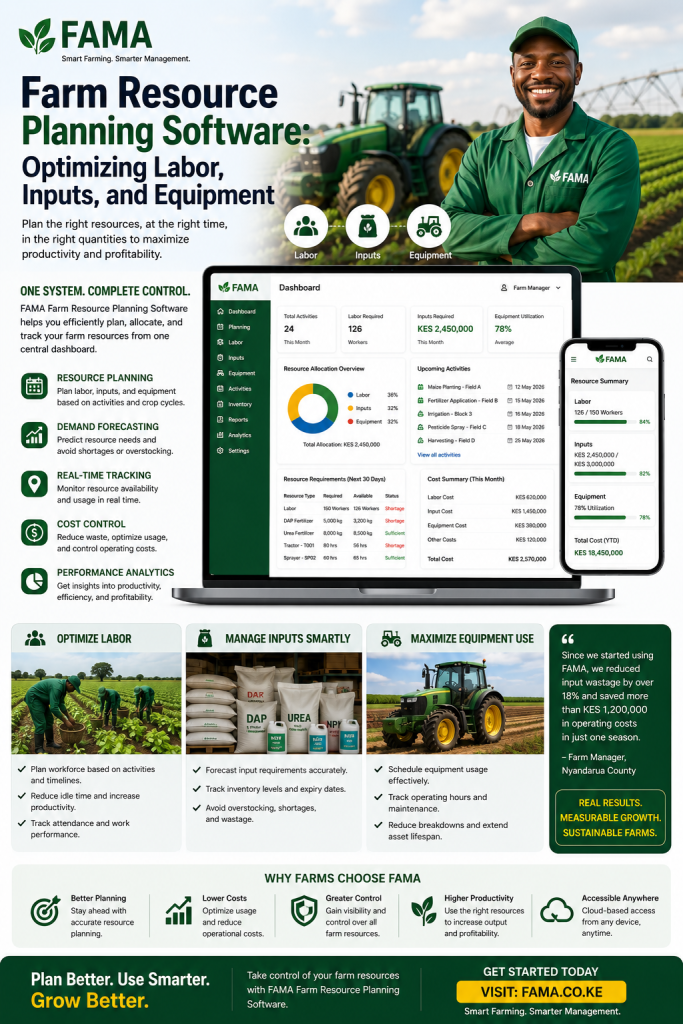
anning Software improves planning, coordination, accountability, and visibility. These improvements help farms reduce waste and optimize resource utilization.
For agricultural businesses seeking sustainable growth, resource planning has become one of the most important aspects of farm management.
What Is Farm Resource Planning Software?
Farm Resource Planning Software is a digital platform designed to help farms manage and optimize resources such as labor, equipment, inventory, livestock, inputs, and operational activities.
The software functions similarly to enterprise resource planning systems used in manufacturing, logistics, retail, and other industries. However, it is specifically adapted to agricultural operations.
A modern Farm Resource Planning Software platform integrates multiple functions into one system. Instead of managing labor schedules in spreadsheets, inventory records in notebooks, and equipment maintenance on paper, managers can access everything from a centralized dashboard.
This creates better visibility across the farm and improves coordination between departments.
The ultimate goal is to ensure that resources are available where and when they are needed while minimizing waste and inefficiency.
Why Resource Planning Matters in Agriculture
Agriculture depends heavily on timing.
Planting must occur during specific windows. Fertilizer applications must happen at appropriate growth stages. Irrigation schedules must align with weather conditions. Harvesting must be completed before crops deteriorate.
Resource shortages during critical periods can significantly affect productivity.
A Farm Resource Planning Software solution helps managers forecast requirements and allocate resources effectively.
Rather than reacting to problems as they arise, farms can plan proactively.
This planning capability becomes increasingly valuable as operations expand and complexity increases.
Large agricultural enterprises often manage hundreds of workers, multiple equipment categories, and extensive inventories. Coordinating these resources manually becomes difficult and error-prone.
Farm Resource Planning Software for Labor Management
Labor remains one of the largest operational expenses for many farms.
Managing workers efficiently requires careful scheduling, task allocation, attendance tracking, and productivity monitoring.
A Farm Resource Planning Software platform helps managers assign responsibilities and monitor progress in real time.
Workers can be allocated to planting, harvesting, irrigation, livestock management, maintenance, or warehouse activities based on operational priorities.
Managers gain visibility into workforce utilization and can identify areas where productivity improvements may be needed.
This structured approach helps reduce confusion and improves accountability throughout the organization.
Businesses seeking advanced workforce management may also explore solutions available through Dexa for attendance tracking and operational workflow management.
Optimizing Equipment Utilization
Farm equipment represents a significant investment.
Tractors, harvesters, planters, irrigation systems, generators, milk cooling units, transport vehicles, and processing machinery all require careful management.
A Farm Resource Planning Software system helps farms track equipment availability, usage patterns, maintenance schedules, and operational performance.
Managers can identify underutilized assets and improve scheduling to maximize equipment productivity.
Better utilization reduces unnecessary capital expenditures and improves return on investment.
Equipment planning also helps minimize downtime during critical farming periods.
Managing Agricultural Inputs Effectively
Seeds, fertilizers, pesticides, livestock feeds, veterinary supplies, and fuel represent essential farm inputs.
Poor inventory management often results in shortages, wastage, or emergency purchases.
A Farm Resource Planning Software solution provides visibility into inventory levels and usage patterns.
Managers can forecast future requirements based on production plans and historical consumption data.
This helps improve purchasing decisions and reduces operational disruptions.
Accurate input management also contributes to better financial control.
Inventory Planning and Warehouse Management
Inventory extends beyond agricultural inputs.
Many farms maintain spare parts, packaging materials, tools, maintenance supplies, and finished products.
A Farm Resource Planning Software platform helps track inventory movement and maintain accurate stock records.
Warehouse managers can monitor incoming deliveries, internal transfers, and outgoing shipments.
This visibility reduces losses and improves inventory accuracy.
Better inventory control also supports production continuity and customer satisfaction.
Livestock Resource Planning
Livestock operations require careful management of animals, feeds, medications, breeding schedules, and housing facilities.
A Farm Resource Planning Software platform helps integrate livestock management into broader operational planning.
Managers can monitor feed requirements, vaccination schedules, production performance, and breeding activities.
This centralized approach improves coordination and supports better decision-making.
Whether managing dairy cattle, poultry, goats, sheep, pigs, or beef herds, resource planning contributes to operational efficiency.
Financial Benefits of Farm Resource Planning Software
One of the most valuable benefits of Farm Resource Planning Software is improved financial visibility.
Many farms understand production volumes but struggle to understand resource utilization costs.
The software helps connect operational activities with financial information.
Managers can evaluate labor expenses, equipment operating costs, inventory consumption, and production efficiency.
This insight supports more informed budgeting and investment decisions.
Better financial visibility often leads to stronger operational discipline and improved profitability.
Farm Resource Planning Software for Multi-Farm Operations
Agricultural enterprises frequently expand into multiple locations.
Managing resources across different farms can become challenging without centralized systems.
A Farm Resource Planning Software platform enables management teams to monitor operations across all locations from a single dashboard.
Resources can be allocated more efficiently based on operational needs.
Management gains better visibility into performance and can make strategic decisions more effectively.
This scalability makes digital planning systems particularly valuable for growing agricultural businesses.
Improving Communication Across Departments
Many farms struggle with communication challenges.
Production teams, livestock managers, maintenance crews, warehouse staff, and administrative personnel often operate independently.
A Farm Resource Planning Software platform creates a shared source of information that improves coordination.
Managers can communicate priorities, assign tasks, and monitor progress through structured workflows.
This reduces misunderstandings and improves operational efficiency.
Better communication contributes to stronger teamwork and more consistent execution.
Data-Driven Agricultural Decision Making
Modern agriculture increasingly depends on data.
A Farm Resource Planning Software platform collects and organizes information that supports better decision-making.
Managers can review reports on labor productivity, equipment utilization, inventory trends, production performance, and operational costs.
Rather than relying solely on experience or intuition, decisions can be supported by accurate information.
Data-driven management helps farms respond more effectively to challenges and opportunities.
Farm Resource Planning Software and Sustainability
Sustainability has become a major priority within agriculture.
Farmers are under increasing pressure to use resources responsibly while maintaining productivity.
A Farm Resource Planning Software solution helps monitor resource consumption and identify opportunities for improvement.
Managers can track water usage, fertilizer applications, fuel consumption, and equipment efficiency.
Better visibility supports more sustainable farming practices and helps reduce waste.
Organizations such as Food and Agriculture Organization (FAO) continue to promote technology adoption as a driver of sustainable agricultural development.
Integration With Modern Agricultural Technologies
Agricultural technology continues evolving rapidly.
Sensors, GPS systems, drones, weather stations, automated irrigation systems, and smart livestock monitoring tools are becoming increasingly common.
A modern Farm Resource Planning Software platform can integrate information from these technologies into one centralized system.
This integration improves visibility and reduces manual data entry.
As agriculture becomes more connected, integrated resource planning will become increasingly important.
Internal Technology Ecosystem for Agricultural Businesses
Growing agricultural enterprises often require multiple digital solutions.
Useful business platforms include:
- Fama for agricultural management.
- Jaat for enterprise operations.
- Vega POS for agrovet and retail management.
- Pawa for connectivity management.
- RentalDesk for property management.
- Ratibu for school administration.
- ChurchesAdmin for church management.
- KayaPro360 for business operations.
Together, these platforms demonstrate how digital systems improve operational efficiency across industries.
Risks and How to Mitigate Them
Implementing Farm Resource Planning Software offers significant benefits, but there are potential risks.
One challenge is inaccurate data entry. If information is incomplete or inconsistent, reports become less reliable. Training staff and establishing clear procedures help address this issue.
Another challenge is resistance to change. Employees accustomed to manual processes may initially hesitate to adopt new technology. Gradual implementation and ongoing support improve adoption rates.
Connectivity limitations may affect cloud-based platforms in some rural areas. Selecting software with offline capabilities can reduce disruptions.
Data security is also important. Farms should choose reputable providers that offer backups, encryption, and secure access controls.
Finally, selecting software without agricultural functionality may limit long-term value. Farms should prioritize solutions specifically designed for agricultural operations.
Is This Worth It? Honest Verdict
For most commercial farms, the answer is yes.
The value of Farm Resource Planning Software comes from improved coordination, better visibility, stronger accountability, and more informed decision-making.
Small farms may initially manage operations manually, but growing businesses often reach a point where spreadsheets and notebooks become difficult to maintain.
Farms managing multiple workers, equipment categories, inventory items, livestock operations, or production sites generally experience the greatest benefits.
The software does not eliminate operational challenges, but it provides the structure needed to manage them more effectively.
Farm Resource Planning Software and Strategic Farm Growth
Many farms focus heavily on production activities while paying less attention to resource planning. However, the difference between an average farm and a highly profitable farm often comes down to how resources are allocated and managed. Land, labor, equipment, capital, livestock, and agricultural inputs must all work together efficiently. A modern Farm Resource Planning Software solution helps bring these resources into a single management framework, allowing farm owners to make decisions based on real operational data rather than assumptions.
As agricultural businesses grow, resource planning becomes increasingly complex. A farm managing 10 acres may be able to coordinate activities manually, but a farm managing hundreds of acres, multiple livestock units, warehouses, and dozens of employees requires a more structured approach. This is where Farm Resource Planning Software becomes an essential business tool rather than a luxury.
The software provides visibility across the entire operation, helping managers identify bottlenecks, forecast future needs, and improve overall efficiency. Better planning leads to smoother operations, stronger financial control, and more predictable business performance.
Improving Daily Farm Operations Through Better Planning
Daily farm operations involve countless moving parts. Workers need assignments, machinery must be available, inventory must be sufficient, and production activities need proper coordination.
Without a centralized system, communication gaps often emerge. Workers may wait for instructions, equipment may be double-booked, or critical inputs may run out unexpectedly.
A Farm Resource Planning Software platform creates structure around daily activities. Managers can assign tasks, monitor progress, track resource utilization, and respond quickly to operational issues.
This improved visibility allows farms to maintain productivity even during busy periods such as planting, harvesting, vaccination campaigns, or feed distribution schedules.
Operational consistency becomes easier to achieve because everyone works from the same source of information.
Farm Resource Planning Software for Equipment Lifecycle Management
Farm machinery represents one of the largest capital investments in agriculture. Tractors, harvesters, irrigation pumps, milk cooling systems, generators, transport vehicles, and processing equipment require careful management to maximize their useful life.
A Farm Resource Planning Software solution helps farms track equipment throughout its entire lifecycle.
Managers can record purchase information, maintenance schedules, repair histories, warranty details, and operating hours. This information creates a complete asset profile that supports better decision-making.
Instead of replacing equipment based on assumptions, farms can make informed decisions based on actual performance data.
Lifecycle management also helps reduce ownership costs by ensuring that equipment receives appropriate maintenance and remains productive for longer periods.
Supporting Agricultural Expansion
Growth is a common goal for many agricultural businesses. Whether expanding crop acreage, increasing livestock numbers, adding processing facilities, or entering new markets, growth creates additional management complexity.
A Farm Resource Planning Software platform provides the operational foundation needed to support expansion.
As the business grows, managers can maintain visibility across multiple locations, departments, and production units. Resource allocation becomes more strategic because decision-makers have access to accurate information.
Expansion without proper systems often leads to inefficiencies and operational confusion. By implementing Farm Resource Planning Software early, farms create scalable processes that support sustainable growth.
This scalability becomes particularly valuable for commercial farms seeking long-term success.
Workforce Productivity and Performance Monitoring
Labor management remains one of the most challenging aspects of agriculture. Seasonal fluctuations, workforce availability, and varying productivity levels can significantly affect farm performance.
A Farm Resource Planning Software solution helps managers monitor workforce utilization and productivity more effectively.
Tasks can be assigned digitally, completion status can be tracked, and supervisors gain better visibility into operational progress.
This structured approach helps identify productivity gaps and supports continuous improvement.
When labor resources are managed efficiently, farms can achieve more consistent results while maintaining operational discipline.
The software also helps reduce misunderstandings and improve accountability throughout the organization.
Farm Resource Planning Software and Cost Control
Agricultural profitability depends heavily on cost management.
Input prices, labor expenses, fuel costs, equipment maintenance, and transportation expenses all affect financial performance.
A Farm Resource Planning Software platform provides detailed visibility into resource consumption and operational costs.
Managers can monitor spending trends, identify inefficiencies, and evaluate resource allocation decisions.
For example, unusually high fuel consumption may indicate equipment inefficiencies. Excessive inventory usage may reveal wastage issues. Unexpected labor costs may highlight scheduling challenges.
By identifying these issues early, farms can take corrective action before costs escalate.
Better cost control contributes directly to improved profitability and stronger financial sustainability.
Enhancing Agricultural Decision-Making
One of the most important benefits of Farm Resource Planning Software is improved decision-making.
Agricultural businesses generate large amounts of information. However, data alone has little value unless it can be organized and interpreted effectively.
The software consolidates information from different operational areas and transforms it into useful insights.
Managers can review reports, analyze trends, compare performance across locations, and evaluate operational efficiency.
This visibility supports better strategic planning and reduces reliance on guesswork.
Data-driven decisions are increasingly becoming a competitive advantage in modern agriculture.
Farms that understand their operations in detail are generally better positioned to adapt to market changes and operational challenges.
Why Farm Resource Planning Software Is Becoming a Standard Requirement
Agriculture is becoming increasingly professionalized.
Customers expect traceability. Financial institutions expect accurate records. Investors expect operational transparency. Regulators expect compliance documentation.
Meeting these expectations becomes difficult without digital systems.
A Farm Resource Planning Software platform helps farms maintain organized records and generate reliable information when needed.
This improves credibility and strengthens relationships with lenders, suppliers, customers, and business partners.
As technology adoption continues increasing across the agricultural sector, digital planning systems are gradually shifting from optional tools to standard business requirements.
Farms that delay modernization may find themselves struggling to compete with more organized and data-driven operations.
The Future of Farm Resource Planning Software
The future of agriculture will be increasingly connected, automated, and data-driven.
Emerging technologies such as artificial intelligence, predictive analytics, machine learning, IoT sensors, satellite monitoring, and automated equipment systems are transforming how farms operate.
A modern Farm Resource Planning Software platform serves as the foundation that allows farms to integrate and benefit from these innovations.
As more operational data becomes available, planning systems will become even more valuable. Predictive maintenance, automated scheduling, advanced forecasting, and real-time resource optimization will continue improving farm efficiency.
Farms that establish strong digital management practices today will be better prepared to leverage future technologies.
The agricultural businesses that thrive over the next decade are likely to be those that combine practical farming expertise with strong digital management capabilities.
Final Thoughts
A Farm Resource Planning Software solution does far more than organize information. It helps farms coordinate labor, optimize equipment usage, manage inventory, improve communication, strengthen accountability, and support strategic growth.
In an increasingly competitive agricultural environment, efficient resource management is no longer optional. It is a critical component of profitability and long-term sustainability.
Whether managing crops, livestock, mixed farming operations, or large commercial enterprises, farms benefit from having clear visibility into how resources are utilized across the business.
By adopting Farm Resource Planning Software, agricultural businesses position themselves for greater efficiency, stronger financial performance, and improved resilience in a rapidly evolving industry.
For farms serious about modernization and growth, resource planning software represents one of the most practical and valuable investments available today.
Frequently Asked Questions
What is Farm Resource Planning Software?
Farm Resource Planning Software helps farmers manage labor, equipment, inventory, livestock, inputs, and operational activities from one centralized platform.
Can small farms use Farm Resource Planning Software?
Yes. Many platforms are scalable and suitable for small, medium, and large agricultural operations.
Does Farm Resource Planning Software support livestock farms?
Yes. Most modern systems support both crop and livestock management functions.
Is cloud-based farm planning software secure?
Reputable providers use encryption, backup systems, and access controls to protect farm information.
How quickly can farms see results?
Many farms experience improvements in organization, planning, communication, and reporting within the first few months of implementation.
Start Optimizing Farm Resources Today
Modern agriculture requires more than hard work. Success increasingly depends on how effectively farms manage labor, equipment, inventory, livestock, and operational resources.
A powerful Farm Resource Planning Software solution helps farmers improve visibility, reduce waste, strengthen accountability, and support sustainable growth.
If you are ready to modernize your agricultural operations and gain greater control over your resources, start your digital transformation journey with https://fama.coke .The right planning system can help your farm become more efficient, productive, and competitive in Kenya’s evolving agricultural landscape.