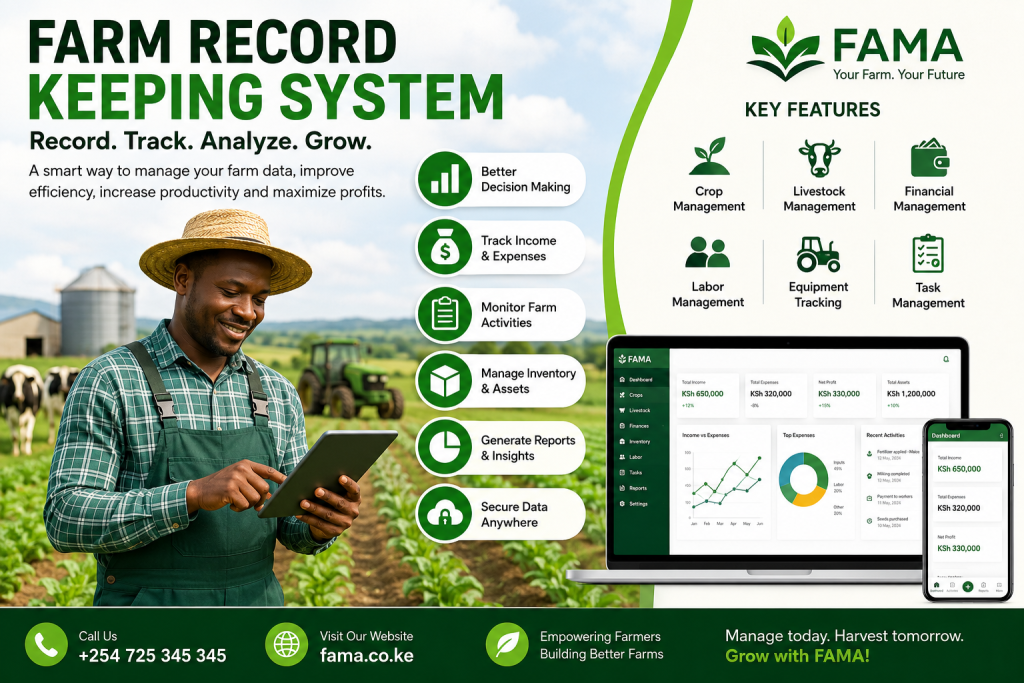
Farm Record Keeping System: Why Every Modern Farm Needs Digital Records
Agriculture is becoming increasingly data-driven, and every successful farmer understands the importance of maintaining accurate farm records. A reliable farm record keeping system helps farmers track expenses, monitor production, improve profitability, and make informed decisions. Whether you operate a small family farm or a large commercial agricultural enterprise, implementing a farm record keeping system can transform the way you manage your farm.
At FAMA, we provide innovative farm management solutions that simplify record keeping, improve operational efficiency, and support sustainable agricultural growth. Visit fama.co.ke or call +254 725345345 to learn how our farm management software can help your farming business.
What Is a Farm Record Keeping System?
A farm record keeping system is a structured method used to collect, store, organize, and analyze farm data. The system can be manual, using notebooks and spreadsheets, or digital through specialized farm management software.
A modern farm record keeping system enables farmers to:
- Track crop production records
- Monitor livestock performance
- Record farm expenses
- Manage farm income
- Monitor inventory
- Track labor activities
- Generate reports
- Analyze profitability
- Maintain compliance records
- Improve farm planning
The primary goal of a farm record keeping system is to provide farmers with accurate information for better decision-making.
Why Farm Records Matter
Many farmers focus heavily on production but overlook documentation. Without proper records, it becomes difficult to determine whether a farming operation is profitable.
A comprehensive farm record keeping system provides answers to important questions such as:
- Which crops generate the highest profits?
- What are the monthly operating expenses?
- How much fertilizer was used during the season?
- Which livestock animals are performing best?
- What is the average yield per acre?
- How much labor is required for each activity?
- What are the annual farm revenues?
By maintaining detailed records through a farm record keeping system, farmers gain visibility into every aspect of their operations.
Benefits of a Farm Record Keeping System
Improved Financial Management
One of the biggest advantages of a farm record keeping system is better financial control. Farmers can easily monitor:
- Revenue streams
- Production costs
- Input expenses
- Equipment maintenance costs
- Labor expenses
- Cash flow
Financial records help identify areas where costs can be reduced and profits increased.
Better Decision Making
A quality farm record keeping system provides historical data that supports strategic decisions.
Farmers can evaluate:
- Previous planting seasons
- Crop performance trends
- Livestock productivity
- Fertilizer effectiveness
- Market opportunities
Data-driven decisions often lead to higher yields and improved profitability.
Increased Productivity
When farm operations are properly documented, inefficiencies become easier to identify.
A farm record keeping system helps managers:
- Schedule activities effectively
- Monitor worker productivity
- Track resource utilization
- Optimize production processes
This leads to increased operational efficiency.
Easier Access to Financing
Banks, SACCOs, investors, and agricultural lenders often require farm records before approving loans.
A well-maintained farm record keeping system demonstrates:
- Business performance
- Revenue history
- Production capacity
- Growth potential
This improves the chances of obtaining agricultural financing.
Regulatory Compliance
Many agricultural certifications and government programs require proper documentation.
A digital farm record keeping system helps farmers maintain:
- Input usage records
- Chemical application logs
- Livestock health records
- Environmental compliance records
Essential Components of a Farm Record Keeping System
Crop Production Records
Crop production records form the foundation of any farm record keeping system.
Important information includes:
- Planting dates
- Crop varieties
- Seed quantities
- Fertilizer applications
- Irrigation schedules
- Pest management activities
- Harvest dates
- Yield results
These records help farmers analyze production performance over time.
Livestock Records
Livestock farmers benefit significantly from a comprehensive farm record keeping system.
Key livestock records include:
- Animal identification
- Birth records
- Vaccination schedules
- Breeding records
- Feed consumption
- Weight measurements
- Milk production
- Mortality records
These records support herd management and productivity improvements.
Financial Records
Every farm record keeping system should include financial tracking.
Examples include:
- Sales revenue
- Input purchases
- Equipment costs
- Labor payments
- Utility expenses
- Transportation costs
- Maintenance expenses
Accurate financial records help determine actual farm profitability.
Inventory Records
Inventory management is an important component of a farm record keeping system.
Farmers should track:
- Seeds
- Fertilizers
- Chemicals
- Animal feed
- Farm tools
- Equipment parts
Inventory records help prevent shortages and reduce wastage.
Labor Records
Labor costs represent a significant portion of farm expenses.
A farm record keeping system helps track:
- Employee attendance
- Daily activities
- Wages paid
- Productivity levels
- Seasonal labor requirements
These records support efficient workforce management.
Challenges of Manual Farm Record Keeping
Many farmers still use notebooks and paper files. While traditional methods may seem convenient, they often create challenges.
Common issues include:
Lost Records
Paper records can be misplaced, damaged, or destroyed.
Calculation Errors
Manual calculations increase the likelihood of mistakes.
Limited Reporting
Generating reports from paper records requires considerable effort.
Data Duplication
Information may need to be entered repeatedly.
Poor Accessibility
Paper records are difficult to access remotely.
These challenges highlight the importance of adopting a digital farm record keeping system.
Digital Transformation in Agriculture
Technology is revolutionizing agriculture across Kenya and beyond.
Modern farm record keeping system solutions provide:
- Cloud-based storage
- Mobile access
- Automated reporting
- Real-time updates
- Data analytics
- Financial tracking
- Inventory management
- Multi-user access
Farmers can now manage operations from smartphones, tablets, or computers.
Features of an Effective Farm Record Keeping System
Dashboard Reporting
A dashboard provides an overview of farm activities and performance indicators.
Expense Tracking
Track all farm expenditures in one centralized location.
Income Management
Monitor sales and revenue generation.
Crop Management
Manage planting schedules, field activities, and harvest records.
Livestock Management
Track animal health, production, breeding, and feeding records.
Inventory Control
Monitor stock levels and consumption patterns.
Financial Analysis
Generate profitability reports and financial summaries.
Mobile Accessibility
Access records from anywhere using mobile devices.
Data Security
Protect valuable farm information through secure digital storage.
Automated Reports
Generate reports instantly without manual calculations.
How a Farm Record Keeping System Improves Farm Profitability
Profitability depends on understanding both revenue and expenses.
A farm record keeping system enables farmers to:
- Identify profitable enterprises
- Reduce unnecessary expenses
- Improve resource allocation
- Monitor production efficiency
- Increase yields
- Enhance planning accuracy
When decisions are based on reliable data, profitability typically improves.
Choosing the Right Farm Record Keeping System
Before selecting a solution, farmers should evaluate:
Ease of Use
The system should be simple and user-friendly.
Scalability
It should support future farm growth.
Mobile Compatibility
Access from smartphones is essential.
Reporting Capabilities
Comprehensive reporting improves decision-making.
Customer Support
Reliable support ensures smooth implementation.
Data Security
Farm data must be protected and backed up.
Integration Capabilities
The system should work seamlessly with other farm management tools.
For farmers seeking a modern and reliable farm record keeping system, FAMA offers advanced solutions tailored to the needs of agricultural businesses across Kenya.
Contact us today at +254 725345345 or visit fama.co.ke to learn more.
Implementation Best Practices for Agricultural Businesses
Introducing a digital platform into daily operations requires planning and commitment. While technology can simplify management, success depends on how effectively the solution is adopted by managers, workers, and stakeholders.
The first step is identifying the information that is most important to your operation. Different enterprises have different priorities. Crop producers may focus on planting schedules and harvesting activities, while livestock enterprises may emphasize breeding, feeding, and health monitoring.
Once priorities are established, it becomes easier to determine which information should be collected regularly and how often updates should occur.
Training employees is equally important. Team members should understand how to enter information accurately and consistently. Clear procedures help maintain data quality and ensure reports remain useful for decision-making.
Another critical factor is consistency. Information entered occasionally may provide limited value, while regular updates create meaningful insights over time. Successful agricultural businesses build a culture where documentation becomes part of everyday operations rather than an afterthought.
Improving Resource Utilization
One of the greatest challenges in farming is maximizing productivity while controlling costs. Every resource—land, labor, equipment, water, seed, fertilizer, and fuel—must be used efficiently.
Detailed operational records reveal patterns that might otherwise go unnoticed. For example, managers can identify fields that consistently outperform others, determine which activities consume the most labor hours, or discover equipment that generates excessive maintenance costs.
These insights allow businesses to allocate resources more strategically and improve overall performance.
Water management offers a good example. Irrigation activities can be monitored to identify areas of waste and opportunities for conservation. Similarly, tracking fuel consumption helps identify machinery that may require servicing or replacement.
The result is improved efficiency across the entire operation.
Supporting Long-Term Planning
Agricultural success often depends on decisions made months or even years in advance. Historical information provides valuable guidance when developing future strategies.
Long-term planning may include:
- Expansion into new production areas
- Acquisition of additional equipment
- Introduction of new crop varieties
- Livestock herd growth
- Infrastructure development
- Irrigation projects
- Storage facility investments
Access to accurate historical information reduces uncertainty and supports more confident decision-making.
Rather than relying solely on assumptions, managers can evaluate previous performance trends and identify opportunities with greater precision.
Enhancing Communication Across Teams
Larger agricultural enterprises often involve multiple departments and personnel. Communication challenges can arise when information is scattered across notebooks, spreadsheets, and individual devices.
Centralized digital platforms create a single source of truth for everyone involved in operations.
Field supervisors can monitor activities in real time. Farm owners can review reports remotely. Accountants can access financial information without waiting for paperwork. Managers can coordinate activities more effectively across different locations.
Improved communication reduces delays, minimizes misunderstandings, and strengthens accountability.
Data-Driven Decision Making
Modern agriculture increasingly depends on data rather than guesswork.
Historical production figures, expense reports, weather information, inventory levels, and market trends can all contribute to better decisions.
For example, a manager may discover that a specific variety consistently performs better under local conditions. Another analysis may reveal that certain inputs generate stronger returns than alternatives.
By examining patterns and trends, agricultural businesses can make more informed decisions regarding production methods, resource allocation, and investment priorities.
Over time, this approach contributes to greater efficiency and profitability.
Risk Management and Business Continuity
Farming involves numerous risks, including:
- Weather variability
- Market fluctuations
- Pest outbreaks
- Disease challenges
- Equipment failures
- Labor shortages
Comprehensive operational information supports risk management by providing a clear understanding of business performance and vulnerabilities.
When unexpected challenges occur, managers can quickly assess potential impacts and develop appropriate responses.
Historical records may also support insurance claims, financing applications, and recovery planning following adverse events.
Business continuity becomes easier when critical information is securely stored and readily accessible.
Sustainability and Environmental Responsibility
Sustainability is becoming increasingly important across the agricultural sector.
Consumers, regulators, investors, and certification organizations are placing greater emphasis on environmentally responsible practices.
Digital documentation supports sustainability initiatives by helping businesses monitor:
- Water usage
- Fertilizer application
- Chemical usage
- Energy consumption
- Waste management
- Soil conservation activities
Accurate information makes it easier to evaluate environmental performance and identify opportunities for improvement.
Sustainable practices often contribute to both environmental protection and long-term profitability.
The Role of Mobile Technology
Smartphones have transformed the way agricultural businesses operate.
Managers no longer need to wait until returning to the office to update information. Activities can be recorded directly from the field, greenhouse, dairy unit, poultry house, or storage facility.
Mobile access offers several advantages:
- Real-time updates
- Faster communication
- Improved accuracy
- Reduced paperwork
- Better accessibility
Field personnel can submit information immediately, ensuring that reports remain current and reliable.
This capability is particularly valuable for operations spread across multiple locations.
Reporting and Performance Measurement
Performance measurement is essential for continuous improvement.
Regular reporting helps managers answer questions such as:
- Which activities generate the highest returns?
- What costs are increasing?
- Are productivity targets being achieved?
- Which departments require additional support?
- How does current performance compare to previous seasons?
Well-designed reports transform raw data into actionable insights.
Instead of spending hours compiling spreadsheets, managers can focus on interpreting information and implementing improvements.
Future Trends in Agricultural Management
Technology continues to reshape the agricultural landscape.
Several emerging trends are expected to influence management practices in the coming years:
Artificial Intelligence
AI-powered tools can analyze large volumes of information and provide recommendations for improving productivity and efficiency.
Predictive Analytics
Advanced forecasting models can help businesses anticipate challenges and opportunities before they occur.
Internet of Things (IoT)
Connected sensors can monitor soil conditions, weather patterns, equipment performance, and livestock health in real time.
Automation
Automated systems can reduce labor requirements while improving accuracy and consistency.
Cloud-Based Platforms
Cloud technology enables secure access to information from virtually anywhere.
Precision Agriculture
Precision farming techniques support targeted resource application, reducing waste and increasing productivity.
These innovations are expected to play a significant role in the future of agricultural management.
Frequently Asked Questions
Is digital documentation suitable for small farms?
Yes. Operations of all sizes can benefit from organized information management. Small-scale producers often gain significant advantages because they can identify inefficiencies more quickly and make informed decisions with limited resources.
Can information be accessed remotely?
Most modern solutions offer cloud-based access, allowing users to view information from computers, tablets, and smartphones.
Is training required?
Basic training is recommended to ensure users understand how to enter, manage, and interpret information effectively.
How secure is digital information?
Modern platforms typically include security features such as encrypted storage, user permissions, and automatic backups.
Can reports be customized?
Many solutions allow businesses to generate reports tailored to their specific operational and financial requirements.
How quickly can benefits be realized?
Many organizations begin seeing improvements within a few months of consistent use, particularly in areas such as efficiency, planning, and cost control.
Building a Culture of Continuous Improvement
Beyond technology and processes, long-term success in agriculture depends on creating a culture of continuous improvement. Every season presents new lessons, opportunities, and challenges. Organizations that regularly review their performance are often better equipped to adapt and grow.
Continuous improvement begins with evaluating completed activities. After planting, harvesting, breeding cycles, or marketing campaigns, managers should assess what worked well and what could be improved. These reviews provide valuable insights that can guide future planning and resource allocation.
Employee involvement is also essential. Workers who participate in daily operations often have practical knowledge about field conditions, equipment performance, and operational challenges. Encouraging feedback from team members helps identify inefficiencies and generate innovative solutions.
Benchmarking can further support improvement efforts. Comparing current performance against previous seasons allows businesses to measure progress and set realistic goals. Indicators such as yield levels, production costs, labor efficiency, and revenue growth can provide a clear picture of operational performance over time.
Another important aspect is knowledge management. Agricultural businesses accumulate valuable experience over the years, but this knowledge can be lost when employees leave or management changes. Maintaining organized documentation ensures that important information remains available for future reference and decision-making.
Strategic planning should also be reviewed regularly. Market conditions, consumer preferences, weather patterns, and production costs can change rapidly. Periodic evaluations help ensure that business objectives remain relevant and achievable. Organizations that adapt quickly to changing conditions often maintain a competitive advantage.
Collaboration with agricultural experts, consultants, suppliers, and industry organizations can provide additional opportunities for growth. Access to professional advice and industry best practices helps businesses stay informed about emerging trends and innovative production techniques.
Investing in staff development is equally important. Training programs improve employee skills, increase productivity, and strengthen overall operational performance. As new technologies become available, ongoing education helps teams maximize the value of these investments.
Ultimately, successful agricultural enterprises view improvement as an ongoing process rather than a one-time initiative. Small adjustments made consistently over time can produce significant results. By combining accurate information, strategic planning, employee engagement, and a commitment to learning, organizations can build resilient operations capable of thriving in an increasingly competitive agricultural environment.
This approach not only supports profitability but also strengthens sustainability, enhances operational efficiency, and creates a solid foundation for future expansion. As agriculture continues to evolve, businesses that prioritize learning, adaptation, and innovation will be best positioned to achieve lasting success.
Conclusion
Agriculture is becoming increasingly complex, competitive, and data-driven. Businesses that embrace modern management practices are better positioned to improve productivity, control costs, and achieve sustainable growth.
Accurate information provides the foundation for informed decision-making. Whether managing crops, livestock, finances, inventory, labor, or infrastructure, organized data helps transform daily activities into measurable business outcomes.
Organizations that invest in digital solutions gain greater visibility into operations, improve accountability, strengthen planning capabilities, and position themselves for long-term success.
If you are looking for a reliable solution to streamline agricultural operations and improve management efficiency, FAMA is ready to help.
Visit fama.co.ke today or call +254 725345345 to learn how our agricultural management solutions can support your farming business and drive sustainable growth.