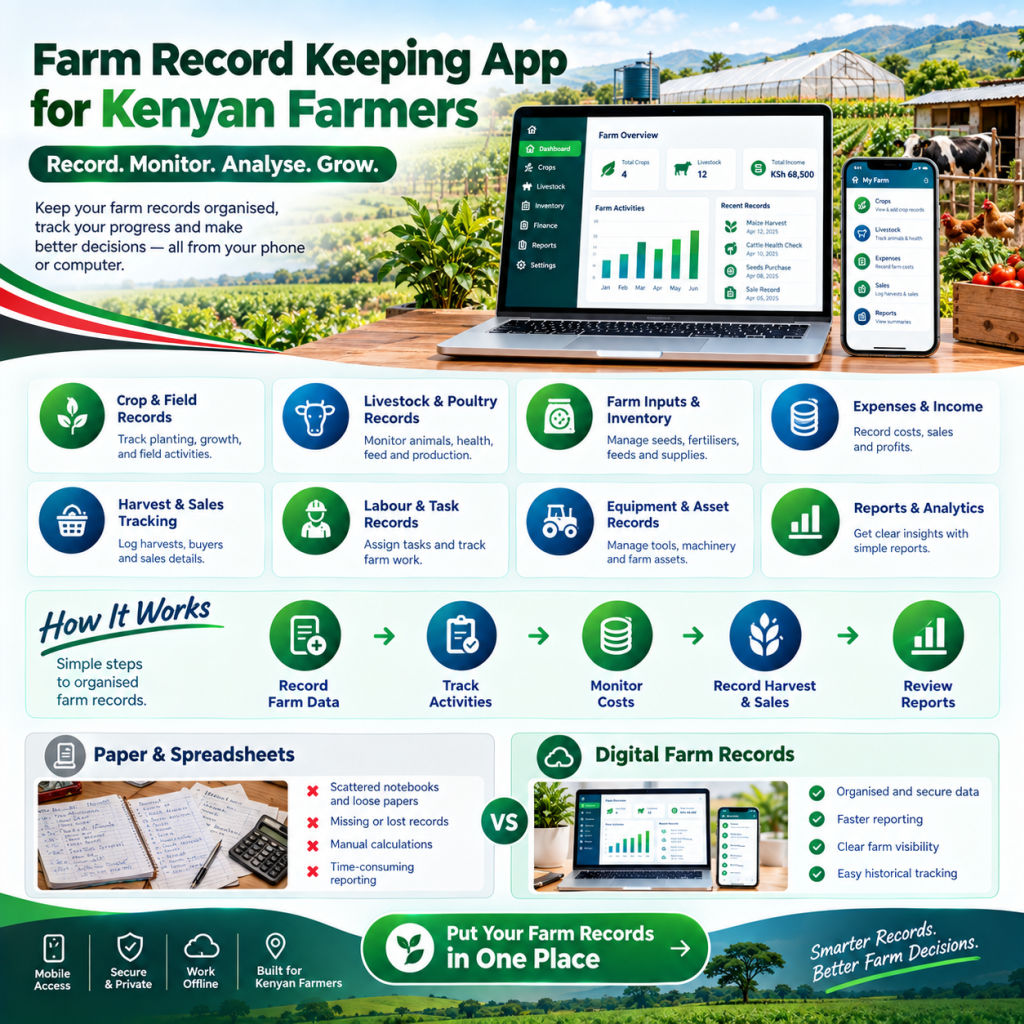
A farm record keeping app for Kenyan farmers exists to solve the oldest problem in this country’s agriculture: the distance between the work a farmer does and the numbers a farmer actually knows.
For generations, Kenyan farming ran on memory — the fertiliser quantity remembered from last season, the feed ration guessed each morning, the sale price reconstructed from a handshake weeks later, the season’s profit or loss discovered only when the money ran out.
That system worked when land was generous, inputs were cheap, and markets forgave imprecision. None of those conditions hold anymore, which is why the farms now pulling ahead are the ones whose owners can open a phone and answer, in seconds, questions that memory-based farms cannot answer at all.
Walk through any trading centre on a market day and you will meet both kinds of farmer. One quotes the cost of producing a crate of eggs, a litre of milk, or a 90-kilogram bag of maize down to the shilling, and negotiates from that certainty.
The other guesses, accepts whatever is offered, and discovers the truth of the season only at its end. The difference between them is rarely intelligence, effort, or even land — it is information, and information is precisely what a farm record keeping app for Kenyan farmers organises, protects, and converts into negotiating power.
What has changed is not the farmer but the environment around the farm. Input prices climb every season; buyers demand traceability from plot to plate; banks and saccos require evidence of cash flow before they advance a shilling; insurers and certification schemes are built entirely on documentation.
A farm that cannot show its numbers is quietly excluded from each of these doors, while a farm that can — farm record keeping app for Kenyan farmers in hand — is welcomed through all of them.
This guide examines the farm record keeping app for Kenyan farmers in full: what it is, which records deserve capture, the features that separate genuine tools from gimmicks, the benefits farms report after going digital, how records unlock financing, what the system costs, and how to adopt one without disrupting a busy operation.
By the end, the path from notebook to digital clarity becomes a decision rather than a mystery.
Why the Timing Is No Accident
The timing of this shift is no accident. Kenyan farms have been professionalising rapidly — markets demanding documentation, lenders demanding records, and input costs demanding precision — and the farmers feeling this pressure first are those working on the smallest margins, which is to say most of them.
What was once good enough for a grandfather’s shamba is no longer good enough for a market that asks questions a grandfather never faced.
Until recently, each stream of farm information lived in its own fragile place: the exercise book for sales, the chalkboard for store balances, the wall calendar for vaccinations, and the owner’s memory for everything in between.
The farm as a whole existed nowhere at all — and a business that exists nowhere cannot be managed, financed, defended, or inherited. The farm record keeping app for Kenyan farmers ends that fragmentation by giving the entire operation one home: one logbook, one set of accounts, one source of truth that travels in the pocket and survives the rain.
That is why adoption of the farm record keeping app for Kenyan farmers is now outpacing every other category of agricultural technology in the country — not because it is fashionable, but because it is the first tool that meets the farm where the farm actually lives: in daily entries, small amounts, and decisions made before sunrise.
Why Farm Records Decide Everything in Kenyan Agriculture
Agriculture employs the majority of Kenya’s rural population and contributes roughly a third of national GDP, yet most farm failures trace back to a single root cause: nobody knew the real numbers until it was too late.
A farmer who cannot say what a bag of maize cost to produce cannot know whether today’s price represents profit or quiet loss; a dairy farmer who never tracks feed against milk cannot tell which cow is subsidising the others.
The farm record keeping app for Kenyan farmers eliminates this blindness by capturing costs at the moment they happen, while they can still be verified and understood.
Records also settle the debates that memory cannot.
Which shamba performed better last season — the one planted with certified hybrid seed or the one planted with retained seed? Should the extra acre go to fodder or cabbages? Without documentation, farm meetings become arguments of opinion between family members; with records, they become straightforward questions with answers everyone can see and accept.
And the wider economy now demands paperwork as the price of entry.
Loan applications, buyer contracts, insurance claims, subsidy programmes, and co-operative audits all begin with the same request — show us your records — and the farmer holding a farm record keeping app for Kenyan farmers answers that request in minutes, while others spend weeks reconstructing history from memory, scattered receipts, and hope.
What a Farm Record Keeping App Actually Is
At its core, a farm record keeping app for Kenyan farmers is a digital system — usually a mobile application, increasingly paired with a web dashboard — designed to capture, organise, and analyse everything that happens on a farm.
Think of it as the farm’s memory and its accountant combined: always available, never too busy, and never too tired at the end of a long field day to write things down properly.
A well-built farm record keeping app for Kenyan farmers handles several families of information at once: production figures such as milk litres, egg counts, and harvest weights; financial entries matching every income and expense to its enterprise; inventory balances for seed, feed, fertiliser, and chemicals; and activity logs documenting planting, spraying, vaccination, and every operation worth remembering.
None of these families lives in isolation — the app’s real work is connecting them.
Modern platforms are built for real Kenyan conditions, not laboratory ones: they work offline where coverage fails, then sync automatically when the network returns; they run on affordable Android handsets as comfortably as premium phones; and many accept Kiswahili as readily as English.
The payoff for all this capture is analysis — cost per unit produced, profit per enterprise, yield trends across seasons — delivered by a farm record keeping app for Kenyan farmers in seconds, from data the farm was already generating anyway.
Core Records and Features That Matter
The Daily Log
Everything begins with capture that survives a working day. The daily log is where a farm record keeping app for Kenyan farmers earns its keep: two minutes in the evening recording what the day actually did — what was issued, sold, planted, treated, or lost.
Entries anchored to an existing routine — after evening milking, at closing the store — become as automatic as locking a gate, and consistency matters more than completeness: a log kept daily beats a log kept thoroughly once a month.
Production Records
Production records are the heart of the system: litres per cow per day, trays of eggs per week, kilos of tomatoes per greenhouse, bags of maize per acre.
Recorded alone they are history; recorded continuously they become diagnosis, because a farm record keeping app for Kenyan farmers converts these entries into trends that reveal whether productivity is rising, plateauing, or quietly declining — long before the decline reaches the bank account.
Financial Records
Financial records are where most farms leak money unnoticed. Every purchase — fertiliser, seed, feed, fuel, casual labour — and every sale should be captured the day it happens, and a farm record keeping app for Kenyan farmers matches each entry to its enterprise automatically.
Within a single season, the farm learns which venture truly pays and which has been riding on the others: knowledge that no amount of intuition, tradition, or neighbourly advice can produce.
Inventory and Input Tracking
Inventory tracking watches the physical store: bags of planting fertiliser remaining, litres of acaricide left, feed in the shed. Good inventory data prevents both stock-outs that delay planting and the silent losses — theft, spoilage, expiry — that shared stores invite.
A farm record keeping app for Kenyan farmers keeps a running stock position that updates with every receipt and every issue, and raises reorder alerts before the empty shelf becomes a crisis.
Activity, Health, and Compliance Records
Activity records document the actions behind the results: planting dates and varieties, spray programmes with chemical names and application rates, vaccination schedules, veterinary treatments, and withdrawal periods.
Should a buyer, a vet, or an inspector ever ask what was applied to a crop and when, the farm record keeping app for Kenyan farmers answers in seconds — and in markets that now enforce maximum residue limits, that answer is a commercial asset rather than a courtesy.
Offline-First Design
Kenyan connectivity is improving but remains uneven, especially across the most productive rural areas.
A serious farm record keeping app for Kenyan farmers lets workers capture entries with zero signal and syncs everything automatically once coverage returns, without losing a single record — because a tool that only works online is a tool that fails exactly where farms live.
M-Pesa Integration
Mobile money now carries the majority of farm transactions, and integration turns that traffic into records automatically.
When a sale is logged the moment the M-Pesa confirmation arrives, the books stay current without depending on discipline, and a farm record keeping app for Kenyan farmers linked to the payment stream eliminates the transcription errors that manual entry invites.
Multi-Enterprise Support
Most Kenyan farms are mixed farms, running crops alongside livestock, and the software must respect that reality.
Cows, chickens, and a maize plot should each be tracked separately yet consolidated into one picture of farm health, because the profit of one enterprise often hides the losses of another — and a farm record keeping app for Kenyan farmers built for local conditions treats the mixed farm as the norm, not the exception.
Alerts and Reminders
A diversified farm’s deadlines would fill three separate diaries — the crop calendar, the animal health calendar, the commercial calendar — and memory alone drops entries from all three.
With a farm record keeping app for Kenyan farmers watching vaccination dates, spray windows, reorder points, and payment due dates, the farm’s mornings begin with the system reporting what needs attention, ranked and ready.
Reporting That Answers Questions
The reporting layer is where capture becomes management. Profit and loss per enterprise, cost per litre and per crate and per bag, production curves across seasons, and exportable summaries for a bank manager or a buyer — a capable farm record keeping app for Kenyan farmers generates these on demand, serving every audience from the family planning meeting to the credit committee.
The Benefits Farms Report After Going Digital
The first benefit is cost clarity — the discovery, almost without exception, that the farm’s internal economics differed from everyone’s assumptions.
Enterprises long trusted turn out to break even at best; unglamorous sidelines turn out to carry the household; and the reasons become visible in the cost structures a farm record keeping app for Kenyan farmers assembles. Owners describe their first complete profit-per-enterprise report as the most consequential document their farm ever produced.
The second benefit is leakage elimination. Shared stores, casual labour, and multiple enterprises create more hiding places for waste than any other business type, and unified tracking closes them: feed issued to nothing becomes visible, inputs consumed by no enterprise surface immediately, and produce that moves without records is caught between the harvest log and the sales log.
Farms running disciplined inventory through a farm record keeping app for Kenyan farmers routinely recover several percent of input spending within the first months — a sum that typically exceeds the app’s cost many times over.
The third is timing precision. The missed vaccination, the late spray, the forgotten reorder — the failures that divided attention guarantees become rare when a farm record keeping app for Kenyan farmers consolidates every deadline into one watched schedule, and each prevented failure pays for a season of software in a single stroke.
The fourth is selling discipline. A farmer who knows their cost of production never sells in panic during a harvest glut, because they know exactly what a sale must return to be worthwhile — and a farm record keeping app for Kenyan farmers replaces desperate selling with informed patience, one of the most profitable personality changes in agriculture.
The fifth is market access. Contract buyers, processors, and exporters increasingly want suppliers who can document their operations — inputs used, intervals observed, volumes delivered over time — and a farm record keeping app for Kenyan farmers functions as the farm’s CV when agribusinesses scout for reliable out-growers, placing its owner ahead of thousands of applicants with nothing to show.
The sixth is financing. Twelve months of organised income and expense records constitute exactly the evidence a loan officer needs, and farmers presenting histories drawn from a farm record keeping app for Kenyan farmers consistently report faster, friendlier lending conversations — what was once declined as unverifiable becomes approvable on presentation of the records.
The seventh compounds the longest: institutional memory. Family farms span generations, and their knowledge — which field grows what best, which cow line produces, which season favours which crop — has always lived in the senior generation’s memory.
A farm whose whole operation lives inside a farm record keeping app for Kenyan farmers inherits differently: the successor receives a database rather than a mystery, and the enterprise compounds instead of restarting with each transition.
Who Needs It Most
Smallholder and medium-scale farmers benefit most proportionally, because they run the most enterprises per shilling of management capacity.
A family running two acres of crops, five dairy cows, and two hundred layers is conducting three businesses with one phone and one memory, and a farm record keeping app for Kenyan farmers gives that family the coordination infrastructure of a much larger operation — every enterprise tracked, every deadline carried by the system rather than by whoever remembers.
Commercial farms and estates need the system as operational necessity rather than advantage.
An operation running grain, horticulture, and dairy simultaneously coordinates dozens of workers and constant competition for land, cash, and labour — complexity that manual systems cannot survive, and complexity a farm record keeping app for Kenyan farmers resolves through attribution: every input, task, and harvest recorded against its enterprise, with the consolidated picture assembled automatically for owners and boards.
Farmer groups and co-operatives form the third constituency.
Groups function on trust, and trust functions on records; the member who arrives with a clean production and sales history drawn from a farm record keeping app for Kenyan farmers becomes the one everyone backs — for aggregation contracts, premium opportunities, and leadership positions alike.
New and young farmers entering agriculture benefit immediately, because they have no accumulated memory to fall back on. For them, a farm record keeping app for Kenyan farmers is not a transition from notebooks but the founding document of the business — every entry from day one compounding into the history their older competitors must now struggle to reconstruct.
Agricultural consultants and farm managers serving multiple clients complete the list. A professional responsible for five farms cannot hold five farms’ details in memory, and platforms that consolidate every client’s data behind one login have redefined the profession: advice grounded in each farm’s measured economics, delivered from farm record keeping app for Kenyan farmers data the consultant and the client both trust.
Records by Enterprise: What Each Farming System Demands
Dairy: Precision in Every Litre
Dairy is where records pay back fastest, which is why serious dairy farmers are the earliest adopters.
When a farm record keeping app for Kenyan farmers tracks milk yield per cow per day, problem animals reveal themselves within a week — the cow whose production is drifting steadily downward, the one whose yield never justifies her feed. Serving dates, expected calvings, treatments, and withdrawal periods all sit on one timeline with reminders attached, so nothing slips through the cracks.
Poultry: Margins Live in the Details
Poultry operates on razor-thin margins, which makes it unforgiving of ignorance.
Daily mortality tracked against the running flock total tells the manager immediately whether a management problem or a sales projection needs fixing; feed conversion computed automatically by a farm record keeping app for Kenyan farmers exposes where the money goes batch after batch; and complete vaccination histories let the farmer price birds as certified healthy stock rather than competing purely on price.
Horticulture: The Spray Record as Currency
Horticulture rewards documentation because the crop cycle is long and the decisions many.
Planting dates, varieties, fertiliser applications, and irrigation events logged crop by crop create a complete biography of every season — and export buyers now demand evidence of what was applied and when, evidence a farm record keeping app for Kenyan farmers timestamps automatically, complete with pre-harvest intervals, keeping produce acceptable in premium markets year after year.
Maize and Cereals: Winning the Long Game
Cereal farming is a game of narrow margins, and records are how the margins widen.
Input costs per acre tracked against final yield reveal what a bag genuinely costs to produce — the number every other decision depends on — and over three or four seasons a farm record keeping app for Kenyan farmers turns each season into a controlled experiment: which variety outperformed on this soil, which planting window consistently delivered, which fertiliser programme earned its cost and which merely looked impressive in the shop.
Cost of Production: The Number That Changes Everything
The single most valuable output of disciplined recording is the answer to the question most farmers have never truly been able to ask: what does this actually cost me? The question sounds simple, but answering it honestly requires attributing everything — the feed, the labour, the transport, the store space — and that attribution is precisely the engineering inside a farm record keeping app for Kenyan farmers.
Where memory leaves each enterprise’s costs half-invisible, the system computes complete pictures: cost per litre including labour, cost per crate including the feed actually consumed, cost per bag including the fertiliser and the weeding.
Farmers working through their first complete analysis in a farm record keeping app for Kenyan farmers describe the experience as seeing the farm truly for the first time — and the reallocation of resources that follows is typically the most profitable management event of the decade.
Paper Notebooks vs Digital Records
Paper is familiar, cheap, and better than nothing — but its weaknesses compound.
Notebooks get rained on, torn, eaten by termites, or borrowed and never returned; a single misplaced exercise book can erase a season’s history, which is precisely the risk a farm record keeping app for Kenyan farmers removes through backups stored safely beyond the farm.
Retrieval is the second failure: finding every reference to yellow maize seed across three years of handwriting sacrifices an entire evening, while the same query in digital records takes seconds.
Arithmetic is the deeper gap. Paper stores numbers; it calculates nothing — totals, averages, margins, and cost-per-unit figures must all be worked by hand, with errors compounding quietly — while a farm record keeping app for Kenyan farmers performs every calculation automatically and updates it each time an entry lands.
Digital also enables what paper never can: several people contributing entries from different phones while the owner sees everything consolidated in real time.
Records and Financing: How Data Unlocks Money
Ask any lender why smallholder credit remains expensive and slow, and the answer is always the same: applicants cannot demonstrate cash flow.
A farm record keeping app for Kenyan farmers changes that conversation completely, because a year of organised records is precisely the evidence a credit committee needs — production by enterprise, costs by activity, sales by channel, reconciled to the shilling — presented from data that matches daily operations by construction.
The same logic extends to insurance and grants. Crop-failure claims settle faster when production histories exist to establish what a normal season looks like, and every government or donor programme requires reporting that becomes trivial when the underlying data already exists — a farm record keeping app for Kenyan farmers effectively pre-writes the compliance paperwork as a free by-product of daily recording.
Weather, Seasons, and Smarter Decisions
Kenyan agriculture remains overwhelmingly rain-fed, which makes climate intelligence a survival skill rather than a luxury.
While an app is not a forecast, a farm record keeping app for Kenyan farmers builds something more personal: a documented history of how this specific farm responds to specific conditions on this specific soil — planting dates against harvests, rainfall timing against yield, season after season.
That history becomes the basis of intelligent adaptation.
Farmers with documented records can test a new variety one season and adjust planting dates the next, measuring results honestly rather than anecdotally — and as weather patterns grow less predictable, a farm record keeping app for Kenyan farmers turns climate change from an abstract complaint at the market into a manageable planning variable.
How to Choose the Right App
Start by defining actual needs rather than imagined ones.
List the three records you struggle with most — perhaps feed costs, milk sales, and labour payments — and test whether the farm record keeping app for Kenyan farmers under consideration handles those three brilliantly, because a tool that does everything poorly is far worse than one that does your top priorities well.
Then insist on a trial before committing to anything. Hand the phone to whoever actually works on the farm and see whether entries survive one full week — a farm record keeping app for Kenyan farmers that only the owner can operate will quietly die within a month, no matter how impressive its feature list. Support and updates deserve equal scrutiny: a responsive developer and an active update history predict years of service, while an abandoned app becomes a digital graveyard for your data.
Finally, think ahead. Today’s needs may be simple production logs; next year’s may be a bank loan or a greenhouse, so choose a farm record keeping app for Kenyan farmers whose reporting and export options can grow with your ambition — and confirm in writing that the farm’s entire history remains yours, exportable in full at any time.
Implementing Without Disrupting the Farm
Begin with an audit of current records — the sales exercise book, the store chalkboard, the animal health calendar — and define what the new system must capture from day one.
Processes defined first and software configured second is the order that works; the reverse produces systems shaped by features rather than by the farm, and a farm record keeping app for Kenyan farmers deployed that way is fighting its own user from the first week.
Load the foundation with care: every plot measured and entered, every herd and flock with counts and ages, opening inventory counted once and recorded once, every active buyer and supplier entered with terms.
A few days spent on this foundation saves a season of corrections, because a farm record keeping app for Kenyan farmers is only as trustworthy as the opening balances beneath it.
Launch small and supervise the first thirty days. Record from today forward rather than digitising five years of history; anchor daily entries to an existing routine; and review the entries across the farm each evening for the first month, because the opening weeks set the farm’s data culture for years.
A farm record keeping app for Kenyan farmers rewards consistency far more than exhaustive backdated entry — two honest minutes a day outrank a heroic weekend every time.
Costs and Return on Investment
Pricing follows recognisable models: free tiers with basic features for smallholdings, modest monthly subscriptions for growing operations, and custom licensing for estates and institutions — with setup and training sometimes quoted separately.
When comparing options, model the total annual cost of each farm record keeping app for Kenyan farmers at your projected scale, and treat any quotation that cannot state its totals plainly as one planning to find its revenue in your experience instead.
The return arrives through channels the farm already knows: leakage recovered from the store, deadline failures prevented across three calendars, enterprise reallocation guided by true profitability, financing won on auditable records, and management hours returned by automated totals.
Across these channels, farms consistently report that a well-run farm record keeping app for Kenyan farmers pays for itself within the first one to two seasons — frequently within months, once the first profit report redirects the farm’s resources toward what actually earns.
The Future of Farm Record Keeping
The technology is still accelerating. Artificial intelligence is beginning to interpret farm data — predicting disease risk from weather patterns, recommending optimal planting windows, and flagging anomalies in production before any human notices. Tomorrow’s farm record keeping app for Kenyan farmers will not merely store your history; it will actively advise your future.
What will not change is the underlying principle: farms run on information, and information must be captured before it can be used. The farmers building the habit today — two honest minutes a day in a farm record keeping app for Kenyan farmers — are compiling the integrated histories that will power that advice for their specific land, animals, and markets, because the one input that cannot be bought retroactively is recorded history.
Frequently Asked Questions
Do I need a smartphone to start keeping digital farm records?
Not necessarily. Many apps run on affordable Android phones, and some allow a single device to serve an entire farm, with other household members reporting to one designated person. Start with the phone you already own.
How much does it cost?
Options range from free versions with basic features to subscriptions of a few hundred shillings per month. Compare the fee against the cost of one wrong decision — an over-planted field, an under-fed batch — and the arithmetic usually speaks for itself.
What if I am not tech-savvy?
Choose an app designed for field use rather than office use — large buttons, minimal typing, Kiswahili support where available. Most farmers master a farm record keeping app for Kenyan farmers within a week, and two or three entries a day is genuinely all it takes to build a complete picture.
How long before I see real benefits?
You will feel the first benefits within weeks — stock levels known, expenses in one place. The deeper returns arrive after one to two production cycles, once seasonal comparison becomes possible and a farm record keeping app for Kenyan farmers starts turning history into decisions.
Can I track multiple enterprises at once?
Yes — and you should. Mixed farms benefit most from consolidated records, because the profit of one enterprise often hides the losses of another; track each venture separately in your farm record keeping app for Kenyan farmers, then review the combined picture monthly to understand the whole farm rather than just its loudest parts.