Table of Contents
ToggleFarm Operations Management System: Intro
Agriculture remains one of Kenya’s most important economic sectors, supporting millions of households and businesses. However, modern farming has become increasingly complex. Farmers must manage crops, livestock, workers, machinery, inventory, finances, suppliers, weather risks, and customer relationships simultaneously. As farm operations grow, relying on notebooks, spreadsheets, and memory becomes inefficient and often costly.
This is why the Farm Operations Management System has become one of the most valuable technologies in modern agriculture. Instead of managing different activities separately, farmers can centralize operations within one digital platform. From planting schedules and livestock records to inventory control and financial reporting, a Farm Operations Management System gives farm owners complete visibility into their operations.
Across Kenya, commercial farms, agribusinesses, cooperatives, and progressive smallholder farmers are adopting digital solutions to improve efficiency and profitability. Rising production costs, increasing competition, and growing market demands require better decision-making. A reliable Farm Operations Management System helps farmers make those decisions based on accurate data rather than assumptions.
For farms looking to improve productivity, reduce waste, and scale operations effectively, digital management tools are becoming essential rather than optional.
What Is a Farm Operations Management System?
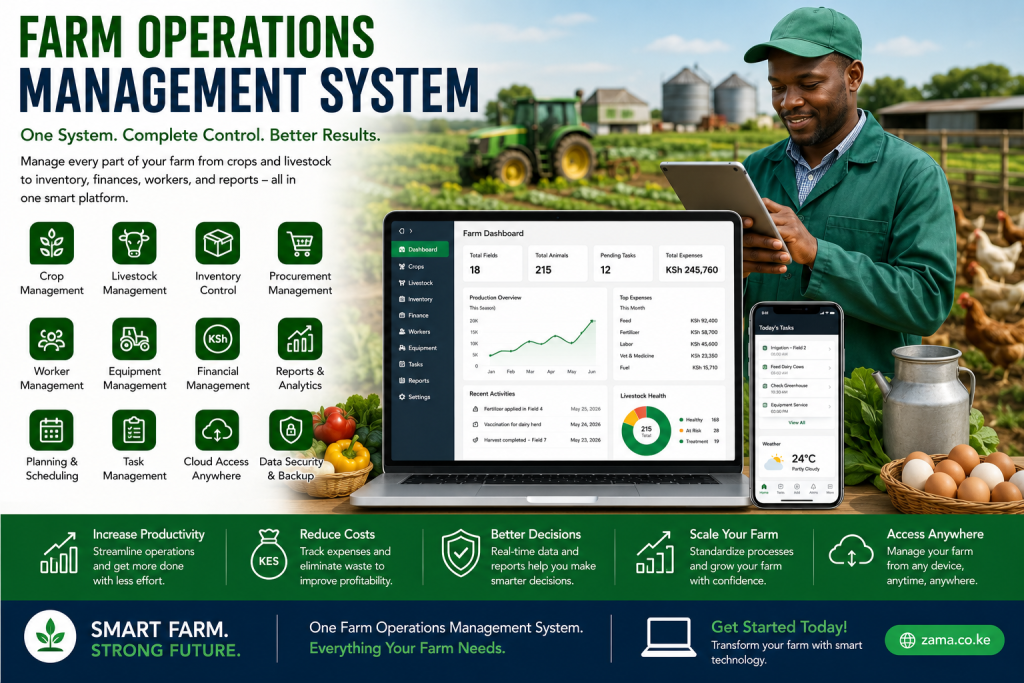
A Farm Operations Management System is software designed to help farmers manage and monitor all farm activities from a centralized platform. It integrates operational records, inventory management, financial tracking, worker management, livestock monitoring, crop production records, and reporting tools.
Instead of maintaining multiple record books, farmers can access information through one system. This improves organization and reduces errors that commonly occur with manual record keeping.
A modern Farm Operations Management System provides real-time insights into farm performance. Managers can monitor production activities, track expenses, manage resources, and identify opportunities for improvement.
Whether operating a dairy farm, horticultural enterprise, poultry business, mixed farm, or large-scale commercial agricultural operation, the software creates a structured environment that supports better decision-making.
Why Modern Farms Need a Farm Operations Management System
Agricultural businesses generate enormous amounts of data every day. Farmers record planting dates, harvest quantities, feed consumption, milk production, labor costs, veterinary treatments, fuel expenses, and equipment maintenance activities.
Without proper systems, this information becomes difficult to organize and analyze.
A Farm Operations Management System ensures that important data is stored securely and remains accessible whenever needed.
Farm managers can quickly answer important questions:
- Which crops generate the highest profits?
- Which livestock groups perform best?
- How much inventory is available?
- What are the largest operating expenses?
- Which workers are most productive?
- What activities require immediate attention?
Having access to this information enables better planning and resource allocation.
Crop Management and Production Planning
One of the biggest advantages of a Farm Operations Management System is crop management.
Farmers can record planting schedules, monitor crop development, track fertilizer applications, manage irrigation activities, and document harvest results.
This information helps managers evaluate production performance across seasons.
For example, if one field consistently outperforms another, the farm can investigate differences in soil management, irrigation practices, or crop varieties.
The ability to analyze production trends over time contributes to continuous improvement and higher efficiency.
Agricultural organizations such as Food and Agriculture Organization (FAO) frequently emphasize the value of farm data in improving agricultural productivity.
Livestock Management Capabilities
Livestock operations benefit significantly from a Farm Operations Management System.
Farmers can maintain detailed animal records that include identification, breeding history, health treatments, vaccinations, production performance, and sales information.
Dairy farms can monitor milk production, while beef operations can track growth rates and breeding outcomes.
Poultry farms can manage flock performance, mortality rates, vaccination schedules, and feed consumption.
By centralizing livestock information, managers gain better visibility into animal performance and operational efficiency.
Inventory Management and Stock Control
Inventory represents a significant investment on most farms.
Feed, fertilizer, pesticides, veterinary supplies, fuel, spare parts, seeds, and packaging materials all require careful management.
A Farm Operations Management System provides real-time inventory visibility and helps prevent stock shortages and overstocking.
Managers can monitor stock levels, track usage patterns, and receive alerts when replenishment is needed.
Better inventory management reduces waste and improves operational continuity.
Financial Management and Cost Monitoring
Many farms struggle because financial records are incomplete or poorly organized.
A Farm Operations Management System integrates financial tracking with operational activities.
Farm owners can monitor expenses related to labor, feed, fertilizers, machinery maintenance, veterinary services, irrigation, and transportation.
Revenue from crop sales, livestock sales, milk deliveries, and other farm activities can also be tracked accurately.
This financial visibility helps farmers understand profitability and make better investment decisions.
Worker Management and Productivity Tracking
Labor management is often one of the most challenging aspects of farm operations.
Large farms may employ dozens or even hundreds of workers across different departments.
A Farm Operations Management System helps track attendance, task assignments, productivity, and labor costs.
Managers can monitor completed activities and identify areas where efficiency improvements may be needed.
Digital labor tracking also improves accountability and reduces administrative workload.
Businesses seeking workforce management solutions may also explore Dexa for attendance tracking and operational workflow management.
Machinery and Equipment Management
Farm equipment represents a major capital investment.
Tractors, irrigation systems, generators, milking equipment, sprayers, and transport vehicles all require regular maintenance.
A Farm Operations Management System helps schedule maintenance activities and track repair histories.
Managers receive reminders for servicing requirements and can monitor equipment performance over time.
Preventive maintenance reduces downtime and extends equipment lifespan.
Real-Time Reporting and Analytics
Data becomes valuable when it supports decision-making.
A Farm Operations Management System generates reports that provide insights into operational performance.
Managers can review:
- Production trends
- Financial performance
- Labor productivity
- Inventory movement
- Livestock performance
- Crop yields
- Equipment utilization
These reports help identify opportunities for improvement and support long-term planning.
Advanced reporting technologies are widely promoted by Microsoft Power BI and Google Cloud.
Cloud-Based Accessibility
Modern farming is no longer restricted to office environments.
A cloud-enabled Farm Operations Management System allows farm owners to access information from smartphones, tablets, and laptops.
Whether visiting fields, attending agricultural exhibitions, meeting suppliers, or managing multiple farms, owners remain connected to operations.
Cloud accessibility improves responsiveness and enhances operational visibility.
Improving Compliance and Traceability
Food safety and agricultural compliance requirements continue to increase.
Many buyers now require traceability records that document production activities and product origins.
A Farm Operations Management System helps farms maintain organized records that support compliance and certification requirements.
This improves credibility and may create access to premium markets.
Multi-Farm and Multi-Branch Management
Large agricultural enterprises often operate across multiple locations.
Managing separate farms manually can create reporting challenges and inconsistencies.
A Farm Operations Management System centralizes information from all locations into a single platform.
Management can compare performance across farms and make decisions based on consolidated data.
This centralized approach improves coordination and strategic planning.
Integration With Modern Agricultural Technologies
Agricultural technology continues to evolve rapidly.
Many farms now use sensors, GPS systems, automated irrigation solutions, weather monitoring devices, and smart equipment.
A modern Farm Operations Management System can integrate with these technologies to provide deeper operational insights.
Automation reduces manual data entry and improves accuracy.
As farms become more connected, integrated management systems will play an increasingly important role.
Supporting Sustainable Agriculture
Sustainability is becoming a major priority across the agricultural sector.
Farmers must balance productivity with environmental responsibility.
A Farm Operations Management System helps monitor resource usage, including water consumption, fertilizer applications, and chemical treatments.
Better visibility supports more efficient resource management and sustainable farming practices.
Organizations such as World Bank Agriculture Programs and International Fund for Agricultural Development continue to highlight the importance of technology in agricultural sustainability.
Internal Technology Ecosystem for Growing Businesses
Many agricultural enterprises require additional software tools as they expand.
Businesses can also benefit from solutions such as:
- Fama for agricultural management and business operations.
- Jaat for enterprise management.
- Vega POS for retail and agrovet point-of-sale operations.
- Pawa for connectivity management.
- Ratibu for education administration.
- RentalDesk for property management.
- KayaPro360 for business operations.
- ChurchesAdmin for organizational administration.
These platforms demonstrate how digital transformation is improving efficiency across multiple sectors.
Risks and How to Mitigate Them
Although implementing a Farm Operations Management System offers numerous benefits, there are risks that farmers should consider.
One common challenge is inconsistent data entry. If farm workers fail to record activities accurately, reports become unreliable. Proper training and clear procedures help mitigate this issue.
Technology adoption resistance is another challenge. Employees accustomed to manual processes may hesitate to embrace digital systems. Gradual implementation and continuous support often improve adoption rates.
Internet connectivity limitations can affect cloud-based platforms in some rural areas. Selecting systems with offline capabilities can reduce operational disruptions.
Data security is also important. Farms should choose providers with strong backup procedures and security measures to protect valuable business information.
Advanced Planning and Resource Allocation With a Farm Operations Management System
One of the most overlooked advantages of a Farm Operations Management System is its ability to improve planning and resource allocation. Many farms lose money not because production is poor, but because resources are deployed inefficiently. Labor may be assigned to the wrong tasks, machinery may sit idle during critical periods, or inputs may be purchased too late.
A modern Farm Operations Management System allows managers to plan activities weeks or months in advance. Planting schedules, fertilizer applications, harvesting activities, livestock vaccinations, feed deliveries, and equipment maintenance can all be scheduled within the system. This creates a clear operational calendar that helps everyone understand upcoming responsibilities.
Better planning also reduces emergency spending. When farms fail to anticipate future needs, they often purchase inputs at higher prices due to urgency. With a Farm Operations Management System, managers can forecast requirements based on historical records and current production plans. This leads to more strategic purchasing decisions and improved cost control.
For farms managing hundreds of acres or large livestock populations, even small improvements in planning efficiency can have a significant impact on overall performance.
Farm Operations Management System and Supply Chain Visibility
Agricultural production does not end at harvest or livestock sale. Modern farms are part of larger supply chains that include suppliers, transporters, processors, distributors, retailers, and consumers.
A Farm Operations Management System helps improve supply chain visibility by providing accurate production forecasts and inventory information. Managers can estimate harvest quantities, schedule deliveries, and coordinate with buyers more effectively.
This visibility becomes particularly important when dealing with perishable products such as vegetables, fruits, milk, eggs, and flowers. Delays or poor coordination can result in product losses and reduced revenue.
By maintaining organized operational records, farms can communicate more effectively with customers and business partners. Accurate information improves trust and strengthens commercial relationships.
Using a Farm Operations Management System to Reduce Operational Risks
Agriculture is exposed to numerous risks including weather changes, disease outbreaks, market fluctuations, labor shortages, and equipment failures. While no software can eliminate these risks entirely, a Farm Operations Management System helps farms prepare and respond more effectively.
For example, historical production records can help managers identify seasonal patterns and prepare for predictable challenges. Equipment maintenance schedules reduce the risk of breakdowns during critical periods. Livestock health records support early disease detection and intervention.
The system also improves documentation. If problems occur, managers can review historical records to identify contributing factors and implement corrective measures. This continuous learning process helps farms become more resilient over time.
Risk management is increasingly important as agricultural businesses grow larger and more complex. A Farm Operations Management System provides the visibility needed to manage uncertainty more effectively.
Improving Communication Across Farm Teams
Communication challenges often increase as farms expand. Workers may misunderstand instructions, managers may lack visibility into completed tasks, and important information may fail to reach the right people.
A Farm Operations Management System creates a centralized information hub that improves communication across departments and locations. Managers can assign tasks, monitor progress, and share updates through a structured platform.
This reduces confusion and improves accountability. Workers know what is expected, supervisors can verify completion, and management gains better visibility into daily operations.
Improved communication also contributes to employee satisfaction. Clear expectations and organized workflows help create a more productive working environment.
The Role of Farm Operations Management Systems in Agribusiness Growth
Many successful agricultural businesses eventually expand beyond basic farming activities. They may establish processing facilities, distribution networks, agrovet stores, transportation services, or export operations.
As businesses grow, operational complexity increases significantly. A Farm Operations Management System provides the foundation needed to support expansion.
Because information is centralized and standardized, management can scale operations more efficiently. New farms, production units, and business activities can be integrated into existing processes without creating unnecessary administrative burdens.
This scalability makes digital management systems particularly valuable for ambitious agricultural entrepreneurs seeking long-term growth.
Why Investors Prefer Farms With Digital Management Systems
Agricultural investors increasingly evaluate management quality before providing financing or partnerships. Strong operational controls, reliable reporting, and accurate records demonstrate professionalism and reduce perceived risk.
A farm using a Farm Operations Management System can often provide more detailed information about production performance, financial results, resource utilization, and growth opportunities.
This transparency improves credibility when seeking financing from banks, investors, development organizations, or strategic partners.
Lenders are generally more comfortable supporting businesses that can demonstrate operational discipline and maintain organized records. A Farm Operations Management System helps create that confidence by providing accurate and accessible information.
The Future of Digital Agriculture in Kenya
Kenya’s agricultural sector continues to embrace technology at an accelerating pace. Mobile banking, digital marketplaces, precision farming tools, smart irrigation systems, and farm management platforms are transforming how agricultural businesses operate.
The Farm Operations Management System is becoming a central component of this digital transformation. Rather than relying on fragmented information sources, farmers can manage entire operations through integrated platforms that provide real-time visibility and actionable insights.
Future developments may include greater use of artificial intelligence, automated reporting, predictive analytics, satellite monitoring, and machine learning. Farms already using a Farm Operations Management System will be better positioned to adopt these innovations because they have established strong data management foundations.
As agricultural competition increases, digital management capabilities will become a major differentiator between high-performing farms and those struggling to remain profitable.
Final Thoughts on Farm Operations Management System Adoption
The modern agricultural environment demands more than hard work alone. Successful farms increasingly depend on accurate information, efficient processes, and informed decision-making.
A Farm Operations Management System helps farmers organize operations, improve accountability, strengthen financial management, optimize resource allocation, and support sustainable growth. Whether managing crops, livestock, machinery, labor, or inventory, digital systems provide visibility that manual processes simply cannot match.
For farms seeking greater efficiency, improved profitability, and long-term competitiveness, investing in a Farm Operations Management System is not just a technology upgrade. It is a strategic business decision that creates a stronger foundation for future success in Kenya’s rapidly evolving agricultural sector.
Is This Worth It? Honest Verdict
For most commercial farms, the answer is yes.
The value of a Farm Operations Management System extends beyond replacing notebooks and spreadsheets. The system improves visibility, strengthens accountability, enhances productivity, and supports better decision-making.
Small farms may initially manage operations manually, but as enterprises grow, manual systems often become increasingly difficult to maintain.
Farms that manage multiple activities, employ several workers, operate across different locations, or handle large inventories typically experience the greatest benefits.
The key to success lies in selecting the right platform and ensuring consistent usage throughout the organization.
Frequently Asked Questions
1. What is a Farm Operations Management System?
A Farm Operations Management System is software that helps farmers manage crops, livestock, inventory, finances, labor, and reporting from a centralized platform.
2. Can small farms use a Farm Operations Management System?
Yes. Many systems are suitable for small, medium, and large-scale farming operations.
3. Does the software support livestock and crop farming?
Most modern systems support both crop production and livestock management within the same platform.
4. Is cloud-based farm software secure?
Reputable providers use security measures such as encryption, backups, and access controls to protect farm data.
5. How quickly can farms benefit from implementation?
Many farms experience improvements in organization, reporting, and operational visibility within the first few months of adoption.
Start Your Farm Digital Transformation Today
Agriculture is becoming increasingly data-driven. Farmers who embrace technology gain greater visibility into operations, make better decisions, and position themselves for sustainable growth.
A Farm Operations Management System provides the tools needed to manage crops, livestock, inventory, finances, labor, and reporting more effectively.
If you are ready to modernize your agricultural business, start your digital transformation journey with Fama. The right system can help your farm improve efficiency, strengthen profitability, and remain competitive in Kenya’s evolving agricultural landscape.