Table of Contents
ToggleIntroduction Farm Asset Management Software
Modern farming is no longer just about planting crops and raising livestock. Today’s agricultural businesses manage valuable assets worth millions of shillings. Tractors, irrigation systems, dairy equipment, vehicles, generators, buildings, tools, livestock, feed inventories, and production equipment all represent significant investments that require proper monitoring and management.
Unfortunately, many farms still rely on notebooks, spreadsheets, memory, or disconnected systems to track these assets. This often results in poor maintenance scheduling, misplaced equipment, unexpected breakdowns, inventory losses, and inaccurate financial records. As farms grow larger and operations become more complex, manual asset tracking becomes increasingly difficult.
This is where Farm Asset Management Software becomes essential. A modern Farm Asset Management Software platform provides farmers with complete visibility into their assets, helping them track ownership, location, condition, maintenance history, utilization, and costs from a centralized system.
When reviewing leading farm software providers, a common pattern appears. Many platforms promote benefits such as “higher profits,” “better productivity,” or “increased efficiency” without providing clear explanations of how those improvements occur. Some claim yield increases or operational improvements without addressing farm size, management practices, weather conditions, or implementation quality.
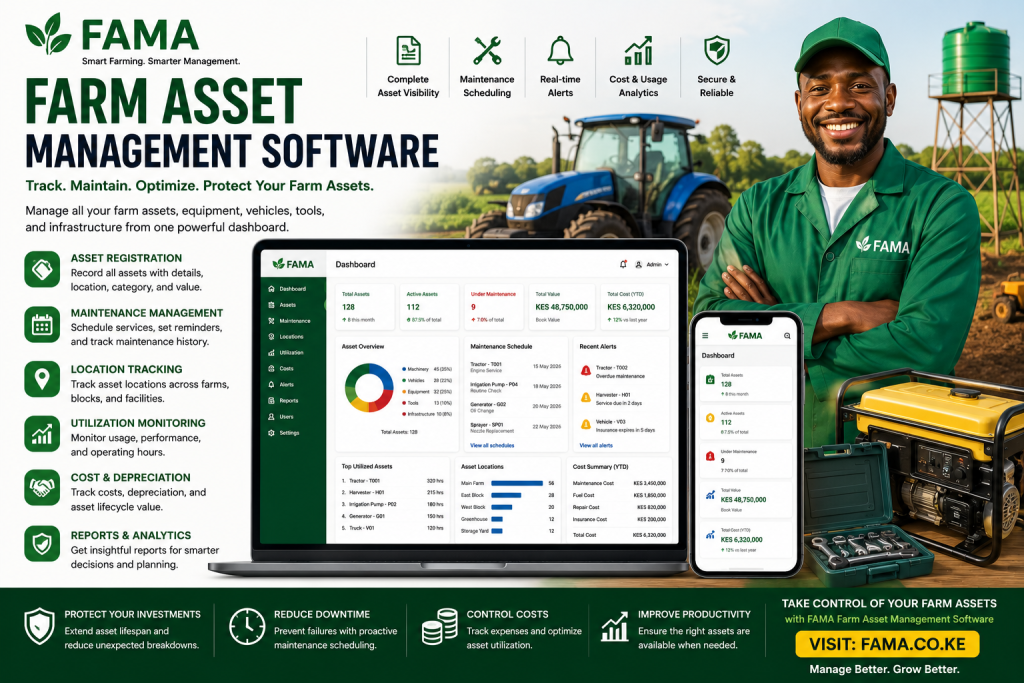
The reality is that software itself does not magically increase profits. Instead, Farm Asset Management Software improves visibility, accountability, and decision-making. Those improvements help reduce avoidable losses and support better operational planning.
For farms seeking long-term sustainability, digital asset management is becoming one of the most important investments in modern agriculture.
What Is Farm Asset Management Software?
Farm Asset Management Software is a digital system designed to help farmers track, manage, monitor, and maintain all physical farm assets from one centralized platform.
These assets may include tractors, harvesters, irrigation systems, vehicles, generators, pumps, livestock facilities, warehouses, dairy equipment, poultry houses, fencing infrastructure, tools, and even livestock inventories.
A quality Farm Asset Management Software platform stores detailed information about every asset, including purchase dates, maintenance schedules, service records, operational status, depreciation information, and usage history.
Rather than relying on paper files or multiple spreadsheets, farm managers gain instant access to accurate asset information whenever needed.
The objective is simple: improve control over farm investments while reducing operational inefficiencies.
Why Asset Management Matters in Agriculture
Agriculture is a capital-intensive industry.
A medium-sized commercial farm may own tractors, irrigation equipment, water pumps, livestock handling facilities, vehicles, generators, and processing equipment worth tens of millions of Kenyan shillings.
When these assets are poorly managed, costs increase rapidly.
Equipment breakdowns can delay planting or harvesting activities. Missing maintenance schedules can shorten equipment lifespan. Lost tools create replacement expenses. Poor inventory control leads to unnecessary purchases.
Farm Asset Management Software helps prevent these problems by providing complete visibility into asset performance and status.
Instead of reacting to problems after they occur, farm managers can take preventive action.
Organizations focusing on agricultural asset management consistently emphasize preventive maintenance and operational visibility as key drivers of farm efficiency.
Farm Asset Management Software for Equipment Tracking
Equipment often represents the largest category of farm assets.
Tractors, planters, sprayers, harvesters, milk coolers, generators, irrigation systems, and transport vehicles require regular monitoring and maintenance.
A Farm Asset Management Software platform allows managers to create digital records for every piece of equipment.
These records include:
- Asset identification
- Purchase details
- Maintenance history
- Repair records
- Operating hours
- Warranty information
- Current condition
This information helps farms extend equipment lifespan while reducing unexpected downtime.
When machinery is properly monitored, managers can identify problems before they become major failures.
Maintenance Scheduling and Downtime Reduction
One of the biggest advantages of Farm Asset Management Software is preventive maintenance management.
Many farms only repair equipment after it breaks down.
This reactive approach often creates operational disruptions during critical farming periods.
A tractor failure during planting season can delay field preparation. Irrigation pump breakdowns can affect crop performance. Dairy equipment failures can interrupt milk production.
With Farm Asset Management Software, maintenance schedules are automated.
Managers receive reminders for servicing activities based on time intervals, operating hours, or usage thresholds.
Preventive maintenance improves reliability and helps reduce emergency repair costs.
Livestock as Farm Assets
Livestock are valuable farm assets that also require structured management.
Dairy cattle, beef herds, goats, sheep, poultry, and pigs represent significant investments that contribute directly to farm revenue.
A comprehensive Farm Asset Management Software solution can track livestock records alongside physical equipment assets.
Managers can maintain information about:
- Animal identification
- Health records
- Breeding history
- Production performance
- Purchase and sale transactions
This integrated approach provides a more complete picture of farm asset performance.
Inventory and Input Management
Many farms lose money through poor inventory control.
Fertilizers, seeds, feeds, veterinary drugs, pesticides, spare parts, fuel, and packaging materials are all important operational assets.
A Farm Asset Management Software platform helps track inventory levels and usage patterns.
Managers can monitor stock movements and identify shortages before they disrupt operations.
Inventory visibility also helps reduce wastage and prevent unnecessary purchases.
Farm management systems increasingly integrate inventory management because disconnected inventory records create inefficiencies and poor decision-making.
Asset Location and Accountability
Large farms often operate across multiple fields, production units, or locations.
Tracking asset locations manually can be difficult.
Tools, machinery, and equipment may be moved without proper documentation.
Farm Asset Management Software helps maintain accountability by recording asset assignments and locations.
Managers can quickly determine where assets are being used and who is responsible for them.
This visibility reduces losses and improves operational control.
Financial Visibility and Asset Cost Tracking
Many farmers know how much they paid for equipment but struggle to understand the total cost of ownership.
Maintenance expenses, fuel consumption, repairs, insurance, and operational costs accumulate over time.
A Farm Asset Management Software platform tracks these costs and provides valuable financial insights.
Managers can evaluate whether equipment remains cost-effective or whether replacement may be justified.
Better financial visibility supports more informed investment decisions.
Multi-Farm Asset Management
Agricultural businesses often expand into multiple locations.
Managing assets across several farms can become challenging without centralized systems.
A Farm Asset Management Software platform allows management teams to monitor all assets from a single dashboard.
This improves coordination and simplifies reporting.
Multi-location visibility also helps optimize resource allocation across the organization.
Workforce Accountability and Asset Usage
Farm assets are frequently shared among multiple workers.
Without proper tracking, accountability becomes difficult.
A Farm Asset Management Software system can link asset usage records to specific employees or departments.
Managers can review usage patterns and identify potential issues such as excessive fuel consumption, unusual maintenance requirements, or operational inefficiencies.
This transparency supports better asset stewardship.
Mobile Access and Real-Time Updates
Modern farming is increasingly mobile.
Farm managers spend significant time in fields, livestock units, warehouses, and production facilities.
A cloud-enabled Farm Asset Management Software platform allows users to access information from smartphones, tablets, and laptops.
This improves responsiveness and enables real-time updates.
Whether inspecting machinery, reviewing maintenance records, or approving repairs, managers remain connected to operations.
Supporting Compliance and Audits
Many agricultural businesses face compliance requirements related to equipment safety, environmental regulations, and operational reporting.
Accurate records are essential.
A Farm Asset Management Software platform provides organized documentation that simplifies audits and inspections.
Managers can quickly retrieve maintenance histories, asset inventories, and operational records when needed.
This reduces administrative burden and improves compliance readiness.
Farm Asset Management Software and Data-Driven Decisions
Successful farms increasingly rely on data rather than assumptions.
A Farm Asset Management Software platform generates reports that help managers understand asset performance and utilization.
These reports may reveal:
- Underutilized equipment
- High-maintenance assets
- Frequent repair issues
- Replacement priorities
- Cost trends
With better information, managers can make more strategic decisions.
Modern farm management systems continue evolving toward integrated reporting and operational analytics because visibility is critical for sustainable growth.
Internal Business Technology Resources
Many agricultural enterprises benefit from complementary digital solutions.
Useful platforms include:
- Fama
- Dexa
- Jaat
- Pawa
- Vega POS
- RentalDesk
- Ratibu
- ChurchesAdmin
- KayaPro360
- Prim Salon Software
- Dereva Platform
- Vota Platform
- Zivo Communication Platform
- Wito RSVP Platform
- Musa Music AI
These systems demonstrate how digital transformation is improving operational efficiency across industries.
Risks and How to Mitigate Them
Like any technology investment, implementing Farm Asset Management Software carries certain risks.
One common challenge is incomplete asset registration. If assets are not entered accurately during setup, reporting quality suffers.
Staff resistance may also create implementation difficulties. Workers accustomed to manual processes may require training and support.
Data accuracy is another concern. Systems only provide value when information is updated consistently.
Connectivity limitations may affect cloud-based platforms in some rural areas. Choosing software with offline capabilities can reduce this risk.
Finally, selecting software that lacks agricultural functionality can limit long-term benefits. Farms should evaluate vendors carefully before implementation.
Farm Asset Management Software and Long-Term Farm Sustainability
Many farmers focus on daily production activities while overlooking the long-term management of their assets. Yet assets are the foundation of every agricultural business. Tractors prepare fields, irrigation systems support crop growth, dairy equipment enables milk production, and storage facilities protect harvested produce. When these assets are not properly managed, operational efficiency declines and profitability suffers.
A modern Farm Asset Management Software platform helps farms build sustainability by ensuring that assets remain productive throughout their lifecycle. Instead of waiting for expensive equipment to fail, managers can monitor performance trends and schedule maintenance proactively. This approach reduces unexpected disruptions and extends asset lifespan.
Long-term sustainability is especially important for family-owned farms that plan to transfer operations to future generations. Accurate asset records help successors understand the condition, value, and history of farm investments. By implementing Farm Asset Management Software, farm owners create an organized foundation that supports continuity and growth.
As agricultural businesses become more sophisticated, investors and lenders increasingly expect professional asset management practices. Farms that demonstrate strong asset control often appear more credible and financially disciplined than those relying entirely on manual record-keeping systems.
Using Farm Asset Management Software to Improve Equipment Utilization
One of the hidden costs on many farms is underutilized equipment. A tractor may sit idle for long periods while another machine is overworked. Certain tools may be purchased even though similar equipment already exists elsewhere on the farm.
A Farm Asset Management Software solution helps identify utilization patterns across all farm assets. Managers can review operational records and determine whether equipment is being used efficiently.
This visibility helps prevent unnecessary purchases and encourages better resource allocation. Instead of buying additional machinery, farms may discover opportunities to optimize existing resources.
Equipment utilization data also supports future investment decisions. Before purchasing a new tractor, irrigation pump, or transport vehicle, managers can evaluate current usage levels and determine whether expansion is truly necessary.
Better utilization translates into stronger returns on capital investments and improved operational efficiency.
Farm Asset Management Software for Seasonal Agriculture
Agriculture operates according to seasonal cycles. Planting, spraying, harvesting, breeding, and feed management activities often occur during specific periods of the year.
A Farm Asset Management Software platform helps farms prepare for these seasonal demands. Managers can schedule maintenance before peak operational periods and ensure that equipment is ready when needed.
For example, irrigation systems can be inspected before dry seasons begin. Harvesting equipment can undergo servicing before harvest periods arrive. Livestock facilities can be prepared before breeding or calving seasons.
This proactive approach minimizes disruptions and helps farms maintain operational readiness throughout the year.
Seasonal planning becomes particularly valuable for large farms managing multiple crop cycles or diverse livestock operations. With Farm Asset Management Software, managers gain greater confidence that assets will be available when critical activities begin.
Digital Transformation and the Future of Asset Management
The agricultural sector is experiencing a significant digital transformation. Technologies such as automation, sensors, GPS tracking, artificial intelligence, and cloud computing are changing how farms operate.
A Farm Asset Management Software platform often serves as the central hub that connects these technologies. Data from equipment, inventory systems, and operational activities can be consolidated into one location.
As technology adoption increases, farms with organized digital records will be better positioned to benefit from emerging innovations. Predictive maintenance, automated reporting, and advanced analytics all depend on accurate data collection.
Farms that delay digital transformation may eventually find themselves at a competitive disadvantage. Meanwhile, farms that adopt Farm Asset Management Software today establish the foundation needed for future technological growth.
The trend toward data-driven agriculture is unlikely to slow down. As a result, asset management software will continue playing a larger role in farm operations worldwide.
Farm Asset Management Software for Agricultural Cooperatives
Agricultural cooperatives face unique asset management challenges. Equipment, storage facilities, transport vehicles, and processing infrastructure may be shared among many members.
Tracking usage and maintenance manually can become difficult as the organization grows.
A Farm Asset Management Software platform helps cooperatives maintain transparency and accountability. Managers can record asset assignments, monitor usage, schedule maintenance, and generate reports for stakeholders.
This improves trust among members and supports more efficient resource utilization.
Cooperatives that manage assets professionally often experience fewer disputes and better operational outcomes. Digital systems create clear records that help ensure fair access and responsible asset usage.
As agricultural cooperatives continue expanding across Kenya and other markets, digital asset management will become increasingly important for sustainable growth.
Building a Competitive Agricultural Business
Competition within agriculture continues to intensify. Farmers must manage rising production costs, changing market conditions, labor challenges, and increasing customer expectations.
Success increasingly depends on operational efficiency.
A Farm Asset Management Software solution helps farms gain a competitive advantage by improving visibility, reducing waste, strengthening accountability, and supporting better decisions.
Managers no longer need to rely solely on memory or scattered spreadsheets. Instead, they can access accurate information whenever needed and respond more effectively to challenges.
The farms that embrace digital management tools are often better prepared to adapt to changing market conditions and seize new opportunities.
Whether operating a dairy farm, poultry enterprise, horticultural business, mixed farm, or large commercial agricultural operation, Farm Asset Management Software provides the structure needed to manage assets professionally and efficiently.
Final Thoughts on Farm Asset Management Software
Agricultural assets represent significant investments that directly influence productivity, profitability, and long-term sustainability. Managing these assets effectively is no longer optional for farms seeking growth and operational excellence.
A modern Farm Asset Management Software platform helps farmers monitor equipment, track inventory, manage maintenance schedules, oversee livestock assets, improve accountability, and generate valuable operational insights.
Beyond improving organization, the software creates a culture of proactive management. Instead of reacting to breakdowns, shortages, and operational problems, farms can anticipate challenges and take preventive action.
As agriculture becomes increasingly technology-driven, digital asset management will continue moving from a competitive advantage to a standard business requirement. Farms that adopt Farm Asset Management Software today position themselves for stronger efficiency, improved profitability, and greater resilience in the years ahead.
For agricultural businesses focused on long-term success, investing in Farm Asset Management Software is not simply a technology decision. It is a strategic investment in the future of the farm itself.
Is This Worth It? Honest Verdict
For most commercial farms, the answer is yes.
The primary value of Farm Asset Management Software is not simply digitizing records. Its value comes from improved visibility, stronger accountability, better maintenance planning, and more informed decision-making.
Small farms with limited assets may initially manage operations using basic systems.
However, as asset values increase and operational complexity grows, manual tracking becomes increasingly difficult.
Farms managing multiple equipment categories, livestock assets, inventory items, and facilities typically experience the greatest benefits from digital asset management.
Success depends on selecting the right platform and ensuring consistent usage throughout the organization.
Frequently Asked Questions
1. What is Farm Asset Management Software?
Farm Asset Management Software helps farmers track equipment, livestock assets, inventory, maintenance schedules, operational costs, and asset performance from one platform.
2. Can small farms use Farm Asset Management Software?
Yes. Many systems are scalable and suitable for both small and large agricultural operations.
3. Does Farm Asset Management Software track livestock?
Many modern solutions support livestock tracking alongside equipment and infrastructure management.
4. Is cloud-based software secure?
Reputable providers use encryption, backups, and access controls to protect farm information.
5. How quickly can farms benefit from implementation?
Many farms experience improvements in organization, maintenance management, and reporting within the first few months of use.
Start Managing Farm Assets Smarter Today
As agriculture becomes more competitive, farms need better visibility into the assets that drive production and profitability.
A modern Farm Asset Management Software solution helps track equipment, livestock, inventory, maintenance activities, and operational costs from a centralized platform.
If you want greater control, improved accountability, and stronger decision-making across your farm, now is the time to embrace digital asset management.
Start your farm technology journey today with https://fama.co.ke and discover how smarter asset management can support long-term agricultural success in Kenya.