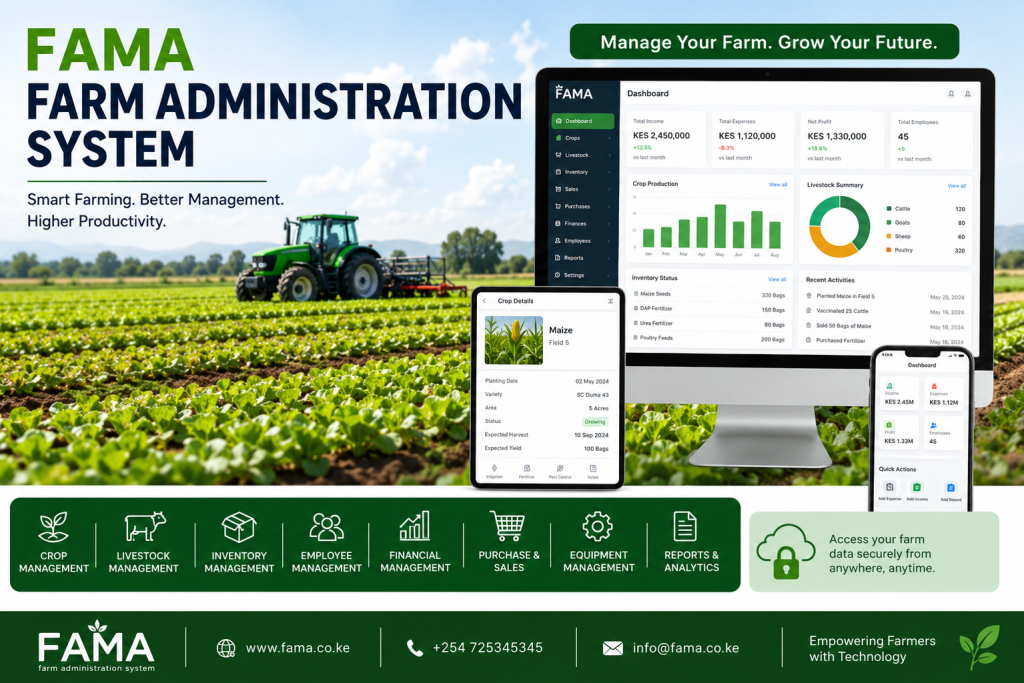
Running a successful farm today requires more than hard work and experience. Farmers must manage crops, livestock, employees, machinery, finances, inventory, customer records, and compliance while making timely decisions that improve productivity and profitability. This is where a farm administration system becomes an essential tool for modern agriculture.
Whether you own a small family farm, a commercial plantation, a dairy farm, a poultry business, or a mixed agricultural enterprise, investing in a reliable farm administration system helps simplify operations, reduce costs, and increase efficiency.
At FAMA, we understand the challenges farmers face every day. Our comprehensive farm administration system is designed to help farmers digitize operations, improve decision-making, and maximize profits through smart farm management.
Visit: https://fama.co.ke
Call/WhatsApp: +254 725345345
What is a Farm Administration System?
A farm administration system is software that helps farmers organize, monitor, and manage every aspect of their agricultural business from a single platform.
Instead of using notebooks, spreadsheets, or multiple disconnected applications, farmers can use one centralized farm administration system to oversee daily farm operations.
A modern farm administration system manages:
- Crop production
- Livestock records
- Employee management
- Financial records
- Equipment maintenance
- Inventory control
- Farm budgeting
- Purchase management
- Sales management
- Farm reporting
- Supplier management
- Customer records
- Production planning
- Compliance documentation
By integrating all these functions into one platform, farmers save time while improving operational efficiency.
Why Every Modern Farm Needs a Farm Administration System
Agriculture has become increasingly competitive. Rising production costs, unpredictable weather, labor shortages, and changing market demands require farmers to make data-driven decisions.
A professional farm administration system provides the information needed to make better decisions every day.
Benefits include:
- Better record keeping
- Improved productivity
- Lower operational costs
- Accurate financial management
- Reduced wastage
- Easier employee supervision
- Better crop planning
- Improved livestock management
- Enhanced profitability
- Faster reporting
Without a proper farm administration system, many farmers struggle to track expenses, monitor production, or evaluate profitability.
Challenges Farmers Face Without a Farm Administration System
Many farms still rely on manual record keeping.
This creates several challenges.
Poor Record Keeping
Paper records can easily be misplaced, damaged, or lost.
A farm administration system securely stores all farm information digitally.
Difficulty Tracking Expenses
Many farmers spend money daily without knowing where most of their expenses go.
A farm administration system categorizes expenses automatically, making budgeting easier.
Inefficient Inventory Management
Without proper tracking, fertilizers, pesticides, feeds, medicines, and seeds may be wasted or stolen.
A farm administration system monitors inventory levels in real time.
Poor Employee Accountability
Managing seasonal workers and permanent employees becomes difficult without structured records.
A farm administration system records attendance, assigned tasks, productivity, and payroll information.
Lack of Financial Visibility
Farm owners often know sales figures but cannot accurately determine profits.
A farm administration system generates financial reports instantly.
Key Features of a Farm Administration System
An advanced farm administration system should provide all the tools required to manage modern farming operations efficiently.
1. Farm Dashboard
The dashboard provides a complete overview of farm performance.
Users can quickly view:
- Current farm activities
- Total expenses
- Expected harvest
- Livestock statistics
- Employee attendance
- Inventory status
- Financial summaries
- Equipment usage
Everything is available from one central location.
2. Crop Management
Crop production involves numerous activities.
A farm administration system allows farmers to record:
- Planting dates
- Crop varieties
- Seed suppliers
- Fertilizer application
- Irrigation schedules
- Pest control
- Disease management
- Harvest dates
- Expected yields
- Actual yields
This information improves future planning.
3. Livestock Management
Livestock farmers need detailed records for every animal.
The system can manage:
- Animal identification
- Breed information
- Birth records
- Vaccinations
- Medication
- Feeding schedules
- Milk production
- Weight records
- Breeding cycles
- Veterinary history
- Mortality reports
Accurate records improve livestock productivity.
4. Employee Management
Large farms employ many workers.
A farm administration system helps manage:
- Employee profiles
- Attendance
- Leave management
- Daily tasks
- Work schedules
- Payroll
- Performance tracking
Managers can monitor labor productivity more effectively.
5. Farm Financial Management
One of the most valuable modules is financial management.
The system records:
- Income
- Expenses
- Cash flow
- Farm budgets
- Loan repayments
- Operational costs
- Profit analysis
This allows farm owners to understand their financial position.
Inventory Management
Agricultural inputs represent a significant investment.
A farm administration system manages inventory including:
- Seeds
- Fertilizers
- Animal feeds
- Veterinary drugs
- Chemicals
- Fuel
- Spare parts
- Irrigation equipment
- Packaging materials
The system automatically updates stock whenever items are issued or received.
Equipment Management
Farm machinery requires regular maintenance.
The software tracks:
- Tractors
- Harvesters
- Irrigation pumps
- Generators
- Sprayers
- Vehicles
- Processing equipment
Maintenance reminders help reduce unexpected breakdowns.
Purchase Management
Farm purchases should be carefully monitored.
A farm administration system records:
- Purchase requests
- Supplier quotations
- Purchase orders
- Delivery notes
- Invoices
- Payment status
This creates transparency in procurement.
Sales Management
Selling farm produce requires proper documentation.
The system manages:
- Customer records
- Sales invoices
- Payments
- Outstanding balances
- Delivery schedules
- Product pricing
Farmers gain better control over revenue.
Supplier Management
Reliable suppliers are essential.
The software stores supplier information including:
- Contact details
- Product categories
- Pricing history
- Delivery performance
- Purchase history
This simplifies future purchasing decisions.
Farm Budget Planning
Budgeting allows farmers to prepare for each production season.
A farm administration system helps estimate:
- Seed costs
- Labor expenses
- Fertilizer requirements
- Machinery expenses
- Irrigation costs
- Animal feed
- Veterinary expenses
- Marketing costs
Comparing budgets with actual expenses improves future planning.
Farm Reports
Reporting is one of the biggest strengths of a farm administration system.
Reports include:
- Income statements
- Expense reports
- Inventory reports
- Livestock reports
- Crop reports
- Employee reports
- Equipment reports
- Production reports
- Sales reports
- Purchase reports
Reports can be generated instantly.
Cloud-Based Farm Administration System
Modern farms benefit greatly from cloud technology.
Cloud software allows farmers to:
- Access records anywhere
- Use mobile devices
- Back up information automatically
- Collaborate with managers
- Improve data security
- Receive automatic updates
This makes farm management more flexible and efficient.
Mobile Access
Farm managers rarely spend all day in an office.
A mobile-friendly farm administration system allows users to:
- Record field activities
- Update livestock records
- Approve purchases
- Monitor inventory
- View financial reports
- Check employee attendance
All from a smartphone or tablet.
Data Security
Farm information is valuable.
A professional farm administration system includes:
- User authentication
- Role-based permissions
- Automatic backups
- Secure cloud storage
- Activity logs
- Data encryption
This ensures information remains safe.
Multi-Farm Management
Many agricultural businesses operate multiple farms.
Instead of using separate systems, a centralized farm administration system enables managers to oversee all farms from one dashboard.
This improves coordination while maintaining separate records for each location.
Compliance and Record Keeping
Agricultural businesses often need records for audits, certifications, insurance, and regulatory compliance.
A farm administration system keeps detailed documentation that is easy to retrieve whenever required.
This reduces paperwork and saves valuable time.
Why Choose FAMA?
At FAMA, we provide a powerful, user-friendly farm administration system built to meet the needs of modern farmers, agribusinesses, cooperatives, and commercial agricultural enterprises. Our solution helps you digitize your farm, improve efficiency, reduce operational costs, and make informed decisions using real-time data.
Whether you manage crops, livestock, or a mixed farm, FAMA offers the tools you need to streamline daily operations and grow your agricultural business with confidence.
Website: https://fama.co.ke
Call or WhatsApp: +254 725345345
Advanced Farm Administration System Features, Implementation, Benefits, and Future Trends
Business Intelligence and Data Analytics
Successful farming is built on good decisions, and good decisions depend on accurate information. Modern agricultural businesses generate large amounts of data every day, from planting records and livestock performance to sales, expenses, labor, and equipment usage. Instead of leaving this information scattered across notebooks and spreadsheets, a digital solution brings everything together into meaningful reports.
A comprehensive farm administration system transforms raw farm data into actionable insights. Managers can monitor production trends, compare performance across different seasons, identify cost-saving opportunities, and evaluate which farming activities generate the highest returns. These insights help reduce guesswork and encourage informed decision-making.
Historical reports are equally valuable because they allow farm owners to compare previous years with current production. By analyzing these patterns, farmers can determine which crop varieties perform best, which livestock breeds are most productive, and where operational improvements are needed. Over time, these reports become one of the farm’s most valuable assets.
Smart Task Scheduling
Every successful farm relies on proper planning. Activities such as planting, spraying, irrigation, harvesting, vaccination, equipment servicing, and inventory replenishment must happen at the right time.
Scheduling tools help farm managers organize daily, weekly, monthly, and seasonal activities without overlooking important tasks. Staff members receive clear assignments, supervisors can monitor completion, and management gains better visibility into ongoing operations.
Rather than relying on memory or handwritten schedules, digital task planning ensures that every responsibility is documented and tracked until completion.
Notifications and Automated Reminders
Agricultural operations involve numerous recurring activities. Missing even one can have costly consequences.
Automated reminders help ensure important events are never forgotten, including:
- Vaccination schedules
- Equipment servicing
- Fertilizer application dates
- Irrigation schedules
- Harvest timelines
- Feed replenishment
- Supplier payments
- Employee payroll dates
- Insurance renewals
- License renewals
Timely notifications improve efficiency while minimizing operational risks.
Managing Seasonal Farming Activities
Agriculture follows seasonal cycles, making planning essential for long-term success.
Instead of preparing manually every season, farmers can create annual operational calendars that outline every major activity. This allows managers to allocate labor, estimate budgets, prepare machinery, purchase inputs, and organize transportation well in advance.
Seasonal planning also improves coordination between departments, reducing delays during busy farming periods.
GPS and Field Mapping
Large farms often consist of multiple fields located in different areas. Monitoring these fields manually can be challenging.
GPS-enabled mapping allows farmers to identify field boundaries, assign crops to specific locations, monitor acreage, and track production by individual fields.
Accurate mapping improves:
- Land utilization
- Crop rotation planning
- Irrigation management
- Field inspections
- Yield analysis
Managers can quickly identify which sections of the farm require additional attention.
Precision Agriculture Integration
Modern agriculture increasingly relies on precision farming techniques that maximize productivity while minimizing waste.
A digital administration platform can integrate with precision agriculture technologies such as:
- GPS-guided tractors
- Variable-rate fertilizer application
- Smart irrigation systems
- Drone monitoring
- Satellite imagery
- Soil sensors
- Weather stations
These technologies provide valuable information that helps optimize resource usage while protecting the environment.
Internet of Things (IoT) Integration
Connected devices are transforming agriculture.
Sensors installed throughout the farm continuously collect information about environmental conditions and automatically transmit data for analysis.
Examples include:
- Soil moisture sensors
- Water tank level sensors
- Greenhouse temperature monitors
- Humidity sensors
- Livestock tracking devices
- Automated feeding systems
- Milk production sensors
- Fuel monitoring devices
Continuous monitoring enables quicker responses to changing conditions while reducing manual inspections.
Weather Monitoring and Planning
Weather has a significant impact on agricultural production.
By incorporating weather forecasts into daily operations, farmers can better plan irrigation, spraying, planting, harvesting, and transportation activities.
Accurate weather information helps minimize losses caused by unexpected rainfall, drought, strong winds, or temperature fluctuations.
Planning around weather conditions also improves worker safety and equipment utilization.
Financial Planning for Sustainable Growth
Growth requires sound financial management.
Farm managers should regularly review operating costs, projected income, cash flow, and investment priorities.
Long-term financial planning includes:
- Equipment replacement
- Infrastructure expansion
- Irrigation projects
- Livestock expansion
- Storage facilities
- Renewable energy investments
Accurate financial records make it easier to secure financing and attract investors by demonstrating responsible business management.
Customer Relationship Management
Agricultural businesses often work with wholesalers, retailers, processors, exporters, cooperatives, and direct consumers.
Maintaining organized customer information improves communication and service quality.
Important customer information may include:
- Contact details
- Purchase history
- Preferred products
- Delivery schedules
- Payment status
- Contract agreements
Strong customer relationships often result in repeat business and long-term partnerships.
Supplier Relationship Management
Reliable suppliers contribute significantly to farm success.
Keeping organized supplier records helps management evaluate pricing, delivery reliability, product quality, and overall performance.
Long-term supplier relationships often lead to:
- Better pricing
- Faster deliveries
- Priority service
- Flexible payment terms
- Improved product availability
Good supplier management supports uninterrupted farm operations throughout the year.
Managing Multiple Departments
Large agricultural enterprises typically include several departments operating simultaneously.
Examples include:
- Crop production
- Dairy operations
- Poultry management
- Fisheries
- Greenhouse production
- Equipment maintenance
- Procurement
- Finance
- Human resources
- Sales and marketing
Having one centralized management platform improves communication between departments and eliminates duplicated work.
Role-Based User Access
Not every employee should have access to every part of the system.
Different user roles ensure employees only view information relevant to their responsibilities.
Examples include:
- Farm owner
- General manager
- Accountant
- Store manager
- Field supervisor
- Livestock manager
- Procurement officer
- Sales officer
- Human resource manager
Role-based access improves security while maintaining accountability.
Document Management
Farms generate numerous documents every year.
Examples include:
- Supplier contracts
- Purchase invoices
- Delivery notes
- Employee contracts
- Veterinary certificates
- Machinery manuals
- Compliance reports
- Insurance documents
- Land ownership records
Digital document storage reduces paperwork while ensuring important files remain easily accessible.
Improving Sustainability
Sustainable agriculture has become increasingly important as farmers seek to balance profitability with environmental responsibility.
Technology supports sustainability by helping farmers monitor water usage, optimize fertilizer application, reduce fuel consumption, minimize waste, and improve resource allocation.
Better planning often results in lower operating costs while protecting natural resources for future generations.
Data Backup and Disaster Recovery
Farm records represent years of valuable information.
Unexpected computer failures, theft, fire, or accidental deletion can result in significant losses if proper backups are not maintained.
Cloud-based storage ensures information remains secure through automatic backups and reliable recovery options.
This provides peace of mind while protecting business continuity.
Scalability for Growing Farms
Agricultural businesses often expand over time.
What begins as a small family farm may eventually grow into a multi-location enterprise with hundreds of employees.
Choosing software that scales alongside business growth eliminates the need to replace systems every few years.
A scalable solution supports additional users, larger inventories, expanded production, and multiple business units without disrupting operations.
Staff Training and User Adoption
Technology only delivers value when employees understand how to use it effectively.
Successful implementation includes proper staff training, user support, and ongoing education.
Training should cover:
- Daily operations
- Data entry
- Reporting
- Inventory updates
- Financial recording
- Security practices
Employees who understand the system are more likely to use it consistently and accurately.
Common Mistakes to Avoid
Many farms fail to realize the full benefits of digital management because of avoidable mistakes.
Some of the most common include:
- Delaying data entry
- Maintaining incomplete records
- Failing to train employees
- Ignoring software updates
- Not performing regular data reviews
- Weak password practices
- Poor inventory discipline
- Lack of management oversight
Addressing these issues early improves long-term success.
Frequently Asked Questions
Is this solution suitable for small farms?
Yes. Small, medium-sized, and large agricultural enterprises can all benefit from improved organization and record keeping. As the business grows, the system can grow alongside it.
Can it support both crops and livestock?
Absolutely. Mixed farming operations can manage crop production, livestock records, financial information, inventory, equipment, labor, and sales from one centralized platform.
Is internet access required all the time?
Many cloud-based features require internet connectivity, but some solutions also support offline data entry that synchronizes once a connection becomes available.
Can multiple users access the platform?
Yes. Managers, accountants, supervisors, storekeepers, and other authorized staff can access the platform simultaneously based on their assigned permissions.
Is my farm information secure?
Professional solutions use encryption, secure authentication, automatic backups, and role-based access controls to help protect valuable business information.
Why Choose FAMA?
At FAMA, we understand that every farm has unique operational needs. Our platform is designed to simplify administration while giving farmers greater visibility into production, finances, inventory, labor, and business performance. Whether you manage a single farm or multiple agricultural enterprises, our solution helps improve efficiency, reduce paperwork, and support informed decision-making.
By adopting a modern digital platform, you can spend less time managing records and more time focusing on growing your agricultural business.
Website: https://fama.co.ke
Call or WhatsApp: +254 725345345
Conclusion
Modern agriculture is becoming more data-driven, competitive, and technology-oriented. Farms that embrace digital management are better positioned to improve efficiency, reduce operational costs, strengthen financial control, and respond quickly to changing market conditions.
A well-designed farm administration system provides far more than digital record keeping. It creates a centralized environment where production, finances, inventory, labor, equipment, suppliers, customers, and reporting work together seamlessly. This integration enables managers to make confident decisions based on accurate, real-time information rather than assumptions.
Whether you operate a small family farm, a commercial plantation, a dairy enterprise, a poultry operation, or a diversified agribusiness, investing in the right technology today lays the foundation for sustainable growth tomorrow.
If you’re looking for a reliable, scalable, and user-friendly solution to modernize your agricultural operations, FAMA is ready to help. Our team is committed to providing innovative farm management tools that simplify administration, improve productivity, and support long-term success.
Contact FAMA today
Website: https://fama.co.ke
Phone/WhatsApp: +254 725345345